[In collaboration with Kardex Remstar – ADVERTISEMENT]
Today, warehouse logistics providers in many industries face the challenge of a constantly growing product range. The goal is to guarantee its fast, complete, and reliable delivery and availability at all times. This is often made more difficult by the simultaneously increasing process complexity, which is further complicated by
- Product range expansions
- Obligation to be permanently available
- increasingly smaller batch sizes and
- higher demands on safety and ergonomics in the workplace
is marked.
Choosing the right storage system
It is now up to logistics experts to optimize available storage capacities and processes to meet the increased demands. Generally, a shift in intralogistics market requirements towards greater flexibility, a wider variety of products, and shorter access times is evident. In addition, the type of goods stored is increasingly moving towards smaller formats.
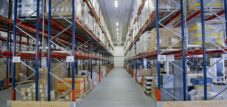
Existing storage systems often fail to meet complex requirements, or only partially do so. Conventional rack storage systems have the biggest disadvantage of the relatively long walking times and distances that personnel must cover. Furthermore, they are inferior to automated systems in terms of picking accuracy, which now perform the task with near 100% precision. However, a common problem with these systems is that storing goods in differently sized containers or boxes is either impossible or only possible with limitations.
For small, low-volume items, automated small parts warehouses (AS/RS) are often the first choice. These systems are typically designed for extensive assortments with 4,000 or more containers, achieving picking rates of up to 200 picks per hour. But what about companies that need a smaller system with shorter storage and retrieval times for their small-item inventory?
The pool of potential customers is large, as such an offer is aimed at diverse user profiles: from supplying a production line with a high variety of items to a buffer warehouse for assembly to order picking in the distribution warehouse.
The next generation
To achieve high process efficiency in the warehouse, these companies need a system that best meets the following criteria:
- high picking performance and precision
- easy integration into existing conveyor technology and WMS software
- Energy efficiency
- ergonomic design of workplaces
- Storage of different containers and boxes
- Recording of different storage heights
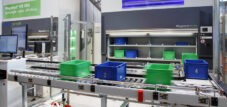
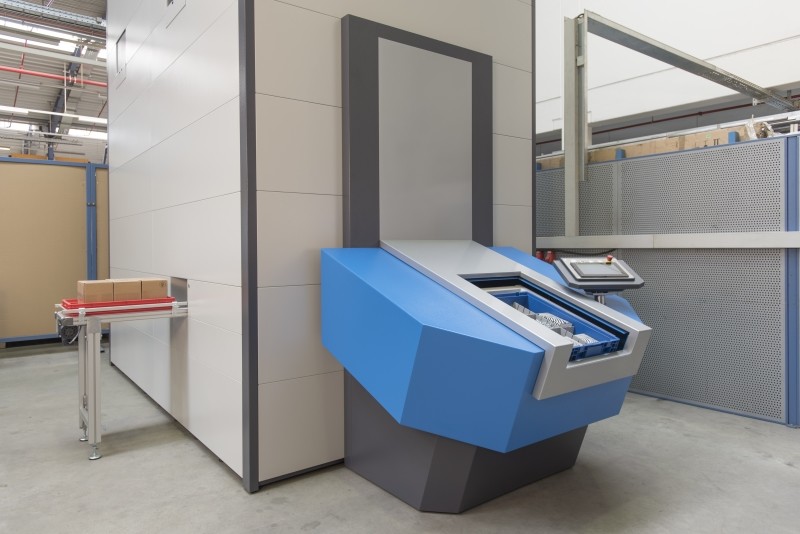
Intralogistics provider Kardex Remstar has targeted customers with precisely these requirements with a newly developed provisioning system called Kardex Remstar LR 35.
Higher productivity – lower costs
With its product category dubbed Vertical Buffer Module, Kardex Remstar is implementing a new brand line for medium-sized, fast-picking, and flexibly deployable storage lifts. It is expected that, in addition to the 35 kg load-carrying unit, further versions will be added to the portfolio in the medium term.
The main features of the device are performance improvements in the following areas:
Speed: It enables up to 250 double plays (storage and retrieval) per unit per hour. The system thus handles up to 500 picks per hour, making it extremely fast compared to other devices.
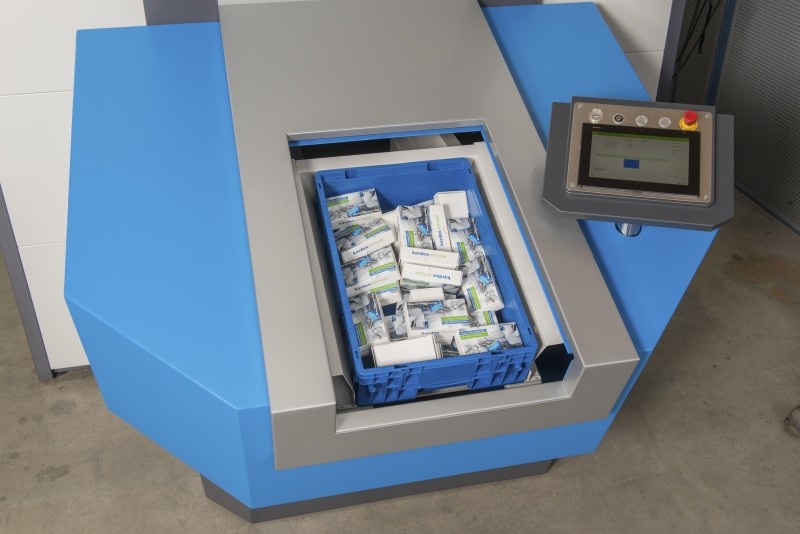
Precision: The included software and touchpad-based control element enable virtually zero-error picking accuracy. Pickers are further supported by pick-to-light systems that display detailed information about each item to be picked, thus increasing accuracy even more.
Energy efficiency: The design of the Vertical Buffer Module is geared towards energy saving. The central transport arm inside the unit is used so efficiently that, compared to similar systems (AS/RS, lifting beam systems), only one-third of the energy is consumed.
Flexibility: Users can be flexible regarding the type of load, as the units can store containers, boxes, or trays of various shapes. Up to four different storage heights are possible, and the access openings can be positioned anywhere. Furthermore, the units can be combined with one another, so that the overall solution can, if required, approach the storage capacity of automated small parts warehouses (AS/RS) with tens of thousands or more stored containers.
Compatibility: The device's open design allows for seamless integration into existing logistics systems. Whether it's integrating conveyor technology via a conveyor belt or automatically transferring items to autonomously operating transport robots, such as those from Servus Intralogistics, the Vertical Buffer Module can be adapted to existing intralogistics in a variety of ways. Thanks to its modular design, the system can be optimally adapted to existing building heights and widths.
Personnel deployment: Since one order picker can operate up to two devices simultaneously, the system reduces personnel requirements. This frees up capacity that can be efficiently deployed in other areas of warehouse logistics.
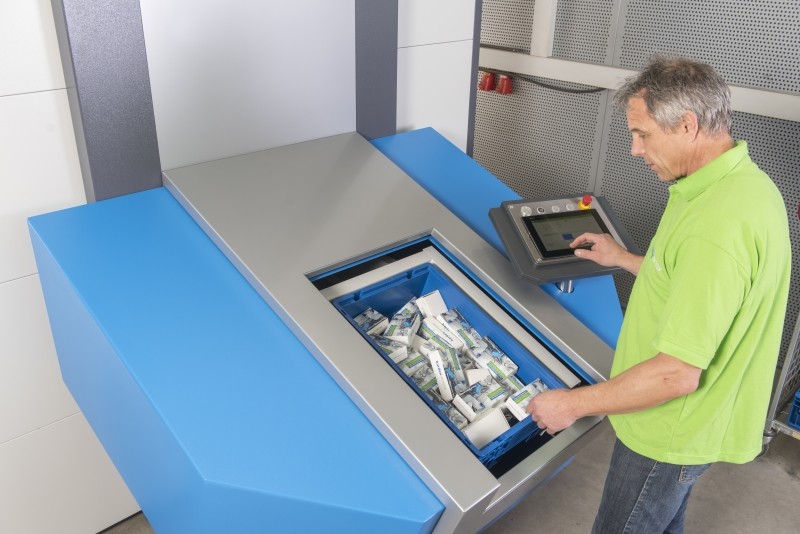
Ergonomics: The "goods-to-person" principle used in order picking results in significant improvements for employees in terms of both travel time and ergonomics. Furthermore, parts are delivered to an ergonomically lowered access opening (by 20 degrees), which further simplifies the picking process. Safe operation of the machine is ensured by an access control system with an automatically opening sliding door.
Software: The warehouse management software allows for easy integration with the company's existing WMS/MFR software. Furthermore, software-supported picking strategies for efficient retrieval and order picking, such as batch picking or multi-user picking, are included.
Overall, the Vertical Buffer Module proves to be an efficient solution for storing and retrieving small-volume items. With its high picking performance of up to 500 order items per hour, low energy consumption, and flexibility, it is suitable for a wide range of applications: whether as a replacement for automated small parts warehouses (AS/RS), for supplying a production line, or as a buffer or distribution warehouse.
Keep in touch