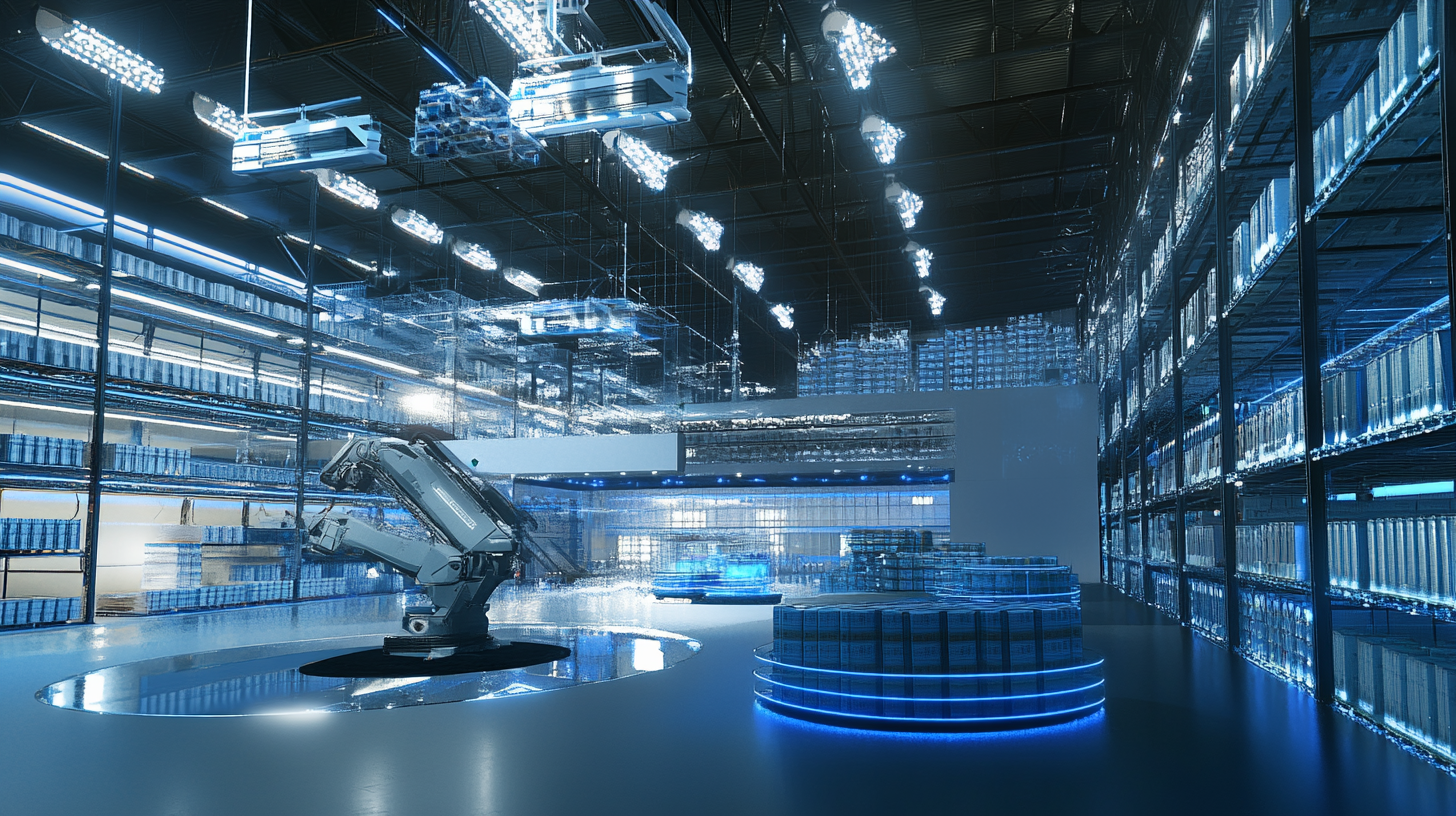
Efficient placement of goods with Logistics 4.0: From the warehouse to the shelf – efficiency through smart logistics and intralogistics processes – Creative image: Xpert.Digital
⚙️💼 From warehouse to shelf: Optimized processes through automation
🌐📦🚀 Rapid digitalization has revolutionized almost all sectors of the economy in recent years. One of the key drivers of this development is Logistics 4.0, which offers enormous opportunities, particularly for companies involved in the warehousing and distribution of goods. Logistics 4.0 refers to the use of modern technologies such as the Internet of Things (IoT), artificial intelligence (AI), big data, and automation to make logistics and intralogistics processes more efficient, faster, and more cost-effective. The goal is a seamless and optimized flow of goods from the warehouse to the shelf, benefiting both companies and customers.
Fundamentals of Logistics 4.0
Logistics 4.0 represents the digitalization and networking of processes along the entire supply chain. The goal is to achieve maximum transparency and flexibility through smart technologies. This involves not only the movement of goods, but also the collection and use of data. This data can be used to control processes in real time, identify bottlenecks early on, and better meet customer requirements.
One example of the application of Logistics 4.0 is the use of IoT sensors in warehouses. These sensors can collect data such as temperature, humidity, or the location of goods and feed it into a central system. This allows companies to ensure that sensitive products are stored under optimal conditions, while simultaneously enabling precise tracking.
Intelligent warehouse management: The first step to efficiency
🏗️🤖 The foundation for efficient logistics processes begins in the warehouse. Modern warehouse management systems (WMS) are able to digitally coordinate all warehouse operations. Using algorithms, they can decide which goods are stored where to ensure short distances and quick access. This saves not only time but also costs.
Another innovation in warehouse logistics is autonomous transport robots. These robots can automatically move goods to their storage location or prepare them for shipment. They are equipped with sensors that prevent collisions and enable safe navigation. This increases efficiency while relieving human workers of monotonous tasks.
Importance of intralogistics
🏭🔄 Intralogistics, or internal logistics, plays a crucial role in Logistics 4.0. It encompasses all processes that take place within a company to move and provide goods. Smart intralogistics solutions ensure that goods movements are optimally coordinated and that no unnecessary delays occur.
A key element here is the digitization of interfaces. By using technologies such as RFID (Radio Frequency Identification), the flow of goods within a company can be seamlessly tracked. This makes it possible, for example, to see which products are currently being picked or which are already ready for shipment. This transparency enables more efficient planning and control of processes.
The path to the shelf: Automation in retail
🛍️🚚 The advantages of Logistics 4.0 don't end in the warehouse. The journey of goods to the shelf can also be optimized through smart technologies. One example of this is the use of autonomous delivery vehicles. These can deliver goods directly to retailers without requiring human intervention. In combination with AI-supported planning tools, delivery times and routes can be optimized to minimize costs and emissions.
In retail stores, smart shelving systems ensure optimal product placement. These shelves are equipped with sensors that monitor current stock levels and automatically trigger reorders when a product is running low. This not only ensures that customers always have access to the products they need, but also reduces the effort required for manual inventory checks.
Challenges and opportunities
⚖️📈 Despite the numerous advantages offered by Logistics 4.0, companies also face challenges during implementation. One of the biggest hurdles is integrating existing systems into a digital infrastructure. Many companies still use outdated technologies that are not readily compatible with modern solutions. This requires investment in new hardware and software.
Another challenge is data protection. Since Logistics 4.0 is based on the collection and processing of large amounts of data, companies must ensure that sensitive information is protected. This requires not only technical measures but also training for employees to raise awareness of the importance of data security.
On the other hand, Logistics 4.0 offers enormous opportunities for companies. It enables not only greater efficiency and lower costs, but also better adaptation to customer needs. By analyzing data, companies can identify trends early and adjust their offerings accordingly. This gives them a competitive advantage in an increasingly dynamic market.
The future of logistics: sustainability and innovation
🌱🔋 Another important aspect gaining significance in Logistics 4.0 is sustainability. The use of modern technologies can reduce emissions and utilize resources more efficiently. Autonomous vehicles and drones equipped with environmentally friendly propulsion systems could play a central role in the future. Similarly, intelligent planning tools make it possible to avoid empty runs and minimize energy consumption.
Innovations like 3D printing could also fundamentally change the logistics industry. The ability to print products directly on-site could eliminate long transport routes. This would not only save costs but also protect the environment.
Efficient and customer-oriented approach
✨🚀 Logistics 4.0 opens up new opportunities for companies to make their processes more efficient and customer-oriented. From the warehouse to the shelf, smart technologies ensure seamless and optimized goods movement. Despite the challenges associated with implementation, the advantages clearly outweigh the disadvantages. Companies that invest early in the digitalization of their logistics processes will benefit from increased competitiveness in the long run.
In a world increasingly characterized by speed and flexibility, Logistics 4.0 is no longer just an option, but a necessity. It is the key to future-proof, sustainable, and successful logistics.
📣 Similar topics
- 📦 Efficiency through automation in warehouse logistics
- 🚁 Drones are revolutionizing inventory management
- 🤖 Robots in intralogistics: More than just helpers
- 🚚 Driverless transport systems optimize warehouse processes
- 🔍 Intelligent systems improve material flow
- ⏱️ Faster and more precise transport in distribution logistics
- 🌐 Real-time transparency through information logistics
- 📡 RFID technology: The key to efficient tracking
- 🛍️ Customer-centric logistics: Flexibility as a success factor
- 🔐 Challenges and opportunities of Logistics 4.0
#️⃣ Hashtags: #Logistics4.0 #WarehouseAutomation #Transparency #CustomerCentricity #DataSecurity
Expert partner in warehouse planning and construction

🌟📦 Efficient product placement
⏱️🛍️ The warehouse manager must define a set of criteria and rules for placing goods in the warehouse based on actual order demand (rotation, product type, etc.). Implementing warehouse management software minimizes the risk of errors in this process and optimizes slotting, i.e., the management of storage locations within the warehouse.
How can digital twins and artificial intelligence improve and optimize the process?
The placement of goods in the warehouse, also known as slotting, is a crucial process for optimizing warehouse logistics. By using digital twins and artificial intelligence (AI), this process can be significantly improved and made more efficient. Here are the key benefits and improvements that can be achieved through these technologies:
🔄💡 Digital Twins: Simulation and Real-Time Analysis
A digital twin is a virtual representation of the physical warehouse that is updated in real time. This technology offers several advantages for optimizing merchandise placement:
Virtual simulation of warehouse layouts
Before changes are made to the warehouse, they can be simulated using the digital twin. This allows for a precise analysis of the impact of layout changes, such as moving shelves or changing the placement of specific products. This way, optimizations can be tested risk-free before being implemented in practice [2][3].
Real-time monitoring and transparency
The digital twin continuously collects data on the warehouse's condition, including the position of goods and transport vehicles. This real-time information enables immediate adjustments in case of deviations or bottlenecks, thus improving efficiency [3].
Optimization of walking routes
By analyzing the movement patterns of order pickers and vehicles in the warehouse, the digital twin can suggest the most efficient routes to reach products faster. This reduces unnecessary trips and saves time [3].
🤖🔍 Artificial Intelligence: Automated Optimization and Predictions
AI can contribute to improved product placement by processing large amounts of data in real time:
Demand forecasting and dynamic adjustment
AI systems analyze historical data and current trends to predict future demand. Based on this, frequently requested items can be placed in easily accessible locations, while less frequently requested products are stored further back. This leads to a dynamic adjustment of the warehouse layout to the actual order demand [5][7].
Automated inventory management
AI can automatically monitor inventory and trigger reorders based on predefined thresholds. This minimizes the risk of overstocking or stockouts and ensures optimal utilization of available storage space [5].
Optimization of the warehouse layout
AI continuously analyzes data on item locations, picking frequency, and movement patterns. Based on this information, it suggests more efficient warehouse layouts that reduce labor and increase productivity [6][7].
🛠️🌐 Synergy between Digital Twins and AI
The combination of digital twins and AI offers particularly great added value:
Continuous improvement through feedback loops
The digital twin provides real-time data on the current state of the warehouse, while AI analyzes this data and makes suggestions for optimization. This continuous feedback loop enables both technologies to improve each other and continuously optimize the warehouse [4].
Proactive maintenance and safety
Using sensors, digital twins can detect potential problems such as defective infrastructure or blocked emergency exits. AI can use this information to proactively suggest maintenance measures or minimize safety risks [3].
🔄📦 Product placement process
The use of digital twins and artificial intelligence makes the warehouse placement process not only more efficient, but also more flexible and adaptable to changing market conditions. These technologies enable more precise planning, real-time adjustments, and continuous optimization of the entire warehouse operation.
📣 Similar topics
- 🚀 Optimizing product placement through technology
- 🤖 Digitalization and AI in the warehouse process
- 🔄 Make slotting more efficient with a digital twin
- 💡 Modern Warehouse Management with AI
- 🔍 Real-time analysis for improved warehouse logistics
- 📊 Data-driven warehouse optimization
- 🧠 Intelligent inventory management through AI
- 🌐 Synergies between technology and logistics
- 🔧 Proactive maintenance through digital technologies
- 📦 Efficient warehouse processes through technological innovation
#️⃣ Hashtags: #Efficiency #WarehouseManagement #ArtificialIntelligence #DigitalTwins #LogisticsOptimization

Xpert.Plus Warehouse Optimization - High-bay warehouses and pallet warehouses: Consulting and planning
We are here for you - Consulting - Planning - Implementation - Project Management
☑️ SME support in strategy, consulting, planning and implementation
☑️ Creation or realignment of the digital strategy and digitization
☑️ Expansion and optimization of international sales processes
☑️ Global & Digital B2B trading platforms
☑️ Pioneer Business Development

Konrad Wolfenstein
I would be happy to serve as your personal advisor.
You can contact me by filling out the contact form below or simply call me on +49 7348 4088 965 .
I'm looking forward to our joint project.
Write to me



Xpert.Digital - Konrad Wolfenstein
Xpert.Digital is a hub for industry focusing on digitalization, mechanical engineering, logistics/intralogistics and photovoltaics.
With our 360° Business Development solution, we support renowned companies from new business to after-sales.
Market intelligence, smarketing, marketing automation, content development, PR, mail campaigns, personalized social media and lead nurturing are part of our digital tools.
You can find more information at: www.xpert.digital - www.xpert.solar - www.xpert.plus
Keep in touch