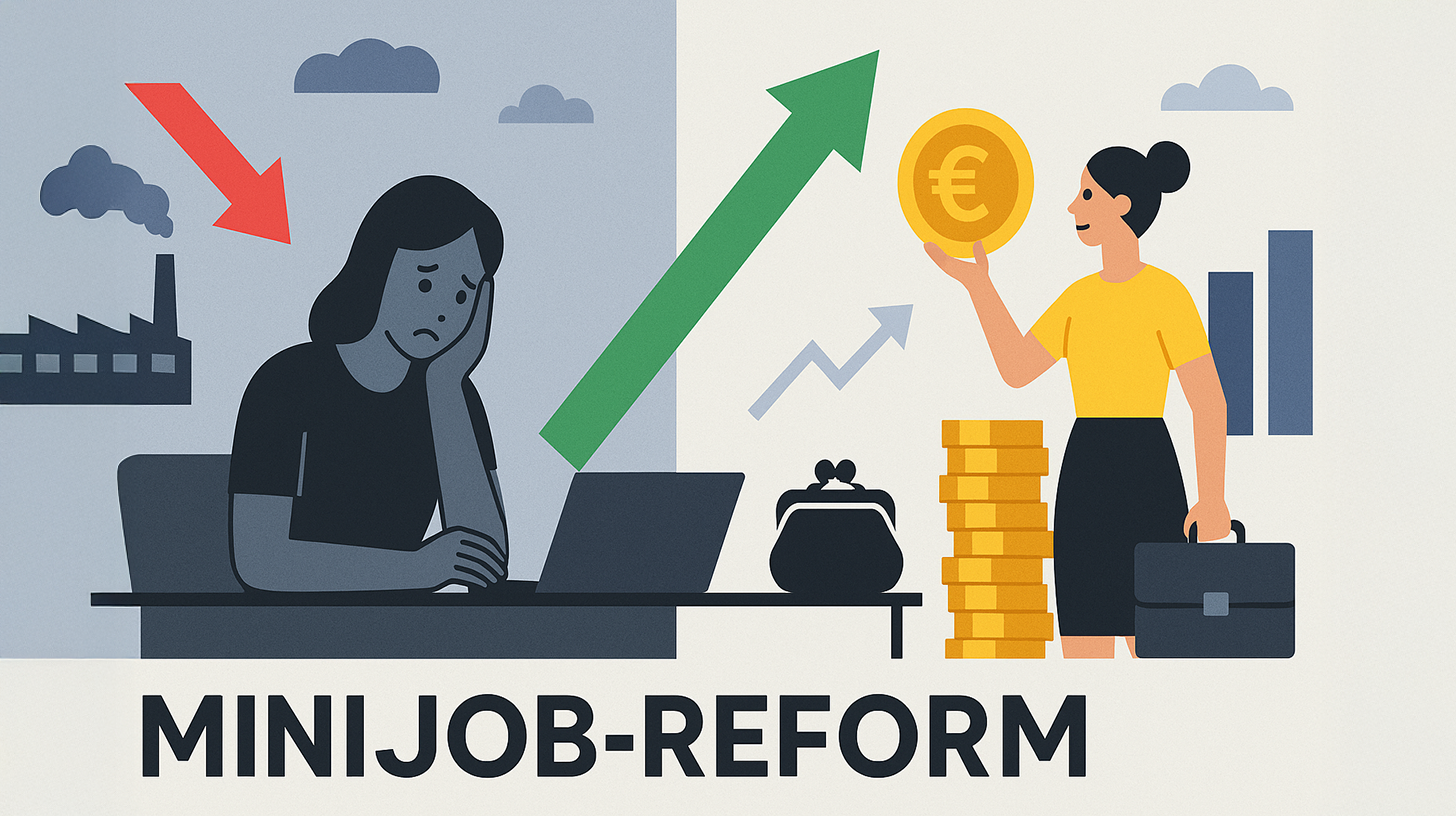
Economic crisis? Also examine and optimize the negative impact of mini-jobs on the German economy! – Image: Xpert.Digital
The mini-job model is proving to be a structural obstacle to Germany's economic development
Negative effects of mini-jobs on the German economy
The mini-job model has significant negative effects on various sectors of the German economy. Current research findings demonstrate structural problems that extend far beyond the individual level and cause damage to the overall economy.
Contrary to initial hopes, mini-jobs rarely serve as a stepping stone to regular employment
The mini-job model is proving to be a structural obstacle to Germany's economic development. It displaces more productive jobs, weakens social security systems, wastes human capital, and creates economically harmful incentive structures. The negative effects clearly outweigh the supposed advantages of flexibility, making a fundamental reform of this form of employment urgently necessary.
In Germany, approximately 4.4 million people (2023) to 4.5 million (2024) work exclusively in a mini-job. This corresponds to about 11.4 percent of all employees. These individuals have a mini-job as their sole source of income and do not hold any other employment subject to social security contributions.
Related to this:


Displacement of regular jobs
Substitution of jobs subject to social security contributions
The Institute for Employment Research (IAB) has demonstrated that mini-jobs are systematically displacing regular employment. In small businesses with fewer than ten employees, an additional mini-job replaces, on average, half a full-time job subject to social security contributions. Extrapolated, mini-jobs have displaced approximately 500,000 full-time jobs subject to social security contributions in small businesses alone.
Structural distortions
Nearly 40 percent of employees in small businesses work in mini-jobs, while in large companies it's only ten percent. This imbalance particularly weakens smaller businesses, which play a vital role in the German economic structure.
Negative productivity and growth effects
Prevention of economic growth
Model calculations by the Bertelsmann Foundation show that a reform to abolish mini-jobs could increase gross domestic product by €7.2 billion by 2030 and create 165,000 additional jobs. This illustrates the considerable growth potential that is blocked by the existing mini-job system.
Weakening of labor productivity
Minijobs often lead to the underemployment of qualified workers in unskilled jobs. This wastes valuable human capital and weakens productivity growth – a critical factor in light of demographic change and skills shortages.
Burden on social security systems
Loss of revenue from social security contributions
Minijobs cause significant losses in the social security system. While employees subject to social security contributions pay around 40 percent of their gross wages into social security together with their employers, this figure is only 28 percent for minijobs. The resulting revenue losses for the social security system amounted to over three billion euros in 2014 alone.
Additional burden due to basic income support
Since those in marginal employment (minijobs) are not entitled to unemployment benefits, they fall directly into basic social security if they lose their jobs. This places an additional burden on municipalities and the state budget, as was particularly evident during the Corona crisis when 870,000 people in marginal employment lost their jobs.
Labor market distortions and inefficiencies
Negative incentive systems
The mini-job system creates counterproductive incentives. At the €450 threshold (currently €556), the tax burden jumps sharply to around 20 percent, which penalizes overtime. For employees, it can be more attractive to take on a low-paying side job than to work overtime in their main job.
Missing bridging function
Contrary to initial hopes, mini-jobs rarely serve as a stepping stone to regular employment. Those in marginal employment often remain in the low-wage sector and work below their skill level.
Higher volatility and susceptibility to crises
Extreme vulnerability to crises
Minijobs are particularly vulnerable during economic crises. The likelihood of job loss is about twelve times higher for minijobbers than for those in jobs subject to social security contributions. The high turnover rate of 63 percent, compared to 29 percent for regular employees, incurs additional costs for recruitment and training.
Lack of stability
The lack of social security leads to higher staff turnover, which reduces operational planning security and prevents efficiency gains through the accumulation of experience.
Minijob reform: Paths to an economic success story
To transform mini-jobs into an economic success story, fundamental structural reforms are needed, based on proven international models. The current problems can be solved through a combination of different reform approaches.
Fundamental system reform: Away from special status
Abolition of the marginal employment threshold
The special status of mini-jobs should be abolished. Instead, a sliding scale transition zone could be introduced, ranging from zero to 1,800 euros per month, with linearly increasing social security contributions. At zero euros, the contribution rate would be zero percent; at 1,800 euros, it would be approximately 20 percent.
Dynamic expansion of mid-level jobs
The existing transitional income range (currently €556 to €2,000) should be extended downwards to create seamless transitions. This reform would relieve the burden on 26.1 percent of the working population and create 165,000 additional full-time equivalent jobs by 2030.
Adapting international success models
Working Tax Credit based on the British model
The UK demonstrates successful alternatives with its Working Tax Credit (WTC). This system combines minimum wages with tax-based wage subsidies embedded in the income tax system. The WTC promotes employment of 16 hours or more per week and creates genuine work incentives through degressive withdrawal rates.
Earned Income Tax Credit Adaptation
The US EITC system shows impressive results. It reaches 23 million families with a total of $64 billion and is considered one of the most successful anti-poverty programs. The system rewards work with a tax credit that initially increases with rising earned income, then remains constant, and finally gradually decreases.
French RSA model
The French Revenu de Solidarité Active (RSA) demonstrates how combined wages can work. When transitioning into employment, only 38 percent of social assistance is deducted, instead of 100 percent as with the old social assistance system. This creates strong incentives to work.
Concrete reform proposals for Germany
New incentive systems
Negative income tax
Germany could introduce a system similar to the EITC, where low-income earners receive tax credits instead of paying taxes. This would directly reward work and combat poverty.
Progressive social security contribution
Instead of the hard threshold at the mini-job level, a sliding contribution rate should be introduced, which rises continuously from zero to the standard rate. This eliminates the "mini-job trap" and creates incentives for increasing working hours.
Structural improvements
Adjustment of minimum wage
The earnings limits should be automatically linked to minimum wage increases, as was already introduced in 2022. This prevents future adjustment problems.
Strengthening social security
All forms of employment above a minimum volume should be subject to social security contributions. This strengthens the systems and provides security for employees.
Accompanying measures
Qualification and further training
Minijobs should be systematically used as a stepping stone through mandatory further training and qualification measures.
Fixed-term contracts for certain groups
Restricting mini-jobs to pupils, students, pensioners and transitional situations would prevent the long-term trap effect.
Corporate incentives
Businesses that transfer mini-jobbers into regular employment could receive tax incentives or subsidies.
Financing and implementation
Counter-financing
The reform costs can be covered by the elimination of the fiscal costs of mini-jobs and higher tax revenues from regular employment. In the medium term, the reforms will lead to net additional revenues of €2.21 billion annually until 2050.
Gradual introduction
Reform should be introduced gradually over several years to avoid disruptions and give companies time to adapt.
Expected successes
If these reforms were consistently implemented, Germany would achieve:
- Productivity increase through better use of human capital
- Strengthening social security through more contributors
- GDP growth of up to 7.2 billion euros by 2030
- 165,000 additional full-time equivalent jobs
- Reduced poverty among the elderly through higher pension entitlements
- Strengthening domestic demand through higher net incomes
International experience shows that "Make Work Pay" strategies work when they are properly designed and not driven by party politics. By reforming its mini-job system, Germany could not only eliminate the negative effects but also create an internationally exemplary model for flexible, socially secure employment.
Our EU and German expertise in business development, sales and marketing

Our EU and German expertise in business development, sales and marketing - Image: Xpert.Digital
Industry focus areas: B2B, digitalization (from AI to XR), mechanical engineering, logistics, renewable energies and industry
More information here:
A thematic hub offering insights and expertise:
- Knowledge platform covering global and regional economies, innovation and industry-specific trends
- A collection of analyses, insights, and background information from our key areas of focus
- A place for expertise and information on current developments in business and technology
- A hub for companies seeking information on markets, digitalization, and industry innovations
History of mini-jobs: How it all began and where it led
Origin and target group of mini-jobs in Germany
The marginal employment, known today as a minijob, was originally designed for specific target groups: pupils, students, pensioners and full-time workers who wanted to earn some extra money on the side.
Historical development and original intention
Marginal employment was introduced in the 1960s when Germany experienced an acute labor shortage. Even the guest workers recruited at that time could not fully meet the demand for labor. In this situation, policymakers sought to mobilize additional labor reserves.
The original target audiences were explicit:
- Employed people in their free time (secondary jobs)
- Non-working housewives
- Pensioner
- Pupils and students
These groups formed the so-called "labor market reserve", which was to be activated by increasing the attractiveness of marginal employment.
Legal framework since the beginning
Since the introduction of social security codes at the end of the 19th century, exceptions to compulsory insurance have existed for secondary employment or marginal work. The original motivation was to prevent very low pension entitlements, as such activities were considered insignificant for old-age security.
The term "marginal employment" was introduced into the Social Code with the creation of Book IV of the Social Code (SGB IV) on July 1, 1977.
Increase in attractiveness in the 1960s
In the 1960s, tax-free marginal employment was made more attractive in light of an acute labor shortage, in order to mobilize housewives, pensioners, students, and those with part-time jobs into gainful employment, even on an hourly basis. Exemption from social security contributions was granted because the social security funds were not yet strained at that time.
Modern development from 2003 onwards
The form of mini-jobs known today arose from the Hartz reforms of 2003. The original concept was significantly expanded, and the earnings limit was raised from €325 to €400. The limit of a maximum of 15 hours of weekly working time was abolished.
Current situation
Today it is clear that the original target group has expanded considerably. Of the approximately 7-8 million people in mini-jobs in total:
- 63 percent women
- Around a third are housewives or househusbands
- One in five is a pupil or student
- 17 percent are already full-time employees with a side job
The current earnings limit is 556 euros per month in 2025 and has been dynamically linked to the minimum wage since 2022.
In short, mini-jobs were originally conceived as a tool for mobilizing additional workers from specific population groups – particularly for individuals who already had other forms of financial security (housewives through their spouses, pensioners through their pensions, students through their parents/student loans) or who wanted to earn extra income alongside their main job. This original conception as a "supplementary income" for specific target groups is still evident today in the legal structure and tax advantages of mini-jobs.
Full-time part-time workers in Germany
In Germany, approximately 4.4 to 4.5 million people work exclusively in a mini-job. This corresponds to about 11.4 percent of all employees. These individuals have a mini-job as their sole source of income and do not hold any other employment subject to social security contributions.
Citizen's allowance recipient with a mini-job
According to current statistics from the Federal Employment Agency, in July 2024 approximately 356,000 recipients of citizen's income were exclusively employed in a mini-job. This corresponds to roughly 43 percent of all employed citizen's income recipients. Other sources indicate that around 350,000 citizen's income recipients also work in a mini-job.
Calculated share
Based on the available data, the following proportion results:
- Total number of full-time part-time workers: 4.4 million people
- Citizen's income recipients with a mini-job: 356,000 people
- Calculated share: Approximately 8.1 percent of full-time minijobbers also receive citizen's allowance
Legal framework for the combination
The combination of a mini-job and citizen's allowance is legally permissible, but is subject to certain crediting rules:
Exempt amounts
- The first 100 euros remain completely exempt from deductions
- Of incomes between 100.01 and 520 euros, 20 percent remain exempt from being counted towards benefits
- Of incomes between 520.01 and 556 euros, 30 percent remain exempt from being counted towards benefits
Example calculation for a full mini-job (556 euros)
- In a 556-euro mini-job, approximately 194.80 euros remain exempt from deductions
- The remaining 361.20 euros will be deducted from the citizen's allowance
Development trends
The figures show a stable to slightly increasing trend in the number of people in marginal employment. From 2022 to 2023, the total number of people in mini-jobs increased by approximately 240,000 to around 7.9 million. The number of those who hold a mini-job in addition to another job rose particularly sharply, by about 150,000.
Women are significantly overrepresented among those exclusively in marginal employment, at around 60 percent, which reflects the social structure of this form of employment.
Your global marketing and business development partner
☑️ Our business language is English or German
☑️ NEW: Correspondence in your native language!

Konrad Wolfenstein
I and my team are happy to be available to you as your personal advisor.
You can contact me by filling out the contact form here wolfenstein@xpert.digital:or simply call me at +49 7348 4088 965. My email address is
I'm looking forward to our joint project.
☑️ SME support in strategy, consulting, planning and implementation
☑️ Creation or realignment of the digital strategy and digitization
☑️ Expansion and optimization of international sales processes
☑️ Global & Digital B2B trading platforms
☑️ Pioneer Business Development / Marketing / PR / Trade Fairs
🎯🎯🎯 Benefit from Xpert.Digital's extensive, five-fold expertise in one comprehensive service package | BD, R&D, XR, PR & Digital Visibility Optimization

Benefit from Xpert.Digital's extensive, five-fold expertise in a comprehensive service package | R&D, XR, PR & Digital Visibility Optimization - Image: Xpert.Digital
Xpert.Digital possesses in-depth knowledge across various industries. This allows us to develop tailored strategies precisely aligned with the requirements and challenges of your specific market segment. By continuously analyzing market trends and monitoring industry developments, we can act proactively and offer innovative solutions. The combination of experience and expertise generates added value and provides our clients with a decisive competitive advantage.
More information here: