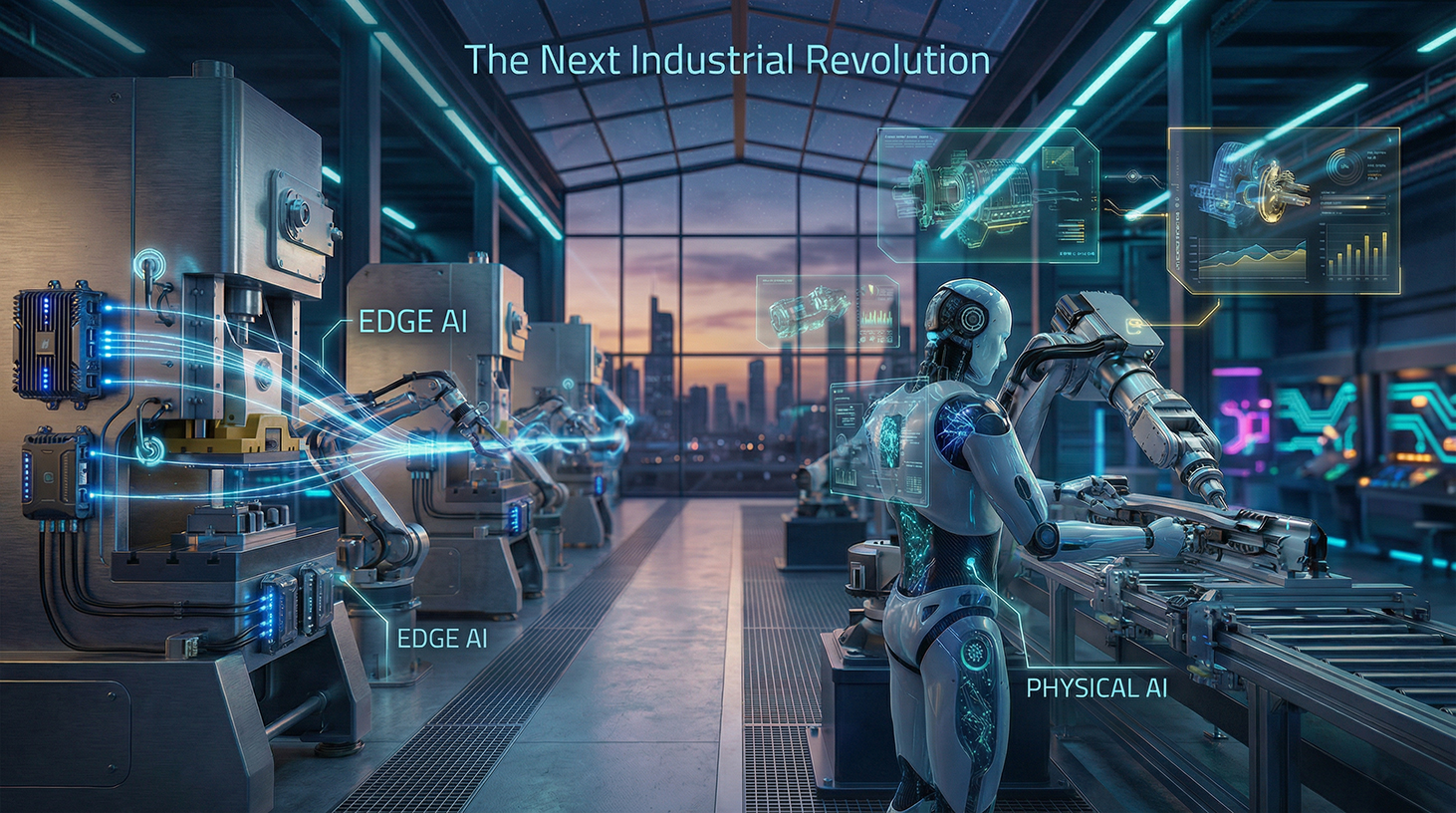
Edge AI, Physical AI, and the multi-billion-dollar mechanical engineering market: Is Germany missing out on the next big AI trend? – Image: Xpert.Digital
Edge AI vs. Physical AI: The difference that will determine the future of industry
From thought to action: Why Physical AI is forever changing mechanical engineering
AI on the assembly line: Why Edge AI is already indispensable in industry today
For a long time, a simple but error-prone principle prevailed in networked industry: the machine provided the data, while the intelligence resided far away in the cloud. But this paradigm is outdated. To be able to react in milliseconds in modern production lines, artificial intelligence must move to where the action is taking place – directly to the machine. This is precisely where Edge AI comes in. But while local data processing is already becoming the "life insurance" for predictive maintenance and quality control, an even more significant revolution is brewing in the background: Physical AI.
When AI systems suddenly cease to merely analyze data and instead see, grasp, and act in the real world in the form of humanoid robots and autonomous systems, the boundaries between software and mechanical engineering become definitively blurred. This article illuminates the essential difference between Edge AI and Physical AI. Using concrete examples from BMW, Siemens, and NVIDIA, it demonstrates how the factory of the future is undergoing radical transformation and explains why these two key technologies will be indispensable for Germany's future manufacturing sector.
When machines no longer just think, but act – why the difference will determine the future of mechanical engineering
Intelligence at the edge: What Edge AI really means
Since the rise of cloud computing, a simple principle has long prevailed: data originates at the machine, intelligence resides in the data center. Edge AI fundamentally breaks with this paradigm. Edge AI refers to the execution of AI models directly on or near the data source—on sensors, machine controllers, industrial gateways, or local edge servers in the factory—without requiring a continuous connection to the cloud. Unlike purely cloud-based approaches, data is pre-processed or fully evaluated locally; only relevant results or condensed features are transmitted to higher-level systems.
The technological foundation consists of specialized processors: Microcontroller Units (MCUs), Microprocessor Units (MPUs), and Neural Processing Units (NPUs), which can execute AI inference locally with minimal energy consumption. The significance of this shift for industry can be seen in a single metric: While cloud-based systems exhibit latency of up to 250 milliseconds, edge computing reduces this to around 10 milliseconds – a factor of 25. In modern production lines that process up to 60 parts per second, this time difference can determine scrap and product quality.
Edge AI is therefore not merely an optimization of existing infrastructure, but a reorganization of the intelligence architecture in production. Decision-making logic moves closer to the physical process. This results in five strategic advantages that are particularly relevant in an industrial context: low latency for safety- and cycle-time-critical applications, offline capability in remote or mobile facilities, data sovereignty through local processing of sensitive operational data, predictable and decreasing transmission costs, and a reduced CO₂ footprint due to less data traffic on wide area networks.
More than just intelligence: The anatomy of Physical AI
Physical AI goes significantly further conceptually. The term, coined primarily by NVIDIA, refers to AI systems that not only operate in digital environments but also see, feel, reason, and act in the physical world. Physical AI systems must cope with real sensors, a body in space and time, dynamic environments, and unforeseen situations—requirements that purely digital AI systems, such as language models or image generators, fundamentally cannot meet.
What fundamentally distinguishes Physical AI from conventional Edge AI can be summarized in three core dimensions. First: movement. While Edge AI systems are typically stationary—a sensor on a machine, a camera system above a conveyor belt—Physical AI operates at a moving edge. A humanoid robot navigating a factory floor and grasping components must make decisions in real time while itself being part of the environment it is processing. Second: safety and determinism. If something goes wrong, a Physical AI system must reliably transition to a safe state—a requirement that is hardly relevant for stationary analysis systems but can mean the difference between life and death for robots. Third: actuation. Physical AI not only makes decisions but also physically executes them—grasping, moving, welding, assembling.
For this reason, Physical AI almost always builds upon Edge AI as its foundation, but extends it with a complete perception-decision-action loop. An industrial robot equipped with Physical AI combines high-resolution sensors (cameras, lidar, force/torque sensors) with real-time inference on-site and physical action – all within milliseconds, without cloud latency. The decision about what to perceive and how to act must be made locally, quickly, and with fault tolerance. Safety-critical movements such as collision avoidance or precise gripping remain entirely local to the system.
Comparison: Where the borders lie
The following overview highlights the key differences between the two concepts:
| feature | Edge AI | Physical AI |
|---|---|---|
| Primary function | Local inference, analysis, classification | Perceiving, deciding, acting in the real world |
| mobility | Inpatient or semi-inpatient | Actively moves through the physical environment |
| Actuators | No physical action required | Grippers, drives, robot joints, drive systems |
| Security requirement | Moderate (data security) | Extremely high (functional safety, ISO 13849) |
| determinism | Desirable | Absolutely essential (real-time guarantees) |
| Training base | Pre-trained model, OTA updates | Foundation Models, Reinforcement/Imitation Learning |
| Example technologies | MCU/NPU, edge servers, IIoT gateways | NVIDIA Jetson AGX, humanoid robots, autonomous vehicles |
| Typical application | Anomaly detection, quality control, predictive maintenance | Assembly, sorting, logistics, autonomous navigation |
| Regulatory framework | Data protection, IT security | EU Machinery Directive, AI Regulation, CE marking |
Edge AI and Physical AI differ fundamentally in function, mobility, security, and application. While the primary function of Edge AI lies in local inference, analysis, and classification, Physical AI goes a step further by perceiving, deciding, and acting in the real world. This is also reflected in their mobility: Edge AI is usually stationary or semi-stationary and does not perform its own physical actions, whereas Physical AI actively moves through its environment and uses actuators such as grippers, drives, or robotic joints. This results in significantly different requirements. For Edge AI, security requirements are moderate, focusing on data security, and determinism is desirable. For Physical AI, however, they are extremely high, with functional safety according to standards such as ISO 13849, and determinism with real-time guarantees is mandatory. The training basis also differs: Edge AI uses pre-trained models with over-the-air (OTA) updates, while Physical AI relies on foundation models in combination with reinforcement or imitation learning. Accordingly, typical use cases range from anomaly detection, quality control, and predictive maintenance (Edge AI) to assembly, sorting, logistics, and autonomous navigation (Physical AI). This also necessitates different regulatory frameworks, ranging from data protection and IT security (Edge AI) to the EU Machinery Directive, AI Regulation, and CE marking (Physical AI).
Edge AI is therefore the broader, more technologically accessible category – a tool that factories are already widely using today. Physical AI is the more specialized, demanding discipline that uses Edge AI as a building block and extends it with embodied intelligence. Anyone wanting to operate Physical AI needs a complete development pipeline that includes not only models and data, but also training, simulation, inference, and deployment in a seamless workflow.
The nervous system of the factory: Sensors and IoT as a foundation
Both paradigms would be inconceivable without high-performance sensors and a robust IoT infrastructure. Industrial sensors with integrated microprocessors continuously measure vibrations, temperature, pressure, current flow, and visual anomalies of each asset. They communicate locally via industrial protocols such as LPWAN, Modbus, or OPC UA, ensuring reliable data acquisition without network overload. The fusion of this IoT infrastructure with AI is known as AIoT – Artificial Intelligence of Things – a term that underscores the systemic nature of this integration.
Bosch operates one of the world's most advanced semiconductor plants in Dresden, where machines learn from errors using self-optimizing algorithms and can be serviced from over 9,000 kilometers away. The company has filed over 1,500 AI patents in five years and now employs nearly 5,000 people specializing in AI. At CES 2025, Bosch presented edge AI integrated directly into sensors – with enhanced data security, reduced latency, lower energy consumption, and real-time feedback as key performance features.
The sensors form the first stage of a three-tiered architecture: Preprocessing and inference run locally at the edge; a higher-level edge layer (on-premises servers at the factory) aggregates and coordinates the data; the cloud serves for long-term model maintenance, training new models, and enterprise-wide monitoring. NXP Semiconductors and NVIDIA further developed this architecture in March 2026 with the integration of the NVIDIA Holoscan Sensor Bridge into NXP's edge portfolio: It efficiently connects sensors, actuators, and computing units, enabling secure, low-latency, real-time data processing as a key requirement for physical AI systems.
A particularly relevant topic in this context is the Industrial Internet of Things (IIoT). The combination of 5G networks and edge AI makes it possible to control entire factory parks in real time – without relying on a stable long-distance connection. According to an STL Partners analysis, computer vision, i.e., AI-supported image processing directly on camera systems in the production line, will account for more than half of total edge AI revenue by 2030. Industrial quality control via camera, which previously operated manually or with rigid rule sets, will thus become an adaptive, learning system that adjusts to new product variants without requiring programmer intervention.
A new dimension of digital transformation with 'Managed AI' (Artificial Intelligence) - Platform & B2B solution | Xpert Consulting

A new dimension of digital transformation with 'Managed AI' (Artificial Intelligence) – Platform & B2B solution | Xpert Consulting - Image: Xpert.Digital
Here you will learn how your company can implement customized AI solutions quickly, securely and without high entry barriers.
A managed AI platform is your all-inclusive, worry-free solution for artificial intelligence. Instead of dealing with complex technology, expensive infrastructure, and lengthy development processes, you receive a ready-made solution tailored to your needs from a specialized partner – often within just a few days.
The key advantages at a glance:
⚡ Rapid implementation: From idea to ready-to-use application in days, not months. We deliver practical solutions that create immediate added value.
🔒 Maximum data security: Your sensitive data stays with you. We guarantee secure and compliant processing without sharing data with third parties.
💸 No financial risk: You only pay for results. High upfront investments in hardware, software, or personnel are completely eliminated.
🎯 Focus on your core business: Concentrate on what you do best. We take care of the entire technical implementation, operation, and maintenance of your AI solution.
📈 Future-proof & scalable: Your AI grows with you. We ensure continuous optimization and scalability, and flexibly adapt the models to new requirements.
More information here:
Forget the cloud: The next AI revolution is happening directly in the machine
What's already happening today: Edge AI in practice
The applications of edge AI in industry and mechanical engineering are already diverse and proven. Predictive maintenance is the most widespread and economically quantifiable use case.
Siemens has introduced its Predictive Service Analyzer, an edge application that detects defects in drive systems at an early stage, before they impact overall production. The AI-based solution identifies early signs of anomalies indicating mechanical damage – bearing damage, imbalance and misalignment in motors, as well as critical operating conditions of inverters. The app assesses the severity of the defect and the expected remaining service life, thus predicting future failures. The result is an increase in plant availability of up to 30 percent and a productivity increase of up to 10 percent. The particular advantage of the edge architecture over the MindSphere cloud solution lies in the ability to analyze very large volumes of data in near real-time and the secure data handling within the plant itself.
Siemens takes its Senseye Predictive Maintenance a step further: The platform combines machine learning with generative AI and human knowledge to make maintenance processes more interactive and intuitive. Instead of generating static failure notifications, the generative AI scans and groups recorded maintenance cases regardless of language, searches for similar historical cases, and proactively derives a suitable maintenance strategy – an approach known as prescriptive maintenance. This can reduce unplanned downtime by up to 50 percent and extend machine lifespan by up to 20 percent.
Other specific application areas for Edge AI in mechanical engineering include:
- Visual quality control with AI cameras directly on the production line, which classify errors in real time and reject defective components before they are passed on.
- Energy optimization through local algorithms that regulate the power consumption of individual machines or entire line sections in real time.
- Anomaly detection on rotating machines via vibration and acoustic sensors that detect subtle changes in operating behavior long before humans or conventional threshold alarms would react.
- Automated process control, where edge AI adaptively adjusts process parameters such as temperature, pressure or speed without having to wait for feedback from the cloud.
Physical AI in action: The first factories are learning to trade
While Edge AI is already widely in production, Physical AI is at a crucial turning point: from lab pilot to scalable industrial deployment. The events of 2025 and early 2026 mark this transition with concrete, groundbreaking projects.
Perhaps the best-known example is the collaboration between BMW and Figure AI. In 2025, Figure 02 humanoid robots were deployed for the first time worldwide in a BMW plant – at the Spartanburg plant in the USA. There, the robot worked ten-hour shifts in body manufacturing, supporting the production of over 30,000 BMW X3 vehicles, positioning a total of around 90,000 components with millimeter precision. The pilot project confirmed that humanoid robots can safely perform precise, repeatable tasks under real-world conditions.
BMW is drawing the right conclusions from this: In spring 2026, the company will also test humanoid robots in its German plants. A pilot project with the humanoid robot AEON is underway in Leipzig in collaboration with Hexagon, a technology company specializing in sensor and software solutions. From summer 2026, AEON will be used in the assembly of high-voltage batteries and in component manufacturing – because its humanoid body can flexibly attach to a variety of hand and gripping tools. In parallel, BMW has established the new Center of Competence for Physical AI in Production to consolidate company-wide knowledge and ensure that the insights gained can be used more broadly.
Tesla, in turn, trains its Optimus robot at its Gigafactory in Austin using imitation learning: The robot observes human workers and mimics their movements. It already performs simple tasks, and more complex capabilities are expected to follow by the end of 2026. Hyundai, together with Boston Dynamics and the Atlas robot, plans to produce tens of thousands of units annually by 2028 – a scaling ambition that would finally take physical AI out of the prototype phase.
In the German mechanical engineering sector, Schaeffler has announced a five-year strategic partnership with the robotics company Humanoid, with the aim of deploying hundreds of humanoid robots in its own production facilities starting in 2026/2027. Siemens and Humanoid completed a proof of concept for logistics tasks such as destacking and container transport – an application area that has previously been too variable for rigid automation solutions.
The technological infrastructure: NVIDIA's ecosystem as the backbone
No player is currently driving the physical AI infrastructure forward more than NVIDIA. The Isaac platform combines GPU-accelerated simulation with Robot Foundation Models, enabling developers to train robot strategies in digital twin environments at 1,000 times real-world speed – drastically reducing the cycle from concept to deployment.
At GTC 2026 in San Jose, NVIDIA presented the next stage in the development of this ecosystem. Cosmos 3 generates synthetic worlds so that physical AI systems can better learn and test complex environments. Isaac GR00T N1.7 is an open vision-language-action model specifically for humanoid robots, designed, according to the company, for real-world commercial applications. And the Omniverse DSX Blueprint enables the virtual validation of multi-billion-dollar AI factory investments before a single screw is turned in the real world.
The impact of this ecosystem is evident in the breadth of partnerships: FANUC, ABB Robotics, YASKAWA, and KUKA—together with a global installed base of over two million robots—integrate NVIDIA Omniverse libraries and Isaac simulation frameworks into their virtual commissioning solutions. For real-time AI inference directly at the robot, these manufacturers rely on NVIDIA Jetson modules in their controllers. Microsoft Azure and Nebius integrate the NVIDIA Physical AI Data Factory Blueprint to enable developers to generate scalable, agent-driven synthetic training data.
The three-computer model that NVIDIA recommends for full physical AI deployments illustrates the complexity of this pipeline: training on NVIDIA DGX systems with massive datasets, simulation and synthetic data generation on Omniverse with Cosmos on RTX PRO servers, and finally, inference directly on the robot using the Jetson AGX Thor for energy-efficient, compact, real-time processing. In March 2026, Deloitte announced plans to develop physical AI solutions based on NVIDIA Omniverse and to open a new Physical AI Center of Excellence in Shanghai—a signal that the consulting sector considers the industrial relevance of this technology to be established.
Market dynamics: Two growth curves, one common direction
The economic dimension of both technology fields is remarkable. The global edge AI market was valued at $8.7 billion in 2024 and is projected to grow to $56.8 billion by 2030 – a compound annual growth rate (CAGR) of 36.9 percent. The market for edge AI hardware is also on a steep growth trajectory: from $26.14 billion in 2025 to $58.90 billion by 2030, with a CAGR of 17.6 percent. Some analysts are even more optimistic: STL Partners forecasts a total addressable edge AI market volume of $157 billion by 2030.
The market for edge AI software is also growing, from a value of $1.95 billion in 2024 to a projected $8.91 billion by 2030 (CAGR 28.8%). Physical AI is also on an explosive growth trajectory, with a current market volume of $5.41 billion (2025) and a projected $61.19 billion by 2034.
Within the edge AI market, the manufacturing sector stands out: it comprises more than 35 percent of the total market volume and, together with retail and transportation, will achieve a combined revenue share of 77 percent by 2030. Computer vision is the dominant application category and will account for more than half of edge AI revenue by the end of the decade. The three main demand drivers are the need for real-time data processing, the expansion of IoT devices, and its application in industrial robotics systems.
Future prospects: What will be decided in the next five years
For the German and European mechanical engineering sector, several groundbreaking questions will arise by 2030, the answers to which will determine the competitive position of entire industries.
The convergence of Edge AI and Physical AI is progressing rapidly. Systems currently considered Physical AI—robots with a fixed task in a controlled environment—will be replaced within a few years by generalizable Foundation Models that adapt to new tasks without reprogramming. NXP and NVIDIA are jointly driving this development by creating secure, low-latency, real-time processing platforms explicitly designed for the interplay of Physical AI and safety-critical sensors. The integration of the NVIDIA Holoscan Sensor Bridge into edge hardware platforms clearly demonstrates that the boundary between sensor and thinking machine is becoming increasingly blurred.
Digital twins are becoming the universal training and validation infrastructure. Instead of building physical test installations, machine builders will train and test robots and entire production lines in virtual space – with physically accurate simulations that reflect results in real time. In early tests, warehouse automation robots achieved a 40 percent increase in picking efficiency by optimizing their navigation paths through simulation, even before the physical warehouse was built. Azure infrastructures already make it possible to mirror IoT sensor data in real time in Omniverse digital twins to develop and test anomaly detection.
The regulatory framework will gain considerable importance in the coming years. The new EU Machinery Regulation (EU) 2023/1230 will apply from January 20, 2027, and significantly tightens the requirements for software-based controls and safety-relevant AI functions. Humanoid robots will therefore be subject to CE marking, conformity assessment procedures, and the requirements of the EU AI Act – a regulatory environment that will strongly influence investment decisions in mechanical engineering in the future.
The shortage of skilled workers is an often underestimated driver of this development. Siemens explicitly points to the relief provided to maintenance personnel by generative AI in predictive maintenance systems: Instead of requiring specialists to analyze complex machine conditions, a dialogue-oriented AI system enables even less experienced employees to take the right maintenance measures at the right time. Physical AI addresses the same bottleneck at the operational level: When a humanoid robot takes over physically demanding, repetitive, or dangerous tasks, it frees up human labor for more complex, value-added activities.
The energy transition is creating another dimension of demand. Edge AI enables the use of AI applications even in environments with limited connectivity or unstable power supplies – precisely where renewable energies are often generated and used decentrally. Preprocessing data at the source significantly reduces data volume and thus energy consumption in wide area networks. Given rising energy costs and ambitious EU climate targets, this aspect should not be underestimated from an economic or strategic perspective.
Strategic implications for mechanical engineering companies and industrial enterprises
The analysis allows for the derivation of concrete strategic orientations for industrial companies that want to remain competitive in both technology fields.
Edge AI offers most manufacturing companies an immediate and feasible entry point. The technology is proven, and the investment costs are easily calculable thanks to predictive maintenance, quality improvements, and energy savings. Siemens demonstrates that cost savings of up to 40 percent can be achieved through AI and IoT integration in production facilities. Companies that are not yet systematically implementing edge AI risk falling further behind in the competition – especially compared to rivals who are already optimizing based on continuous machine data.
Physical AI, on the other hand, requires a medium- to long-term strategic positioning. Mastering Physical AI demands a complete development pipeline: training, simulation, inference, and deployment as a seamless workflow. This means it's no longer just about mechanical engineering or software, but about integrating both disciplines with AI, data science, and systems engineering. BMW's establishment of a dedicated Center of Competence for Physical AI in Production is a prime example of how leading industrial companies are institutionally anchoring this transformation.
For the German mechanical engineering sector – an international leader in machine tools, drive technology, conveyor technology, and special-purpose machinery – this opens up an extraordinary window of opportunity. The combination of mechanical precision, established customer relationships, and in-depth process knowledge, enabled by Edge AI and Physical AI, can lead to a new category of intelligent, adaptive machines that are far more than mere executing units. They become knowledge partners – systems that digitize a company's production knowledge, continuously refine it, and implement it autonomously.
The crucial economic question is not whether, but when and how quickly this transformation will occur. Market data, technological maturity, and industrial pilot projects leave no doubt: The next phase of industrial value creation will depend significantly on how consistently companies integrate intelligence into their physical infrastructure – in the machine, in the robot, in the sensor, in every link of the value chain.
Your global marketing and business development partner
☑️ Our business language is English or German
☑️ NEW: Correspondence in your native language!

Konrad Wolfenstein
I and my team are happy to be available to you as your personal advisor.
You can contact me by filling out the contact form here wolfenstein@xpert.digital:or simply call me at +49 7348 4088 965. My email address is
I'm looking forward to our joint project.
☑️ SME support in strategy, consulting, planning and implementation
☑️ Creation or realignment of the digital strategy and digitization
☑️ Expansion and optimization of international sales processes
☑️ Global & Digital B2B trading platforms
☑️ Pioneer Business Development / Marketing / PR / Trade Fairs
🎯🎯🎯 Data-driven B2B industry hub as a quasi-in-house solution

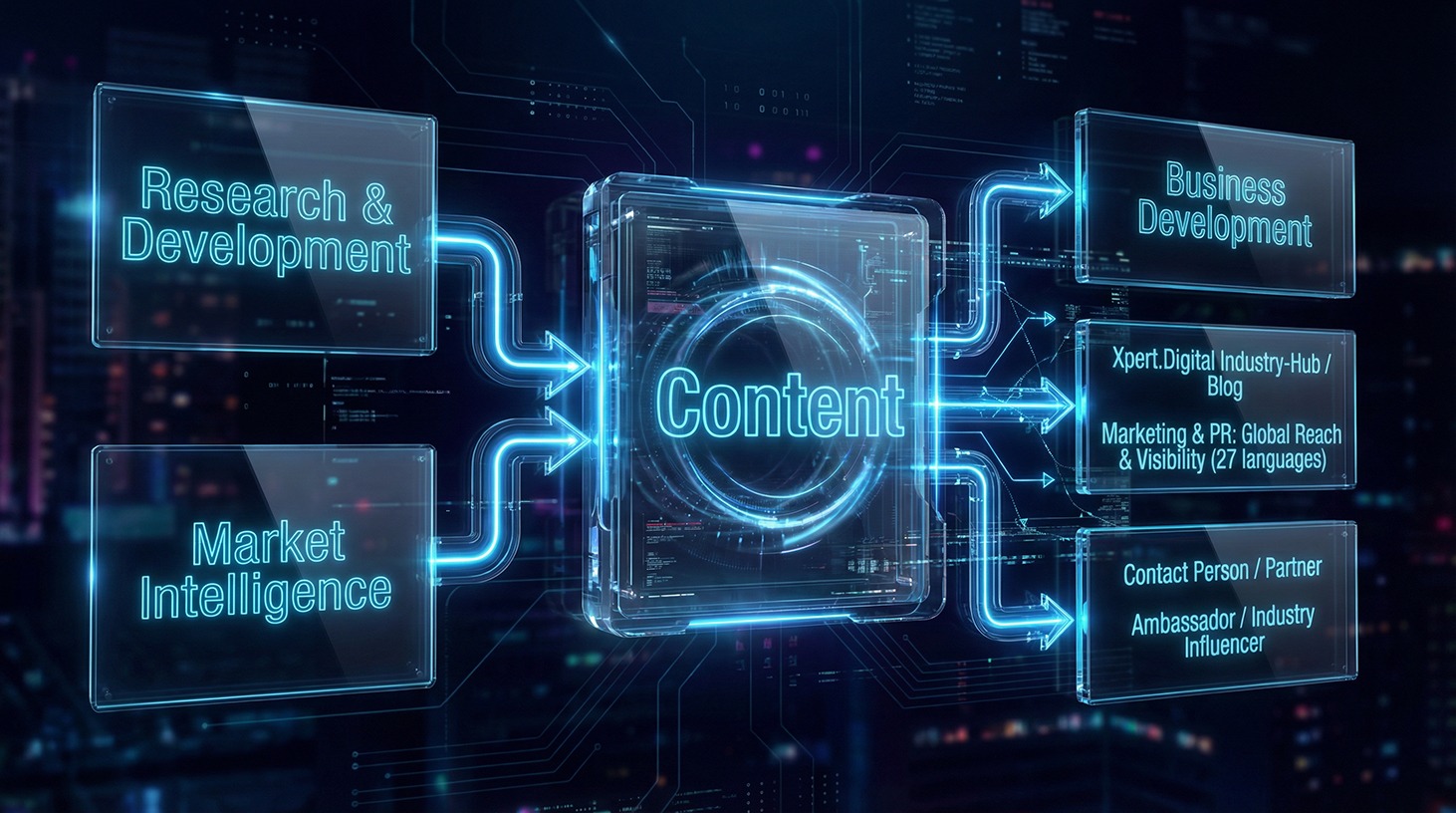
The quasi-in-house solution: How Xpert.Digital closes operational gaps in B2B marketing and sales – Smart Content-Driven Business - Image: Xpert.Digital
Xpert.Digital is a data-driven B2B industry hub led by Konrad Wolfenstein . The company acts as an external, quasi-in-house solution for industrial partners, closing operational gaps in marketing, content, and sales – without requiring additional resources on the client side.
More information here: