Sudden system malfunctions and gradual deterioration in system performance can lead to power losses. With the "OptPV4.0" project, Silicon Austria Labs (SAL), together with six project partners, is working on a solution for the energy transition and thus aims to contribute to tackling climate change.
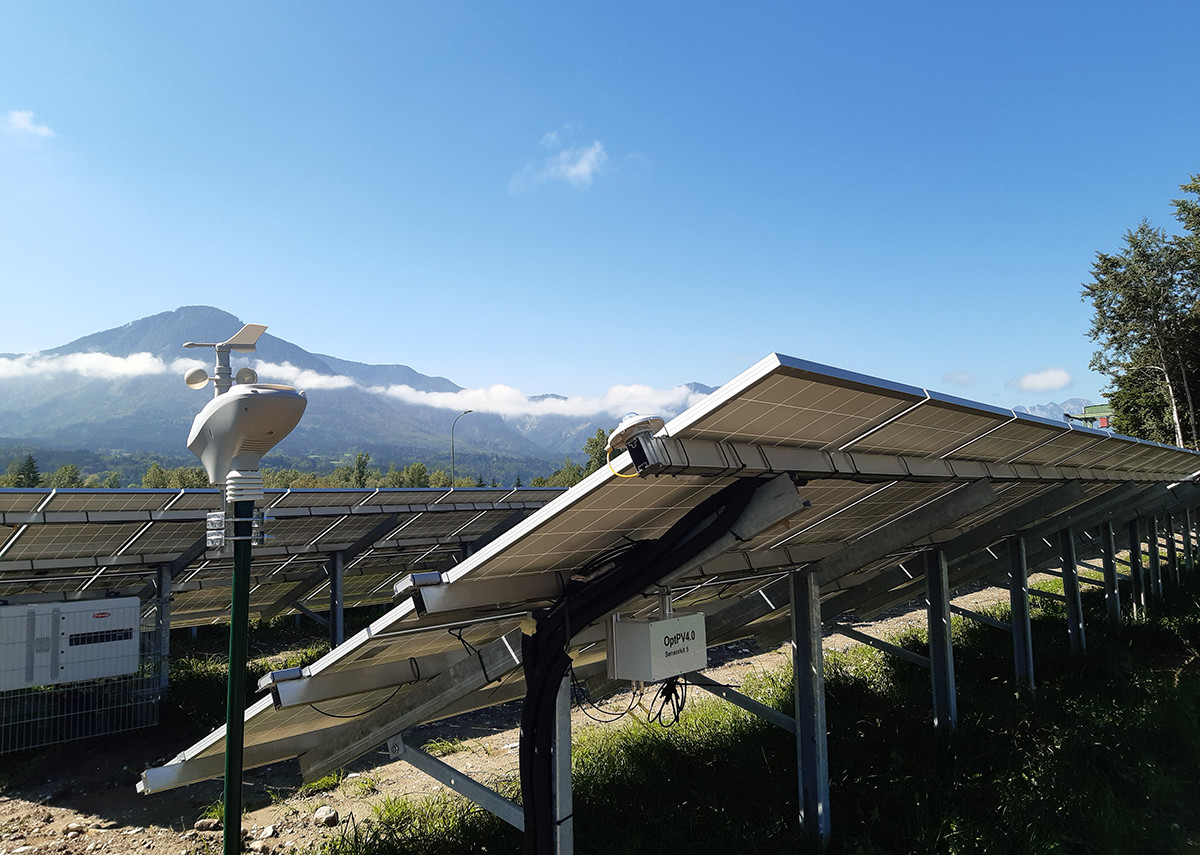
Early detection of faults in photovoltaic systems. PV system with weather station and sensor upgrade kit – Image: Silicon Austria Labs
Silicon Austria Labs optimizes the operation of photovoltaic systems with a sensor kit
With the "OptPV4.0" project, Silicon Austria Labs (SAL), together with six project partners, is working on a solution for the energy transition and aims to contribute to tackling climate change. The research project focuses on the early detection of faults and gradual degradation in photovoltaic systems. As part of the project, SAL developed a sensor upgrade kit, which has now been installed in VERBUND's new photovoltaic pilot plant at the Feistritz-Ludmannsdorf Drau power plant.
Photovoltaics has long since evolved from a niche industry to one of the most important renewable energy sources. To further expand the global transition to renewable energy sources, it is crucial to ensure and optimize the performance of photovoltaic systems. Sudden system failures and gradual deterioration in system performance can lead to power losses – the "OptPV4.0" project aims to prevent this.
Together with project partners ENcome Energy Performance GmbH, Fronius International GmbH, Montanuniversität Leoben, the peak lab. GmbH & Co. KG, Uptime Engineering GmbH, and VERBUND Green Power GmbH, Silicon Austria Labs is working to detect potential errors earlier in order to minimize downtime through appropriate countermeasures. To this end, the project has taken systematic steps: Firstly, error patterns in existing system data have been standardized, and secondly, a sensor upgrade kit for collecting important system data has been developed. This kit is being tested on real PV systems. The data obtained in this way will allow for the development of analysis models to identify sudden errors more quickly.
The sensor upgrade kit has now been installed in Verbund's new pilot plant, located directly on the grounds of the Feistritz-Ludmannsdorf Drau power plant. "With the completion of this pilot plant, VERBUND is launching its expansion course in the field of photovoltaics and wind power. By 2030, we aim to supplement hydropower generation with approximately 25 percent PV and wind power generation, thus making an important contribution to achieving #mission2030," explains Thomas Burchhart, head of the "OptPV4.0" project at VERBUND.
In addition to the early detection of faults and degradation, the data from the kit is also intended to make PV operation more cost-effective. "For photovoltaics to be fully established in the Austrian electricity system, reducing the levelized cost of electricity (LCOE) is essential. The development of the sensor upgrade kit, together with the algorithms for early damage detection, will make a significant contribution to increasing annual energy production at lower LCOE," says Wolfgang Mühleisen, head of the "OptPV4.0" project at SAL.
The results of the project provide an important basis for making the operation of photovoltaic systems of any size more economical and predictable – two important prerequisites for further promoting the spread of PV systems and their contribution to the energy transition and climate protection.
Keep in touch