


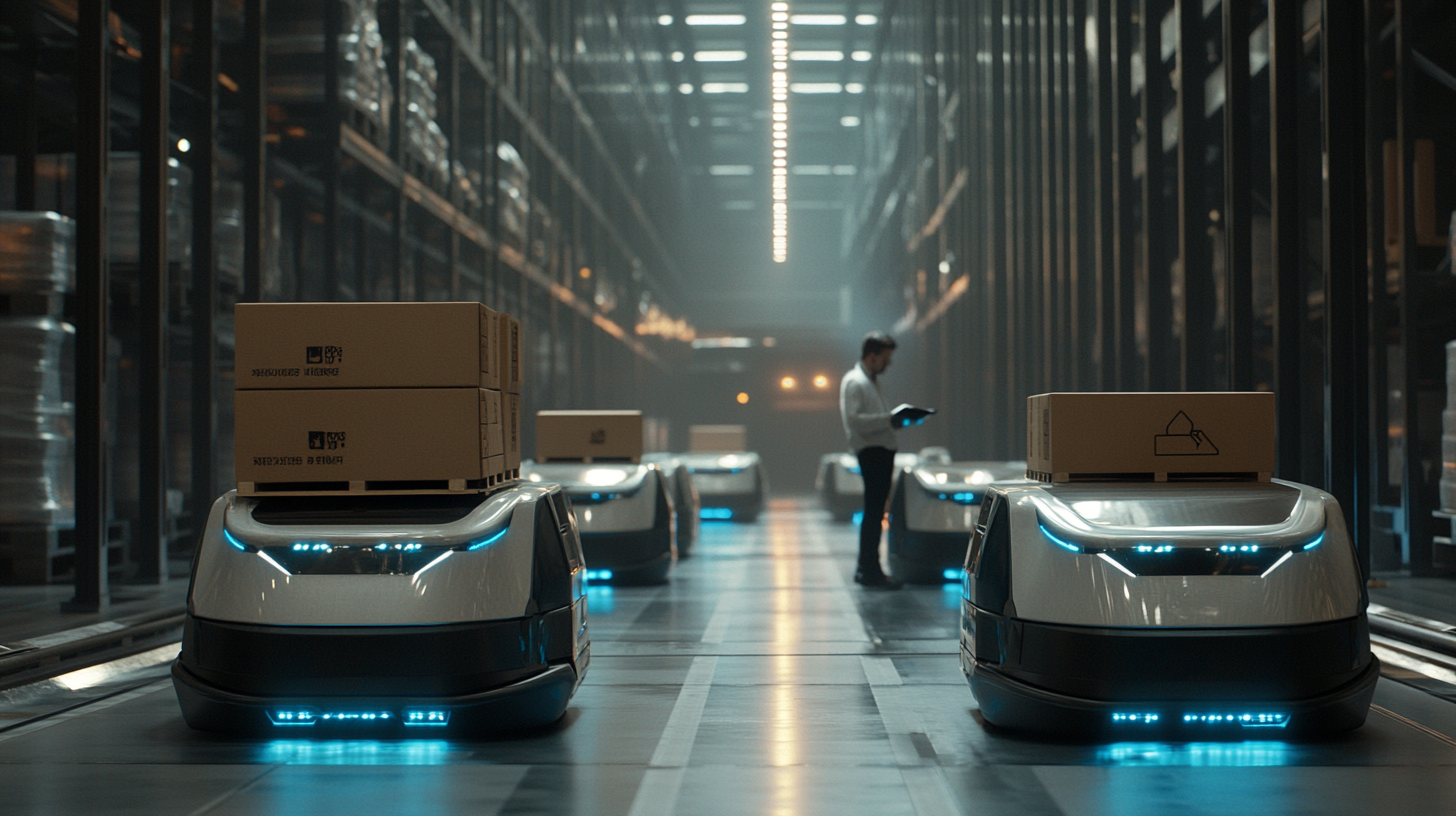
Driverless transport systems: What role do start-ups and industry play in the AMR (Autonomous Mobile Robot) business development in Europe? – Image: Xpert.Digital
From startup to industry standard: Growth trends in the European AMR market
Autonomous Mobile Robots in Europe: The synergistic role of startups and industry in innovation and market development
The European autonomous mobile robot (AMR) market is undergoing a transformative phase, driven by the dynamic interplay between agile startups and established industry players. Projected to grow from US$1.4 billion in 2022 to US$8.73 billion in 2030, the market is solidifying Europe's position as a global leader in AMR innovation. Startups such as Energy Robotics, Capra Robotics, and N Robotics are driving advancements in modular designs, AI-powered navigation, and cross-industry applications, while established companies like ABB and Mobile Industrial Robots (MiR) are scaling these innovations through strategic collaborations and acquisitions. This report examines how Europe's AMR ecosystem is thriving through technological innovation, public-private partnerships, and a strong startup culture, propelling the continent to the forefront of the global automation revolution.
Related to this:
Market landscape and growth forecasts
Exponential market growth
The global AMR market is projected to grow at a compound annual growth rate (CAGR) of 25.7% between 2022 and 2030, driven by the need for operational efficiency, workplace safety, and cost optimization. Europe dominates this market due to its early adoption of Industry 4.0 initiatives and investments in smart manufacturing. For example, the German company Item Industrietechnik demonstrated the feasibility of AMRs in intralogistics by integrating robots in the robotic-in-the-rafters (MIRs) into its 225-meter-long logistics complex, reducing manual transport tasks by 40%. Similarly, ABB's recently opened AMR training center in Madrid underscores industry's commitment to workforce training and the seamless integration of AMRs into production networks.
Main drivers of acceptance
Labor shortages and an aging population are forcing companies to deploy AMRs for repetitive, hazardous, or physically demanding tasks. In healthcare, AMRs are increasingly taking over logistical tasks such as transporting materials or samples within facilities. In manufacturing, they optimize material flow, support just-in-time processes, and enable flexible production lines. The COVID-19 pandemic further accelerated the demand for AMRs, as contactless automation solutions were needed to ensure the resilience of supply chains and the protection of employees. One example is Hitachi's deployment of MiR200 robots in Barcelona, which not only reduced direct employee contact with potentially hazardous areas but also increased the efficiency of internal transport processes.
The startup ecosystem: catalysts of innovation
Groundbreaking technological breakthroughs
European startups are redefining the capabilities of automated guided vehicles (AGVs) through specialized solutions. Energy Robotics, a spin-off from TU Darmstadt, has developed a hardware-independent software platform that enables cloud-based fleet management and AI-driven data analysis for industrial inspections. Its collaborations with Shell and Merck demonstrate the demand for AGVs in hazardous environments such as oil refineries and chemical plants. Similarly, the Danish company Capra Robotics secured €11.3 million to develop versatile AGVs for logistics and infrastructure inspections, addressing critical gaps in perimeter security and urban maintenance.
Financing and strategic partnerships
Venture capital funding drives the scalability of startups. Node Robotics, a German startup, secured significant funding to develop Node.OS, an operating system that enables collaboration between AMR fleets from different manufacturers. This innovation allowed BMW to deploy a synchronized fleet of intelligent transport robots and increase warehouse efficiency by 30%. Furthermore, incubators like INCATE provide early support to AMR startups by offering non-dilutive funding and industry connections.
Industry acceptance and strategic collaborations
Integration of startups into industrial structures
Established companies are increasingly acquiring or partnering with startups to accelerate the deployment of AMRs. ABB's acquisition of ASTI Mobile Robotics expanded its AMR portfolio and enabled matrix production systems in which robots navigate autonomously between modular workstations. Similarly, Siemens' investment in Magazino underscores the strategic importance of startups specializing in AI-driven decision-making in intralogistics.
Europe's AMR sector: Startups and industry are driving autonomous robotics development
The European AMR sector is thriving thanks to the symbiotic interplay between startups and industry, where agile innovation meets industrial scalability. Startups are driving technological breakthroughs in AI, modularity, and cross-industry applications, while established companies provide the infrastructure and market reach for global implementation. With supportive EU policies, regional cooperation, and a focus on SME integration, Europe is well-positioned to maintain its leadership in the AMR revolution. Future developments in humanoid robotics and 5G-powered swarm intelligence will further define industrial automation and solidify Europe's role as the epicenter of AMR innovation.
Related to this:
We are here for you - Consulting - Planning - Implementation - Project Management
☑️ Our business language is English or German
☑️ NEW: Correspondence in your native language!

Konrad Wolfenstein
I and my team are happy to be available to you as your personal advisor.
You can contact me by filling out the contact form here wolfenstein@xpert.digital:or simply call me at +49 7348 4088 965. My email address is
I'm looking forward to our joint project.