

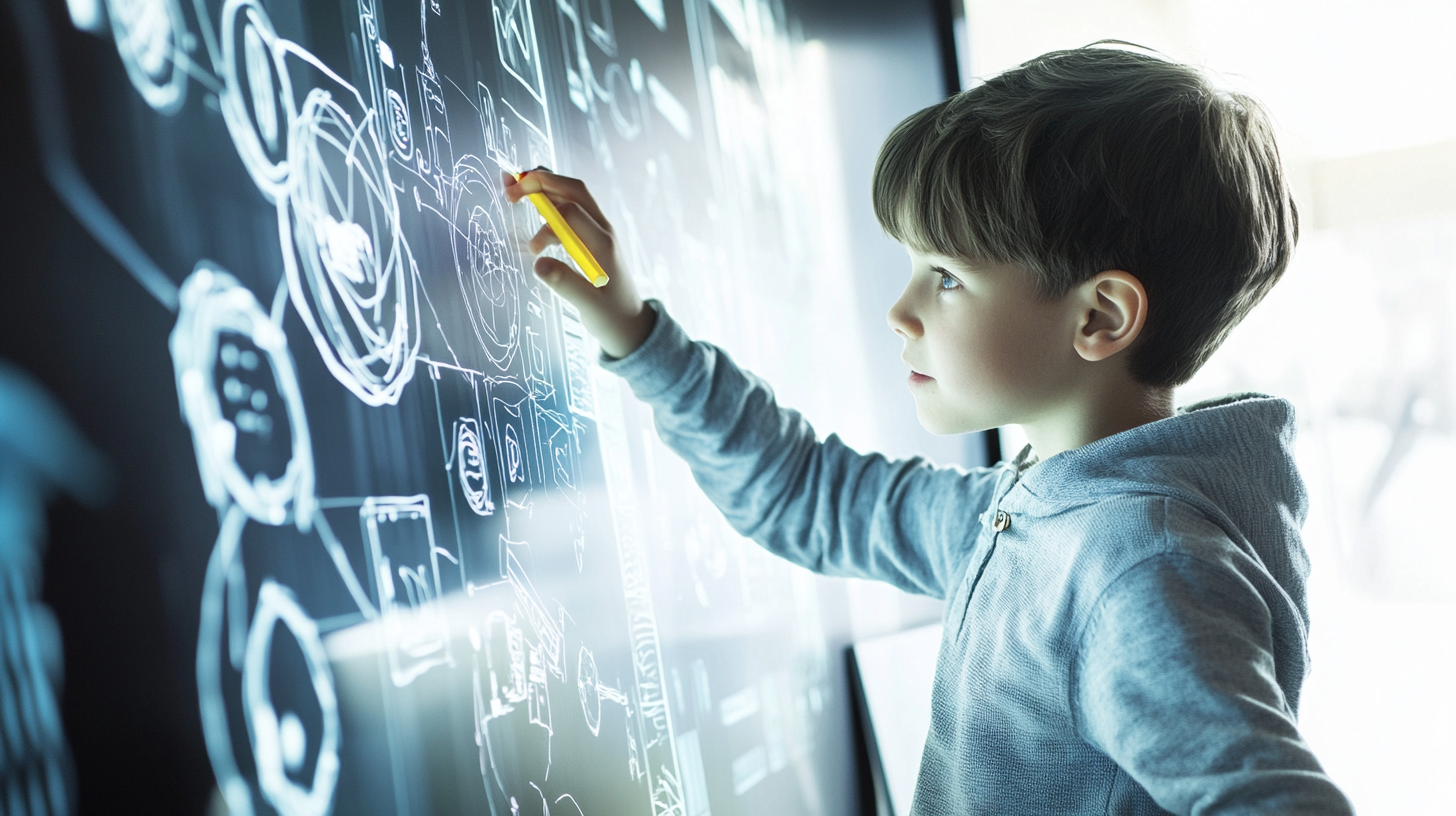
Interactive displays are a dominant trend in the education sector – The pedagogy behind the use of digital whiteboards – Image: Xpert.Digital
Digital whiteboards are revolutionizing teaching – The path to School 4.0
Digital whiteboards are revolutionizing teaching – The path to School 4.0
The increasing equipping of educational institutions with interactive displays is a dominant trend in the education sector. These digital whiteboards are increasingly replacing traditional chalkboards and offer diverse possibilities for more interactive and multimedia-based teaching.
This is evidenced by numerous articles about school districts and institutions investing in new technology (e.g., schools in Achern, Leonberg, Brandenburg an der Havel, Hallenberg Elementary School, and others). The headlines emphasize the advantages for interactive teaching and improved user-friendliness. The pedagogy behind the use of digital whiteboards is also discussed.
However, the use of interactive displays is far more than just a technological upgrade of the classroom. Rather, it brings about a pedagogical reorientation that makes learning more interactive, individualized, and collaborative. In this article, we examine the advantages, challenges, and pedagogical concepts associated with the use of digital whiteboards.
Advantages of interactive displays in the classroom
Interactive displays offer numerous advantages over traditional whiteboards, benefiting both teachers and students:
Multimedia presentation
By integrating text, images, videos, and interactive elements, teachers can make their lessons more engaging and exciting. Complex topics can be explained more clearly through animations and diagrams.
Increased student participation
The ability to interact directly on the screen encourages active participation from learners. For example, students can work together to solve problems, create sketches, or design interactive presentations. This strengthens their self-confidence and motivation.
Flexibility and adaptability
Teachers can easily save, edit, and reuse lesson content. This saves time and allows for flexible lesson planning that can be adapted to the current needs of the class.
Supporting different learning styles
Interactive displays allow for the delivery of teaching content in a variety of ways, thus catering to different learning styles. Auditory, visual, and kinesthetic learners all benefit equally from the multimedia possibilities.
Promoting digital competence
The use of digital whiteboards helps students learn to use digital technologies safely and competently from an early age. This is an essential skill for their later professional lives and lifelong learning.
Collaborative work
Networking with other devices allows learners to collaborate on projects, share information, and develop solutions to problems. This promotes teamwork and social skills.
Educational concepts and didactic challenges
Integrating interactive displays into lessons requires adapting teaching methods and adopting a new approach to learning:
Interactive and cooperative learning
Digital whiteboards support collaborative learning by facilitating interactive group work. Students can visualize their ideas and discuss them in real time. This active participation promotes critical thinking and problem-solving skills.
Differentiated learning opportunities
Digital technologies allow learning content to be adapted to individual learning paces. Adaptive learning enables more targeted support for weaker students, while higher-achieving children receive additional challenges.
Development of media literacy
Critical reflection on digital content is becoming increasingly important. By using interactive displays, students learn to critically examine media, analyze information, and recognize fake news. This media literacy is essential for a digital society.
Individualized support
Interactive displays make it easier for teachers to provide learning materials for different ability levels. Whether through adaptive learning programs or interactive quizzes, lessons can be specifically tailored to the needs of individual students.
Challenges in implementation
Despite the many advantages, there are also challenges that need to be overcome:
Professional development needs for teachers
For interactive displays to reach their full potential, teachers need appropriate training. Pedagogical concepts must be linked with technological possibilities to meaningfully enrich lessons.
Technical problems
Like any technology, interactive displays are susceptible to technical malfunctions. Internet connection problems, software errors, or lack of maintenance can disrupt lessons. Schools must therefore invest in a reliable IT infrastructure.
Costs and financing
The purchase, maintenance, and regular updates of interactive displays require significant financial resources. Not all schools have the necessary resources, making funding programs and government support essential.
Danger of over-technologization
The use of digital whiteboards should be pedagogically sound and not an end in itself. An excessive focus on digital content can lead to the neglect of traditional teaching methods. A balanced approach between digital and analog methods is crucial.
The future of the digital classroom
The trend towards the digitalization of the classroom will continue. Interactive displays are increasingly seen as central elements of modern learning environments. However, their successful use depends on the pedagogical concept, the technical infrastructure, and the competence of the teachers.
When used effectively and purposefully, interactive displays offer enormous potential to enrich lessons, increase learning motivation, and optimally prepare students for the digital future. The challenge lies in using digital technologies to support, not replace, proven teaching methods.
Interactive displays are no longer just a vision of the future – they are already a reality. The crucial question now is how they are used to improve education in a meaningful and sustainable way.
Related to this: