DNA proof for your steak: This tech combination promises absolute origin guarantee using blockchain technology – Image: Xpert.Digital
Digital transformation of the meat industry: Blockchain creates seamless traceability
Veritas in Carne: An industry report on blockchain and the future of a sustainable meat supply chain
The global meat industry is at a critical juncture, caught between the pressure of escalating global protein demand and an undeniable, multifaceted sustainability crisis. The environmental, social, and economic shortcomings of the current production model—characterized by significant greenhouse gas emissions, land and water degradation, labor exploitation, and systemic inefficiencies—are no longer sustainable. Incremental improvements have proven insufficient and necessitate a paradigm shift toward radical transparency and accountability.
This article conducts a comprehensive analysis of blockchain technology as a potential cornerstone for this new paradigm. By creating a decentralized, immutable, and transparent digital ledger, blockchain provides a fundamental infrastructure for transforming the meat supply chain. It offers the technical means to establish a “single source of truth,” enabling the verification of sustainability claims, ensuring ethical practices, and combating economic fraud.
We are on the cusp of a revolutionary transformation in the logistics and transportation industry thanks to blockchain technology. As a digital ledger, blockchain promises the ability to record transactions, eliminate intermediaries, reduce costs, and prevent manipulation.
Related to this:


Our analysis shows that while the technology's potential is profound, its implementation faces significant challenges. These include technological hurdles such as scalability and the "garbage in, garbage out" problem of data integrity, which can only be mitigated by integrating supporting technologies like the Internet of Things (IoT) and DNA testing. Even more formidable, however, are the socio-organizational barriers: the lack of industry-wide data standards, the difficulty of ensuring collaboration and fair incentives across a fragmented value chain, and complex governance issues.
Case studies from industry giants like Walmart, JBS, and Tyson Foods, as well as innovators like BeefLedger, reveal two parallel adoption paths: one focused on internal risk management and efficiency, and another that creates consumer-centric value through provenance and trust. Future developments suggest a convergence of these paths, driven by a strong feedback loop of increasing consumer demand for verifiable information, evolving regulatory requirements such as the FDA's Food Safety Modernization Act, and accelerated market investment.
This article concludes that blockchain is not a panacea. However, it is a crucial foundational technology. Its ultimate success will be measured not by its cryptographic elegance, but by its ability to provide the trusted data layer upon which a more sustainable, equitable, and resilient meat industry can be built. We offer strategic recommendations for all stakeholders—from producers and processors to investors and regulators—to navigate the complexities of this transition and harness the transformative potential of blockchain.
The need for a new paradigm in meat production
The global meat supply chain is a modern marvel of logistics and scale, providing food and livelihoods for billions of people. But this success comes at a high price. The industry remains under immense pressure from two opposing forces: On the one hand, global meat consumption will continue to be driven beyond 2025 by population growth and rising incomes in many regions, albeit no longer in the form of a doubling, but rather with slower, yet steady growth. On the other hand, there is a growing global consensus that the current operating model of the meat industry is not ecologically, socially, or ethically sustainable.
The ecological footprint of meat production remains a significant driver of climate change, deforestation, and water pollution. The industry is responsible for a substantial share of greenhouse gas emissions and contributes to the overexploitation of land and water resources. Its social record continues to be marked by hazardous working conditions and negative impacts on local communities. Economically, the industry's structure remains complex and opaque, perpetuating inefficiencies and vulnerability to large-scale fraud.
These challenges are not minor; they are systemic and woven into the fabric of a supply chain optimized for low-cost, high-volume production. Consequently, incremental improvements and voluntary corporate commitments have proven insufficient to address the scale of the crisis. What is needed is a fundamental paradigm shift—a move away from a system built on opaque processes and mediated trust to one based on verifiable data and radical transparency.
This article posits that blockchain technology, a decentralized and immutable digital ledger, represents a potential cornerstone for this new paradigm. By creating a shared, immutable, and transparent record of every transaction and data point from producer to consumer, blockchain provides the architectural foundation to restore trust and enforce accountability across the entire value chain. It promises to transform abstract claims of “sustainability” into verifiable evidence, reward responsible producers, and offer regulators unprecedented transparency. This analysis will address the multifaceted sustainability crisis in the meat industry, deconstruct the core principles of blockchain technology, and critically assess its real-world application, limitations, and future development in creating a more resilient and responsible future for meat production.
The sustainability deficit in the global meat supply chain
To understand the transformative potential of a proposed solution, it is first necessary to comprehensively diagnose the problem. The global meat supply chain, in its current form, exhibits a significant sustainability deficit across three interconnected pillars: the environmental, the social, and the economic. These challenges are not isolated failures, but rather systemic consequences of a model that has long externalized its true costs.
The ecological footprint: A planetary burden
Greenhouse gas (GHG) emissions
The environmental impacts of industrial meat production are immense and well-documented, placing a significant strain on the planet's finite resources. The meat industry is a major contributor to climate change. Livestock farming is responsible for a substantial portion of global anthropogenic greenhouse gas (GHG) emissions, with estimates ranging from 11% to 20%. The impacts vary dramatically depending on the animal species; beef production, for example, generates a carbon footprint 8 to 10 times larger than that of chicken and up to 50 times larger than that of beans. This is largely due to enteric fermentation in cattle, which releases enormous quantities of methane, a greenhouse gas far more potent than carbon dioxide in its heat-trapping capacity.
Land and water use
The industry's hunger for land is insatiable. Roughly half of all habitable land on Earth is used for agriculture, and a staggering 80% of that farmland is dedicated to livestock farming, either directly as pasture or indirectly for growing feed crops. This extensive land use often comes at the expense of natural ecosystems. The water footprint is similarly unsustainable; producing a single pound of beef can require as much as 2,400 gallons of water, a staggering figure in a world increasingly plagued by water scarcity.
Deforestation and loss of habitats
The expansion of the meat industry is a major driver of deforestation, particularly in critical biomes like the Amazon rainforest. Forests are being cleared at an alarming rate to create pastureland for cattle ranching and soy cultivation, a key ingredient in animal feed. This practice not only releases immense amounts of carbon into the atmosphere but also destroys biodiversity, pushing thousands of plant and animal species to the brink of extinction.
Waste and pollution
The industrial model of meat production, based on factory farms (CAFOs), generates waste on a scale that overwhelms local ecosystems. Manure is often stored in vast open-air lagoons prone to leaks and overflows, contaminating nearby soils and waterways with a toxic cocktail of antibiotics, bacteria, pesticides, and heavy metals. Furthermore, runoff of excess fertilizers and chemicals from the millions of hectares of monocultures grown for animal feed creates nutrient loads that lead to oxygen-depleted "dead zones" in coastal waters, suffocating vital marine habitats such as coral reefs. This linear, waste-intensive model stands in stark contrast to the principles of a circular economy, which would aim to add value to byproducts and minimize waste streams.
The social and ethical quagmire: A price for humans and animals
Beyond the environmental impact, the modern meat industry is fraught with profound social and ethical problems affecting workers, communities, and the animals themselves.
Labor exploitation
Meatpacking has been called "the most dangerous factory job in America." The workforce is disproportionately comprised of vulnerable populations, including low-income people of color and undocumented immigrants who often have few other employment opportunities. These workers face a host of hazards: low wages, dangerously fast processing lines designed to maximize throughput, and constant contact with sharp tools and heavy machinery. Injury rates are exceptionally high, with reports of an average of two amputations per week among workers in U.S. meatpacking plants between 2015 and 2017. Psychological strain is also severe, with studies documenting higher rates of anxiety, depression, and post-traumatic stress disorder among slaughterhouse workers. In its most extreme forms, particularly in global supply chains originating from regions such as Brazil, the industry has been linked to practices of modern slavery and forced labor.
Rights of communities and indigenous peoples
The negative externalities of industrial animal farming are not confined to factory walls. These farms are often located in or near marginalized communities, which then bear the brunt of air and water pollution, foul odors, and related health problems such as respiratory illnesses and higher rates of premature death. This pattern constitutes a form of environmental injustice. Furthermore, the relentless expansion of land for cattle ranching and feed production is a direct cause of land grabbing and, in some cases, violent conflict with Indigenous peoples whose ancestral lands are destroyed or stolen.
Animal welfare
The economic logic of industrial agriculture treats animals not as sentient beings, but as production units optimized for efficiency. This leads to systemic suffering on a massive scale. Billions of animals are raised annually in extreme conditions, unable to engage in natural behaviors. They are routinely subjected to painful mutilations—such as dehorning, castration, and tail docking—often without anesthesia. The entire life cycle, from birth and transport to slaughter, is designed to minimize costs and maximize yield, with animal welfare playing a subordinate role.
Economic inefficiencies and integrity gaps
The complexity and lack of transparency that define the global meat supply chain also create significant economic challenges, including widespread fraud, inefficiency, and injustice.
Food fraud and economically motivated adulteration (EMA)
The long and convoluted journey from farm to fork, with its many intermediaries and paper-based records, is an ideal breeding ground for food fraud. This practice involves the deliberate substitution or adulteration of food for financial gain and is estimated to cost the global food industry between $10 billion and $40 billion annually. High-profile incidents such as the 2013 European scandal, in which horsemeat was widely sold as beef, have severely damaged consumer confidence. The problem is persistent; for example, the Australian beef industry faces massive challenges from fraudulent products sold under its brand names in the lucrative Chinese market, damaging both its reputation and sales. EMA (Effective Microorganisms) is not just an economic problem; it can also pose serious health risks if undeclared allergens or harmful substances are introduced.
Related to this:
Inefficiencies and waste
Traditional supply chains operate with siloed data systems. Each participant—farmer, processor, distributor, retailer—maintains their own separate records, often on paper or in varying digital formats. This fragmentation creates massive inefficiencies. It makes tracing the source of a contamination outbreak a slow, cumbersome, and imprecise process, often resulting in excessively broad and costly product recalls where safe food is discarded along with contaminated items. The lack of shared, real-time transparency leads to poor inventory management, delays, and increased food waste throughout the system.
Economic inequality
The current structure of the meat value chain is highly centralized, with a few large corporations wielding immense market power. This often leaves small producers and farmers in a precarious position. They struggle to compete with the economies of scale of large industrial operations and receive only a small fraction of the final price paid by consumers, contributing to economic and social inequalities in rural communities.
These environmental, social, and economic challenges are not separate problems but are deeply intertwined. They are the predictable results of a system designed to prioritize the production of cheap meat above all else. The economic pressure for cheap protein fuels the industrial model of CAFOs (Central Animal Farming Facility). This model, in turn, concentrates animals and their waste, directly causing severe local pollution. Processing these animals on a large scale requires fast, repetitive, and dangerous factory lines, leading to the exploitation of a vulnerable workforce. The opacity and complexity enabled by this externalized cost model also create the perfect conditions for economic fraud to flourish. Therefore, a viable solution cannot consider just one dimension in isolation. It must confront the fundamental economic model of the industry. A technology like blockchain, which proposes radical, systemic transparency, is ideally suited to do just that by challenging the status quo and making the true costs of production visible and accountable.
Blockchain as a fundamental technology for supply chain transformation
To address the systemic flaws in the meat supply chain, a technology is needed that can fundamentally change how information is recorded, shared, and trusted. Blockchain technology, often described as a decentralized digital ledger, offers a novel architecture designed precisely for this purpose. It is not merely an incremental improvement on existing databases; it is a new technological paradigm for creating and maintaining a shared, secure, and unified record of truth among multiple, often distrustful, parties.
Basic principles: The triad of trust
The strength of blockchain technology stems from the interplay of three core principles that together build trust and integrity into a digital system.
decentralization
Unlike traditional centralized databases, where a single entity (such as a company or bank) owns and controls the data, a blockchain ledger is distributed and replicated across a network of computers, often called nodes. Every participant in the network holds a copy of the ledger. This decentralized structure eliminates any single point of failure or control. No single actor can unilaterally alter the records, shut down the system, or censor transactions, making the network highly resilient and robust.
immutability
This principle ensures that once data is entered into the blockchain, it cannot be retroactively altered or deleted. Transactions are grouped into "blocks," and each new block is cryptographically linked to the previous one, creating a chronological and unbreakable chain. Any attempt to manipulate a recorded block would change its cryptographic signature, invalidating all subsequent blocks in the chain. Such a change would be immediately detected and rejected by the rest of the network. This feature creates a permanent and tamper-proof audit trail of every transaction ever made on the network. If an error is made, it cannot be erased; a new transaction must be created to correct the mistake, and both transactions remain visible, guaranteeing a complete history.
transparency
Although blockchain networks can be configured with varying levels of data protection (e.g., public, private, or permission-based), the core principle of transparency means that all authorized participants in the network can access the same version of the ledger in real time. This ensures that every stakeholder—from farmers to regulators to consumers—has access to a single source of truth. This shared visibility eliminates the information silos that plague traditional supply chains, promotes accountability, and enables independent data verification by every participant.
Key architectural components
Several key technological components underpin the principles of decentralization, immutability, and transparency.
Distributed Ledger Technology (DLT)
This is the basic concept. DLT refers to any database that is shared based on consensus and synchronized across multiple locations, institutions, or geographic regions. Blockchain is the most well-known type of DLT. Its main advantage is that it records transactions only once, thus eliminating the massive duplication of effort and constant reconciliation requirements characteristic of traditional business networks, where each party maintains its own separate ledger.
Cryptographic hashing
This is the mathematical function that ensures the security and integrity of the blocks. A hash is a unique, fixed string of characters that serves as a digital fingerprint for a data set. Each block in the chain contains its own unique hash, as well as the hash of the preceding block. This creates the secure, sequential chain. Even a tiny change to the data within a block would generate a completely different hash, breaking the chain and signaling tampering.
Consensus mechanisms
In a decentralized system without a central authority, a protocol is needed so that network participants can agree on which transactions are valid and should be added to the ledger. This is the role of the consensus mechanism. The most well-known is Proof-of-Work (PoW), where "miners" compete to solve complex mathematical puzzles. Another well-known mechanism is Proof-of-Stake (PoS), where "validators" are selected to create new blocks based on the amount of cryptocurrency they have staked (deposited) as security. These mechanisms allow the network to maintain its integrity and agree on a single version of the truth.
Smart Contracts
These are among the most powerful applications of blockchain technology for supply chains. A smart contract is essentially a program stored on the blockchain that executes automatically when predefined conditions are met. The terms of an agreement are written directly into the code. For example, a smart contract could be programmed to automatically release a retailer's payment to a farmer as soon as an IoT sensor confirms that a shipment of meat has arrived at the distribution center within the correct temperature range. By automating such processes, smart contracts reduce transaction costs, eliminate delays, remove the need for intermediaries like banks or escrow agents, and enforce compliance with agreed-upon rules.
The creation of a “single source of truth”
The combination of these principles and components creates what is often referred to as the "single source of truth" for the supply chain. In a traditional model, the truth is fragmented. The farmer has their version of the truth in their records, the processor theirs, and the retailer theirs. Discrepancies are frequent, and resolving them is time-consuming and costly.
Blockchain technology replaces this fragmented reality with a single, shared, and trusted ledger. Every participant with the appropriate permissions can view the same data simultaneously, knowing that it is a complete and immutable record of events. This shared visibility creates an environment of unprecedented accountability.
It is crucial to understand that blockchain is not simply a more efficient database; it is better described as an “institutional technology” or a “trust engine.” Its primary function is to create trust in environments where it is lacking or expensive to establish. In a conventional supply chain, trust is mediated by intermediaries—banks, lawyers, auditors, certifiers—or built slowly over time through personal relationships. This is a slow, costly, and often fragile process. Blockchain technology automates and externalizes this trust-building function. The cryptographic certainty of the immutable ledger guarantees the integrity of past events, while smart contracts automate the enforcement of future agreements based on this verified data. This reorientation of the technology’s purpose is critical. The goal of blockchain implementation is not merely to manage data more efficiently, but to fundamentally restructure the relationships between supply chain partners by minimizing friction, reducing counterparty risk, and diminishing the power and costs of intermediaries. This has profound implications for the business models, cost structures and power dynamics of the entire meat industry.
🎯🎯🎯 Benefit from Xpert.Digital's extensive, five-fold expertise in one comprehensive service package | BD, R&D, XR, PR & Digital Visibility Optimization


Benefit from Xpert.Digital's extensive, five-fold expertise in a comprehensive service package | R&D, XR, PR & Digital Visibility Optimization - Image: Xpert.Digital
Xpert.Digital possesses in-depth knowledge across various industries. This allows us to develop tailored strategies precisely aligned with the requirements and challenges of your specific market segment. By continuously analyzing market trends and monitoring industry developments, we can act proactively and offer innovative solutions. The combination of experience and expertise generates added value and provides our clients with a decisive competitive advantage.
More information here:
Digital transformation of the meat industry: Blockchain as the key to sustainable production and consumer protection
The Convergence: Applying Blockchain to the Sustainability of the Meat Supply Chain
The true potential of blockchain technology is realized when its core capabilities are directly applied to the specific, deeply rooted sustainability challenges of the meat supply chain. By creating an immutable and transparent record of a product's journey, blockchain can transform vague sustainability claims into verifiable data points, thereby fostering a new level of accountability across the industry's environmental, social, and economic dimensions.
Related to this:


Strengthening environmental accountability
The environmental damage caused by the meat industry is largely a consequence of its lack of transparency. Blockchain offers a powerful tool to bring these hidden impacts to light and to create mechanisms for accountability.
Verifiable claims
Consumers are increasingly skeptical of vague marketing terms like "sustainably raised" or "eco-friendly." Blockchain offers a mechanism to move from mere labels to verifiable evidence. For example, a claim like "deforestation-free" can be substantiated by linking a specific batch of cattle to GPS data from IoT-enabled ear tags, proving that the animals were raised on established pastureland and not recently cleared land. Similarly, a "grass-fed" claim can be verified through immutable records showing the animal's location on the pasture throughout its life. This creates a direct, immutable link between the physical product and its environmental credentials, a process far more robust than traditional paper-based certification.
Making sustainability measurable: Blockchain transforms marketing promises into verifiable data for the meat industry
Resource and emissions tracking
The technology can serve as a comprehensive ledger for a product's ecological footprint. Data on resource use, such as the volume of water consumed or the type and quantity of feed, can be recorded at every stage. This enables the calculation and transparent reporting of a product's entire carbon and water footprint. Such data is invaluable for companies with emissions reduction targets, for complying with new environmental regulations, and for providing consumers with the clear information they need to make informed purchasing decisions.
Incentives for sustainable practices
By making sustainable practices verifiable and transparent, blockchain can underpin new economic models that reward environmental responsibility. For example, a premium price for demonstrably "low-carbon" beef becomes more justified and trustworthy for consumers. Furthermore, novel concepts such as asset-based tokens could be created, where farmers are directly rewarded with digital assets for achieving specific, verified environmental outcomes, such as carbon sequestration on their grazing land or reduced water consumption. This creates a direct financial incentive for producers to adopt more sustainable methods.
Promoting social justice and ethical security
The social problems within the meat industry, ranging from labor exploitation to animal welfare concerns, remain hidden behind complex and opaque supply chains. Blockchain technology can shed light on these practices and create pressure for improvement.
Review of fair working conditions
Exploitative labor practices, including the use of forced or "slave" labor, are a grim reality in parts of the global meat supply chain. Blockchain offers a tool for verification and accountability. The pioneering platform developed by JBS-Brazil to monitor its suppliers' compliance with socio-ecological standards, including the prohibition of slave labor, is a prime example of this application. By creating secure and immutable records of employment contracts, wage payments, and independent audits of working conditions, the technology provides a mechanism to hold companies accountable for human rights standards across their vast networks.
Ensuring animal welfare
Claims such as "humane animal husbandry" or "antibiotic-free" are central to the marketing of many premium meat products, but they are often difficult for consumers to verify. Blockchain technology can record key animal welfare indicators throughout an animal's life. Data points such as space per animal, health records detailing any antibiotic use, and transport conditions can be logged in an immutable ledger. This information could then be made available to consumers via a simple QR code scan on the final product, allowing them to verify the brand's ethical claims and build a deeper level of trust.
Restoring economic confidence and efficiency
The economic benefits of blockchain in the meat supply chain focus on curbing fraud, reducing inefficiencies, and building direct trust with the end consumer.
Combating food fraud
This remains one of the most compelling and immediate use cases for the technology. The lack of transparency in the current system makes it vulnerable to economically motivated fraud. By creating a complete, end-to-end, and tamper-proof record of the product supply chain, blockchain makes it exceptionally difficult to introduce fraudulent or counterfeit products undetected. Every transfer is recorded and verified. A classic example is the BeefLedger project, which was specifically designed to use blockchain to guarantee the authenticity of premium Australian beef exported to the Chinese market—a market where food fraud is a major concern for consumers.
Streamlining transactions and reducing costs
Relying on paper-based processes and intermediaries like banks and auditors causes significant costs and friction in the supply chain. Smart contracts can automate many of these functions. For example, a payment from a processor to a feedlot can be triggered automatically as soon as the system verifies the weight and grade of a delivered batch of cattle. This reduces paperwork, eliminates payment delays, and lowers intermediary fees, resulting in lower overall transaction costs and improved operational efficiency.
Strengthening consumers and building brand trust
Perhaps the most transformative application is creating a direct link of trust between producer and consumer. By scanning a QR code on a steak package, a consumer could potentially access the blockchain entry and see the entire history of that product: the farm where the animal was raised, photos or videos of the farm, its health records, the processing date, and its journey through the supply chain. This level of radical transparency is a powerful tool for building brand loyalty and consumer trust. It shifts the basis of trust from the marketing slogan on the packaging to the verifiable data in the ledger.
The convergence of blockchain and the meat supply chain represents a fundamental shift. It is moving the industry from a world of abstract “claims” to a world of verifiable “attributes.” A claim like “sustainably raised” or “ethically sourced” is currently a marketing label, often backed by an opaque and costly certification process that consumers are expected to trust. Blockchain is changing this dynamic. A claim like “organic” is no longer just a sticker; it becomes a series of immutable, verifiable transactions in a shared ledger—proof of organic feed purchases, land use certification, records of antibiotic-free veterinary care, and so on. Trust is no longer placed in the brand’s marketing department, but in the mathematical and cryptographic integrity of the shared data. This has the potential to completely reshape the nature of branding and competition in the meat industry, forcing a shift from the most appealing claims to the most robust and transparent evidence.
Market implementations and case studies
The application of blockchain technology in the meat supply chain has evolved from theoretical discussions to practical, real-world implementations. These initiatives are driven by both established industry giants seeking to minimize risks and improve efficiency, and agile startups aiming to create new value propositions based on trust and provenance. An examination of these case studies reveals the specific ways in which the technology is being deployed and the diverse business objectives it serves.
Industry giants as pioneers: The push towards broad acceptance
Large, multinational corporations are at the forefront of blockchain research and are primarily using its capabilities for large-scale food safety, compliance, and supply chain optimization.
IBM Food Trust Consortium
This is arguably the most significant collaborative effort in this field. Led by IBM, the consortium includes a list of global industry leaders such as Walmart, Tyson Foods, Nestlé, and Dole. The initiative leverages IBM's permissioned blockchain platform to create a secure environment where trusted partners can share data. The primary objectives are to improve food safety, enhance traceability for faster recalls, and increase overall supply chain efficiency.
Walmart
As a key founding member of the IBM Food Trust, Walmart has been a pioneer in the application of blockchain. The retail giant has conducted high-profile and successful pilot projects, including tracking pork in China and mangoes in the United States. In the mango pilot, the time required to trace the fruit's origin from the store back to the farm was dramatically reduced from seven days to just 2.2 seconds. Building on these successes, Walmart has taken decisive steps, requiring all its fresh leafy green suppliers to join its blockchain network to enable rapid tracing in the event of contamination. The company has also initiated a project to create a fully traceable Angus beef supply chain, connecting ranchers, feedlots, packers, and retailers on a single platform.
JBS
The world's largest meat processor has embraced blockchain through several strategic initiatives. JBS Australia has implemented a "paddock-to-primals" traceability program for its premium King Island Beef, providing detailed origin information. Even more ambitiously, JBS Brazil has launched its own "Transparent Livestock Platform." This blockchain-based system aims to monitor the company's vast and complex network of cattle suppliers for socio-ecological compliance, with a particular focus on combating illegal deforestation in the Amazon and eradicating forced or "slave labor" from its supply chain—a direct response to pressure from investors and NGOs.
Tyson Foods
As another key member of the IBM consortium, Tyson has also deployed blockchain for its own branded products. The company uses the technology to provide traceability for its Open Prairie® Natural Pork and Open Prairie® Natural Angus Beef lines, assuring consumers that the products can be traced back to the specific farms where the animals were born and raised.
Cargill
Cargill has demonstrated the consumer-centric potential of blockchain with its Honeysuckle White® turkeys. A simple code on the product packaging allows consumers to access a website that tells the story of their specific turkey, including the location of the independent family farm that raised it and even photos of the farm, creating a strong connection between producer and consumer.
Innovators and startups: Niche solutions and new models
While industry giants focus on scaling and efficiency, a number of startups have emerged that address specific problems and create new, premium market segments based on blockchain-verified trust.
Beef Ledger
This Australian startup offers an insightful case study on both the potential and the risks of blockchain implementation.
Problem: BeefLedger was founded to address the rampant food fraud and safety concerns surrounding premium Australian beef exported to China. Chinese consumers, wary of counterfeit products, lost confidence in the authenticity of imported beef, resulting in lost sales and reputational damage for legitimate Australian brands.
Solution: The company developed a blockchain platform to provide certified, immutable proof of the beef's entire journey from the Australian paddock to the Chinese consumer. This created a transparent and verifiable supply chain, which was intended to restore trust.
Consumer Insights: A 2019 survey conducted for BeefLedger provided crucial market information. It revealed that Chinese consumers were not only interested in the technology but also willing to pay a significant premium—between 31 and 57 yuan more for a 150-gram steak—for beef whose origin and journey were validated through blockchain technology. The survey also found that the most important proofs for consumers were verifiable packaging and expiration dates, as well as proof of an unbroken cold chain.
Challenges: Despite its innovative approach, BeefLedger faced strong headwinds. The project was significantly impacted by the logistical disruptions of the COVID-19 pandemic and the sharp deterioration in geopolitical relations between Australia and China, which disrupted trade flows. This underscores the vulnerability of even the most advanced technological solutions to external macroeconomic and political shocks.
BeefChain®
This Wyoming, USA-based initiative focuses on the domestic premium market. It uses blockchain and QR codes to enable a consortium of cattle ranchers to track their cattle from "pasture to butcher's counter." The goal is to provide irrefutable proof of origin for high-quality, American-raised beef, allowing ranchers to command a premium price for their products.
Ecotrace
This Brazilian startup offers a comprehensive traceability platform specifically for the beef and poultry sectors. A key focus of Ecotrace is collaborating with the refrigeration and transportation industries to ensure a complete and verifiable record of the cold chain on the blockchain, a crucial factor for meat safety and quality.
The crucial link: Integration of DNA traceability
A critical weakness in any blockchain-based traceability system is the link between the physical product and its digital record. The blockchain can immutably store data about a particular animal, but it cannot, on its own, prove that the piece of meat in a specific package actually came from that animal. This is the "garbage in, garbage out" problem, where the physical asset can be swapped or falsified before its data is recorded in the ledger.
To address this, leading initiatives are integrating DNA testing as the ultimate anchor of physical-digital identity. Companies like Tyson, as well as Ireland's national beef traceability program, have spearheaded this approach. The process involves taking a DNA sample from an animal at the slaughterhouse and linking its unique genetic profile to its record on the blockchain. This creates a definitive, scientific connection. A retailer, regulator, or even a consumer could then have a sample from a finished product tested and compare its DNA to the blockchain record to provide absolute, irrefutable proof of origin. This integration of biotechnology and information technology represents the gold standard for supply chain integrity and closes the final gap in the chain of trust.
A clear strategic divergence is evident in the market. Industry giants like Walmart and JBS primarily use blockchain as a powerful internal tool for risk management, food safety compliance, and large-scale logistics optimization. For them, the return on investment is measured in reduced recall costs and improved operational efficiency. In contrast, startups like BeefLedger and BeefChain are building business models based on a different value proposition: that consumers will pay a premium for the verifiable trust and provenance that blockchain provides, particularly in markets plagued by fraud, or for products marketed based on their unique provenance history. This suggests two distinct but parallel paths for blockchain adoption in the meat industry: a "compliance and efficiency path" driven by company size and a "premiumization and trust path" driven by consumer-centric brands. The long-term maturation of the technology will likely lead to a convergence of these two paths, combining the efficiency gains demanded by the giants with the radical transparency driven by the innovators. The integration of DNA testing represents the pinnacle of the "trust path," offering a level of verification that transforms a simple data log into a scientifically sound guarantee.
Critical analysis of the implementation: hurdles and limitations
Although blockchain has considerable potential to revolutionize the meat supply chain, its practical implementation faces significant hurdles. A sober analysis reveals that the path to widespread adoption is hampered by technological bottlenecks, fundamental economic contradictions, and complex human and organizational challenges. Overcoming these limitations is just as crucial as the development of the technology itself.
Technological and scalability challenges: The performance bottleneck
The core architecture of blockchain technology has inherent performance compromises that are particularly challenging for the data-intensive environment of a global supply chain.
The scalability trilemma
Blockchain systems are notoriously constrained by a “trilemma,” which forces a compromise between three desirable properties: decentralization, security, and scalability. Early public blockchains like Bitcoin prioritized decentralization and security, resulting in very low scalability. They can only process a handful of transactions per second, a rate woefully inadequate for the millions of data points generated every minute in a complex supply chain with IoT sensors and real-time tracking.
Data storage
Designing a blockchain where the ledger grows with each transaction and a complete copy is stored by many participants presents a significant data storage challenge. The sheer volume of data from a meat supply chain—including temperature, humidity, and GPS location data from IoT sensors for each shipment—would result in a "data explosion." Storing all this information directly on the main blockchain ("on-chain") would be prohibitively expensive and technically impractical.
Possible solutions
The blockchain developer community is actively working on solutions to address these performance issues. These can be broadly categorized as:
Layer-1 (On-Chain) solutions: These involve modifying the core protocol of the blockchain itself. Examples include sharding, which divides the blockchain database into smaller, more manageable segments that can process transactions in parallel, and the introduction of more efficient consensus mechanisms (see below).
Layer-2 (Off-Chain) Solutions: These solutions are crucial for making blockchain usable for supply chains. They work by processing the vast majority of transactions "off" the main blockchain in a secondary layer, recording only periodic summaries or proofs back to the main chain for security. This dramatically increases transaction throughput and reduces costs. Key Layer-2 technologies include rollups (which bundle many transactions into a single proof), state channels, and sidechains.
Hybrid models: Many enterprise solutions will likely use a hybrid approach, where most daily supply chain transactions are conducted on a fast, private or permissioned blockchain, while periodically a cryptographic proof of the state of this private chain is 'anchored' on a highly secure public blockchain for ultimate auditability and immutability.
The energy dilemma: A contradiction in sustainability
One of the most significant criticisms of blockchain technology is its high energy consumption, which is a direct contradiction when the technology is proposed as a tool for sustainability.
Proof-of-Work (PoW)
The original consensus mechanism that powers Bitcoin and, until recently, Ethereum, is the main culprit. Proof-of-Work (PoW) relies on a global network of "miners" competing to solve computationally intensive puzzles. This process, by its very design, consumes enormous amounts of electricity, with the Bitcoin network's annual energy consumption equivalent to that of entire countries like Argentina or the Netherlands. Using a PoW-based blockchain to track the sustainability of a meat product would be a profound and indefensible act of hypocrisy.
Energy-efficient alternatives
Fortunately, PoW is not the only option, and the industry is rapidly moving towards more sustainable alternatives.
Proof-of-Stake (PoS): This is the leading energy-efficient consensus mechanism. Instead of computationally intensive mining, PoS systems select "validators" to create and approve new blocks based on the amount of the network's cryptocurrency they are willing to stake as security. This eliminates competitive, energy-intensive puzzle-solving. The Ethereum network's transition from PoW to PoS in 2022 resulted in a reduction of its energy consumption by over 99.9%, a groundbreaking achievement for the industry.
Proof-of-Authority (PoA): This mechanism is particularly well-suited for private or consortium blockchains, which are common in enterprise supply chain applications. In a PoA system, transactions are validated by a small, pre-vetted group of trusted nodes (the "authorities"). Because it does not require widespread competition or complex calculations, its energy consumption is minimal.
For any serious application of blockchain in a sustainable meat supply chain, the choice of consensus mechanism is a crucial strategic decision. The use of Proof-of-Work (PoW) is not viable, while Proof-of-Stake (PoS) and Proof-of-Action (PoA) offer highly efficient and sustainable alternatives.
Comparative analysis of blockchain consensus mechanisms
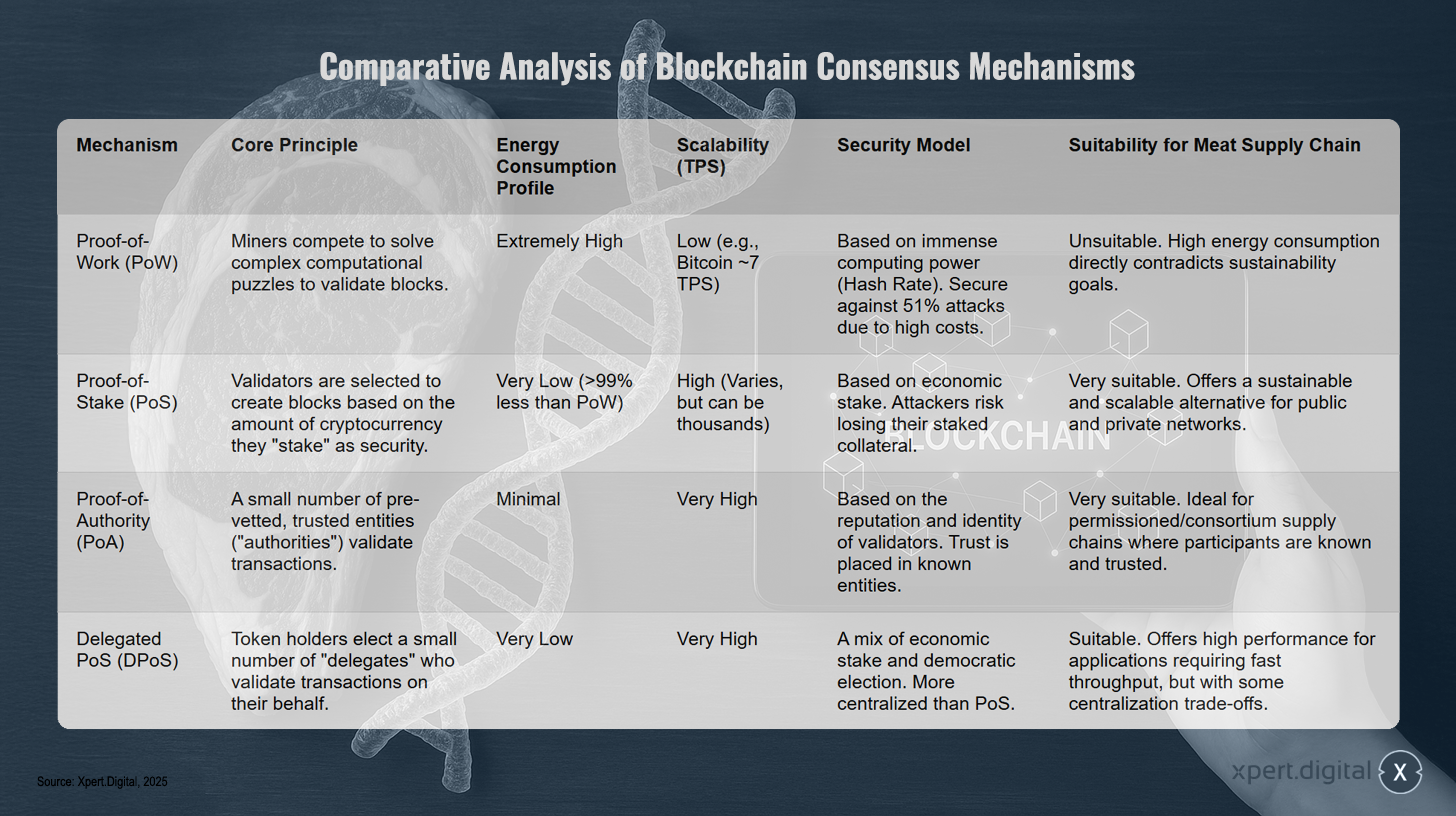
Comparative analysis of blockchain consensus mechanisms – Image: Xpert.Digital
A comparative analysis of blockchain consensus mechanisms reveals significant differences in their suitability for the meat supply chain. Proof-of-Work (PoW) is based on the principle that miners must solve complex computational puzzles to validate blocks. This mechanism is characterized by extremely high energy consumption and offers only low scalability of approximately 7 transactions per second, as the Bitcoin example demonstrates. The security model relies on immense computing power and, due to its high costs, is secure against 51% attacks. Because of its high energy consumption, which contradicts sustainability goals, PoW is unsuitable for the meat supply chain.
Proof-of-Stake (PoS) works differently: Validators are selected based on the amount of cryptocurrency they stake as collateral. This approach consumes over 99% less energy than Proof-of-Work (PoW) and offers high scalability with thousands of transactions per second. Security is based on economic stake, with attackers risking the loss of their staked collateral. PoS is proving to be very suitable for the meat supply chain, as it offers a sustainable and scalable alternative for public and private networks.
Proof-of-Authority (PoA) relies on a small number of pre-vetted, trusted entities as authorities to validate transactions. Energy consumption is minimal, while scalability is very high. The security model is based on the reputation and identity of the validators, placing trust in known entities. PoA is well-suited for approval-required consortium supply chains where participants are known and trusted.
Delegated Proof-of-Stake (DPoS) combines several approaches: Token holders elect a small number of delegates to validate transactions on their behalf. Energy consumption is very low, and scalability is very high. The security model represents a blend of economic stake and democratic election, but is more centralized than Proof-of-Stake (PoS). DPoS is suitable for applications requiring high throughput, but it does involve some compromises in terms of centralization.
The “garbage-in, garbage-out” problem: The oracle challenge
The immutability of a blockchain is both its greatest strength and a critical weakness. The ledger perfectly and permanently secures the data it receives, but it has no inherent ability to know whether that data was correct or truthful at the time of entry. If a farmworker manually enters false data—for example, claiming that a batch of conventionally raised chickens is "organic"—the blockchain will faithfully record and secure this lie. This is the "garbage in, garbage out" (GIGO) principle, and it poses a fundamental challenge to the integrity of any blockchain-based system.
This problem is known as the oracle problem: the challenge of getting reliable, trustworthy data from the real world (off-chain) onto the blockchain (on-chain). The credibility of the entire system is only as strong as its "oracles"—the sources of its data.
Mitigation strategies
The solution to the oracle problem lies not in the blockchain itself, but in its integration with other technologies that can automate and verify data entry in order to reduce the dependence on fallible human input.
Internet of Things (IoT)
This is the most critical integration. Using automated sensors to capture and directly transmit data to the blockchain minimizes the risk of human error or intentional manipulation. Tamper-proof IoT sensors can automatically record and log critical data points such as the temperature of a refrigerated truck, the GPS location of a cattle herd, or the humidity in a warehouse.
DNA tests
As detailed in section 4.3, the integration of DNA analysis provides a definitive, scientific link between the physical meat product and its digital identity on the blockchain. This offers the strongest possible protection against physical substitution or fraud.
Third-party audits
The system can be designed to incorporate data input from trusted, independent third-party auditors who physically verify practices on-site (e.g., animal welfare standards, organic land use) and confirm them on the blockchain.
Inter-organizational and governance barriers: The human factor
Beyond the technological hurdles, the biggest barriers to adoption are often social, economic, and political in nature.
Data standardization
The global meat supply chain is a patchwork of countless players in numerous countries, each using their own internal systems, processes, and data formats. There is no universally accepted standard for what data to collect (e.g., how to classify a carcass, what defines "free-range") or how to format it. This lack of standardization makes creating an interoperable blockchain system that can be used by all participants a monumental challenge.
Cooperation and incentives
Blockchain is a network technology; its value is directly proportional to the number of participants. However, convincing every actor in a long and fragmented supply chain to adopt the technology is a major hurdle. Smallholder farmers in developing countries, for example, may lack the resources, training, or technical infrastructure to participate. More fundamentally, there is the question of incentives. Why should a farmer at the beginning of the chain bear the cost and effort of meticulously entering data when the financial premium for the "traceable" end product is entirely captured by the brand or retailer at the end of the chain? Without fair, transparent, and often automated (via smart contracts) incentive structures, adoption will fail at the crucial "first mile.".
Data protection vs. transparency
While transparency is a key benefit, supply chain participants are understandably protective of commercially sensitive information such as supplier lists, prices, and transaction volumes. Designing a system that provides enough transparency to satisfy consumers and regulators without revealing proprietary data that could compromise a company's competitive position is a delicate balancing act. Permission-based blockchains, where only authorized parties can view specific data, offer a solution, but this can raise concerns about centralization and control by dominant players who set the rules for the network.
Ultimately, the biggest obstacles to blockchain adoption in the meat supply chain are not purely technical. Technological challenges like scalability and energy consumption have plausible and emerging solutions. The far more intractable problems lie in the human and organizational layers. A development team can design a highly scalable, energy-efficient proof-of-stake blockchain system. What they cannot do is force a group of competing meat-packing companies to agree on a single, unified data standard for carcass classification. They cannot force a large retailer to fairly share the premium it charges for "traceable beef" with the hundreds of small farmers who had to enter the data. And they cannot, through code alone, prevent a worker from entering incorrect data without a robust system of automated sensors or external audits to address the oracle problem. This leads to a crucial conclusion: successful blockchain implementation is less about deploying the “best” technology and more about building a thriving ecosystem. This requires the challenging work of establishing strong governance bodies, creating fair and transparent economic incentives, investing in complementary technologies like IoT, and fostering unprecedented industry-wide collaboration. Initiatives like the World Economic Forum’s Blockchain Toolkit directly acknowledge this reality and focus on creating neutral platforms and governance frameworks to address this complex challenge at the ecosystem level.
Our recommendation: 🌍 Limitless reach 🔗 Connected 🌐 Multilingual 💪 Sales power: 💡 Authentic with strategy 🚀 Innovation meets 🧠 Intuition


From local to global: SMEs conquer the world market with a clever strategy - Image: Xpert.Digital
In an era where a company's digital presence determines its success, the challenge lies in creating an authentic, personalized, and far-reaching presence. Xpert.Digital offers an innovative solution that positions itself as the intersection of an industry hub, a blog, and a brand ambassador. It combines the advantages of communication and sales channels in a single platform and enables publication in 18 different languages. Cooperation with partner portals and the ability to publish articles on Google News and a press distribution list with approximately 8,000 journalists and readers maximize the reach and visibility of the content. This represents a crucial factor in external sales and marketing (SMarketing).
More information here:
Blockchain is revolutionizing meat supply chains: Why traceability is more complex than with coffee and vegetables
Comparative analysis: The meat supply chain compared to other agricultural sectors
To fully appreciate the unique challenges and opportunities of implementing blockchain in the meat industry, it is insightful to compare its supply chain with those of other agricultural sectors where the technology has been applied, such as coffee, seafood, and fruits/vegetables. This comparative analysis reveals that the specific characteristics of the product itself—particularly its transformation and blending—are the primary determinants of the complexity and cost of a blockchain solution.
Related to this:


Unique complexities of the meat supply chain
The journey of meat from farm to plate is characterized by several complexities that make traceability a significantly greater challenge than with many other foods.
Transformation and mixing
This is the most fundamental challenge. A coffee bean, a head of lettuce, or a fish fillet largely retains its discreet identity throughout the supply chain. In stark contrast, a single living animal, such as a cow, is transformed into a multitude of different products—various cuts of steak, roasts, and ground meat, as well as byproducts like hides for leather. During processing, particularly for products like ground meat or sausages, meat from hundreds or even thousands of different animals is often mixed. This physical “encryption” of identity makes it impossible to trace a package of ground meat back to a single animal using a simple track-and-trace system. Without advanced and costly solutions like DNA tagging, the traceability trail for these products effectively ends at the batch level of the slaughterhouse.
Long and complex life cycles
The life cycle of farm animals is considerably longer and more fragmented than that of most crops. An animal can pass through several stages of ownership—a breeder, a rearer, a fattening farm, and finally a slaughterhouse—before even entering the processing and distribution phase. Each of these transfers represents a critical point where data must be accurately captured and transferred, increasing the potential for data loss or errors throughout the animal's long life.
Integrity of the cold chain
As a highly perishable product, meat requires an uninterrupted, temperature-controlled environment—the "cold chain"—from the moment of processing until it reaches the consumer. Verifying the integrity of this cold chain is not just a matter of quality, but a critical food safety requirement. This makes the integration of IoT temperature sensors not merely an add-on, but a fundamental necessity for a credible meat traceability system, adding an extra layer of technological complexity and cost.
Fragmented "first mile"
While the processing and retail stages of the meat industry are dominated by large, powerful corporations, the "first mile" of the supply chain—the farms and ranches where the animals are born and raised—is often highly fragmented. It consists of numerous small, independent producers who may lack the capital, technical expertise, or incentive to adopt sophisticated data collection technologies. This reflects the "smallholder problem" seen in other agricultural sectors and presents a significant obstacle to achieving true end-to-end traceability.
Cross-sectoral insights: Lessons from coffee, seafood and fruit/vegetables
The study of blockchain applications in other agricultural sectors provides valuable lessons and points of comparison for the meat industry.
Coffee
The coffee supply chain shares the critical challenge of empowering and integrating smallholder farmers who produce the majority of the world's coffee. Blockchain projects in this area, such as those initiated by Farmer Connect and Moyee Coffee, have focused heavily on ensuring fair and prompt payments to farmers and providing consumers with traceability stories for single-origin beans. A key hurdle identified in the coffee sector is the unequal distribution of value and the immense power wielded by a few large traders and roasters. This offers a direct lesson for the meat industry: a traceability system that fails to consider economic fairness and incentives for the primary producer is unlikely to achieve the necessary acceptance and data quality at the source.
seafood
The seafood industry, particularly for high-value and frequently counterfeited products like tuna, has been an important testing ground for the use of blockchain for fraud prevention and verifying claims about legal and sustainable fishing practices. Provenance's case study, which tracked tuna from Indonesian fishermen to consumers, demonstrated the importance of building an ecosystem that includes not only companies but also certification bodies and NGOs to validate claims. Intel's project using Hyperledger Sawtooth for seafood traceability highlighted the power of integrating blockchain with sensor equipment to monitor critical conditions such as temperature during storage and transportation—a direct parallel to the cold chain requirements for meat.
Fruit & Vegetables
The primary driver for blockchain adoption in the fresh produce sector has been food safety and the need for rapid recalls. Walmart's well-known mandate for its leafy green suppliers to join its blockchain network was a direct response to repeated E. coli outbreaks. The key success metric here is speed—reducing traceability times from days to seconds. Implementation is generally less complex than with meat, as fruit and vegetable items are not typically transformed or mixed to the same extent. However, the challenge with fruits and vegetables is often the low profit margin, which can complicate the cost-benefit analysis for blockchain implementation for anything other than high-risk or premium specialty items.
This comparative analysis leads to a crucial conclusion: The success and complexity of a blockchain solution in a given agricultural supply chain are inversely proportional to the degree of physical product transformation and mixing. The more a product maintains its discrete identity from its origin to the end consumer, the simpler and more cost-effective it is to implement a straightforward and effective blockchain traceability system. A batch of single-origin coffee can be tracked as a single unit. A head of lettuce remains a head of lettuce. However, an ox becomes hundreds of different products, which are then often mixed with products from other oxen to create new items such as ground beef. This physical disaggregation and reaggregation of identity is the biggest technical challenge for meat traceability. This implies that for a significant portion of the meat market, a simple track-and-trace blockchain model is insufficient. To achieve true, verifiable farm-to-fork traceability for processed and blended meat products, more advanced and expensive solutions capable of re-establishing identity at the point of sale—namely, the integration of DNA testing—are not just an improvement, but a necessity. This reality places the technological and economic hurdles for widespread blockchain adoption in the meat industry at a significantly higher level than in many of its agricultural counterparts.
Future developments: Market dynamics, consumer behavior and regulatory evolution
The future of blockchain in the meat supply chain will be shaped by the dynamic interplay of market forces, evolving consumer expectations, and an increasingly demanding regulatory landscape. Current trends indicate an acceleration of adoption, transforming the technology from a niche feature for premium products into a fundamental requirement for market access and operational integrity.
Market forecast and investment trends
Despite the significant implementation challenges, the market outlook for blockchain in the broader agricultural and food sector is exceptionally strong, signaling significant investor confidence in the technology's long-term value proposition.
Market growth forecasts
Forecasts for the global blockchain market in the agricultural and food supply chain consistently predict explosive growth. While specific figures vary among market research firms, the consensus points to a strong upward trend. Forecasts include growth from approximately $133 million in 2020 to around $948 million by 2025, and from $232 million in 2024 to nearly $985 million by 2030. Other reports predict even more aggressive growth, with some estimates reaching $7.4 billion or $8.4 billion by 2030/2033. Regardless of the exact figures, these forecasts reflect a robust compound annual growth rate (CAGR) in the range of 27% to 48%, indicating a market rapidly transitioning from infancy to high-growth.
Key market drivers
This rapid growth is not speculative; it is underpinned by fundamental changes in the industry. The main drivers are rising consumer demand for food safety and transparency, the urgent need for more efficient and resilient supply chains, and an increase in venture capital and corporate investment in agricultural technology (ag-tech). The global COVID-19 pandemic acted as a catalyst, clearly exposing the weaknesses of traditional, opaque supply chains and accelerating the push for digitalization and improved traceability.
Investment focus
Investment trends reflect a maturing understanding of technological requirements. Capital is increasingly flowing not only into pure software platforms but also into companies that can offer integrated end-to-end solutions. These include providers that combine the blockchain platform with essential hardware (such as IoT sensors), data intelligence and analytics, and implementation services. Investors are seeking companies that address the entire ecosystem challenge and recognize that strong partnerships and clear governance models are key indicators of long-term profitability and success.
The changing consumer: From passive buyer to active tester
The modern consumer is no longer a passive recipient at the end of the supply chain. Armed with information and a growing awareness of health, environmental, and ethical issues, the consumer is becoming an active participant who demands scrutiny.
Willingness to Pay (WTP)
A growing body of research confirms that this demand for transparency translates into tangible economic value. Several studies have shown that consumers are willing to pay a significant price premium for meat products that offer robust traceability and verifiable claims. For example, a 2019 survey conducted for the BeefLedger project found that Chinese consumers were prepared to pay a substantial premium for blockchain-tracked Australian beef, demonstrating a clear market for trust.
The power of trust
Consumer trust is a key driver of purchasing decisions and brand loyalty. Blockchain's unique ability to provide cryptographic proof offers a new foundation for this trust, enabling a shift from trust in a brand's abstract promises ("social trust") to trust in the verifiable, immutable data on the ledger ("technological trust"). This is a powerful differentiator in a market plagued by food scandals and fraudulent claims. However, this potential hinges on consumer education. Current familiarity with blockchain technology is low, and significant efforts will be needed to educate consumers about its benefits and the use of traceability tools such as QR codes.
Information preference
Research into consumer attitudes reveals specific preferences for the types of information they value most. For beef products, traceability data covering the entire supply chain, country of origin, and, crucially, the integrity of the cold chain (temperature history) are highly valued. A fascinating finding is that consumers exhibit a strong aversion to uncertainty and ambiguity; they prefer traceability that reveals a minor adverse event (such as a brief temperature fluctuation) to having no information at all. This suggests that for consumers, transparency itself, even if imperfect, is more valuable than the illusion of perfection created by opacity.
The regulatory horizon: From directive to regulation
Governments and regulatory authorities are increasingly recognizing the potential of blockchain to support the enforcement of food safety and traceability standards, and are moving from a position of observation to one of active promotion and, in some cases, regulation.
Government initiatives
In the United States, the Food and Drug Administration (FDA) is a key driver of this change. The Food Safety Modernization Act (FSMA), particularly Section 204, and the agency's plan for a "New Era of Smarter Food Safety" are pushing the industry toward improved, technology-driven traceability for high-risk foods. These regulations create a strong, compliance-based incentive for companies to adopt technologies like blockchain that can meet these new, stringent record-keeping requirements.
International cooperation and standards
A major obstacle to the global adoption of blockchain is the lack of harmonized international standards for data and interoperability. Multi-stakeholder consortia, particularly the World Economic Forum (WEF), play a crucial role in addressing this. The WEF has launched initiatives to develop neutral, open-source toolkits and governance frameworks aimed at fostering industry-wide collaboration and creating the interoperable systems necessary for a truly global, transparent supply chain.
Future framework conditions
The regulatory landscape of the future will likely be a hybrid model. It will combine government regulations for critical food safety traceability with industry-led standards for value-added claims (e.g., organic, ethically sourced, carbon neutral). As technology matures, blockchain-based smart contracts could gain formal legal recognition as binding agreements, providing a powerful new tool for automating and enforcing compliance with both regulatory and commercial requirements across the supply chain.
A powerful and self-reinforcing feedback loop is beginning to develop, linking consumer behavior, technological capabilities, and regulatory pressure. As consumers become better informed about sustainability issues in the meat industry—a process facilitated by the transparency offered by early blockchain projects—they intensify their demand for verifiable information. This clear consumer demand creates a profitable market for companies offering traceability solutions, stimulating further investment and innovation. As these technological solutions become more widespread and proven, regulators see an opportunity to leverage them to enforce food safety and sustainability standards more effectively and efficiently. This leads to the creation of new rules, such as the FDA's Food Traceability Rule, which in turn compels a broader segment of the industry to adopt the technology to remain compliant. This wider adoption further increases transparency, raising consumer awareness and expectations, thus completing and reinforcing the loop. This dynamic suggests that blockchain adoption in the meat supply chain will accelerate, moving from a niche feature for premium brands to a fundamental, non-negotiable requirement for market access, particularly in developed and highly regulated markets. Companies that view this development merely as a new compliance burden to be managed will inevitably fall behind those who recognize it as a profound strategic opportunity to build lasting consumer trust and create new value.
Stakeholder roadmap: Strategic recommendations and concluding remarks
The transition to a blockchain-enabled meat supply chain is a complex undertaking requiring coordinated action from all stakeholders. Based on a comprehensive analysis of the technology's potential, its inherent limitations, and the dynamic market forces at play, the following strategic recommendations are proposed.
For producers (farmers and livestock breeders)
Adopting collaborative models
The costs and technical expertise required for blockchain implementation can be prohibitive for individual small to medium-sized producers. Forming or joining cooperatives to pool resources, share the costs of technology acquisition and training, and negotiate collectively with downstream partners is a crucial strategy.
Demand fair value for data
Data is a valuable asset. Producers must advocate for and collaborate with processors and retailers who use transparent, smart contract-based systems that ensure fair and automated compensation for providing accurate, timely data. The value derived from traceable, premium-priced products must be fairly redistributed to the source.
Focus on high-quality data points
Prioritize collecting data that consumers and buyers value most, such as proof of origin, animal welfare conditions, and antibiotic use, to maximize the return on investment in data collection.
For processors and brands
Start with strategic pilot projects
Begin implementation with high-value or high-risk product lines (e.g., premium steak brands, organic lines, products exported to markets with a high risk of fraud) to demonstrate a clear return on investment and build internal expertise before attempting a full rollout.
Invest in the ecosystem, not just in the technology
The success of a blockchain initiative depends on the strength of the network. Actively engage in industry consortia to help develop and promote common data standards. A proprietary, isolated blockchain will have limited long-term value.
Solving the "garbage-in" problem
Recognize that blockchain alone is not enough. Prioritize investment in supporting technologies such as IoT sensors for automated data collection (especially for cold chain integrity) and explore the integration of DNA testing for high-value products to provide the ultimate guarantee of authenticity.
For retailers
Leveraging origin as a competitive advantage
Leverage blockchain-verified traceability as a powerful marketing tool to strengthen consumer trust and brand loyalty. Make this information easily accessible to shoppers via QR codes and in-store displays.
Using data for risk management
Leverage aggregated, real-time data from the blockchain network to achieve unprecedented supply chain transparency. Use this information to better manage inventory, anticipate disruptions, and identify potential risks before they escalate.
Promoting transparency
Act as an important driver in the feedback loop by educating consumers about the benefits of traceability and demanding higher transparency standards from suppliers.
For technology providers
Focus on user-friendliness and interoperability
Design solutions with user-friendly interfaces that abstract away the underlying technical complexity, especially for participants like farmers. Prioritize building platforms that are interoperable with both legacy enterprise systems (such as ERPs) and other blockchain networks.
Building for sustainability and scalability
Develop solutions based on energy-efficient consensus mechanisms such as Proof-of-Stake (PoS) or Proof-of-Authority (PoA). Architectural systems with Layer 2 solutions ensure they can handle the high transaction volume of a global supply chain cost-effectively and efficiently.
Offering end-to-end solutions
The market is moving towards integrated solutions. Work with hardware (IoT) vendors and consulting firms to offer a complete package that covers the entire implementation lifecycle, from strategy and governance to deployment and maintenance.
For investors
Evaluate the ecosystem, not just the pitch deck
When evaluating investment opportunities, look beyond the technology itself. Examine the startup's partnership strategy, its plan for building a participant network, and its governance model. A company that addresses the human and organizational challenges of collaboration has a higher probability of success than one with a purely technological focus.
Identify critical enablers
Look for investment opportunities in the critical supporting technologies that make blockchain profitable, such as companies developing low-cost, tamper-proof IoT sensors or scalable DNA tracing services.
Take a long-term perspective
The transformation of the meat supply chain won't happen overnight. Invest in companies with a clear, pragmatic roadmap that acknowledges the significant hurdles and has a sustainable plan to overcome them.
For regulatory authorities and political decision-makers
Promoting collaborative standardization
Work closely with industry consortia and international bodies to develop practical, harmonized data standards for food traceability. Avoid creating fragmented, country-specific regulations that hinder global trade.
Creating "safe harbor" environments
Establish regulatory sandboxes that allow companies to pilot and innovate with blockchain technology in a controlled environment, without fear of violating unsafe or outdated laws.
Creating legal clarity
Develop clear legal frameworks that address critical issues such as the legal status of smart contracts, data ownership and privacy rights on a distributed ledger, and liability in a decentralized multi-party system.
From pasture to fork: Blockchain makes meat supply chains traceable
The global meat industry is at a crossroads, facing the existential need to reconcile its production methods with the planet's ecological limits and evolving societal ethical standards. This report has demonstrated that blockchain technology, while not a panacea, offers a powerful and potentially transformative tool to facilitate this reconciliation. It is not a magic bullet that can single-handedly solve the industry's deep-seated environmental, social, and economic problems. Its implementation is complex, costly, and fraught with challenges that are as much human as they are technical.
However, dismissing blockchain technology because of these hurdles would be a misapprehension of its fundamental value. Blockchain's true contribution lies not in a standalone solution, but in a fundamental infrastructure – a new "layer of trust" for the industry. By creating a shared, immutable, and transparent record of truth, it provides the essential data architecture upon which a more sustainable, accountable, and equitable meat supply chain can be built.
It is the tool that can make deforestation-free claims verifiable, give substance to promises of humane animal treatment, and guarantee the authenticity of a product to a skeptical consumer. It provides the mechanism for tracking carbon footprints, ensuring fair labor practices, and streamlining a system riddled with inefficiency and fraud.
The ultimate success of blockchain in the meat supply chain will not be measured by its transaction speed or the elegance of its cryptographic algorithms. It will be measured by its ability to enable and verify real, tangible changes in environmental practices, working conditions, and the equitable distribution of value. The path is long and complex, but with strategic implementation, multi-stakeholder collaboration, and a clear understanding of both its potential and limitations, blockchain can serve as a crucial cornerstone in building a meat industry equipped for a more sustainable future.
XPaper AIS - R&D for Business Development, Marketing, PR and Content Hub
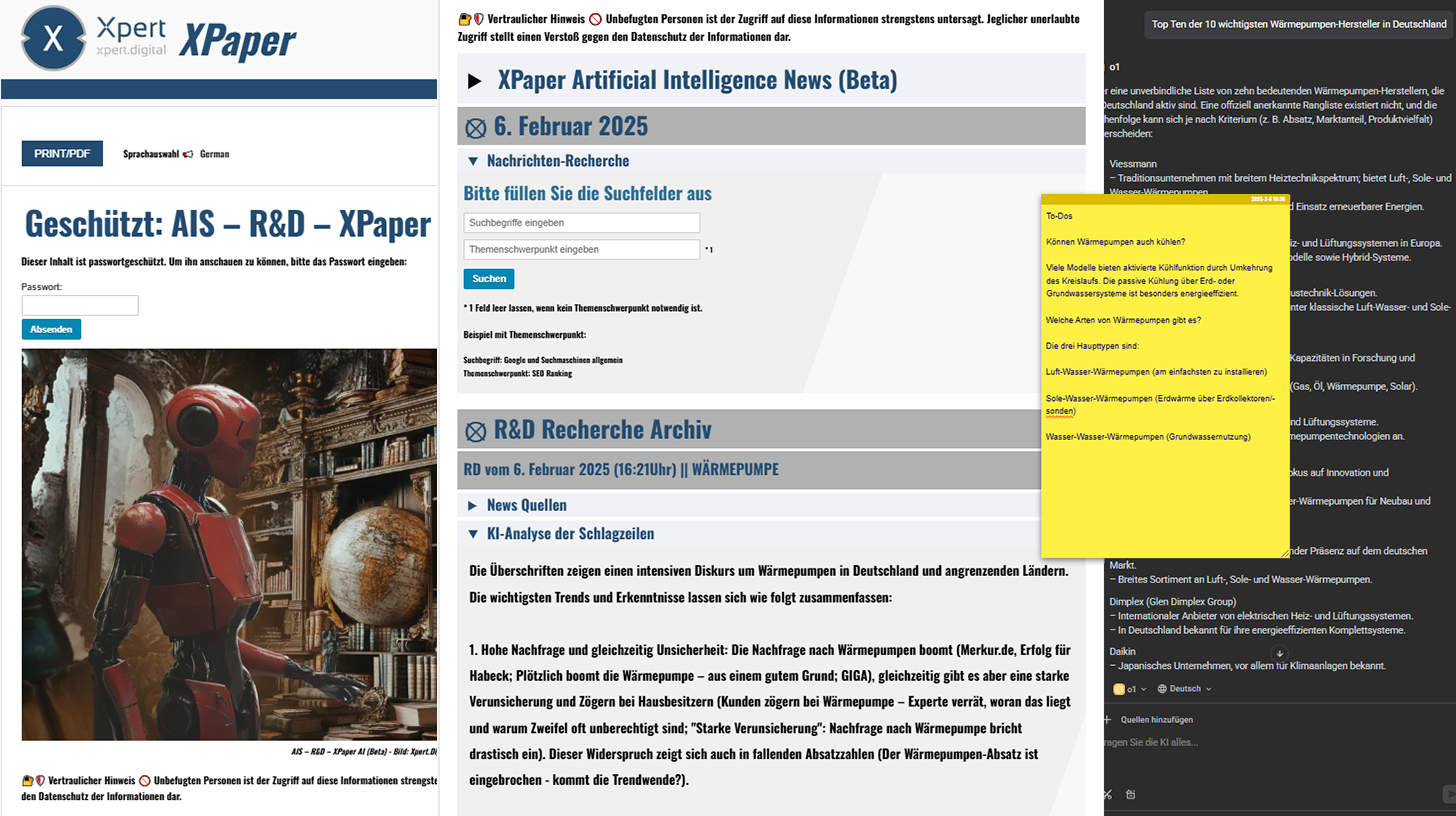
XPaper AIS application possibilities for business development, marketing, PR and our industry hub (content) - Image: Xpert.Digital
This article was handwritten. I used my self-developed R&D research tool, 'XPaper,' which I primarily use for global business development in a total of 23 languages. Stylistic and grammatical refinements were made to make the text clearer and more fluid. Topic selection, drafting, and the collection of sources and materials are all handled by an editorial team.
XPaper News is based on AIS (Artificial Intelligence Search) and differs fundamentally from SEO technology. However, both approaches share the goal of making relevant information accessible to users – AIS on the search technology side and SEO on the content side.
Every night, XPaper sifts through the latest news from around the world with continuous, round-the-clock updates. Instead of investing thousands of euros monthly in cumbersome and generic tools, I've created my own tool to stay up-to-date in my work in Business Development (BD). The XPaper system is similar to tools used in the financial sector, which collect and analyze tens of millions of data points every hour. At the same time, XPaper isn't just for business development; it's also used in marketing and PR – whether as a source of inspiration for the content factory or for article research. The tool allows you to evaluate and analyze all sources worldwide. No matter what language the data source speaks, it's no problem for the AI. Various AI models are available for this purpose. The AI analysis quickly and clearly generates summaries that show what's currently happening and where the latest trends lie – and XPaper offers this in 18 languages. XPaper allows for the analysis of independent subject areas – from general to specific niche topics, in which data can be compared and analyzed with past periods, among other things.
We are here for you - Consulting - Planning - Implementation - Project Management
☑️ SME support in strategy, consulting, planning and implementation
☑️ Creation or realignment of the digital strategy and digitization
☑️ Expansion and optimization of international sales processes
☑️ Global & Digital B2B trading platforms
☑️ Pioneer Business Development

Konrad Wolfenstein
I would be happy to serve as your personal advisor.
You can contact me by filling out the contact form below or simply call me on +49 7348 4088 965 .
I'm looking forward to our joint project.
Write to me


Xpert.Digital - Konrad Wolfenstein
Xpert.Digital is a hub for industry focusing on digitalization, mechanical engineering, logistics/intralogistics and photovoltaics.
With our 360° Business Development solution, we support renowned companies from new business to after-sales.
Market intelligence, smarketing, marketing automation, content development, PR, mail campaigns, personalized social media and lead nurturing are part of our digital tools.
You can find more information at: www.xpert.digital - www.xpert.solar - www.xpert.plus
Keep in touch