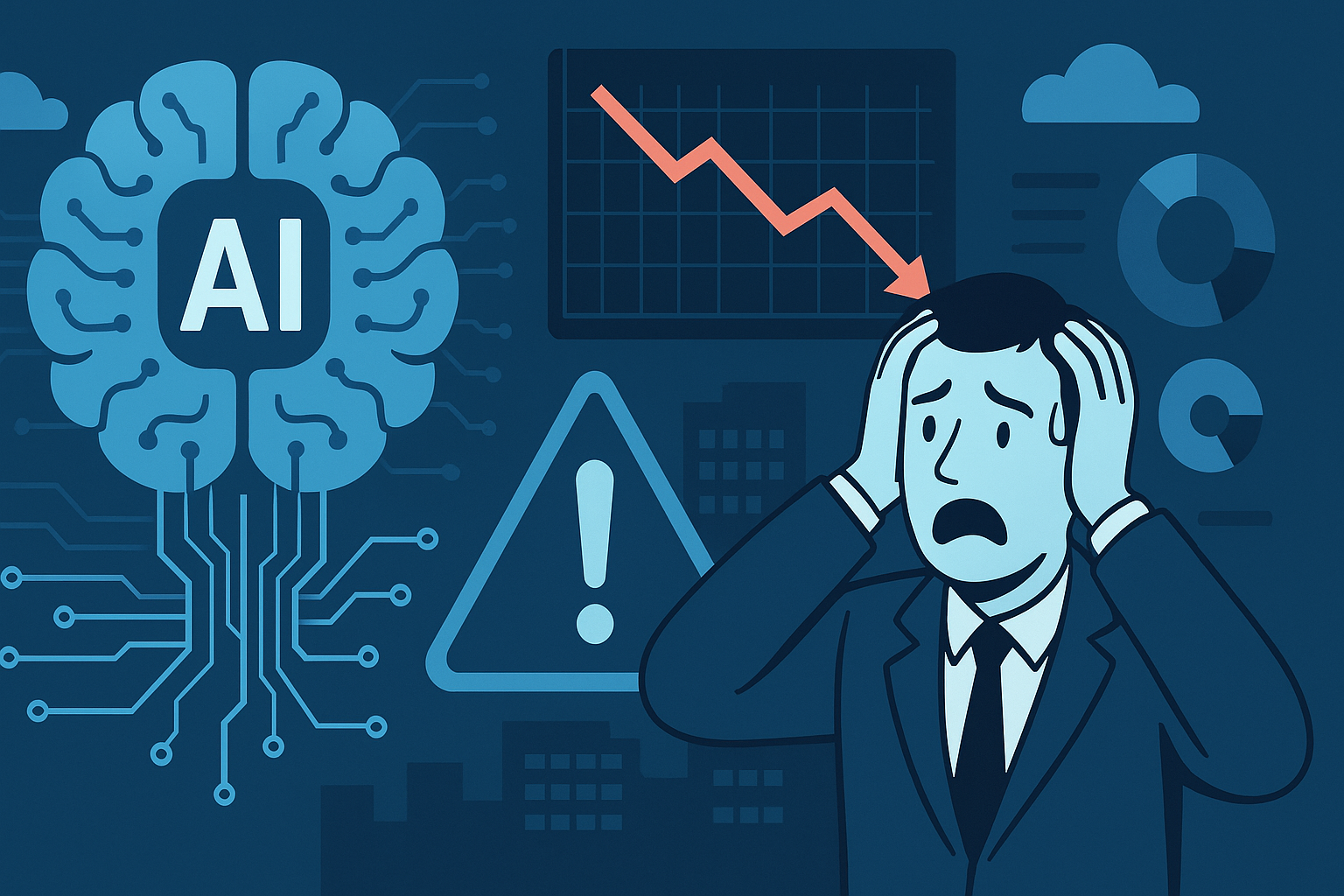
Digital Transformation with Artificial Intelligence: Shocking Forecast: 40% of AI Projects Fail – Is Your Agent Next? – Image: Xpert.Digital
AI agents fail: Why a third of all digital projects are on the verge of collapse
Failed Automation: The Brutal Truth About AI Development Projects
For years, digital transformation has promised a golden age of automation and efficiency. AI agents, in particular, are touted as the digital employees of the future, expected to relieve the burden on human workers and revolutionize business processes. But reality paints a different picture: more than one in three development projects is on the verge of collapse, and euphoria is increasingly giving way to disillusionment. This discrepancy between promise and reality raises fundamental questions about the actual maturity and practical benefits of this technology.
What are AI agents and why are they considered revolutionary?
AI agents differ fundamentally from conventional automation tools. While classic software solutions like Zapier or Make operate according to fixed rules, AI agents combine perception, decision-making, and action capabilities into an autonomous system. They can decide, based on the situation, which action is appropriate next, instead of always following the same pattern.
These advanced computer programs are designed to act autonomously, make decisions, and take action without constant human intervention. They can analyze data, learn from experience, and adapt to changing conditions. Unlike simpler automation tools, AI agents can handle complex tasks and adapt to unpredictable situations.
The merging of seemingly logical deductions and genuine action capability is considered a proven path to more powerful, universal AI systems. An agent no longer simply searches for product information and makes recommendations, but also navigates the provider's website, fills out forms, and completes the purchase – solely based on a brief instruction and learned processes.
Related to this:


The promise of increased productivity
The potential benefits of AI agents for businesses seem impressive at first glance. Studies do indeed show positive results: A study by the Massachusetts Institute of Technology and Stanford University, based on data from 5,179 customer service employees, found that employees supported by an AI agent were 13.8 percent more productive than those without access. A recent study even shows that AI agents can increase team productivity by 60 percent.
AI agents are expected to handle a wide range of tasks, from scheduling appointments and booking travel to research and reporting. They can automate repetitive and time-consuming tasks, freeing up human employees to focus on strategic and creative endeavors. Imagine an AI agent that automatically processes invoices, generates reports, and schedules meetings, allowing employees to concentrate on more complex tasks that require human expertise.
The applications span virtually all areas of business. In customer service, AI agents can provide personalized support around the clock, using natural language processing to handle customer inquiries and escalate issues to human representatives only when necessary. In IT support, they assist with automated troubleshooting by identifying, analyzing, and resolving problems. In financial and insurance systems, they can detect and prevent fraudulent activity by analyzing patterns and anomalies in the data.
The harsh reality: Why AI agents fail
Despite the promising outlook, the reality is sobering. Market research firm Gartner predicts that over 40 percent of all AI agent projects currently planned or in use will be discontinued by 2027. This forecast is based on three main reasons: rising costs, lack of return on investment for companies, and insufficient risk control.
Anushree Verma, Senior Director Analyst at Gartner, explains the situation as follows: Most agent-based AI projects are currently in an early experimental phase or are still concepts driven by hype and being misapplied. Many AI users still lack an understanding of how expensive and complex AI agents actually are when scaled up to entire enterprises.
Technical deficiencies and quality problems
A fundamental problem lies in the technical immaturity of current systems. According to Gartner analysts, only about 130 of the more than 1,000 tools that promise agentic AI capabilities actually deliver on that promise. Most agentic AI promises lack significant value or return on investment because they are not mature enough to autonomously achieve complex business objectives or to follow instructions in detail every time.
The problems become particularly apparent when AI agents are confronted with complex, multi-stage tasks. A benchmark from Salesforce shows that even top models like Gemini 2.5 Pro achieve only a 58 percent success rate in simple tasks. Performance drops dramatically to 35 percent in longer dialogues. As soon as several rounds of conversation are required to gather missing information through follow-up questions, performance declines significantly.
Another benchmark in the financial sector shows similarly sobering results: The best-performing model tested, OpenAI's o3, achieved only 48.3 percent accuracy at an average cost of $3.69 per answer. While the models are capable of extracting basic data from documents, they fail to provide the in-depth financial reasoning necessary to truly complement or replace analyst work.
The problem of exponentially increasing error probability
A particularly problematic characteristic of AI agents is their tendency toward cumulative errors. Patronus AI, a startup that helps companies evaluate and optimize AI technology, found that an agent with a one percent error rate per step up to the 100th step has a 63 percent probability of making a mistake. The more steps an agent needs to complete a task, the higher the likelihood of something going wrong.
This mathematical reality explains why seemingly small improvements in accuracy can have a disproportionate impact on overall performance. An error in any single step can cause the entire task to fail. The more steps involved, the higher the chance that something will go wrong before the end.
Security risks and new attack vectors
Microsoft researchers have identified at least ten new categories of AI agent failures that could compromise the security or protection of AI applications or environments. These novel failure modes include agent compromise, the infiltration of rogue agents into a system, or the impersonation of legitimate AI workloads by attacker-controlled agents.
Of particular concern is the phenomenon of "memory poisoning." Microsoft researchers demonstrated in a case study that an AI agent analyzing emails and performing actions based on their content can be easily compromised if it is not hardened against such attacks. Sending an email containing a command that modifies the agent's knowledge base or memory leads to unintended actions, such as forwarding messages on specific topics to an attacker.
The economic challenges
Exploding implementation costs
The cost of implementing AI agents varies dramatically depending on the scope and complexity. For small businesses requiring only basic solutions, simple AI plans typically cost between $0 and $30 per month. For mid-sized companies, implementation costs can range from $50,000 to $300,000, while large organizations with enterprise-wide AI initiatives should expect investments of $500,000 to $5 million in the first year.
However, the true costs extend far beyond the initial implementation expenses. Companies must factor in hardware costs for specialized servers and GPU clusters, software licensing fees, data storage solutions, and cloud computing resources. Additionally, data preparation—often the most time-consuming aspect of AI projects—requires significant investment. According to Gartner research, organizations typically spend between $20,000 and $500,000 on initial AI infrastructure, depending on the project scope.
The problem of unclear return on investment
A particularly problematic aspect is the difficulty in quantifying the actual benefits of AI agents. While traditional automation solutions often offer clear cost savings through staff reductions or efficiency gains, the ROI of AI agents is harder to measure. The parameters for measuring success need to be adjusted, as the return on investment cannot be determined directly.
Despite optimistic expectations – a survey shows that 62 percent of companies expect a return on investment (ROI) of over 100 percent for agentic AI – reality often falls short. Many pilot projects fail to transition to the production environment because the promised added value fails to materialize or the implementation costs exceed the expected savings.
Agent Washing: The Marketing Problem
An additional factor that increases the confusion is so-called "agent washing." Many vendors rebrand existing technologies such as AI assistants, robotic process automation, or chatbots as supposedly agent-based solutions, even though these often lack the crucial characteristics of real agents. Gartner estimates that of the thousands of vendors, only around 130 actually offer genuinely authentic agent-based AI technologies.
This practice leads to unrealistic expectations among companies that believe they are implementing mature agent technology when in reality they are only receiving enhanced automation tools. The confusion between true AI agents and traditional automation solutions contributes significantly to the high failure rates.
B2B procurement: Supply chains, trade, marketplaces & AI-powered sourcing


B2B procurement: Supply chains, trade, marketplaces & AI-powered sourcing with ACCIO.com - Image: Xpert.Digital
More information here:
AI agents put to the test: The hidden hurdles of automation
Specific challenges in practice
Integration into existing systems
One of the biggest practical hurdles is integrating AI agents into existing IT landscapes. Integration can be a real challenge, as companies need to ensure that AI agents integrate seamlessly into their existing infrastructure. This integration often requires significant adjustments to existing systems and can lead to costly disruptions to ongoing business processes.
Many existing enterprise systems were not designed to interact with autonomous AI agents. The necessary API interfaces, data formats, and security protocols often require complete redesign. This technical complexity leads to longer implementation times and higher costs than originally anticipated.
Related to this:


Data protection and compliance issues
The use of AI agents also raises questions about data protection and compliance with laws such as the GDPR. Companies must ensure they protect their customers' privacy and adhere to applicable laws. Agents' access to and processing of sensitive data significantly increases data protection risks.
Autonomous AI systems partially escape human control, creating new vulnerabilities. In networked multi-agent systems, emergent effects can occur, making their behavior unpredictable. Fully autonomous agents can act in unexpected ways, raising legal and ethical concerns.
Organizational resistance
An often underestimated factor is resistance within the workforce. Automation through AI agents can lead to workplace changes and job losses. Companies must prepare for these changes and take measures to support their employees. Employees need to be convinced of the benefits of AI agents in order to use them effectively.
Successful implementation requires not only technical expertise, but also change management and training programs. Without the acceptance and active support of the workforce, even technically sophisticated implementations will fail due to human factors.
Why current approaches fall short
The complexity of real business processes
Many AI agents are designed to operate in controlled environments, but real-world business processes are far more complex and unpredictable. Rule-based systems exhibit a degree of fragility, meaning they can break down when confronted with situations not anticipated by their developers. Many workflows are far less predictable, characterized by unexpected twists and turns and a multitude of possible outcomes.
AI agents that perform well in controlled testing environments often fail when confronted with the complexity and unpredictability of real-world business environments. They may overlook crucial contextual information or make poor decisions when faced with ambiguity.
Overestimated autonomy
A fundamental problem lies in overestimating the actual autonomy of current AI agents. Most so-called autonomous systems still require significant human oversight and intervention. Agents that act completely autonomously walk a tightrope between usefulness and unpredictability. Complete autonomy sounds ideal until the agent books a trip to the wrong city or sends an unverified email to an important client.
Current AI models lack the necessary capabilities to independently achieve complex business objectives, nor are they capable of following nuanced instructions over extended periods. This limitation often prevents the promised automation from materializing, and human oversight remains necessary.
Successful implementation strategies
Focus on specific use cases
Despite the many challenges, there are indeed successful implementations of AI agents. The key lies in focusing on specific, well-defined use cases, rather than trying to create universal solutions. Successful organizations have concentrated on prioritizing and adapting use cases. Decision-makers who pursue every AI opportunity are likely to have more failed projects.
A proven approach is to use AI agents for decision-making, automating routine processes, or handling simple queries. These limited, clearly defined tasks offer a higher probability of success than attempting to fully automate complex, ambiguous business processes.
Step-by-step implementation
A pragmatic approach is the phased introduction of AI agents. Instead of trying to transform entire business units at once, companies should start with smaller, more manageable projects. Smaller companies can minimize their costs by using AI telephony services and pre-built solutions that require less upfront investment than custom-designed systems.
One example of a successful phased implementation is a mid-sized insurance company that implemented AI for claims processing and customer service. Despite an initial investment of $425,000, the system achieved a positive return on investment within 13 months and delivered combined savings and revenue improvements of $1.2 million over three years.
The importance of governance and risk management
AI agents for decision intelligence are neither a panacea nor infallible. They must be used in combination with effective governance and risk management. Human decisions still require sufficient knowledge as well as data and AI expertise.
An effective governance framework should include clear guidelines for monitoring and controlling AI agents. This includes mechanisms for detecting and correcting errors, regular audits of agent performance, and clear escalation paths for situations requiring human intervention.
The future outlook: Realistic expectations
Long-term trends despite short-term setbacks
Despite current challenges, Gartner predicts that AI agents will play a significant role in the long term. By 2028, approximately 15 percent of all everyday workplace decisions are expected to be handled by agentic tools – compared to 0 percent in 2024. Furthermore, 33 percent of all enterprise software solutions are projected to include AI agents by 2028, compared to less than one percent in 2024.
These forecasts suggest that the current problems should be understood as growing pains of a still young technology. The fundamental concepts are promising, but the implementation needs to mature and adapt to the realities of everyday business.
The need for realistic assessments
The high failure rates of AI agent projects should not be interpreted as a general failure of the technology, but rather as a warning sign of unrealistic expectations and immature implementation strategies. Failed projects should not always send a negative signal to CEOs. Celebrating failures in this field is important, as it fosters a culture of experimentation, regardless of whether the idea makes it to production.
This exercise can also lead to iterative experimentation and better results. It's important to know when AI is the right tool and when it isn't, to avoid wasting time on a losing hand.
Related to this:

Strategic recommendations for companies
Realistic goal setting and expectation management
Companies should approach their AI agent initiatives with realistic expectations. Instead of trying to achieve revolutionary transformations, they should focus on incremental improvements. To unlock the true benefits of agent AI, companies should not only look at automating individual tasks, but also focus on increasing productivity at the enterprise level.
A good starting point is the use of AI agents for specific, measurable tasks with clear business value. The goal should be to maximize this business value – be it through lower costs, better quality, higher speed, or improved scalability.
Investment in fundamentals
Before implementing complex AI agents, companies should ensure the fundamentals are sound. This includes a solid data strategy, effective data governance, and a robust technology platform. Poor data quality is the reason for the failure of over 70 percent of AI projects. AI systems cannot deliver on their promise without high-quality, relevant, and well-managed data.
Building internal expertise
Successful implementation of AI agents requires specialized skills that many organizations lack. Companies must either invest in developing internal AI capabilities or forge strategic partnerships with experienced providers. Developing internal capabilities typically costs between $250,000 and $1 million for medium-sized projects, including hiring specialized developers and purchasing development tools.
A turning point for AI agents
The high failure rate of AI agent projects marks a significant turning point in the development of this technology. The initial euphoria is giving way to a more realistic assessment of its possibilities and limitations. This disillusionment, however, is not necessarily negative – it can lead to better, more thoughtful implementation strategies.
The technology itself isn't the problem. AI agents certainly have the potential to improve business processes and open up new opportunities. The problem lies in the discrepancy between inflated expectations and current technological reality. Companies that view AI agents as a panacea or try to achieve too much too soon will likely be among the 40 percent that will have to abandon their projects by 2027.
Success with AI agents requires a pragmatic, incremental approach focused on specific use cases with clear business value. Companies must be prepared to invest in the necessary foundations – from data quality to internal skills development. Most importantly, they must understand that AI agents are not a substitute for sound business strategy and robust project management practices.
The coming years will show which companies learn from current failures and successfully integrate AI agents into their business processes. The winners will be those who have realistic expectations, proceed methodically, and are prepared to invest in this technology for the long term, rather than relying on quick fixes.
We are here for you - Consulting - Planning - Implementation - Project Management
☑️ SME support in strategy, consulting, planning and implementation
☑️ Creation or realignment of the AI strategy
☑️ Pioneer Business Development

Konrad Wolfenstein
I would be happy to serve as your personal advisor.
You can contact me by filling out the contact form below or simply call me on +49 7348 4088 965 .
I'm looking forward to our joint project.
Write to me


Xpert.Digital - Konrad Wolfenstein
Xpert.Digital is a hub for industry focusing on digitalization, mechanical engineering, logistics/intralogistics and photovoltaics.
With our 360° Business Development solution, we support renowned companies from new business to after-sales.
Market intelligence, smarketing, marketing automation, content development, PR, mail campaigns, personalized social media and lead nurturing are part of our digital tools.
You can find more information at: www.xpert.digital - www.xpert.solar - www.xpert.plus
Keep in touch