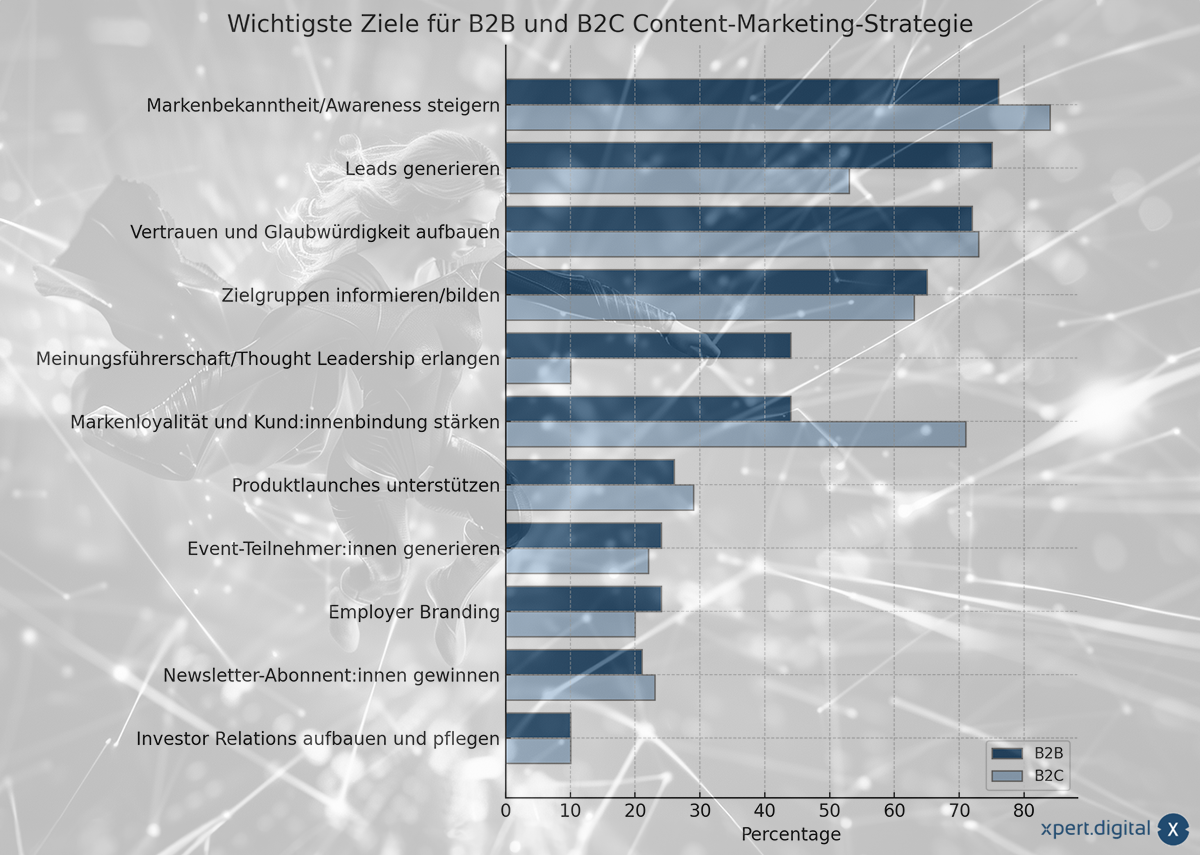
Key objectives for B2B and B2C in content marketing strategy: increasing brand awareness, recognition, and visibility – Image: Xpert.Digital
📈 Content marketing: An essential component of modern marketing strategies
Content marketing is an essential element of modern marketing strategy for both B2B and B2C companies. It offers businesses the opportunity to effectively reach their target audiences, build brand awareness, and cultivate long-term customer relationships. The use of content marketing aims to provide added value to customers, build trust, and ultimately achieve business objectives. In this context, the question arises: What specific goals do companies pursue with their content marketing activities, and how do these differ between B2B and B2C markets?
🔍 Brand awareness and trust as primary goals
A key objective for both B2B and B2C companies is increasing brand awareness. In an increasingly digital world, where customers have a wealth of information and brands to choose from, it is crucial that a brand is visible and stands out from the competition. Brand awareness not only helps reach potential customers but is also the first step in building long-term trust.
For B2B companies, however, building trust and credibility is just as important as brand awareness. In this market segment, purchasing decisions are often more complex and require longer sales cycles. Therefore, it is crucial that the target audience perceives the brand as trustworthy and competent. Content marketing, which provides relevant information and demonstrates expertise, plays a vital role in gaining this trust.
B2C companies, on the other hand, place particular emphasis on strengthening brand loyalty and customer retention, in addition to brand awareness. In markets where competition is fierce and customers can easily switch to competitors, it is crucial to acquire and retain loyal customers. Through tailored content that addresses customer needs and interests, companies can build a stronger emotional connection to their brand.
🎯 Lead generation and target group formation
Another key objective for many companies is lead generation. This is crucial for B2B companies, as the success of sales teams often depends on acquiring high-quality leads that can be converted into sales leads. Content marketing can be an effective tool in this regard, attracting potential customers and transforming them into qualified leads by providing valuable and relevant information.
B2C companies are also increasingly recognizing the value of lead generation through content marketing. The goal here is often to identify potential customers early in the buying decision process and persuade them to make a purchase through targeted marketing measures. This can be achieved by offering exclusive content, discounts, or providing product information that convinces customers of the brand and encourages them to buy.
In addition to lead generation, educating and informing the target audience is another essential aspect of content marketing. For B2B companies in particular, it's crucial to educate potential customers about the benefits of their products and services and help them make informed decisions. This not only strengthens trust but also positions the company as an expert in its industry.
💡 Thought Leadership and Opinion Leadership
Another goal, particularly relevant for B2B companies, is achieving thought leadership. In highly competitive markets, a company can establish itself as a thought leader by providing high-quality, informative, and innovative content. This helps position the company as a leading player in its industry in the eyes of its target audience, which in turn strengthens brand trust.
For B2C companies, thought leadership plays a less central role. Instead, the focus is often on emotionally engaging customers to create strong brand loyalty. Through creative and appealing content, companies can capture the attention of their target audience and become integrated into their daily lives.
🚀 Challenges and opportunities in content marketing
Although the goals are clearly defined, companies also face significant challenges in content marketing. One of the biggest challenges is consistently producing high-quality and relevant content that resonates with the target audience. Especially in today's fast-paced digital world, companies must constantly innovate and adapt to changing market conditions.
Another obstacle is measuring the success of content marketing activities. While it can be easy to measure metrics like website visits or social media engagement, it is often more difficult to quantify the actual impact of content marketing on sales or brand loyalty. Companies therefore need to develop effective methods to determine the ROI of their content marketing strategies.
Despite these challenges, content marketing offers numerous opportunities. With the right strategy, companies can not only strengthen their brand and expand their target audience, but also build deeper relationships with their customers. This is particularly important in a time when consumers are increasingly seeking authenticity and transparency.
📊 Pillar in the marketing strategy
Content marketing remains a crucial pillar in the marketing strategy of both B2B and B2C companies. While specific goals may vary, both market segments share the overarching objective of building trust, creating brand awareness, and cultivating long-term relationships with their target audience. With a well-thought-out and consistently implemented content marketing strategy, companies can strengthen their market position, achieve their business objectives, and thrive in an increasingly competitive world.
📣 Similar topics
- 📈 Increase brand awareness with content marketing
- 🔑 Build trust through high-quality content
- 🏢 B2B vs. B2C Marketing Goals: A Comparison
- 🎯 Lead generation for B2B companies
- 💡 Thought Leadership as a Competitive Advantage
- ❤️ Strengthening customer loyalty in the B2C sector
- 📊 Measuring success in content marketing
- 🌟 Analyze challenges and opportunities
- 📚 Target group formation through informative content
- 🚀 Success strategies in content marketing
#️⃣ Hashtags: #ContentMarketing #BrandAwareness #LeadGeneration #CustomerLoyalty #ThoughtLeadership
Our recommendation: 🌍 Limitless reach 🔗 Connected 🌐 Multilingual 💪 Sales power: 💡 Authentic with strategy 🚀 Innovation meets 🧠 Intuition


From local to global: SMEs conquer the world market with a clever strategy - Image: Xpert.Digital
In an era where a company's digital presence determines its success, the challenge lies in creating an authentic, personalized, and far-reaching presence. Xpert.Digital offers an innovative solution that positions itself as the intersection of an industry hub, a blog, and a brand ambassador. It combines the advantages of communication and sales channels in a single platform and enables publication in 18 different languages. Cooperation with partner portals and the ability to publish articles on Google News and a press distribution list with approximately 8,000 journalists and readers maximize the reach and visibility of the content. This represents a crucial factor in external sales and marketing (SMarketing).
More information here:
🌐📈 Content Marketing: B2B and B2C Goals Compared 📉💼
📊 Brand awareness and recognition as a central goal
The primary goal pursued by both B2B and B2C companies with their content marketing strategies is to increase brand awareness. In the B2B sector, 76% of companies state that this is their most important objective. For B2C companies, this figure is even higher at 84%. This underscores the importance of branding as an essential component of marketing success. Strong brand awareness helps companies differentiate themselves in an increasingly competitive market environment. In the B2C sector, it is crucial to bring the brand directly into the minds of consumers to create an emotional connection and influence purchasing decisions. In the B2B sector, brand awareness is equally crucial, as it strengthens the trust of potential business partners and forms the basis for long-term business relationships.
🔒 Trust and credibility as the foundation of marketing success
Besides increasing brand awareness, building trust and credibility is a key objective. In the B2C sector, 73% of companies see this as one of their top goals, while in the B2B sector, the figure is 72%. Trust is a crucial element in the buying process. Consumers and companies want to ensure they are working with a brand or business partner they can trust. In B2C marketing, this often involves authentic communication and transparent practices that strengthen consumer trust. B2B companies, on the other hand, must demonstrate expertise and competence to be perceived as trustworthy partners. Effective content marketing that creates added value through informative and valuable content is essential in this regard.
🕵️♂️ Lead generation as a central goal in B2B
Another important goal, particularly emphasized in the B2B sector, is lead generation. 75% of B2B companies state that this is one of their top priorities. In comparison, only 53% of B2C companies consider this a key objective. Lead generation is especially important for B2B companies, as they typically have longer and more complex sales cycles. Building a qualified lead database is a crucial step in establishing long-term business relationships and driving revenue growth. Content marketing offers the opportunity to reach potential customers with valuable information and tailored content, guiding them through their decision-making process.
📚 Target group information and education
Informing and educating the target audience is also of paramount importance, particularly in the B2B sector, where 65% of companies consider this a key objective. In the B2C sector, 63% of companies view this as important. Content marketing provides a platform for sharing knowledge, explaining complex topics, and educating the target audience. This is especially relevant for B2B companies, as their products or services often require technical or specialized information to support buyers' decision-making processes. B2C companies, on the other hand, use content marketing to inform consumers about products, trends, or lifestyles, thereby influencing brand loyalty and purchasing decisions.
💌 Brand loyalty and customer retention
Brand loyalty and customer retention are crucial factors for ensuring long-term success, especially in the B2C sector, where 71% of companies consider this one of their top goals. In the B2B sector, this is important for 44% of companies. While brand awareness helps acquire new customers, customer retention ensures that they stay with the company long-term. Loyalty can be fostered through personalized content, exclusive offers, and the continuous provision of added value. In the B2B sector, the focus is on nurturing business relationships through regular communication and support.
💡 Thought Leadership and Opinion Leadership
A differentiating goal in B2B marketing is achieving thought leadership, which is pursued by 44% of companies. In the B2C sector, this plays a significantly smaller role at only 10%. Thought leadership is crucial for B2B companies because it allows them to position themselves as leading experts in their industry. By providing innovative ideas, research findings, and deep insights into industry trends, companies can build trust and differentiate themselves from the competition.
🛒 Product launches and event participant acquisition
In B2C marketing, supporting product launches (29%) and attracting event attendees (22%) are also key focuses. These goals are often specific to launching new products or services and increasing brand presence at events. In the B2B sector, these goals play a less significant role, as product development often takes longer and the event landscape tends to focus on specialized conferences and trade fairs rather than large public events.
📢 Differences and similarities in content marketing goals
The differences and similarities in the content marketing goals of B2B and B2C companies demonstrate that while content marketing is universally applicable, it must be tailored to the specific target group and business model. While B2C companies focus more on emotions and direct consumer engagement, B2B companies concentrate on professional authority and long-term business relationships. Both approaches, however, underscore the paramount importance of brand awareness and trust building as cornerstones of any successful content marketing strategy.
By tailoring content marketing strategies to specific business goals and target groups, companies in both the B2B and B2C sectors can increase their competitiveness and achieve sustainable growth. A clear focus on the right priorities – be it brand awareness, lead generation, or customer retention – enables companies to use their marketing resources efficiently and achieve measurable results.
📣 Similar topics
- 📣 Strengthening brand awareness: The foundation of success
- 🤝 Focus on trust and credibility
- 🏆 Effective lead generation in B2B marketing
- 🎓 Target group information and education as a key
- 💡 Thought Leadership in B2B: More than just expertise
- 🌟 Boost brand loyalty through targeted content marketing
- 🚀 Successful product launches with content marketing
- 📅 Attracting event participants through targeted content
- 📢 The universal meaning of trust in marketing
- 💬 Individual content strategies for B2B and B2C
#️⃣ Hashtags: #BrandAwareness #Trust #LeadGeneration #TargetGroupBuilding #ThoughtLeadership
We are here for you - Consulting - Planning - Implementation - Project Management
☑️ SME support in strategy, consulting, planning and implementation
☑️ Creation or realignment of the digital strategy and digitization
☑️ Expansion and optimization of international sales processes
☑️ Global & Digital B2B trading platforms
☑️ Pioneer Business Development

Konrad Wolfenstein
I would be happy to serve as your personal advisor.
You can contact me by filling out the contact form below or simply call me on +49 7348 4088 965 .
I'm looking forward to our joint project.
Write to me


Xpert.Digital - Konrad Wolfenstein
Xpert.Digital is a hub for industry focusing on digitalization, mechanical engineering, logistics/intralogistics and photovoltaics.
With our 360° Business Development solution, we support renowned companies from new business to after-sales.
Market intelligence, smarketing, marketing automation, content development, PR, mail campaigns, personalized social media and lead nurturing are part of our digital tools.
You can find more information at: www.xpert.digital - www.xpert.solar - www.xpert.plus
Keep in touch