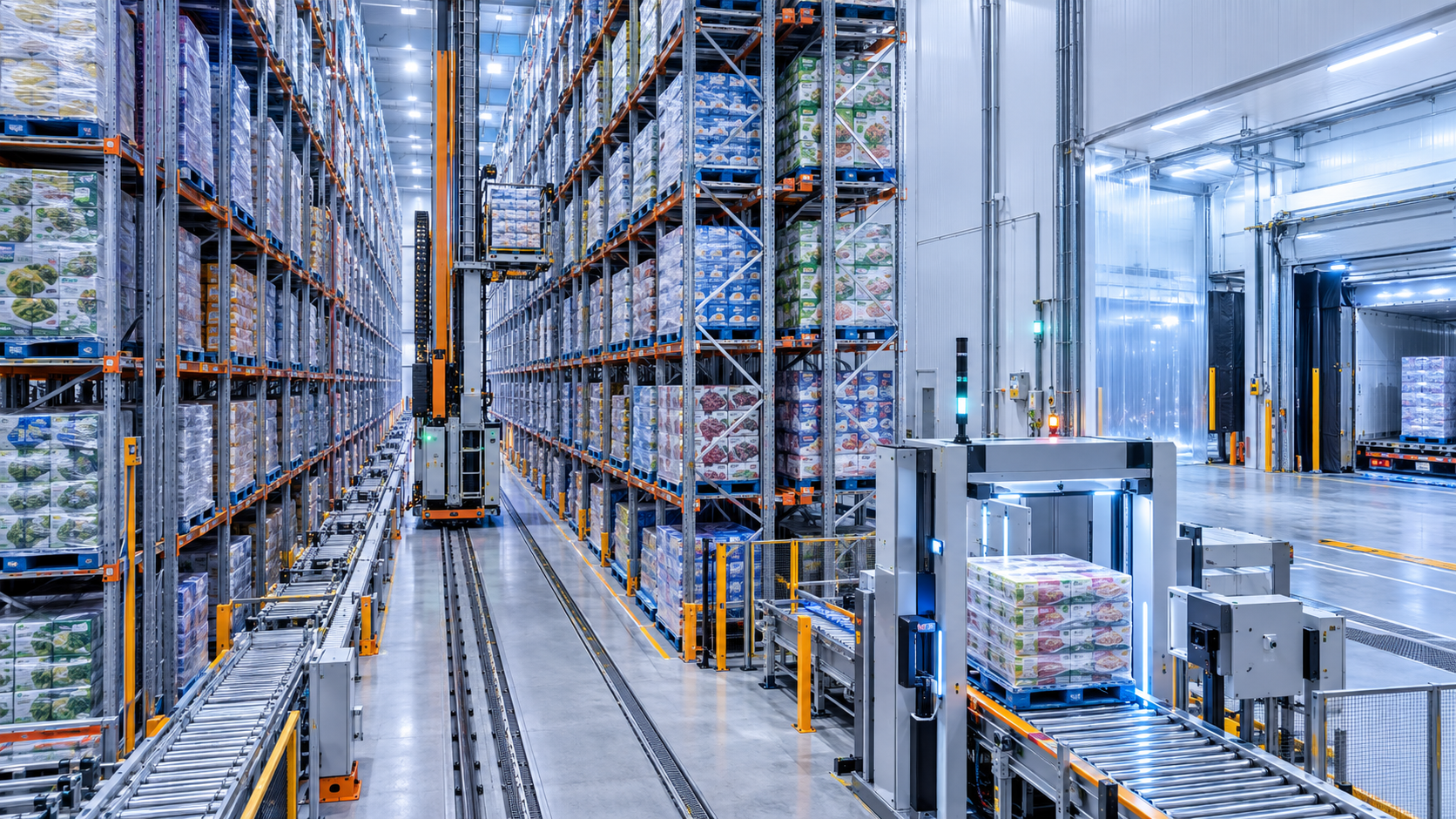
$200 million for frozen food logistics: What NewCold's expansion in Melbourne is changing – 80,000 additional "cold" pallet spaces – Creative image on the topic, created with AI: Xpert.Digital
40 meters high and fully automated: NewCold's new deep-freeze warehouse put to the economic test
More than just cold storage: Why NewCold's expansion is changing food logistics
80,000 additional pallet spaces: How NewCold is expanding its frozen food capacity
NewCold has expanded its automated deep-freeze warehouse in Truganina, near Melbourne, by 80,000 pallet spaces. The 200 million Australian dollar investment increases the site's capacity to 180,000 pallet spaces – making the project more than just a major construction undertaking. It demonstrates the growing importance of combining storage, automation, energy efficiency, and digital inventory management for the food industry. However, additional capacity alone does not guarantee economic success: reliable customer volumes, a secure power supply, and uninterrupted operation are crucial. The expansion thus highlights both the opportunities of modern frozen food logistics and the demands and risks associated with significant investments in this infrastructure.
NewCold's expansion in Melbourne shows why frozen food logistics is becoming a competitive advantage
NewCold's expansion in Truganina near Melbourne demonstrates how frozen food logistics is evolving from a downstream service to a strategic prerequisite for industrial food production. Crucially, it's not just the additional storage capacity, but the combination of automation, energy efficiency, digital inventory management, and reliably available supply chains.
The project's economic significance therefore lies less in its spectacular building height than in a fundamental shift in competitive conditions. Food manufacturers increasingly require logistics systems that can scale with their production, ensure quality, and manage fluctuating demand. At the same time, logistics companies must utilize substantial investments over extended periods and protect themselves against electricity price risks, technical malfunctions, and changes in consumer behavior. NewCold thus provides a vivid example of the opportunities offered by this business model, but also of its demanding requirements.
An industrial-scale investment
On September 16, 2026, NewCold inaugurated the completed expansion of its automated deep-freeze warehouse in Truganina, Victoria, Australia. The investment totaled 200 million Australian dollars. The correct currency is crucial for economic reasons: Australian dollars and US dollars are not interchangeable, and any confusion would significantly distort the international classification of the project. The expansion creates 80,000 additional pallet spaces, increasing the warehouse's capacity to 180,000 pallet positions. This represents an 80 percent increase compared to the previous 100,000 positions.
The new deep-freeze area covers 10,453 square meters of floor space, reaches a height of 40 meters, and operates at minus 23 degrees Celsius. This places it in a size class of automated high-bay warehouses that are of particular importance internationally in frozen food logistics. However, a precise global ranking cannot be derived from this alone, as warehouses are compared according to various criteria: pallet spaces, building volume, floor space, or throughput.
Together, NewCold's two facilities in Truganina offer 405,000 pallet spaces. This figure includes frozen, chilled, and unchilled storage areas and should therefore not be interpreted as pure frozen storage capacity. This combination is particularly strategically interesting. It makes it possible to meet diverse temperature requirements within a single, integrated logistics network and to serve multiple product groups from a single manufacturer.
Convenience changes value creation
The demand for frozen foods cannot be explained solely by a general desire for quick preparation. It stems from an economic relationship between money, time, planning, and food consumption. A prepared meal can be attractive to households if it saves time in the kitchen, makes portion sizes easier to calculate, and spoils less often than fresh produce bought at short notice. However, whether this translates into a sustained demand advantage depends on price, quality, and individual dietary habits.
Frozen foods therefore compete with home-cooked meals, chilled ready meals, restaurants, delivery services, and other forms of convenient eating. If prices for eating out rise sharply, ready-to-eat or easy-to-prepare products can become relatively more attractive. Conversely, if delivery services become cheaper or consumer preferences shift, this situation can change again. A larger market for convenient eating thus does not automatically guarantee equally strong growth for each individual frozen food category.
For logistics, this development is nevertheless structurally relevant. French fries, pizza, vegetables, ice cream, snacks, and complete meals all require reliable temperature control, but differ in terms of seasonality, storage duration, and order frequency. A high-performing service provider must economically reconcile these differences. Its competitive advantage arises not solely from handling as much merchandise as possible, but from coordinating diverse flows of goods with minimal friction.
Correctly interpreting market growth
A commonly used market projection estimates Australian domestic consumption of prepared and frozen packaged meals at 3.7 billion Australian dollars by 2030. This is based on 2.7 billion Australian dollars in 2018. This represents an increase of approximately 37 percent over twelve years. While this is a substantial long-term growth trajectory, it does not indicate an explosive expansion of the overall frozen food market within just a few years.
The distinction is important. The category under consideration does not exclusively include frozen products, but also other prepared meals. Conversely, it does not represent all food items stored in a freezer warehouse. Ice cream or individual frozen ingredients cannot simply be equated with a market for complete prepared meals. Therefore, the $3.7 billion figure is neither the revenue pool of the Australian frozen food logistics sector nor the total demand base of the Truganina site.
Furthermore, the time lag in the forecast must be considered. The underlying study dates back to 2019 and is based on assumptions about population and actual per capita spending. It provides a long-term perspective, not a current sales measurement for 2026. Inventory investment must also be assessed based on concrete customer volumes, contractual obligations, production plans, and regional trade flows. The market projection describes a plausible demand background; actual capacity utilization must be ensured at the company level.
Population creates demand, not full capacity
The demographic background supports the fundamental demand for food. At the end of March 2026, Australia had a population of approximately 27.9 million, 392,700 more than a year earlier. This corresponds to an annual growth rate of 1.4 percent. Victoria reached a population of around 7.15 million, growing by 1.6 percent. A larger population, all other things being equal, increases the required supply capacity and thus also fundamentally strengthens the need for storage and transport.
However, these figures do not provide a direct sales forecast for a single frozen food warehouse. Crucial factors also include purchasing power, age structure, household composition, and the actual demand for specific food products. The geographic location of population growth is also relevant. New demand may justify additional capacity at an existing facility, but it may also necessitate regional distribution solutions closer to consumers.
For investors, this results in a clear separation between structural demand and operational implementation. Population growth can make a long-term investment more plausible, but it does not replace competitive analysis or the review of specific customer contracts. An economically viable warehouse emerges where sufficient quantities, suitable transport connections, a reliable power supply, and competitive operating costs converge. Not every growing region meets these conditions to the same degree.
The level changes the cost structure
Vertical construction follows a sound economic logic: more storage capacity can be accommodated on a limited plot of land. This can reduce the space required per pallet space and improve the utilization of well-connected logistics locations. In the deep-freeze sector, there is an additional thermal advantage. A compact building design can reduce the heat-transferring building envelope relative to the usable storage volume. The specific geometry is crucial here, not the building height in isolation.
A tall warehouse still requires a considerable volume of refrigerated space. It would therefore be misleading to automatically assume a smaller footprint translates to a correspondingly smaller overall cold storage capacity. Economic advantages arise instead from the combination of high storage density, suitable insulation, limited air exchange, efficient refrigeration technology, and coordinated goods movements. Narrow, automated aisles can also help reduce the amount of unused space.
This is offset by higher demands on the supporting structure, conveyor technology, fire protection, maintenance access, and control systems. Vertical compaction replaces simple floor space with more technically sophisticated infrastructure. It is therefore particularly attractive when large and sufficiently standardized quantities of goods are moved over long periods. For highly variable special formats, small quantities, or business models with uncertain lifecycles, a more flexible, less capital-intensive solution may be economically superior.
Efficiency promises need reliable limits
NewCold estimates the potential energy consumption advantage of its construction method compared to conventional cold storage facilities at around 50 percent. This figure is economically significant but must be considered a company-provided comparative data point. Without disclosed measurement series, comparable facilities, and standardized operating conditions, it is impossible to derive independently verified savings for every facility or operating condition. Furthermore, a reduction in energy consumption does not automatically equate to a corresponding reduction in all operating costs.
A meaningful comparison must consider several factors: storage temperature, ambient temperature, insulation standard, capacity utilization, number of goods movements, and the condition of the stored products. Simply maintaining already frozen goods at temperature presents different challenges than additional cooling processes. Similarly, a warehouse with frequently opened transfer areas differs from a system with well-coordinated airlocks and consistent goods flows.
For operational evaluation, key performance indicators such as electricity consumption per occupied pallet space and time period, as well as per pallet handled, are therefore more meaningful than an isolated total consumption. In addition, absolute electricity quantities must be considered. A growing site can operate significantly more efficiently per pallet and yet still require more energy overall. The economic strength of automation then lies in the improved performance per resource used, not necessarily in a decrease in overall energy consumption.
Sub-zero temperatures are a product decision
The operating temperature of minus 23 degrees Celsius illustrates that deep-freeze logistics requires continuous technical performance. The cold is not produced once and then stored free of charge. Heat enters the system through the building envelope, air exchange, and via incoming and outgoing goods as well as technical processes. Refrigeration systems must continuously dissipate this heat load. Therefore, good process design directly impacts energy costs.
At the same time, the correct temperature is not solely a matter of cost. It must correspond to the properties of the stored products and the respective quality requirements. Ice cream can react differently to temperature fluctuations than other frozen foods. A blanket increase in the storage temperature would therefore be just as inappropriate as an unnecessarily low setting without product-specific justification. The goal is reliable quality with the lowest possible resource consumption.
Food law also distinguishes between general safety requirements and specific manufacturer specifications. Australian regulations stipulate that certain frozen foods must remain frozen during storage and transport. This does not automatically result in a uniform legal target temperature of minus 23 degrees Celsius for every product. Product specifications, labeling, and agreed quality standards also play a role in practical application. Precise temperature control is therefore both a technical challenge and an integral part of the performance promise to customers.
Capital replaces manual labor, not responsibility
Automated cold storage facilities shift the cost structure from repetitive manual labor to higher initial investments and specialized technical and digital services. Storage and retrieval machines, shuttles, and conveyor systems handle standardized movements, while employees are more involved in monitoring, maintenance, troubleshooting, and process control. This is particularly relevant in a work environment characterized by extreme cold and stringent product protection requirements.
A lower number of manual interventions does not mean, however, that the plant can operate without skilled personnel. The required skills are changing. Electrical engineering, mechatronics, refrigeration system operation, software integration, and data quality are becoming increasingly important. The initial planning for the Melbourne expansion included 65 additional jobs. This figure reflects a previous plan and should not be confused with the confirmed current number of employees.
Economically, the overall process performance is the deciding factor. Avoiding damage, incorrect loading, and search times generates benefits beyond mere labor cost savings. At the same time, maintenance contracts, spare parts inventory, and the availability of qualified technicians can create new bottlenecks. Automation, therefore, does not eliminate operational risk but rather changes its form. An efficient operator must master this altered risk structure as well as the material handling technology itself.
The pallet becomes a data carrier
At Truganina's warehouse, every incoming pallet is digitally recorded, scanned, and assigned to a destination. Automated systems then transport the goods through the high-bay warehouse. This creates a close link between physical movement and digital inventory tracking. The warehouse management system not only knows the quantity available but also assigns it to specific storage locations and processing steps.
The economic value of this connection lies in more reliable decision-making. Inventory that exists on paper but is untraceable, blocked, or incorrectly assigned cannot reliably fulfill a customer order. Conversely, inaccurate inventory levels can trigger unnecessary safety stocks. More precise inventory management can therefore help limit tied-up capital and shortages. However, whether and to what extent such effects actually occur also depends on the manufacturers' data and the interfaces to their systems.
For food products, batch numbers, expiration dates, and temperature information are also crucial. A suitable digital infrastructure can support traceability and targeted stockpiling. However, full automation alone does not guarantee these capabilities. Consistent data models, clear responsibilities, and reliable data capture are essential. Information quality thus becomes a production factor in logistics, not merely an administrative add-on.
Your intralogistics experts

Consulting, planning and implementation of complete solutions for high-bay warehouses and automated storage systems - Image: Xpert.Digital
More information here:
Innovative cooling strategies in the food industry
The time advantage arises at night
A particularly interesting aspect of the operation is the predictive reorganization of pallets. At night, the system uses order data and forecasting methods to rearrange goods so that inventory needed early the following day is more conveniently positioned for picking. The site has 21 loading docks. The software thus not only processes current orders but also prepares for future workloads.
This approach can alleviate peak loads. By preparing foreseeable shipments during quieter hours, fewer additional movements are required during peak shipping times. This allows for better utilization of available technical capacity. For manufacturers, this time saving is particularly valuable when tight pickup windows must be met and delays would result in additional transport costs or delivery problems.
However, stock transfers are not free. Every movement requires energy, demands technology, and must generate a predictable benefit. If forecasts are inaccurate or customers change their orders at short notice, preparatory movements can lose their value. Good management therefore optimizes not the number of transfers, but the ratio between preparatory effort and subsequent relief. Predictive analytics is a concrete tool for capacity management; it is not proof that every decision is based on particularly advanced artificial intelligence.
Entry control protects the entire system
Before a pallet enters the automated warehouse, the system checks, among other things, its weight, height, and compliance with permissible dimensions. Overhanging loads or other deviations can lead to rejection. What at first glance seems like a technical detail has significant economic implications. A faulty load unit can cause damage, block conveyor lines, and delay subsequent orders.
Incoming goods inspection shifts the need for error correction to a point where it is more manageable. Instead of discovering an unsuitable pallet deep within the high-bay warehouse, the discrepancy becomes visible before automated storage. The benefit thus extends beyond the individual product to the stability of the entire flow of goods. In tightly coupled technical processes, a small error can otherwise have a disproportionately large impact.
This simultaneously creates a requirement for the upstream supply chain. Manufacturers and transport partners must align pallet quality, packaging, and load securing with the permissible standards. Warehouse efficiency thus begins as early as the customer's production line. Those who consider automation solely within their own building walls underestimate the importance of these interfaces. Standardization can reduce costs, but it requires binding cooperation.
Large customers secure volumes and negotiating power
Key users of the site include McCain, Peters Ice Cream, and Patties. McCain is now NewCold's largest customer worldwide; the global business relationship originated in Australia. NewCold has been active there since 2017 and is led by founder and CEO Bram Hage. This development demonstrates how a regional collaboration can evolve into an internationally transferable logistics partnership. For a capital-intensive operator, such relationships are particularly valuable because they facilitate planning and scaling.
Large food manufacturers, in turn, benefit from not having to develop and operate all their own storage capacity. They can utilize specialized infrastructure and focus their own organization more on production, brands, and sales. However, this economic advantage only materializes if performance, price, and long-term availability are satisfactory. Outsourcing shifts responsibility and capital requirements, but does not eliminate them entirely.
The downside is a potential concentration on a few large clients. A significant customer stabilizes volumes but can also gain negotiating power. Changes in their production sites or sales plans impact logistics. Sufficient information regarding specific contract durations, minimum order quantities, or price adjustment rules of the companies involved is lacking for a reliable assessment. Therefore, while the quality of the customer base can be determined, the actual contractual safeguarding of project revenue remains unclear.
National distribution requires regional precision
For Peters Ice Cream, managed by Emma-Jane Collins, NewCold's Melbourne base serves as a national distribution point. This increases the strategic importance of the location beyond supplying the immediate metropolitan area. A nationally oriented center consolidates inventory and can improve the overview of available quantities. At the same time, the demands on the connection between warehousing, long-distance transport, and regional delivery increase.
In a vast country, the efficiency of supply cannot be achieved solely through high-bay warehouses. Crucial factors include appropriate departure times, reliable transport capacities, and suitable transfer points. A product that is quickly dispatched offers little economic benefit if it then has to wait for a vehicle or cannot be delivered regionally on time. The overall network's performance is limited by its weakest links.
NewCold's expansion of its Australian transport operations through the acquisition of Karras fits this logic. Combining warehousing and refrigerated transport can reduce coordination problems and consolidate responsibility for interfaces. However, it also introduces additional risks to the business model, such as vehicle utilization, staff availability, and the costs of long-distance transport. Integration, therefore, does not automatically create greater efficiency; it initially creates the opportunity to jointly optimize the flow of goods across more process stages.
A full memory is not enough
The most publicly visible metric for a large warehouse is usually the number of pallet spaces. However, for economic efficiency, at least two dimensions must be distinguished: occupancy and throughput. A warehouse can be highly utilized but move little goods. It can also have a high turnover rate without being permanently fully occupied. Which combination is attractive depends on the revenue structure and the technical effort required for the respective services.
Slow-moving inventory creates occupancy but ties up capital at the customer's site and can indicate weak sales. Fast-moving goods increase the number of movements but put a strain on conveyor technology, transfer areas, and shipping. Therefore, an operator must market storage space and processing capacity together. Additional storage spaces only help to a limited extent if, during peak periods, retrieval or loading at the docks becomes a bottleneck.
Industry trends show that structurally important infrastructure is not automatically protected from weak demand. Lineage achieved virtually unchanged revenue of approximately US$5.36 billion in 2025, while adjusted operating profit before interest, taxes, depreciation, and amortization (EBITDA) declined by 2.3 percent. The economic occupancy rate across the portfolio was 81 percent. These figures are not a forecast for NewCold, but they illustrate that market size, occupancy rates, and earnings performance can diverge.
Debt service never slows down
Dividing the investment of 200 million Australian dollars by 80,000 additional pallet spaces yields a cost of 2,500 Australian dollars per new pallet space. This ratio provides an indication of the capital intensity. However, it is neither a general market price for warehouse technology nor a complete indicator of profitability. The investment amount may include various building, technology, and integration components.
Crucial information is missing for a return on investment calculation: financing, depreciation structure, operating costs, contractual revenues, and capacity utilization trends. Without these factors, a concrete amortization period would be speculative. A more technically sound approach is to consider the economic mechanics. The greater the proportion of long-term tied-up costs, the more the unit costs depend on how reliably the planned quantities are achieved.
Expanding an existing site can offer advantages over building a completely new one because customer relationships and parts of the infrastructure are already in place. At the same time, new technology must be integrated into ongoing processes. Delayed commissioning, start-up problems, or poorly coordinated interfaces can postpone the expected benefits. Therefore, capital-intensive logistics projects should not only be evaluated under stable, regular operation, but also during the start-up phase and under periods of lower demand.
Power supply becomes a question of location
Energy efficiency reduces electricity consumption per unit of output, but it doesn't replace a properly sized grid connection. A large cold storage facility requires a reliable electrical supply for refrigeration systems, conveyor technology, and control systems. This makes electricity availability a fundamental site selection requirement. Land price and transport connections are insufficient investment criteria if connection capacity, security of supply, or long-term energy costs are inadequate.
Photovoltaics, storage, suitable power purchase agreements, and intelligent control systems can improve the cost structure. A distinction must be made between general technical potential and the actual equipment already in place. The high degree of automation at a site does not automatically mean that every one of these solutions is installed. Likewise, on-site power generation does not automatically guarantee complete grid independence. Economic viability and security of supply must be assessed for the specific load profile.
Another approach is to adjust the timing of refrigeration operation. The thermal inertia of stored goods can, under suitable conditions, help to shift electricity consumption. However, product specifications and permissible temperature fluctuations impose limits. Particularly sensitive goods should not be treated as an arbitrarily available energy reserve. The economic value of flexible refrigeration arises where energy costs can be reduced without compromising product quality and technical stability.
Climate protection requires more than thrift
NewCold is linking its expansion to a long-term decarbonization goal. The overarching target extends to 2040. In its more detailed target architecture, the company distinguishes between operational CO₂ neutrality for direct emissions and purchased energy by 2035, and a net-zero target for all other emissions in the value chain by 2040. Crucially, these are future goals, not a state already achieved.
A reliable climate assessment must consider several factors. These include electricity supply, potential refrigerant losses, transportation, and emissions from construction and technical equipment. Low electricity consumption per pallet is an important step forward, but it is not sufficient on its own to claim a climate-neutral supply chain. A distinction must also be made between actual emission reductions and the accounting treatment of remaining emissions.
At the same time, functioning refrigeration can reduce food waste and thus protect resources already in use. International studies estimate the loss caused by a lack of effective refrigeration in 2017 at around 526 million tons of food. This global figure doesn't describe the benefit of the individual project in Melbourne. However, it illustrates why cold chains can be both an energy problem and part of a solution. The relevant question is not whether refrigeration consumes energy, but rather what the overall effect of a well-designed system is.
Centralization also increases the potential for damage
Consolidating large volumes of goods creates economies of scale, but can also amplify the consequences of a disruption. If a major hub is out of service for an extended period, potentially multiple manufacturers, distribution channels, and regions are affected. Therefore, high efficiency during normal operations is not synonymous with high resilience. Both must be planned for together. Reserve capacities and alternative transport routes may seem expensive in daily operations, but can be of considerable economic value in the event of a disruption.
The distinction between technical and geographical failover protection is particularly important. Multiple conveyor lines within a building can mitigate individual disruptions. However, in the event of a widespread power outage, the closure of a site, or a severe external event, only alternative locations and appropriate emergency plans may be effective. The available project data does not allow for a comprehensive assessment of the specific safeguards in place at Truganina.
It must also be clarified which functions take priority in the event of a disruption. Temperature control, inventory information, and delivery capability are interconnected but not identical. A system can continue to safely refrigerate goods while temporarily ceasing to process orders. A realistic cost-benefit analysis therefore considers not only potential product damage but also supply interruptions, restart times, and the costs of alternative supply options.
Digital power creates new dependencies
The more closely software and physical goods flow are coupled, the more crucial the availability of digital systems becomes for operations. A disruption in warehouse management or plant control can directly impact storage and shipping. While the ability to precisely track a pallet's position is an advantage, the fact that it is virtually inaccessible without functioning controls is the corresponding dependency.
For such systems, separate security zones for office IT and operational technology, controlled remote access, tested data backups, and robust restart procedures are therefore important design principles. This does not imply any statement about which specific measures NewCold has implemented. It describes the requirements against which a highly automated operator must be measured. For a 40-meter-high system, a completely manual backup process cannot simply be assumed.
Furthermore, there is the long-term commitment to technical platforms. Proprietary software and standardized automation can create differentiation, but may also complicate the switching of components or service providers. Therefore, not only the acquisition costs are economically relevant, but also maintainability, interfaces, data access, and the ability to modernize. A warehouse building can remain usable for a long time, while individual digital and electrotechnical components will need to be replaced much sooner.
Technology transfer requires local adaptation
NewCold's development in Australia demonstrates how a specialized logistics concept can be transferred internationally. The combination of high-bay racking, automated movement, and proprietary software can serve as a recurring technical foundation. Systematic evaluation of experience from multiple projects allows for improvements in planning, commissioning, and ongoing operation. The competitive advantage then lies not solely in a single system, but in the accumulated knowledge gained across many systems.
However, such transferability does not mean that the same design will work equally well economically everywhere. Electricity prices, land costs, building regulations, labor markets, and customer volume structures all differ. Transport distances and regional consumption centers also affect the optimal warehouse architecture. Therefore, an internationally standardized system requires local adaptation, rather than simply replacing site selection with technical enthusiasm.
For multinational food manufacturers, a globally experienced partner can still be attractive. Comparable processes and interfaces generally facilitate collaboration across national borders. At the same time, the choice of supplier becomes more important when the same partnership covers multiple regions. The customer gains coordination but may also develop additional dependencies. This model is economically compelling where standardization and scalability outweigh the risks of concentration and switching suppliers.
The competition is becoming more demanding
This expansion increases the pressure on other frozen food logistics providers to define their performance not solely by available storage space. Customers can increasingly expect energy efficiency, inventory accuracy, reliable delivery windows, and digital connectivity. This shifts the competitive landscape from simply providing cold storage space to the quality of an integrated operating system. For providers with older facilities, this could lead to a growing need for modernization.
However, this does not imply a general obligation to build huge, fully automated centers. Smaller and regional companies can remain competitive where they offer proximity to customers, flexible special services, or the cost-effective processing of heterogeneous quantities. Existing facilities can also be improved through better insulation, modernized refrigeration technology, targeted automation, and more precise control. The economically sound investment depends on the specific performance profile.
The justified perspective on Truganina is therefore neither one of unbridled enthusiasm for the technology nor of skepticism regarding its size. The expansion speaks to a high-performance model, provided that sufficiently secured quantities, reliable technology, and controlled energy costs come together. Its measure of success is not the height of the building, but the consistently available capacity of the entire cold chain. Whoever organizes this capacity efficiently, verifiably, and reliably creates a competitive advantage that additional pallet spaces alone cannot provide.
Your global marketing and business development partner
☑️ Our business language is English or German
☑️ NEW: Correspondence in your native language!

Konrad Wolfenstein
I and my team are happy to be available to you as your personal advisor.
You can contact me by filling out the contact form here wolfenstein@xpert.digital:or simply call me at +49 7348 4088 965. My email address is
I'm looking forward to our joint project.