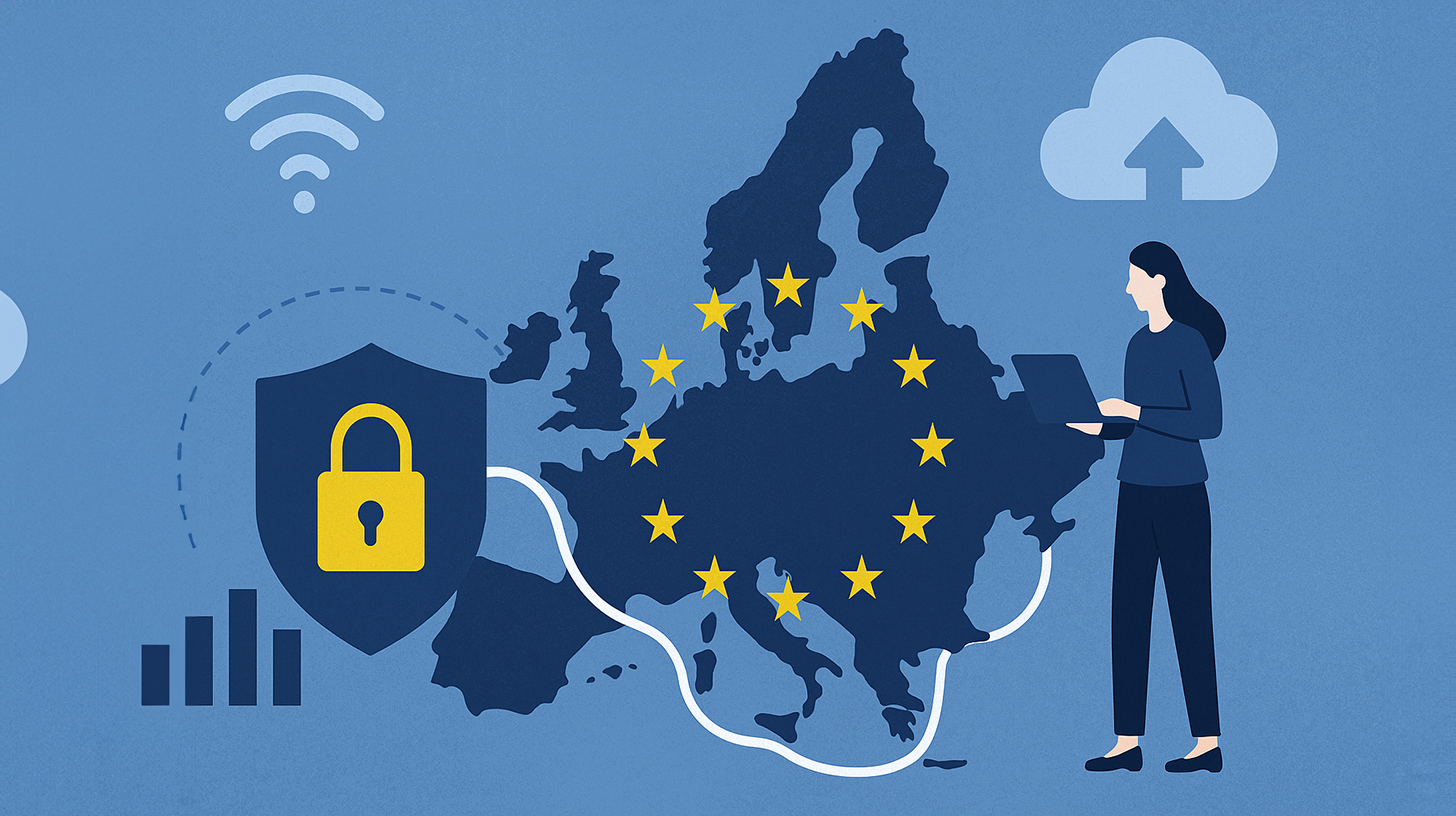
Cloud Hyperscalers: Analysis of the criticism from SAP CEO Christian Klein and the European innovation potential – Image: Xpert.Digital
Europe's digital independence: Why Christian Klein's skepticism about data centers falls short
European cloud sovereignty: Klein's provocative hyperscaler criticism and the reality of the EU digital strategy
SAP CEO Christian Klein's provocative statement about European data center ambitions has sparked an important debate about Europe's digital sovereignty. His assessment that "many new data centers with EU funding in Europe will not create a counterweight to the US hyperscalers" deserves closer examination. While Klein's criticism of uncoordinated infrastructure investments is justified, it overlooks the specific strengths and innovative approaches with which Europe is developing genuinely competitive alternatives. The European cloud strategy is not primarily based on trying to replicate the sheer size of American hyperscalers, but rather on sustainable, data protection-compliant, and interoperable solutions, driven by initiatives such as Gaia-X, specialized high-performance computing projects, and innovative business models from European providers.
Related to this:


Klein's critique in the context of European realities
Christian Klein's stark warning against European data center projects reflects very real challenges. His statement that "the competitiveness of the European automotive or chemical industries will not be achieved by building 20 different data centers in France" makes an important point regarding the efficiency of resource allocation. Klein argues that Europe should leverage its strengths in the application of AI and intelligent software, rather than becoming embroiled in costly infrastructure battles.
Energy costs do indeed pose a significant challenge. According to the European Commission, the energy consumption of data centers in the European Union already amounted to 76.8 TWh in 2018 and is expected to increase by 28% to 98.5 TWh by 2030. These figures underscore Klein's argument about the cost disadvantages of European locations. SAP itself remains "completely infrastructure-agnostic" and offers various security levels without engaging in hardware battles.
Nevertheless, Klein's own corporate strategy reveals the ambivalence of his position. Despite his public criticism, SAP, together with Deutsche Telekom, IONOS, the Schwarz Group, and Siemens, is planning a joint application to the EU for "huge data centers for AI applications." This apparent contradiction suggests that Klein, too, recognizes the necessity of strategic European infrastructure investments, provided they are coordinated and appropriate.
Related to this:

European differentiation strategies and competitive advantages
Europe is deliberately pursuing a different strategy than the American hyperscalers, one that focuses on differentiation through regulation, sustainability, and data sovereignty. The Gaia-X initiative perfectly exemplifies this approach. Contrary to widespread misconceptions, Gaia-X is "not a European cloud in the sense of a monolithic hyperscaler, but a framework that establishes a unified architecture for infrastructure, standards, and rules.".
The Gaia-X concept aims to avoid vendor lock-in and create a "competitive, fair, and trustworthy data economy." This approach creates added value by "reducing dependencies" and enables companies to "break free from vendor lock-in and transfer their data between competing providers." The initiative relies on "decentralized infrastructure instead of platform monopolies," thus representing an alternative to American platform capitalism.
European cloud providers like OVHcloud and IONOS have already proven that alternative business models can work. OVHcloud advertises "fair, transparent, and predictable prices with no fees for inbound and outbound data transfers" and promises "no compromises" on technology and value for money. The company manufactures its own servers and operates over 30 of its own data centers worldwide, enabling complete control over the value chain.
The Sovereign European Cloud API (SECA), initiated by Aruba, IONOS, and Dynamo, demonstrates further innovative strength. This "open cloud industry standard API specification" promotes "digital sovereignty and independence for European companies" through improved "interoperability, scalability, and security." SECA enables companies to "seamlessly deploy workloads and applications across various cloud environments of their choice" while maintaining "the highest levels of security, control, and data sovereignty.".
Technological sovereignty through high-performance computing
While Klein warns against excessive data center ambitions, Europe's success in high-performance computing demonstrates the potential of coordinated technology investments. The JUPITER supercomputer at the Jülich Research Centre is an impressive example of European innovation. Ranked as the "fastest supercomputer in Europe," JUPITER is fourth on the global TOP500 list and is also "the most energy-efficient system among the top five.".
JUPITER's significance extends far beyond its technical specifications. With its "enormous computing capacity, JUPITER opens up new possibilities in diverse fields of application," from climate simulation to the development of sustainable energy systems. The system can "train the largest AI models (Large Language Models) – at full capacity, JUPITER needs less than a week for this.".
The EuroHPC Joint Undertaking demonstrates how strategic European cooperation can work. This initiative "pools the resources of the European Union, 32 European countries, and three private partners with the goal of making Europe a world leader in supercomputing." With an increased budget of €8 billion, EuroHPC has already "acquired five peta-sized supercomputers capable of performing at least 10^15 calculations per second.".
Sustainability as a strategic competitive advantage
One area where Europe has developed clear advantages over American hyperscalers is sustainability. With its delegated regulation on the Energy Efficiency Directive, the EU Commission has created "efficiency standards for data centers," establishing a common EU assessment system. This system is intended to incentivize operators to increase energy efficiency and contribute to promoting the use of renewable energy, waste heat recovery, and grid efficiency.
The new Energy Efficiency Act (EnEfG) obliges data center operators to "cover 100 percent of their electricity consumption with renewable energy sources from 2027 onwards." These regulatory requirements not only create environmental benefits but also competitive advantages for European providers who invested early in sustainable technologies.
Scientists from the Öko-Institut and the Fraunhofer IZM have developed, for the first time, a holistic methodology that captures the environmental footprint of cloud services across their entire life cycle. This transparency allows European providers to differentiate themselves through demonstrably lower environmental impacts. The studies already show a wide range of CO2 emissions from different providers, creating opportunities for competitive advantages through efficiency.
Regulation as a driver of innovation and market differentiation
Klein's criticism of European regulation overlooks its innovation-promoting effect. The GDPR and other European data protection laws have not only strengthened the protection of personal data but have also fostered new business models and technologies. European cloud providers can differentiate themselves through "genuine data sovereignty," which can be "demonstrated.".
The US Cloud Act poses a structural problem for American providers, as "US authorities can use the Cloud Act, via agencies like the NSA, CIA, or FBI, to order access to data outside the US." This legal uncertainty creates market opportunities for European providers who can offer "maximum protection against such regulations.".
As a "Day-1 Member" of Gaia-X, IONOS brings years of experience in the demanding day-to-day operation of an IaaS cloud and offers "a foundation ideally suited to Gaia-X for sovereign cloud computing with the IONOS High Performance Cloud Stack." This positioning demonstrates how European companies can transform regulatory requirements into competitive advantages.
Related to this:
Specialization instead of hyperscale competition
Europe's strength lies not in direct competition with hyperscalers, but in specialization in specific application areas and customer requirements. Hyperscale data centers are "exceptionally large and powerful facilities" that "handle rapidly increasing demand for cloud computing services." Their features include "automated scaling up," "very large hybrid data centers," and "infinitely scalable user numbers.".
However, European providers can compete through "top performance, scalability, redundancy, energy efficiency, and state-of-the-art security measures" without having to match the size of American hyperscalers. OVHcloud demonstrates this with its promise to offer "double the VPS performance at even lower prices," while simultaneously providing "certainty in an uncertain world" through "fair, transparent, and predictable pricing.".
The success stories of European customers demonstrate the potential of specialized approaches. Leetify was able to save approximately 50% of costs with OVHcloud, while iATROS, as an AI-powered, certified health app, protects patient data in a highly secure and compliant public cloud environment.
Europe's path to digital sovereignty
Klein's criticism of uncoordinated European data center investments is justified, but his conclusion is too pessimistic. Europe is indeed developing competitive alternatives to American hyperscalers, not through direct competition on scale, but through strategic differentiation. The combination of regulatory advantages, sustainable technologies, data sovereignty, and innovative cooperation models like Gaia-X creates unique market opportunities.
JUPITER's success in high-performance computing demonstrates that Europe is indeed capable of achieving global technological leadership when resources are coordinated and strategically deployed. The European cloud strategy should therefore not be considered a failure, but rather a deliberate alternative to American business models, one that prioritizes transparency, sustainability, and data privacy.
Klein's own plans for shared AI data centers ultimately demonstrate that even skeptical voices recognize the need for European infrastructure investment. The key lies in intelligent coordination and specialization, not in relinquishing digital sovereignty. Europe certainly has the potential to hold its own as an innovative competitor in the global cloud market – if it consistently leverages its specific strengths.
Related to this:
Your AI transformation, AI integration and AI platform industry expert
☑️ Our business language is English or German
☑️ NEW: Correspondence in your native language!

Konrad Wolfenstein
I and my team are happy to be available to you as your personal advisor.
You can contact me by filling out the contact form here wolfenstein@xpert.digital:or simply call me at +49 7348 4088 965. My email address is
I'm looking forward to our joint project.