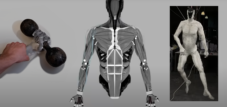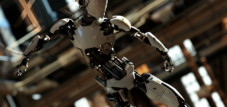
Robotics | Why metal and motors could soon be obsolete – or why Clone Alpha will fail in the face of reality – Original image: Clone Robotics / Creative image: Xpert.Digital
Forget electric motors: Why the future of robotics could consist of water and plastic
Metal as a safety risk: Why Clone Alpha's "soft" construction is key for home care
While the world stares intently at Elon Musk's Tesla Optimus and Figure AI's massive multi-billion-dollar investments in humanoid robots, a quiet but radical revolution is brewing in the shadow of the tech giants. The industrial consensus until now seemed set in stone: the future of work belongs to precise, electromechanical androids made of metal, powered by high-performance motors and complex transmissions.
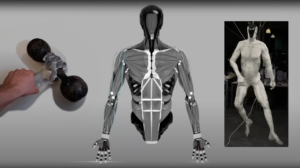
But the startup Clone Robotics is daring to rebel against this dogma with its "Clone Alpha." They are presenting not just a technical variation, but a philosophical counter-proposal: a robot that is not constructed like a machine, but seems to have grown like a biological being – powered by hydrostatics, synthetic muscles, and a structural flexibility that metal can never simulate.
Is this the crucial "missing link" that will finally make robots safe and cost-effective enough for our living rooms? Or is it a romantic technological pipe dream that will crash and burn against the harsh economic realities of maintenance costs, energy efficiency, and watertightness? The following analysis dissects the economic and physical front lines of this new conflict between "hard" and "soft" robotics.
Related to this:

Biomimetic disruption: A paradigm shift in automation economics
The introduction of Clone Alpha by Clone Robotics marks far more than just another iteration in the overheated humanoid robotics market. Economically speaking, we are on the cusp of a fundamental divergence in the capital goods industry: the separation of "soft" robotics from traditional "rigid" robotics. While the market-leading consensus—led by companies like Tesla with Optimus or Figure AI—focuses on scaling electromechanical actuators, Clone Robotics is betting on a biomimetic architecture based on hydrostatics and synthetic tissues.
This distinction is not merely a technical nuance, but a fundamental economic decision. The automation economy to date has been based on precision, repeatability, and speed – attributes that rigid metal robots perfectly fulfill. However, the marginal utility of this technology drops rapidly as soon as these machines leave the structured environment of the factory floor and enter the unstructured, chaotic world of human interaction. Here, rigid precision transforms from an asset into a liability. A metal robot in care settings or households poses a potential safety risk, the mitigation of which requires expensive sensors and reduced speeds.
Clone Alpha attempts to solve this economic dilemma through material substitution. Instead of investing billions in algorithmically compensating for mechanical rigidity (as Tesla does), Clone eliminates rigidity at its source. If claims are true that Clone Alpha can achieve 100 times greater durability on hands than comparable rigid grippers, then the cost curve for maintenance and depreciation shifts dramatically. We are witnessing an attempt to shift complexity from software (AI motion planning) to hardware (fluid dynamics). Should this approach prove scalable, it would significantly lower the barriers to entry into the domestic sector, as the "cost of safety"—the implicit insurance costs and risk reserves associated with the use of robots on humans—would plummet.
Hydrostatics instead of electromagnetism: A cost-benefit analysis of the drive architecture
The core of Clone Robotics' economic gamble lies in its shift away from electric motors towards "myofiber" technology and hydraulic systems. To understand the implications of this decision, one must consider efficiency economics. Electromechanical actuators, as used in almost all competing products, currently operate with efficiencies of 75 to 80 percent, and sometimes even higher. They are "install and forget" components with minimal operating costs (OpEx).
In stark contrast is hydraulics. Historically, hydraulic systems have struggled with efficiencies of only 40 to 55 percent, and with poor maintenance, even as low as 20 percent. The energy loss due to heat generation and fluid friction is immense. For an autonomous, battery-powered humanoid, this is economically disastrous, as the battery's energy density directly dictates the usable operating time ("uptime") and thus the return on investment (ROI) per day. Clone Alpha uses a compact 500-watt pump, which is the equivalent of a human heartbeat. While this enables enormous power density—a 3-gram artificial muscle fiber strand can reportedly lift 1 kilogram—the system achieves this power at the cost of potentially higher operational energy costs per working hour.
However, there is a subtle economic lever that critics often overlook: the cost of complexity in power transmission. An electric motor requires complex, heavy, and expensive gearboxes (harmonic drives) to convert high speeds into usable torque. These gearboxes are often the most expensive wear parts of a robot. Clone Alpha's hydraulic system, based on low-cost valves ("Aquajets") that consume only 1 watt and are 12 mm in size, could drastically reduce the bill of materials (unit costs). If Clone succeeds in significantly reducing the production costs of such a system below those of an electromechanical drivetrain, the initial cost advantage (CapEx) could offset the disadvantages in energy efficiency (OpEx)—at least in markets where robots are frequently plugged in anyway, such as in residential care or kitchens.
The substitution potential in the service economy: Beyond rigid manufacturing
The true economic innovation of Clone Alpha lies not in its torso, but in its hand. The market for dexterous manipulation is the holy grail of robotics. Forecasts indicate that the market for multifunctional robotic hands could explode from a nearly negligible $92 million in 2024 to over $5 billion in 2031, with a compound annual growth rate (CAGR) of around 75 percent. This is the fastest-growing subsector of the entire robotics industry.
Why is this the case? Because the hand is the main obstacle to replacing human labor in the service sector. A rigid metal hand cannot change a diaper, sort soft fruit, or wash a patient without relying on massive sensor technology and computing power to prevent injuries. Clone Alpha's hand has 26 degrees of freedom (DoF) and mimics human anatomy, including bones and ligaments. This enables passive compliance that is mechanically safe without the need for algorithmic intervention.
Economically, this means that Clone Alpha can tap into markets that remain closed to Tesla Optimus or Figure 01, or are extremely difficult to access. The market for care robots alone is estimated to reach over $9 billion by 2034. In an aging society where the shortage of caregivers is driving up labor costs, a robot that can provide physically safe, intimate care is practically priceless. Clone is positioning itself not as a competitor in logistics (carrying boxes), but as a monopolist in intimacy and fine motor skills. The value proposition here lies not in speed, but in market eligibility and acceptance by the end user. A robot that feels like a human lowers the psychological barrier to adoption, which could make the market penetration curve steeper and more profitable.
🎯🎯🎯 Benefit from Xpert.Digital's extensive, five-fold expertise in one comprehensive service package | BD, R&D, XR, PR & Digital Visibility Optimization


Benefit from Xpert.Digital's extensive, five-fold expertise in a comprehensive service package | R&D, XR, PR & Digital Visibility Optimization - Image: Xpert.Digital
Xpert.Digital possesses in-depth knowledge across various industries. This allows us to develop tailored strategies precisely aligned with the requirements and challenges of your specific market segment. By continuously analyzing market trends and monitoring industry developments, we can act proactively and offer innovative solutions. The combination of experience and expertise generates added value and provides our clients with a decisive competitive advantage.
More information here:
When plastic becomes the new steel: Clone Alpha, Tesla Optimus and the battle for the mass market of humanoid robots
Market positioning and competitive dynamics: David versus the silicon Goliaths
Looking at the capital resources reveals a massive asymmetry, which poses the greatest risk for Clone Robotics. While competitors like Figure AI are aiming for valuations of $39 billion and raising billions in venture capital, Clone Robotics operates with comparatively microscopic budgets (seed rounds ranging from under $1 million to a few million). In the hardware economy, capital is often synonymous with destiny. Scaling up production from prototypes to mass production is extremely capital-intensive (a "production hell").
Figure and Tesla use their financial power to dominate supply chains and drive down component prices through volume—a strategy borrowed from the automotive industry. Clone Robotics, on the other hand, pursues a strategy of radical simplification through biomimetics. By claiming their hands are "10x stronger and cheaper to manufacture," they attempt to neutralize the competition's capital advantage through technological superiority.
This suggests a classic niche strategy. It's unlikely that Clone Robotics will conquer Amazon's global logistics centers in the short term. Instead, the most probable economic scenario is either an acquisition by a medical technology giant seeking access to this intellectual property or establishment as a high-priced specialist provider for research and medical applications. The danger is that the "decacorns" (10-billion-dollar startups) will flood the market with "good enough" solutions. If an electromechanical hand can perform 90% of the tasks for 50% of the price, Clone's superior biomimetic hand will be relegated to the status of a luxury product. Clone needs to prove that the final 10% of human dexterity—which only they can offer—is essential to the market.
Technical debt and operational risks: The economics of reliability
An often overlooked aspect in the euphoria surrounding new technologies is the "technical debt" incurred during operation. Water-based hydraulic systems have a long-standing enemy: leaks. In an industrial setting, an oil stain is a nuisance; in a living room or a sterile hospital room, leaking water (or hydraulic fluid) is an absolute deal-breaker. The total cost of ownership (TCO) for hydraulic systems is traditionally higher than for electrical systems. Seals wear out, hoses become porous, and pumps fail.
For the end customer, this means that while a Tesla Optimus might only require maintenance every 5,000 hours, a Clone Alpha could need more frequent servicing due to material fatigue in its soft components and printing system. "Soft robotics" research shows that soft materials are often more susceptible to cracking and fatigue than rigid metals. If Clone Robotics hasn't addressed this material science challenge, its business model will fail due to after-sales costs. A robot requiring monthly maintenance will destroy its own ROI calculation, no matter how inexpensive it was to purchase.
Additionally, there's the issue of thermal management. Hydraulic systems generate heat that must be dissipated. In a humanoid body without active cooling fans (which would be loud and disruptive), this could limit performance. If the robot has to "pause" to cool down after 15 minutes of work, its economic productivity drops to almost zero. These operational risks are the Achilles' heel of biomimetic robotics.
Macroeconomic implications: commodity markets and labor shortages
Should Clone Robotics' biomimetic approach prove successful and scale in the long term, it would have fascinating macroeconomic consequences, particularly for commodity markets. The current generation of robots and electric vehicles is driving up demand for copper (for windings) and rare earth elements (neodymium for magnets) dramatically. A biomimetic robot like Clone Alpha, which relies primarily on polymers, plastics, and water, largely decouples from these volatile commodity markets. A shift towards "plastic robots" could alleviate geopolitical pressure on rare earth supply chains and reduce dependence on specific mining nations.
Furthermore, Clone Alpha addresses the most pressing macroeconomic problem facing the developed world: demographic change. The labor gap in caregiving and basic service is so vast that it can hardly be filled by human migration alone. The "biomimetic revolution" offers a solution that could be more politically and socially acceptable than rigid machines. Acceptance—and thus the speed of this technology's diffusion into the market—is a crucial economic factor. A robot that looks like a human from a biology textbook (muscles and bones) may initially seem unsettling ("uncanny valley"), but its movement is perceived as less threatening than the whirring of servo motors. If this "soft" automation leads to robots moving into private homes five years earlier than predicted, we're talking about an acceleration of global economic output in the trillions.
From niche market to every household: How Clone Alpha can become a robotics game-changer despite Tesla & Figure
From an economic perspective, Clone Alpha is a high-risk, high-reward gamble. Clone Robotics isn't trying to outplay Tesla or Figure in the existing robotics game; they're trying to change the game board. By focusing on hydrostatics and biomimetics, they avoid direct competition for motor efficiency and AI computing power, but open themselves up to greater energy efficiency and maintenance requirements.
In the short term, Clone Alpha will likely remain a niche product for research and highly specialized applications, given the overwhelming financial power of competitors and the maturity of electromechanical supply chains. In the long term, however, if materials science solves the problems of tightness and fatigue, biomimetic architecture could be the only one cost-effective enough to reach virtually every household. In a world where hardware must cost next to nothing, the ultimate winner might not be the most efficient metal, but rather the cheapest plastic that moves most intelligently.
Your global marketing and business development partner
☑️ Our business language is English or German
☑️ NEW: Correspondence in your native language!

Konrad Wolfenstein
I and my team are happy to be available to you as your personal advisor.
You can contact me by filling out the contact form here wolfenstein@xpert.digital:or simply call me at +49 7348 4088 965. My email address is
I'm looking forward to our joint project.