
World misses Paris climate target – Image: Ofenhesse|Shutterstock.com
Climate target missed: Grade 6
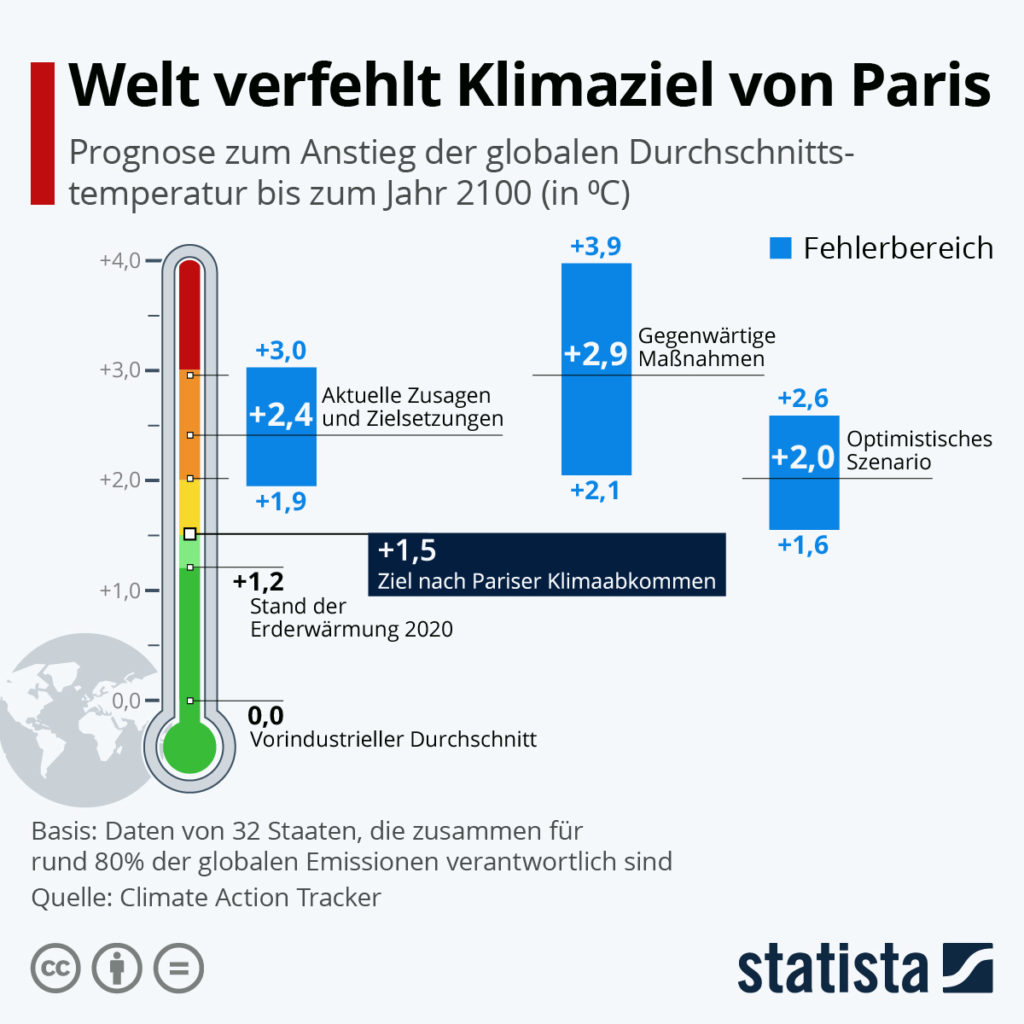
Current targets and pledges from governments worldwide to reduce greenhouse gas emissions are insufficient to limit global warming to 1.5 degrees Celsius. According to researchers, global warming would then reach 2.4 degrees Celsius by the end of the century compared to pre-industrial times. This is shown in the graphic based on the latest forecast from the Climate Action Tracker (CAT) analysis project. If the targets and pledges are not implemented and the status quo remains, the global average temperature would even reach +2.9 degrees Celsius in 2100. In an optimistic scenario with intensified climate protection efforts, global warming would still amount to two degrees.
High concentrations of greenhouse gases in the atmosphere restrict the escape of heat radiated from the Earth into space. As a result, temperatures on Earth rise. Global warming can be measured, among other things, by anomalies in global average continental temperatures. Temperature anomalies are deviations in temperature measured against calculated long-term temperature averages.
The forecast is based on data from 32 countries, which together are responsible for approximately 80% of global emissions. The Climate Analysis (CAT) is compiled by the New Climate Institute, Climate Analytics, and the Potsdam Institute for Climate Impact Research (PIK). The website was launched in November 2009. The CAT is funded by the European Climate Foundation. CAT findings are published in scientific journals, among other publications.
World misses Paris climate target
Current targets and promises by governments worldwide to reduce greenhouse gas emissions are not enough to limit global warming to 1.5 degrees Celsius. According to researchers, global warming at the end of the century would then be 2.4 degrees Celsius compared to pre-industrial times. This is shown in the graphic based on the current forecast of the Climate Action Tracker (CAT) analysis project. If the targets and pledges were not implemented and the status quo remained, the average global temperature in 2100 would even be +2.9 degrees Celsius. Under an optimistic scenario with increased climate change mitigation efforts, global warming would still be two degrees.
A high concentration of greenhouse gases in the atmosphere restricts the escape of heat radiated from the Earth into space. As a result, temperatures on Earth are rising. Global warming can be measured, among other things, by the anomalies of the global average continental temperatures. Temperature anomalies are deviations of the temperature, which are measured at calculated long-term average temperature values.
The forecast is based on data from 32 countries, which together are responsible for around 80% of global emissions. The CAT is produced by the New Climate Institute and Climate Analytics and the Potsdam Institute for Climate Impact Research (PIK). Launched in November 2009, the CAT is funded by the European Climate Foundation. The results of the CAT are published in scientific journals, among other publications.

World misses Paris climate target – Image: Statista
Keep in touch