
A classic, yet neglected: Building trust through visibility and awareness – Image: Xpert.Digital
Visibility before sales: The underappreciated foundation on which every B2B purchasing decision is truly based
Forget the "Rule of Seven": Why B2B customers need over 60 touchpoints today
The invisible revenue killer: Why a lack of brand awareness makes your sales costs explode
Trust is the hardest currency in modern business – yet it can neither be forced nor bought in the short term. In a business world driven by performance metrics and quarterly targets, many companies overlook their most powerful growth tool: systematic brand awareness. For decades, behavioral economics research has demonstrated an irrefutable causal chain – visibility generates awareness, awareness generates trust, and trust generates sales. Those who ignore this sequence and aim directly for a quick sale pay a high price in the form of exploding acquisition costs and declining conversion rates. This article deconstructs the myth of rapid performance marketing. Based on current research data, the psychological mere-exposure effect, and the latest developments in AI-driven visibility, we show why the much-maligned "brand building" is not a soft, luxury discipline, but rather the essential economic foundation upon which every future-proof purchasing decision rests.
Why most companies systematically neglect their most valuable growth tool – even though economic research has proven the opposite for decades
The underappreciated foundation of every purchasing decision
There is a fundamental insight in marketing so basic that it can be found in virtually every serious management consultancy, every business textbook, and every major university program—yet it is chronically underestimated in everyday business practice, especially in small and medium-sized enterprises (SMEs). This insight can be expressed in a single chain of cause and effect: visibility generates awareness, awareness generates trust, and trust generates sales. What sounds like a trivial formula is, in reality, a highly complex economic system that underpins the entire architecture of modern brand management.
Anyone who wants to survive in today's saturated digital competition cannot afford to ignore this chain of events. And yet, business reality shows the opposite every day: budgets are pumped into short-term performance campaigns, content strategies are abandoned after three months due to a lack of visible conversions, and brand building is considered internally a soft luxury to be indulged in only after a breakthrough. This flawed thinking not only costs companies revenue – it costs them their future.
Visibility is not an end in itself, but an economic lever
Before a more in-depth analysis can begin, a persistent conceptual misunderstanding in marketing discussions must be addressed: Visibility is often equated with reach or impressions – that is, with the mere number of people who have seen a brand somewhere. This falls far short. Business-relevant visibility means something different: the mental availability of a brand at the relevant decision-making moment for the potential customer.
The brand must be readily available when the need arises – not just when advertising is running. This mental availability is the result of repeated, consistent presence over an extended period. It cannot be bought in the short term or created with a single viral post. It is the result of strategic perseverance.
From an economic perspective, high mental visibility reduces the information costs in the purchasing decision process. In behavioral economics, the more familiar an option is, the lower the cognitive load of evaluating it. Familiar brands are preferred in the decision-making process because the brain interprets familiarity as a proxy for quality and reliability – long before rational product comparisons take place. This insight is not a marketing ideology, but well-documented behavioral psychology.
The Psychology of Repetition: Why the Brain Mistakens Familiarity for Trust
The scientific basis for this chain of effects is older than modern marketing. In 1968, social psychologist Robert Zajonc described an effect that has since been replicated in hundreds of studies and is known in the literature as the mere-exposure effect: The mere repetition of perceiving a stimulus leads to a more positive attitude towards that stimulus – completely independent of its objective properties.
This effect is more robust than one might expect. Studies show that it works even when test subjects cannot consciously recall having previously seen the brand. In a classic experiment, participants read an article while banner ads appeared at the edge of the screen. Afterward, the participants couldn't remember the banners—but they significantly more often preferred the advertised camera to an equivalent competitor's product. And the more frequently the banner had appeared, the stronger the preference. The brain had unconsciously stored familiarity and retrieved it as a positive evaluation.
For business practice, this means: Every presence counts. Not just the article clicked, not just the email opened, not just the form filled out. Even the fleeting impression of a LinkedIn post, the casual skimming of a guest article in a trade publication, the brief visit to a trade fair booth – all of this accumulates in the potential customer's memory and has an effect long before the first conscious purchase consideration arises.
The rule of seven contacts and its modern re-evaluation
The most popular distillation of these insights is the so-called Rule of Seven, attributed to marketing author Dr. Jeffrey Lant, which states that a potential customer must come into contact with a brand at least seven times within 18 months before they will remember it and develop trust. This rule should not be understood as a rigid law, but rather as a guideline – and today, in the age of digital information overload, it should be seen more as a minimum than a benchmark.
Current data shows how far reality has now extended beyond this classic rule of thumb. According to an analysis by the analytics provider Dreamdata from 2024, B2B customers require an average of 62.4 touchpoints before closing a deal. The platform HockeyStack analyzed data from 150 B2B SaaS companies and even arrived at an average of 266 touchpoints for a closed deal – for deals with a value exceeding $100,000, this number rises to as many as 417 touchpoints. The number of necessary touchpoints increased by almost 20 percent from 2023 to 2024.
These figures may seem alarming at first glance, but they reveal a fundamental truth about modern purchasing decisions: they are slow, multi-stage, and deeply embedded in a web of perceptions, impressions, and accumulated trust. The consequence for companies is clear: those who are not consistently visible fall out of the field of perception—and those who fall out of the field of perception are not bought.
From knowing to liking to buying: The economic logic of the know-like trust principle
The Know-Like-Trust (KLT) principle describes the three-stage journey a potential customer takes in their relationship with a brand or provider. The first stage is awareness: The customer must first know that the company exists, what it offers, and why it is competent. The second stage is liking: The brand must not only be known but also perceived as likeable, relevant, and authentic. Finally, the third and crucial stage is trust – the foundation of every purchase decision.
What makes this principle so economically significant is not its simplicity, but its sequentiality. You can't build the middle floor without laying the foundation. A company that wants to operate directly on the level of trust—through press reports, references, or recommendations—will fail if it lacks the necessary base of awareness upon which these signals can be received. Visibility is therefore not just one possible tool among others, but the essential prerequisite for all further marketing measures.
For 82 percent of Germans, trust is crucial when making a purchase – right after product quality and value for money. This isn't a soft metric. It's a hard economic factor that determines whether an offer even makes it into the selection process. And this factor can't be created through a one-off communication campaign – it grows from consistent, long-term visibility.
Brand awareness and conversion: What the numbers really mean
The economic relevance of brand awareness can not only be derived theoretically, but also precisely measured. Nielsen data from 2024 shows that brands with high consumer awareness achieve 2.5 times higher conversion rates than unknown competitors – and this effect remains consistent across all channels: search, social, display, and video. A TikTok study in collaboration with the brand tracking company Tracksuit paints a similar picture, finding that highly recognized brands achieve a 2.86 times higher conversion rate compared to less well-known brands.
Even more fascinating is the so-called threshold effect: The most significant efficiency gains occur when a brand's awareness grows from below 20 percent to 37 to 40 percent. Beyond this threshold, improvements continue, but at a slower pace. This means that even a medium-sized company that builds moderate brand awareness within its relevant target group can already realize considerable competitive advantages – without needing the budgets of large global corporations.
At the same time, high brand awareness significantly reduces customer acquisition costs. Recent analyses by WARC, based on UK and US campaign data, show that brands with established awareness achieve 30 to 50 percent lower customer acquisition costs (CAC) than unknown competitors. A McKinsey study quantifies the effect for the digital space: The shift from low to medium brand awareness reduces the cost per acquisition by an average of 35 percent. These are not abstract percentages – these are concrete budget savings that directly increase profitability.
The B2B paradox: Where brand awareness often counts more than the product
In B2B marketing, the relationship between visibility, brand awareness, and trust is particularly critical – and yet often neglected. The lengthy duration of B2B purchasing decision processes, which can range from one to six months, and the involvement of two to five or more decision-makers per transaction make accumulated brand perception a crucial competitive factor. Those who have remained top of mind for relevant decision-makers for months already possess a structural advantage at the moment of the proposal request.
66 percent of B2B buyers begin their decision-making process with a Google search, and 45 percent visit supplier websites directly—all before they've ever spoken to a sales representative. 61 percent even prefer a rep-free buyer's journey, meaning a purchasing process without direct sales contact. Those who aren't present and easily discoverable during this phase are simply ignored. The purchase decision has long since been made by the time the first sales contact occurs.
A Forrester analysis from 2025 shows that B2B companies that systematically measure and optimize their awareness KPIs achieve 34 percent higher win rates in tenders and reduce their customer acquisition costs by an average of 21 percent. B2B companies in the top quartile of the Brand Visibility Score generate 41 percent more qualified leads than average. Investing in visibility is therefore not a communications expense—it's a high-yielding corporate investment.
Thought Leadership: When Expertise Creates Reputation
One of the most powerful forms of visibility in the B2B context is thought leadership – the consistent positioning of a company or its representatives as a leading voice on a relevant topic. What might intuitively be misunderstood as intellectual vanity is, in reality, a highly rational economic way to build trust before the first customer contact even occurs.
The annual Edelman-LinkedIn B2B Thought Leadership Impact Report provides robust empirical evidence for this. 95 percent of so-called hidden buyers – decision-makers who research long before the formal bidding phase – state that strong thought leadership makes them more receptive to sales and marketing approaches. 71 percent consider thought leadership content more effective than conventional advertising when evaluating vendors. 86 percent are more likely to invite vendors with strong thought leadership content to pitch.
One specific finding is particularly noteworthy: 53 percent of B2B decision-makers say that strong thought leadership makes brand awareness less important. Conversely, this means that those who consistently share high-quality knowledge can partially compensate for a lack of brand awareness through trust and credibility – a finding of great strategic importance, especially for new market entrants and medium-sized specialist providers. The quality of knowledge transfer, at least temporarily, replaces the brand recognition advantage of established corporations.
🎯🎯🎯 Data-driven B2B industry hub as a quasi-in-house solution

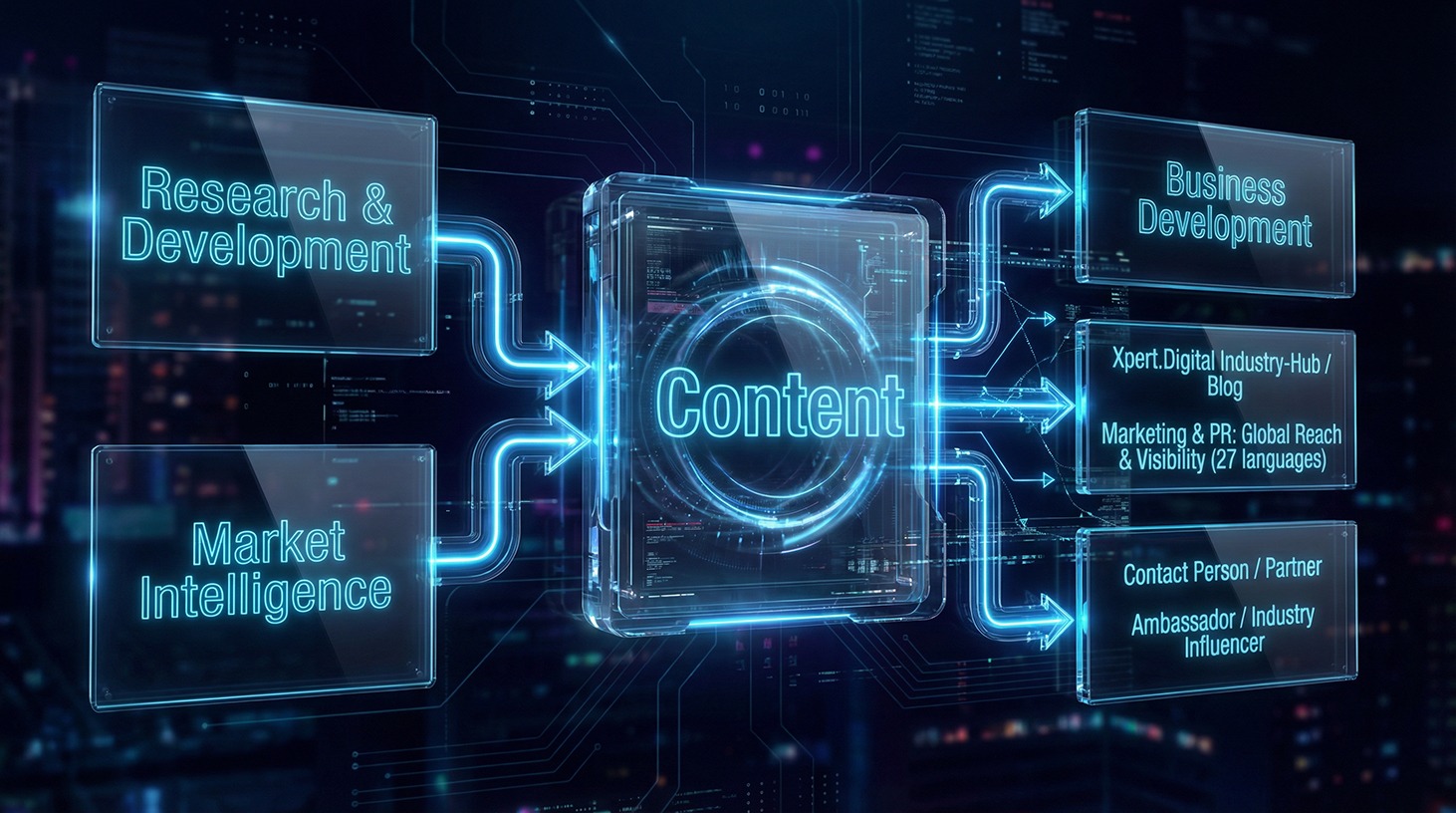
The quasi-in-house solution: How Xpert.Digital closes operational gaps in B2B marketing and sales – Smart Content-Driven Business - Image: Xpert.Digital
Xpert.Digital is a data-driven B2B industry hub led by Konrad Wolfenstein . The company acts as an external, quasi-in-house solution for industrial partners, closing operational gaps in marketing, content, and sales – without requiring additional resources on the client side.
More information here:
Why brands enjoy more trust today than politics and media
Trust in an age of institutional skepticism
The relevance of brand trust is not static – it grows as trust in other societal institutions erodes. The Edelman Trust Barometer 2025 paints an insightful picture for Germany: 73 percent of Germans trust their brands to do the right thing – significantly more than the government (40 percent), the media (46 percent), NGOs (42 percent), or companies in general (49 percent). Brands thus enjoy more trust today than any other societal institution.
This finding has far-reaching strategic implications. In a society increasingly skeptical of political institutions, media, and abstract corporations, familiar brands become reliable anchor points. For companies, this means that investing in consistent, authentic brand building is not just a marketing issue—it's a matter of social positioning. At the same time, this entails a responsibility: Trust, once established, is fragile. Communication strategy and actual corporate behavior must be coherent, because any discrepancy jeopardizes the established trust advantage.
For 82 percent of German consumers, trust is crucial when making a purchase – second only to product quality and value for money. This underscores that trust is not a second-class differentiating factor. It is a fundamental prerequisite for market participation.
The silent efficiency engine: How visibility transforms the entire sales channel
The most direct impact of brand awareness on sales is obvious – more people know the company, and more potential customers are available. However, the indirect channels of influence are at least as important and are even less frequently considered in strategic planning.
Firstly, high brand awareness improves the entire marketing channel. Awareness-optimized campaigns increase the conversion rate in the middle and lower funnel stages by 22 to 35 percent. Performance marketing – that is, targeted advertising to already informed users – becomes significantly more efficient when brand awareness is high. Secondly, brand awareness reduces price sensitivity: customers pay measurably more for well-known brands because awareness subconsciously suggests quality and lowers the perceived purchase risk.
Furthermore, there is a structural advantage in sales conversations: With well-known brands, a significant portion of the persuasion work that would otherwise be necessary in the early stages of a conversation is eliminated. Trust is already established – sales representatives can concentrate on substantive differentiation instead of first establishing credibility. And well-known brands are recommended: People recommend brands they know because the recommendation itself involves a reputational risk. A well-known brand also provides the recommender with a sense of security.
Brand awareness in the digital space: New playing fields, old principles
Digital transformation hasn't fundamentally changed the mechanisms of visibility and brand awareness – it has accelerated, diversified, and refined their measurability. Search engine optimization (SEO) remains the most important organic channel through which potential customers become aware of a company. A branded search volume of at least 15 percent of the total organic search volume is considered an indicator of robust brand awareness within the relevant target group.
But the digital landscape is expanding rapidly. Since 2025, the growing use of AI assistants like ChatGPT or Perplexity has fundamentally changed the logic of visibility: Companies regularly mentioned in these systems' responses are automatically perceived as trustworthy, relevant players – because users tend to attribute a high degree of objectivity to AI recommendations. AI visibility is thus becoming an independent strategic channel based on the same fundamental principles as traditional brand awareness: Those who are mentioned frequently and in relevant contexts gain authority and credibility.
In the new digital architecture, brand awareness increasingly determines whether a company is even considered as a potential answer. Content that is machine-readable, citable, and semantically precise not only generates classic SEO visibility but also AI visibility – and thus a new form of trust transfer through algorithmic recommendations.
Personal branding as a visibility multiplier in B2B
A particularly effective, yet systematically underestimated, form of visibility strategy in the B2B context is the personal branding of company representatives. People trust people – not logos. In a business world where B2B decision-makers increasingly seek direct access to experts and opinion leaders, the personal brand of the entrepreneur, managing director, or specialist becomes an independent communication channel.
LinkedIn is the dominant channel for this form of visibility in the German-speaking B2B sector. Organic LinkedIn visibility complements paid media activities, reduces acquisition costs through relationship capital, and demonstrably increases conversion rates in long sales cycles. Being perceived as an expert in a field on LinkedIn generates trust even before the first formal customer contact – and this initial trust shortens sales cycles, reduces price negotiations, and generates a natural flow of incoming inquiries.
The economic mechanism is identical to that of classic brand awareness, only on a more personal level: Those who regularly share valuable knowledge, are quoted as experts, and make their competence tangible for the target group, build the stages of the know-like-trust principle on a personal level faster and more sustainably than any corporate brand could on its own. The same psychological principle applies: It's not the single brilliant statement that matters, but rather consistent, repeated presence over a long period.
Strategic failure: Why companies still don't invest
If the economic logic is so clear, why is it so often ignored? The answer lies in a systemic bias that permeates most business decision-making processes: the preference for short-term, measurable results. Brand building is a long-term investment. Its impact unfolds over months and years, not quarters. In a corporate culture that measures and justifies success on a quarterly basis, the strategic foundation is systematically subjected to financial pressure.
Furthermore, there is a measurement problem that has only been addressed in recent years through more precise tools and methods. The direct ROI of a brand-building measure is more difficult to isolate than that of a performance campaign. A click can be measured, but a shift in awareness cannot. This asymmetry in measurability leads to a structural underinvestment in brand awareness – even though the aggregated effects, as the studies cited above demonstrate, are significantly greater than those of directly measurable channels.
Statista data shows that 84 percent of B2C and 76 percent of B2B marketers cite increasing brand awareness as the most important goal of their content marketing. The discrepancy between stated goals and actual budget allocation is characteristic: everyone knows what's important – but concrete investments flow into measurable, short-term measures. With the exception of the largest companies, brand awareness remains chronically underfunded and strategically neglected.
The consequence: What a coherent visibility strategy must achieve
An effective visibility strategy that consistently contributes to increasing brand awareness and thus building trust must meet three fundamental requirements.
First, it must be consistent. No single channel, no single format, and no single event is enough to maintain a lasting presence in the minds of a target audience. Strength lies in the systematic repetition of clear, recognizable messages across different channels and formats. Consistency is not the opposite of variation – it is the content-related and visual backbone that holds all variations together.
Secondly, it must be substantial. In a digital space increasingly flooded with generic, AI-generated, superficial content, substance determines visibility. Thought leadership builds trust; generic content erodes it. Content that demonstrates genuine expertise, solves concrete problems, and challenges assumptions generates engagement, sharing, and long-term association with competence and authority—precisely what transforms awareness into trust.
Third, patience is essential. The economic value of a strong brand isn't built in weeks. It arises from accumulated awareness, from hundreds of small touchpoints, from consistently delivering quality over a period that seems too long for most operational planning cycles. Those unwilling to accept this time horizon will remain trapped in a cycle of expensive, short-term measures – and will never lay the foundation for genuine, scalable growth.
Measurability as a key to internal legitimacy
A practical objection to brand-building investments remains the lack of measurability – but this objection is increasingly losing its validity. Modern awareness KPI dashboards allow for differentiated tracking of brand awareness across multiple levels: branded search volume, share of voice in relevant media, direct traffic as an indicator of awareness, social media reach and engagement rates as signals of trust building, and the development of conversion rates in correlation with awareness investments.
B2B companies that systematically track these KPIs and optimize their budgets based on the insights gained achieve measurable improvements, according to Forrester analyses: a 23 percent higher ROI for awareness campaigns through data-driven budget reallocation, 16 percent more qualified leads through a more precise content strategy, and a 31 percent improved conversion rate from the awareness to the interest phase. These are concrete, budget-relevant metrics that will hold up even in board presentations.
The challenge is no longer that brand building is unmeasurable – it lies in defining the right metrics, establishing a sufficiently long observation period, and developing the courage to continue investments even when their impact is still developing. Ultimately, this is a question of a company's strategic maturity.
The long shadow of inaction
Anyone who takes the implications of this article seriously will realize that the costs of inaction are considerably higher than commonly assumed. Every month without systematic visibility marketing is a month without building trust – and a month in which competitors who invest in brand awareness extend their lead. Brand awareness is one of the few resources in a business context whose development is not linear: it doesn't slow down with the initial build-up, but rather accelerates through the compound effect of accumulated presence.
The principle is the same as with long-term wealth accumulation: those who invest early and consistently benefit from the power of compound interest. Those who wait until the perfect moment not only lose time – they lose the head start that early investors have built up. A company that starts investing in its visibility today needs months or years to feel the effects. A company that postpones this step will still need those months and years – just later.
The classic saying that gives this article its title – visibility leads to awareness, awareness leads to trust – is not a romantic marketing adage. It is an empirically proven economic law. The real question is not whether one should follow it. The question is how long one can afford to ignore it.
Your global marketing and business development partner
☑️ Our business language is English or German
☑️ NEW: Correspondence in your native language!

Konrad Wolfenstein
I and my team are happy to be available to you as your personal advisor.
You can contact me by filling out the contact form here wolfenstein@xpert.digital:or simply call me at +49 7348 4088 965. My email address is
I'm looking forward to our joint project.
☑️ SME support in strategy, consulting, planning and implementation
☑️ Creation or realignment of the digital strategy and digitization
☑️ Expansion and optimization of international sales processes
☑️ Global & Digital B2B trading platforms
☑️ Pioneer Business Development / Marketing / PR / Trade Fairs
B2B support and SaaS for SEO and GEO (AI search) combined: The all-in-one solution for B2B companies


B2B support and SaaS for SEO and GEO (AI search) combined: The all-in-one solution for B2B companies - Image: Xpert.Digital
AI search changes everything: How this SaaS solution will revolutionize your B2B ranking forever.
The digital landscape for B2B companies is undergoing rapid change. Driven by artificial intelligence, the rules of online visibility are being rewritten. For companies, it has always been a challenge not only to be visible in the digital mass, but also to be relevant to the right decision-makers. Traditional SEO strategies and managing local presence (geo-marketing) are complex, time-consuming, and often a battle against constantly changing algorithms and intense competition.
But what if there were a solution that not only simplified this process but also made it smarter, more predictive, and far more effective? This is where the combination of specialized B2B support with a powerful SaaS (Software as a Service) platform comes into play, specifically designed for the demands of SEO and GEO in the age of AI search.
This new generation of tools no longer relies solely on manual keyword analysis and backlink strategies. Instead, it leverages artificial intelligence to more accurately understand search intent, automatically optimize local ranking factors, and conduct real-time competitive analysis. The result is a proactive, data-driven strategy that gives B2B companies a decisive advantage: they are not only found, but perceived as the leading authority in their niche and location.
Here's the symbiosis of B2B support and AI-powered SaaS technology that transforms SEO and GEO marketing, and how your company can benefit from it to grow sustainably in the digital space.
More information here: