Business misconceptions: The deceptive appearance of English websites, using South Korea as an example – More than just global content is needed – Image: Xpert.Digital
English websites as a stumbling block in global business
Why the misconception about English-language websites in South Korean business is a costly mistake
In today's globalized economy, it may seem tempting at first glance to leverage the international reach of English and believe that an English-language website is sufficient as a universal key to market entry in South Korea. However, this assumption is a dangerous misconception that simply ignores the complex realities of the South Korean market, its deeply ingrained culture, its unique digital landscape, and the subtle nuances of business etiquette. For companies seriously considering establishing business relationships and achieving long-term success in South Korea, it is essential to understand the multifaceted reasons why a comprehensive localization strategy is not only advisable but absolutely crucial.
English websites often have a global appeal, but are not automatically successful
The cultural pitfalls: More than just language
South Korean culture is rich in traditions and values that profoundly shape business life. A purely English-language website is like trying to represent a complex piece of music with only a few notes – it may be superficially recognizable, but the depth, the emotion, and the true essence are lost.
Related to this:
- The central role of the local language in search engine optimization, using Hangul in South Korea as an example
- Search engine optimization (SEO) in South Korea: Naver vs. Google and comprehensive content strategies
Confucian values and the importance of hierarchy and respect
Confucian thought, which has shaped Korean society for centuries, emphasizes values such as respect for authority, hierarchical structures, harmony, and the importance of long-term relationships. These values manifest themselves in various ways in business. For example, formal communication and adherence to hierarchy are highly valued in Korean business. Decision-making processes are often structured from the top down, and it is common for decisions to be made by senior managers and then passed down to lower levels.
An English-language website that ignores these cultural nuances inevitably sends the wrong message. Korean business partners expect to find information on a website that reflects their cultural values and meets their needs. This includes, for example, a clear presentation of the company hierarchy, the listing of contact persons with correct titles such as „jangnim"Director," "busajangVice President," or "sajangCEO," and the use of formal and respectful language. The absence of such culturally coded elements is quickly interpreted as a sign of disrespect, ignorance, or even a lack of professionalism.
However, it's not just about formal titles and hierarchies. The Confucian emphasis on "Inhwaharmony" and "Jeongemotional bond" plays a crucial role in business. Korean companies place great importance on building personal relationships with their business partners. Trust and mutual respect are the cornerstones of any successful business relationship. A purely transactional, English-language website can neglect these important aspects and give the impression that the company is not interested in a long-term, trusting partnership.
Linguistic preference and trust in one's mother tongue
Even though many South Koreans are proficient in English, the preference for content in their native language, especially in business and contractual contexts, is overwhelming. Numerous studies demonstrate that consumers and decision-makers worldwide perceive content in their own language as more trustworthy, credible, and relevant. A study by the renowned Sungkyunkwan University in Seoul revealed that an impressive 78% of South Korean decision-makers consider websites in Korean to be more trustworthy. This figure speaks volumes and underscores the immense importance of localization beyond mere translation.
However, linguistic preference is not only a matter of trust, but also of efficiency and convenience. Even if a Korean is fluent in English, it is undeniable that processing information in their native language requires less cognitive effort, thus enabling faster and deeper understanding. In complex business situations where precision and clarity are paramount, avoiding any linguistic misunderstandings by using Korean is essential.
Furthermore, it's important to understand that while English proficiency is widespread in South Korea, it's often limited to a certain level. Many Koreans have a passive vocabulary and can read and understand English texts, but active language skills, especially in written expression, can vary. This can lead to communication barriers and misunderstandings, particularly in complex or technical fields. A Korean-language website, on the other hand, ensures that the message is conveyed clearly, precisely, and unambiguously to the target audience.
Social etiquette in the digital space: Avoiding faux pas
Digital communication in South Korea, as everywhere else in the world, is governed by its own set of etiquette rules. What is considered acceptable, or even informal and friendly, in Western cultures can be perceived as impolite or disrespectful in Korea. A website that is exclusively in English carries the risk of unintentionally committing cultural faux pas and alienating potential business partners.
A simple example is the form of address in emails or contact forms. While it is common in English to address people by their first name, this is considered inappropriate and impolite in Korea, especially in formal business contexts. Korean business partners expect a formal address using the family name and appropriate title. Ignoring this convention can create the impression of disrespect and a lack of professionalism.
Even seemingly neutral elements like color scheme and imagery can present cultural pitfalls. Colors have different symbolic meanings in different cultures. For example, in Korea, white is traditionally associated with mourning and death, while red symbolizes good fortune and prosperity. The careless use of color on a website can therefore trigger unintended emotional reactions and negatively impact brand perception. Similarly, imagery is crucial. Images perceived positively or neutrally in Western cultures may be culturally inappropriate or even offensive in Korea. Careful cultural adaptation of visual elements is therefore essential.
Furthermore, polite phrases and greeting rituals play a significant role in Korean communication. Korean websites frequently incorporate ritualized polite phrases such as "AnnyeonghaseyoHello," "BangapseumnidaNice to meet you," or "GamsahamnidaThank you." These phrases are more than mere formalities; they express respect, appreciation, and social harmony. In direct translations into English, these phrases often lose their social function and cultural context. A localized Korean-language website, however, can convey these cultural nuances authentically and effectively.
Technical SEO requirements: Naver dominance and local relevance
Search engine optimization (SEO) is a crucial factor for the online success of any company. However, anyone who believes that a global SEO strategy primarily focused on Google will also lead to success in South Korea is sorely mistaken. The South Korean search engine market is dominated by Naver, a search engine that differs fundamentally from Google in many respects.
Naver vs. Google: An unequal competition
With an impressive market share of over 60%, Naver is the undisputed number one search engine in South Korea, while Google plays a significantly subordinate role with around 30% market share. However, Naver's dominance is not solely a matter of user numbers, but also of the way Naver functions and indexes and ranks content.
Naver is far more than just a search engine in the Western sense. It's a comprehensive internet portal, an integrated ecosystem that unites a multitude of services and content under one roof. In addition to the search engine, Naver offers news, email, blogs, forums ("cafés"), communities, question-and-answer platformsKnowledge iN, e-commerce platforms, and much more. This integration of content and services shapes how Naver presents search results and how users find and consume information.
Naver's algorithm differs fundamentally from Google's. Naver places great emphasis on locally generated, Korean-language content and prioritizes it in search results. Studies show that an impressive 73% of the top 10 rankings on Naver go to Korean-language pages. English content is systematically disadvantaged because Naver performs semantic analysis at the morphology level, and English keywords often do not match Korean search intent.
A clear example illustrates this difference: A Google search for "best smartphones" would likely return a multitude of international tech websites, reviews, and product pages from global brands. On Naver, however, the same search, translated into Korean as " "최고의 스마트폰(choego-ui seumateupon), would primarily deliver results from local tech blogs, Korean online forums ("cafés"), user reviews, and product pages from Korean retailers. Companies not embedded in this local discourse, whose websites are not optimized for Naver, and that do not offer Korean-language content remain simply invisible in Naver's search results.
Cultural keyword optimization and semantic pitfalls
Keyword research for the South Korean market requires a deep understanding of the Korean language, culture, and search habits. A direct translation of English keywords into Korean is often insufficient and can even be counterproductive. Keywords must be culturally adapted and aligned with the specific search intent of Korean users.
For example, the term "premium" in Korean ("프리미엄") has a different connotation than in English. While "premium" in a Western context is often associated with exclusivity, high quality, and luxury, in Korea the term can also evoke negative associations such as "overpriced" or "ostentatious." Successful brands in Korea therefore often use alternative terms to communicate quality and value, such as "gadeukhan" (sophisticated, rich), "ttokttokhan" (clever, intelligent), or "myeongpum" (masterpiece, exquisite product).
The way users search in Korea can also differ from Western search habits. Tools like the Naver Keyword Planner show that long-tail keywords in Korean often use question formats, such as "어떻게 선택하나요?" (eotteoke seontaekhanayo? – "How do you choose?"), "어디에서 살 수 있나요?" (eodieseo sal su innayo? – "Where can you buy?"), or "사용 후기" (sayong hugi – "User reviews"). A direct translation of English keywords misses these specific search intents and leads to lower visibility in Naver search results.
Furthermore, Naver rigorously evaluates user engagement metrics such as bounce rate, dwell time, and click-through rate (CTR). Websites with a high bounce rate, short dwell time, or low CTR are penalized by Naver, even if they offer relevant content for specific keywords. This underscores the importance of a high-quality, user-friendly, and culturally relevant website that meets the expectations of Korean users and encourages them to stay and interact.
Xpert.Digital on Naver
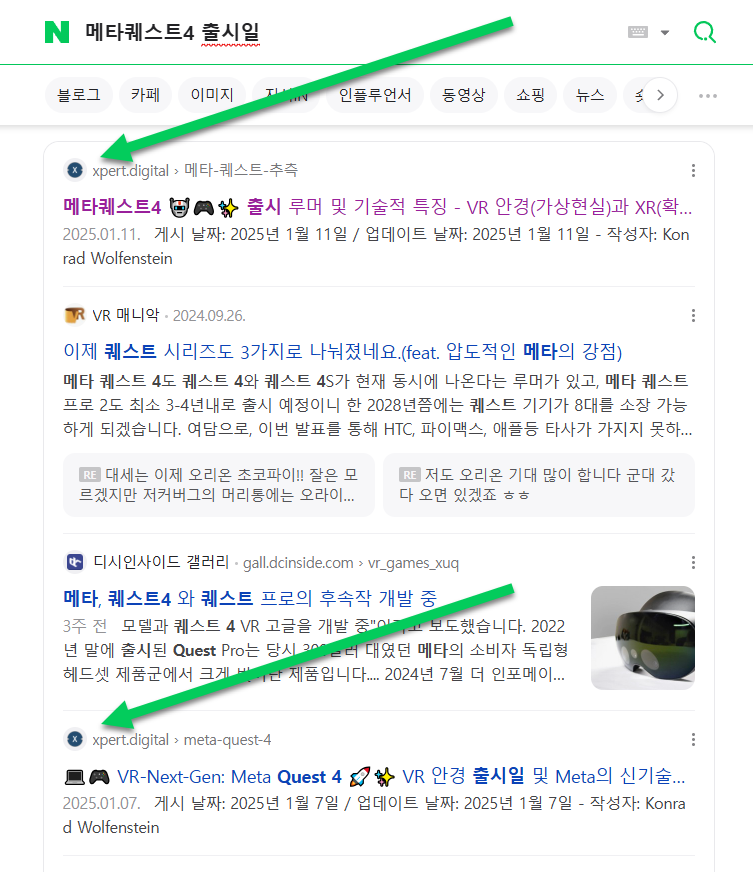
Xpert.Digital is listed on naver.com. Here it shows "Meta Quest 4 release date" – Image: Xpert.Digital
More information here:
Language barriers and loss of trust: More than just translation
The language barrier is often the most obvious obstacle for companies seeking to establish a presence in South Korea. However, the impact of language barriers extends far beyond simply translating texts. They significantly influence the trust, credibility, and perception of a company by Korean business partners and customers.
The illusion of English proficiency: misunderstandings and mistrust
Although statistics show that a significant portion of the South Korean population has some knowledge of English, it is important to critically examine these figures and consider the reality in a business context. Studies indicate that while approximately 53% of South Koreans have basic English skills, only a significantly smaller percentage, around 12%, actively use the language in a business context. Even in multinational companies operating in South Korea, internal communication is predominantly in Korean.
A study by the German-Korean Chamber of Commerce and Industry (AHK Korea) revealed that a striking 89% of local decision-makers initially react with suspicion to business inquiries written exclusively in English. They suspect fraud, a lack of professionalism, or simply an impersonal, standardized approach. This suspicion is not irrational but rather based on a cultural preference for Korean communication and the perception that companies that make the effort to communicate in Korean demonstrate a stronger commitment to and interest in the Korean market.
The discrepancy between passive and active language comprehension is particularly critical. As mentioned earlier, many Koreans can read and understand English texts, but formulating accurate, nuanced, and professional responses in English often proves difficult. This leads to delayed response times, misunderstandings, misinterpretations, and ultimately, a loss of efficiency and trust in communication. In complex negotiations or when clarifying technical details, linguistic misunderstandings can even jeopardize business deals or lead to costly errors.
Legal and administrative hurdles: Korean as an official language
South Korea's regulatory environment and government administration are distinctly Korean-language-dominated. Laws, regulations, guidelines, and administrative processes are written and conducted in Korean. Companies operating in South Korea must adapt to this linguistic framework to avoid legal and administrative obstacles.
For example, South Korea's "Framework Act on Electronic Documents and Transactions" mandates that certain types of electronic documents, such as contracts, import certificates, and compliance documents, must be in state-certified Korean. Incorrect or inaccurate translations of these documents can lead to legal sanctions, fines, or even the loss of business licenses.
A concrete example of the serious consequences of linguistic errors in a legal context is the case of a German machine manufacturer whose imprecisely translated safety instructions led to an import ban on its products in South Korea in 2019. The Korean authorities objected that the English safety instructions had not been translated into Korean with sufficient clarity and comprehensibility, posing a potential safety risk to Korean users. This case illustrates that simply translating documents is not enough; they must also be culturally and legally adapted to meet local requirements.
The psychological dimension of building trust: More than just rational arguments
Trust is the currency of business, and this is especially true in South Korean business culture, which is strongly influenced by personal relationships and emotional bonds. A website is often the first point of contact between a company and potential Korean business partners or customers. Therefore, the website plays a crucial role in building trust and credibility. However, a website that is exclusively in English can unintentionally send signals that undermine trust and make it difficult to build long-term relationships.
Cultural Coding of Professionalism: Details That Make the Difference
In South Korea, professionalism is often defined by details that Western companies might overlook or dismiss as unimportant. However, these details are crucial for building trust and conveying competence and reliability.
These include, for example:
“Jeong-based relationships”
As previously mentioned, personal relationships playJeonga central role in Korean business. A website that emphasizes the value of relationships, highlights local partnerships, or mentions corporate social responsibility (CSR) projects in Korea can significantly increase a company's credibility and positive image in the eyes of Korean users. Mentioning collaborations with Korean universities, NGOs, or local businesses demonstrates a genuine commitment to the Korean market and society.
Visual hierarchy and team presentation
Korean websites often place more emphasis on team photos, the presentation of company history, and employee profiles than on individual expertise or testimonials. This reflects the Confucian emphasis on collectivism and harmony. Visually representing the team and emphasizing shared company values can foster trust and a sense of belonging among Korean users.
Reviews and social proof: Using local review platforms
South Korean consumers and business partners place great value on recommendations, reviews, and social proof. An impressive 92% of South Koreans check at least three local review platforms (such as [example platform name] Naver Blog, KakaoStory, Daum Cafe) and online forums before making a purchase decision or establishing business contacts. Integrating local reviews, user ratings, and testimonials on a Korean-language website can significantly increase trust and credibility. It is advisable to actively monitor local review platforms, highlight positive reviews on your own website, and respond to negative reviews professionally and transparently when necessary.
An analysis by the German-Korean Chamber of Commerce and Industry (IHK Korea) has shown that localized web design and Korean-language content can increase the conversion rate by up to 300%. In contrast, English-language websites in Korea are often perceived as "fleeting," "impersonal," or "incomplete." They convey the impression that the company does not take the Korean market seriously and is unwilling to adapt to the needs and expectations of the local target audience.
The role of hyperlocality: Proximity creates trust
In a globalized world where online businesses often operate without borders, the term "hyperlocality" may initially seem paradoxical. However, it is precisely in the digital realm, where anonymity and distance can prevail, that the emphasis on local connections and adaptations gains importance. South Korean users place great value on hyperlocality and expect websites and online services targeting them to consider local characteristics and convey a sense of closeness and familiarity.
Address formats, phone numbers and local payment methods: details that matter
Hyperlocal customizations encompass a multitude of details that may seem trivial at first glance, but in total have a significant impact on the perception and trust of Korean users.
This includes in particular:
Address details according to the Korean postal system (“번지“ – beonji)
The Korean address system differs fundamentally from Western systems. Addresses are not structured by street names and house numbers, but by neighborhoods ("dong"), districts ("gu"), and "beonji" (a type of property number). Correctly displaying addresses in the Korean format on a website signals to Korean users that the company is familiar with local customs and makes an effort to respect local standards. Conversely, using incorrect or incomplete address formats can cause confusion and create an impression of negligence.
Telephone numbers with country code (+82) and area codes
Providing correct phone numbers with the Korean country code (+82) and relevant area codes is essential to enable Korean users to easily contact the company. Offering international phone numbers without the correct formatting or omitting local contact numbers can give the impression that the company is difficult to reach or not present in Korea. Ideally, companies should provide local Korean phone numbers to lower the barrier to calling and assure users that they are communicating with a contact person in Korea.
Integration of local payment methods such as KakaoPay or Naver Pay
South Korea boasts a highly developed and diverse system of online payment methods. Alongside credit cards and bank transfers, local e-wallet solutions like KakaoPay and Naver Pay play a dominant role in e-commerce. Integrating these local payment methods into a website is essential for businesses wishing to sell products or services in Korea. The absence of local payment options can lead Korean users to abandon the purchase process or perceive the website as unprofessional or untrustworthy. Studies by the Korea Consumer Agency have shown that the lack of local payment methods can reduce a website's trustworthiness by up to 68%.
Hyperlocality, however, goes beyond simply adapting addresses, phone numbers, and payment methods. It also includes considering local holidays, cultural events, and seasonal features in website design and content marketing. Adapting content to local events and interests demonstrates to Korean users that the company is attentive, interested in local culture, and has a genuine understanding of the needs and preferences of the Korean target audience.
Strategic recommendations for successful market development: Localization as an investment in the future
The findings from the preceding sections demonstrate that a purely English-language website is not only insufficient for the South Korean market, but potentially counterproductive. Companies that want to succeed in South Korea must pursue a comprehensive localization strategy that goes far beyond simply translating texts. Localization is not merely a cost center, but a strategic investment in market success that pays off in the long run.
Comprehensive localization across language barriers: Cultural, technical, and content-related adaptations
A successful localization strategy for the South Korean market comprises three essential dimensions:
- Cultural auditing and cultural adaptation: Before launching a website or marketing campaign in Korea, a comprehensive cultural audit is essential. This involves local experts analyzing all elements of the website and marketing materials for their cultural relevance, appropriateness, and potential pitfalls. This includes analyzing colors, images, symbols, narratives, wording, and tone. Cultural experts can provide valuable insights and recommendations for cultural adaptations to ensure that the website and marketing messages are received positively and do not trigger unintended negative reactions.
- Technical localization and SEO optimization for Naver: Technical localization involves adapting the website to the technical requirements and preferences of the Korean market. This includes, in particular:
Mobile-first design
In South Korea, internet access is predominantly via smartphones. Therefore, a mobile-first design is essential to ensure that the website is displayed optimally on mobile devices and offers a user-friendly mobile experience. Statistics show that over 98% of Naver users access the search engine via smartphones.
Optimization of loading times
Korean internet users are accustomed to fast loading times and have little patience with slow-loading websites. Loading times should be optimized to under 2 seconds to minimize bounce rates and maximize user satisfaction.
HTTPS encryption and data security
Data security and privacy protection are also important issues in South Korea. The use of HTTPS encryption and compliance with local data protection regulations are essential to building trust with Korean users.
SEO optimization for Naver
As previously explained in detail, SEO optimization is crucial for visibility in Korean search results on Naver. This includes keyword research in Korean, content optimization for Naver algorithms, the use of Naver Webmaster Tools, and consideration of Naver-specific ranking factors.
Content strategy and Korean-language content
A successful content strategy for the Korean market requires the creation of high-quality, relevant, and culturally appropriate Korean-language content. This includes:
Regular blog posts on the Naver Blog
Naver Blog is one of the most important platforms for content marketing in Korea. Regular blog posts on Naver Blog on relevant topics that appeal to the interests of the Korean target audience can increase visibility in Naver search results, drive traffic to the website, and boost brand awareness.
Video content for YouTube and local video platforms
Video content is extremely popular in Korea. YouTube is the second largest search engine in Korea after Naver. Creating video content in Korean and distributing it on YouTube and local video platforms like Naver TV can significantly increase reach and engagement.
Social media marketing on Korean platforms
South Korea has its own dominant social media platforms such as KakaoTalk, KakaoStory, and Naver Cafe. A successful social media strategy for Korea requires a presence and engagement on these local platforms and the creation of social media content tailored to the Korean audience.
Investing in long-term relationships: Local presence, cultural training, and partnerships
In addition to comprehensive localization of their online presence, investing in long-term relationships is another crucial success factor for the South Korean market. Successful companies often utilize hybrid models that combine online and offline activities
Local branches and representative offices
Opening a local branch or representative office in Korea signals a long-term commitment and builds trust with Korean business partners and customers. A local presence also simplifies compliance processes, facilitates the development of personal relationships, and improves communication and collaboration.
Cultural training and intercultural competence
Raising employee awareness of Confucian business practices, Korean culture, and intercultural communication is essential to avoid misunderstandings and build successful relationships. Cultural training and intercultural workshops can help employees understand the cultural nuances of the Korean market and interact effectively with Korean business partners and customers.
Strategic partnerships and collaborations
Collaborating with local influencers (“ppojangmachulocal opinion leaders”), local businesses, or Korean institutions can increase visibility in Naver searches, strengthen credibility, and facilitate access to the Korean market. Partnerships with local influencers can be particularly beneficial in the areas of social media marketing and brand awareness.
Related to this:
- Industry Influencer: Industry hub as a blog tip & topic portal for industry, mechanical engineering, logistics, intralogistics and photovoltaics
- Higher ROI with Brand Ambassador and Consumer/Industry Influencer Marketing – B2B & B2C Whitepaper Analysis – Top Information
Localization as the key to success in the South Korean market
The belief that an English-language website is sufficient to successfully establish business contacts in the demanding South Korean market is a dangerous misconception that ignores the complex realities of this unique market. Market penetration in South Korea requires a deep understanding of cultural values, the technical specifics of the Naver-dominated search engine market, linguistic preferences, and the psychological dimension of building trust.
From the algorithmic reality of Naver's search behavior to Confucian-influenced expectations of business relationships, the success factors in the Korean market are diverse and closely intertwined. A purely English-language website is not only a communication barrier but also sends subtle signals of disrespect, lack of commitment, and insufficient professionalism.
Companies that invest in professional localization, offer cultural training for their employees, implement technical SEO adjustments, and build long-term relationships not only position themselves more visible and competitive in the Korean market, but also embody the respect for Korean values and cultural norms that forms the basis for long-term partnerships and sustainable business success. Localization is therefore not just a tactical measure, but a strategic necessity for companies that truly want to succeed in South Korea.
Our recommendation: 🌍 Limitless reach 🔗 Connected 🌐 Multilingual 💪 Sales power: 💡 Authentic with strategy 🚀 Innovation meets 🧠 Intuition


From local to global: SMEs conquer the world market with a clever strategy - Image: Xpert.Digital
In an era where a company's digital presence determines its success, the challenge lies in creating an authentic, personalized, and far-reaching presence. Xpert.Digital offers an innovative solution that positions itself as the intersection of an industry hub, a blog, and a brand ambassador. It combines the advantages of communication and sales channels in a single platform and enables publication in 18 different languages. Cooperation with partner portals and the ability to publish articles on Google News and a press distribution list with approximately 8,000 journalists and readers maximize the reach and visibility of the content. This represents a crucial factor in external sales and marketing (SMarketing).
More information here:
We are here for you - Consulting - Planning - Implementation - Project Management
☑️ SME support in strategy, consulting, planning and implementation
☑️ Creation or realignment of the digital strategy and digitization
☑️ Expansion and optimization of international sales processes
☑️ Global & Digital B2B trading platforms
☑️ Pioneer Business Development

Konrad Wolfenstein
I would be happy to serve as your personal advisor.
You can contact me by filling out the contact form below or simply call me on +49 7348 4088 965 .
I'm looking forward to our joint project.
Write to me


Xpert.Digital - Konrad Wolfenstein
Xpert.Digital is a hub for industry focusing on digitalization, mechanical engineering, logistics/intralogistics and photovoltaics.
With our 360° Business Development solution, we support renowned companies from new business to after-sales.
Market intelligence, smarketing, marketing automation, content development, PR, mail campaigns, personalized social media and lead nurturing are part of our digital tools.
You can find more information at: www.xpert.digital - www.xpert.solar - www.xpert.plus
Keep in touch