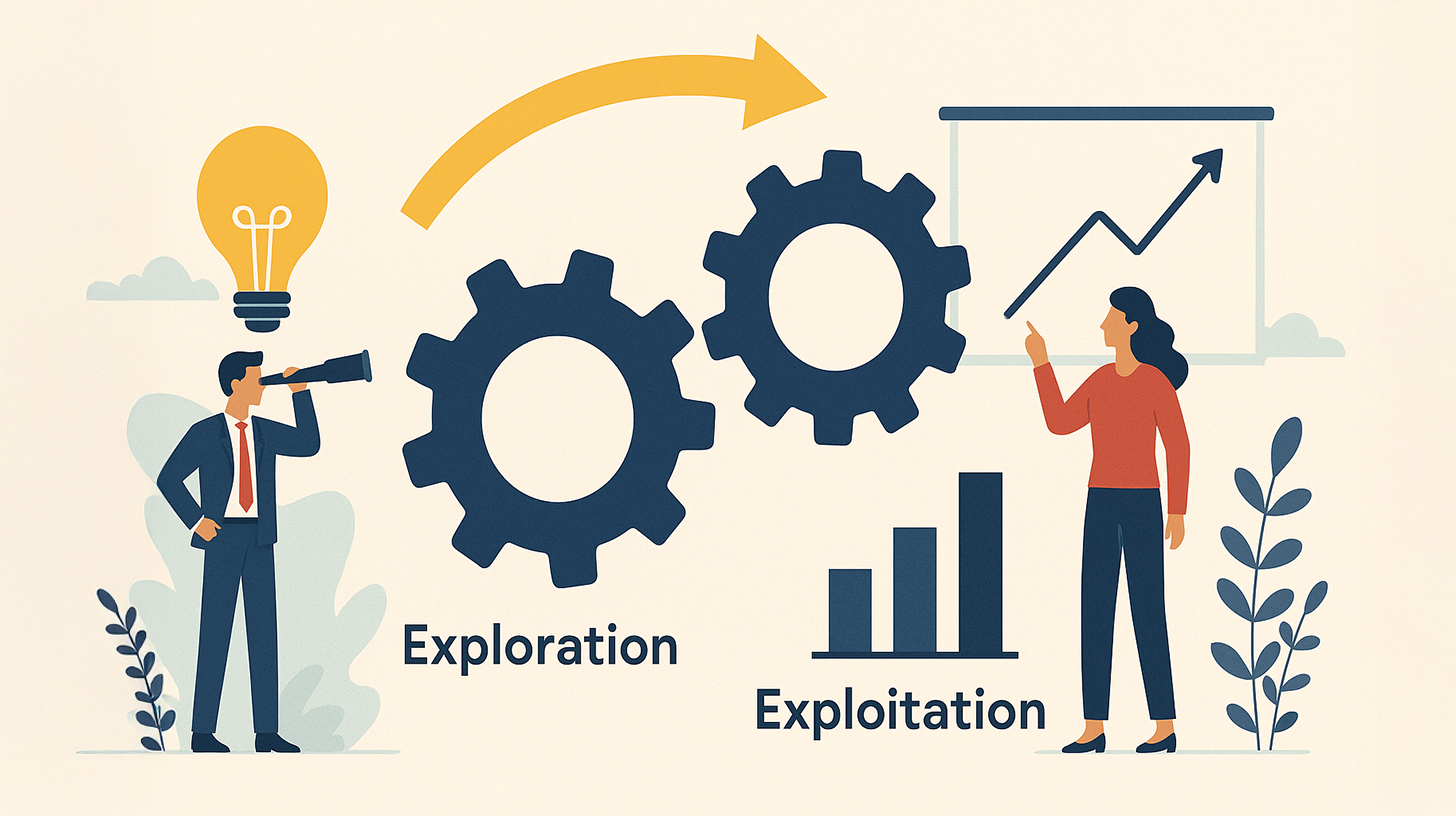
Ambidexterity: The future of corporate management with exploitation and exploration – Image: Xpert.Digital
Caught between innovation and efficiency – How companies must overcome this divide to survive
Dual corporate management: Tradition and innovation as a survival principle
Most companies constantly face the challenge of efficiently operating their core business while simultaneously developing new growth areas. Ambidexterity, the simultaneous mastery of exploitation (maximizing existing markets and processes) and exploration (testing and developing new business areas), is not a new insight, but rather often the fundamental prerequisite for the sustainable competitiveness of modern organizations. The ability to rely on existing strengths while also powerfully developing new ones is central to current management research and practice. Especially in a digitally driven economy with the constant shifting of innovation venues and competitive conditions between companies and their networks, businesses are compelled to consistently balance these two poles of value creation.
The challenge lies less in individual innovation projects than in establishing two inconsistent organizational systems within the same company, pursuing conflicting requirements and thus creating structural tensions. This presents new tasks for managers: they must create teams and leadership structures capable of actively managing paradoxes and contradictions – and, in doing so, establish targeted mechanisms for connecting and integrating the separate areas. The initial solution proposed by many experts is the radical structural separation of exploration and exploitation to overcome the influence of old habits and the dominance of traditional business models, and to create space for new ideas.
Related to this:


Structural separation: Organizational design as the key to ambidexterity
Research clearly shows that the deeply ingrained inertia and resistance of traditional corporate cultures can severely hinder innovative ambidexterity approaches. Experts therefore recommend initially separating organizational ambidexterity structurally. The logic behind this is clear: if the core business and the innovation field are too closely intertwined, the established business model usually dominates and prevents the necessary experimentation and bold testing of new business approaches. However, a complete separation is not always advisable; rather, companies should intelligently combine their resources and create mechanisms that leverage the advantages of both areas – provided that the available resources, branding, finances, and HR allow for this.
The structural separation is therefore not dogmatic, but adaptive: once an innovation field has gained relevance and its own legitimacy, its integration into the overall company can become sensible and necessary in order to leverage its potential. Crucially, leadership competence remains essential, actively managing tensions and political blockages. Without a suitable leadership structure, ambitious ambidexterity strategies fail due to internal power dynamics and the traditional interests of the old business units. Studies show that companies are often only able to truly implement ambidexterity after a restructuring or a change in leadership.
A successful organizational design for ambidexterity is characterized by the following core elements:
- Structural separation of both areas (exploitation and exploration) with their own management teams and resources.
- Targeted integration mechanisms at a higher level, for example through special "bridging roles" or teams.
- Cultural clarity and identity that unites both entities and creates overarching meaning.
Leadership plays a crucial role in this: Only leadership teams that possess cognitive flexibility and conflict resolution skills are able to defend the company's identity-forming values and goals and constructively relate both cultures to each other.
The role of corporate culture: The invisible power of tradition and its potential for change
One of the biggest hurdles in implementing organizational ambidexterity is the corporate culture itself. The pride and inertia of established processes and thought patterns often block change processes more effectively than rational arguments. However, examples like USA Today and Ciba demonstrate that actively shaping corporate culture is crucial. Companies must be able to unite conflicting cultures—such as a focus on efficiency on the one hand and a spirit of experimentation on the other—under one roof and connect them through a strong, identity-forming narrative.
A deeply rooted mission statement can help to manage diversity and division in a stable way because it provides an emotional anchor for employees and managers. Values such as integrity, customer focus, and a commitment to quality can serve as a constant framework across different cultures. The new leadership challenge lies in cultivating stable values while simultaneously fostering openness to change and diversity. Teams that understand innovation and tradition as equally important challenges and embrace contradictions not only broaden their strategic horizons but also significantly increase the likelihood of sustainable success.
From idea to scaling: The three phases of ambidexterity as a development process
Successfully managing ambidexterity is a dynamic process on three levels: ideation, incubation, and scaling. In the first phase, management defines ambitious goals for new business areas and sets strategic priorities. The incubation phase is then characterized by exploration—experiments, partnerships, joint ventures, and the application of agile methods. Many companies struggle with the transition to the third phase: only a few manage to develop their ideas to the point where they can be systematically scaled and integrated into the routines of the core business.
During the scaling phase, it is crucial to intelligently switch between experimentation and implementation, developing both systems in a way that reinforces rather than hinders each other. Studies show that the ability of top management to create strategic frameworks and leadership models that enable and promote the coexistence of both approaches is decisive. It is not enough to have and incubate innovative ideas – they must grow in a protected environment and then be scaled in a targeted and focused manner.
🎯🎯🎯 Benefit from Xpert.Digital's extensive, five-fold expertise in one comprehensive service package | BD, R&D, XR, PR & Digital Visibility Optimization

Benefit from Xpert.Digital's extensive, five-fold expertise in a comprehensive service package | R&D, XR, PR & Digital Visibility Optimization - Image: Xpert.Digital
Xpert.Digital possesses in-depth knowledge across various industries. This allows us to develop tailored strategies precisely aligned with the requirements and challenges of your specific market segment. By continuously analyzing market trends and monitoring industry developments, we can act proactively and offer innovative solutions. The combination of experience and expertise generates added value and provides our clients with a decisive competitive advantage.
More information here:
Ambidexterity in leadership: How top teams use paradoxes to unite future and core business
Leadership in a field of tension: Identity, passion and paradoxes as drivers of success
Successful ambidexterity hinges on leadership quality. Only teams and leaders who can robustly navigate contradictions and paradoxes are capable of defending the company's identity and embodying ambidexterity as a strategy. Crucially, the company's mission statement must be emotionally anchored, as exemplified by Boston Children's Hospital with its credo "until every child is well." Identity and shared passion provide the energy and context in which leadership teams can successfully navigate the balancing act between efficiency and innovation.
Two fundamental approaches have emerged:
- The leader as an individual integrator who actively manages both poles.
- The leadership team as a learning unit that actively establishes and lives systemic processes for dealing with contradictions.
The second option offers greater resilience and stability in the long term. Companies that cultivate this leadership competency develop sustainable innovation and adaptability. Leadership teams must consistently address diverse competitive environments, expand their strategic frameworks, and be able to flexibly utilize both new and traditional opportunities.
Related to this:

Risks and resources: How companies sustainably finance ambidexterity
Small and medium-sized enterprises (SMEs) in particular face the challenge of managing ambidexterity even with limited resources. While investing in exploration often appears risky in the short term, it is essential for sustainable development in the long run. Successful companies utilize smart alliances, partnerships, or joint ventures to pool resources and jointly tackle innovation projects. Digital transformations and technologies further increase the need to continuously secure new competitive advantages beyond the core business.
Practical examples like Moleskine, which is launching digital notebooks with external partners, illustrate how cross-industry collaboration can help to efficiently implement innovation projects despite limited resources. The ability to conduct exploration within intelligent network structures is becoming a survival factor for modern medium-sized businesses.
Cultural change as the key to success: From persistence to transformation
For the long-term establishment of ambidexterity, cultural change is the key success factor. Transforming rigid system and process cultures into flexible, experimental structures is challenging, but possible. Successful examples show how companies like Lululemon have strategically opened up their original, innovation-driven culture for scaling and internal efficiency. Here, transformation means not just a change in methods or leadership, but a fundamental shift in the organization's self-understanding and how it interacts.
The biggest barrier to successful ambidexterity, therefore, is the inability to constructively integrate different and even contradictory cultures. The leadership team is challenged to establish consistent values across both cultures while simultaneously creating an identity that embraces diversity and contradiction. Crucially, a spirit of experimentation must not be stifled by a dominant culture of efficiency – and conversely, efficiency must not be overshadowed by a romanticized view of innovation. The best approach is to initiate targeted programs for cultural change, create narratives, embed values, and develop new leadership models that connect and stabilize both poles.
Practical implementation: Recommendations and best practices for companies
- Structural separation as a starting point: Companies should first consistently separate their core business and innovation area in order to create space for creative experimentation and avoid the dominance of traditional patterns.
- Targeted integration at the management level: Cross-functional teams, bridging roles and periodic alignment meetings ensure synergy effects between the separate areas and prevent parallel independent development without a strategic connection.
- Shaping cultural change programmatically: Leaders must initiate programs that value contrasting cultures and create a shared identity. Narratives and values are key elements for integration.
- Establish innovation processes iteratively: The development of new business areas should take place in the Ideate, Incubate, and Scale phases. Experiments must be systematically evaluated and, if successful, scaled in a targeted manner.
- An adaptive and development-oriented leadership structure is essential: Teams that can actively shape change and manage paradoxes are a prerequisite. Targeted training and coaching are indispensable for this.
- Securing financial and organizational resources: Small and medium-sized enterprises should use alliances and partnerships to realize exploration projects despite limited resources.
- Long-term integration: After successfully establishing new business areas, a gradual reintegration into the core business is recommended in order to optimally pool resources, brand and know-how.
Why ambidexterity is not a luxury, but an existential imperative
The economic advantages of organizational ambidexterity are enormous: it opens up new market potential for companies, protects against disruption, enables the conscious shaping of their own change, and maximizes their long-term value contribution. Companies that fail to master this balancing act risk either suffocating under the inertia of their core business or sinking into innovation romanticism without any economic backing.
The best approach is a consistent combination of structural separation, targeted integration, cultural change, and adaptive leadership. Only through the professional mastery of paradoxes, the anchoring of a sustainable identity, and the development of internal competencies can a successful transition from the present to the future be achieved. While the challenges and risks remain high, companies that strategically leverage the shift towards ambidexterity secure sustainable competitiveness and fully realize their potential in an increasingly complex and digital economy.
Our EU and German expertise in business development, sales and marketing

Our EU and German expertise in business development, sales and marketing - Image: Xpert.Digital
Industry focus areas: B2B, digitalization (from AI to XR), mechanical engineering, logistics, renewable energies and industry
More information here:
A thematic hub offering insights and expertise:
- Knowledge platform covering global and regional economies, innovation and industry-specific trends
- A collection of analyses, insights, and background information from our key areas of focus
- A place for expertise and information on current developments in business and technology
- A hub for companies seeking information on markets, digitalization, and industry innovations
Consulting - Planning - Implementation

Konrad Wolfenstein
I would be happy to serve as your personal advisor.
You can contact me at wolfenstein∂xpert.digital or
Just call me on +49 7348 4088 965 .