Buffer storage in intralogistics – The solution for ensuring supply
The COVID-19 pandemic demonstrated the value of buffer stocks. In the manufacturing industry, those who relied on insufficient or no buffer stocks in their just-in-time strategies were the first to be brought to their knees. The purpose of such a buffer stock is to ensure the smooth operation of production, order picking, and delivery. Every interruption costs time and, above all, a great deal of money. The "real-life" COVID-19 worst-case scenario has once again highlighted the importance of such buffer stocks.
The just-in-time concept, i.e., shifting warehousing to the road, depends not only on good infrastructure but also on day-to-day events over which one has no direct control. The increased risks posed by such unknown factors are a negative side effect of globalization.
Their use is particularly advantageous in the manufacturing industry and for companies that have access to a wide range of products. In e-commerce or retail, a buffer warehouse serves as a stockpile (so-called balancing stock) to enable a quick response to fluctuations in market demand.
Suitable for:
- High-bay warehouse consulting & planning: Automatic high-bay warehouse – optimize pallet warehouse fully automatically – warehouse optimization
- Automated Small Parts Warehouse (ALK)
As soon as the supply of goods from warehouses stops, many companies face the problem of delays in their manufacturing or order picking processes. It doesn't matter whether the technology used is a manually operated, static racking system or a highly automated, fully automated carousel storage system. In any case, these interruptions cost time, productivity, and ultimately money. This problem can be eliminated by adding a buffer warehouse, which ensures the continuous operation of production or order picking.
📦 Buffer storage solutions for logistics managers and warehouse managers
Do you need competent support in implementing your requirements? Do you have questions about Smart Factory, Smart Logistics or digitalization?
🏬 Warehouse optimization and automation for industry, production and trade
The automation of warehouses and supply chains is an essential element of warehouse optimization. We support you in this.
🛒 E-commerce storage solutions for returns, fast shipping (same day delivery) and error-free picking
E-commerce has special requirements and competition is becoming ever stronger. It is not for nothing that e-commerce is considered the driver of changes in the market. With our digital know-how, innovative solutions and implementations are our strength.
In e-commerce and retail sectors, a buffer warehouse serves as a storage facility (so-called balancing stock) to enable short-term responses to fluctuations in market demand. Buffer stocks (or buffer warehouses) are independently maintained and self-regulating measures implemented by the warehouse owner to maintain delivery capability in anticipation of an order.
Fully automated buffer storage
The coronavirus pandemic has brought us another, completely unexpected horror scenario: Despite full warehouses, Amazon France, for example, had to close its logistics centers due to a court ruling regarding coronavirus safety measures. The court had determined that employees were not adequately protected against the dangers of the coronavirus.
Suitable for:
- The Corona pandemic and its effects on key industries: What you need to do now
- An example of full automation: If the goods need to be removed from the warehouse quickly today.
Full automation would have prevented this. Even Amazon, the leader in research spending, which is driving the expansion of its robotics and thus accelerating its automation , did not foresee this scenario. The fact that such fully automated systems are already in use is not new .
Suitable for:
The buffer bearing principle
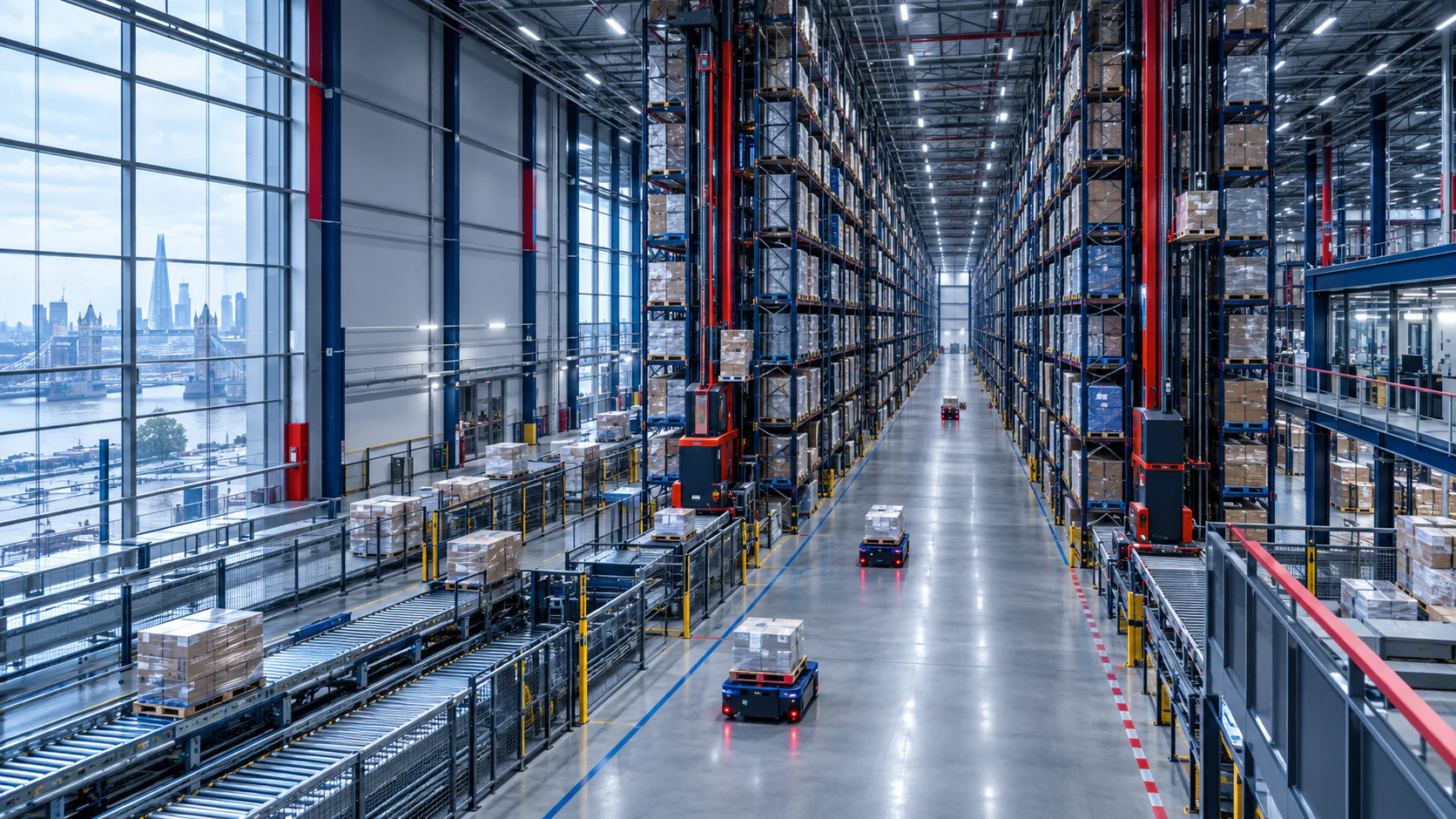
A buffer warehouse, also known as a short-term storage facility, is a temporary storage location for goods. It is this temporary storage that distinguishes it from permanent storage locations. Goods are not assigned fixed storage locations; instead, they are simply "parked" there until they are needed for the next process step – for example, production or order picking. The warehouse is thus located between two successive process stages. Since not every process proceeds at the same speed, the individual goods must be stored securely and in a way that allows for easy retrieval, even in this scenario, as this is the only way to ensure smooth operations. However, a buffer warehouse can also prove economically advantageous if goods need to be stored temporarily for extended periods and in large quantities because they cannot be processed immediately due to time constraints or organizational reasons. In this case, the buffer warehouse serves as temporary storage until the goods are requested by the individual production stations.
Suitable for:
Buffering with carousel storage
To ensure the availability of items at the production or packaging line, carousel storage systems, with their capacity for thousands of items, are particularly well-suited for use as buffer storage. While in an automated small parts warehouse (AS/RS) each item must be individually stored and retrieved from static shelves, the goods in a carousel storage system are stored in a minimal space and can be automatically and efficiently transported to the picking area via the shortest possible route. This principle of delivering goods directly to the person not only saves time and space but also optimizes the ergonomic conditions for warehouse workers. The system is supported by sophisticated software that optimizes the solution for efficiency. For example, a packing pattern generator can create an optimal plan in advance for the order in which the items are retrieved. Using this virtual sorting, the shortest route is calculated for each item, ensuring that multiple orders can be processed simultaneously.
Suitable for:
Possible uses for buffer bearings
In addition to using buffer storage facilities for items without special requirements regarding their storage conditions, they can also be converted for a variety of goods with special requirements regarding the type of storage.
Possible areas of application would be:
Cooling:
Several suppliers offer air conditioning solutions as cooling systems for buffer storage order picking systems, making them particularly attractive for suppliers and manufacturers of frozen goods. The core of the system consists of the manufacturer's carousel storage units, in which the items are automatically temporarily stored and sorted according to a customizable process flow. After the chilled goods arrive at the distribution center, the pallets are first divided into individual units (batches). Following pre-sorting, these are placed on trays, where they are then stored in the carousel storage units. The carousel storage unit serves as a buffer storage system, which can optionally operate at constant ambient temperatures, for example, the typical range for frozen foods between -25 and -28°C. To maintain the cold chain, a consistent temperature must be maintained inside the storage unit at all times. For this purpose, airlock doors are installed before and after the access openings, which drastically reduce air exchange during storage and retrieval.
Fire Protection:
To protect stored parts from fire hazards, customers often demand effective fire protection. One supplier, for example, uses its innovative Fire Solution , which employs a residue-free inert gas for fire suppression. The unique feature of this solution is that nozzles spaced 5 centimeters apart along the entire height of the high-bay warehouse deliver the gas directly into the storage units at a low pressure of approximately 4 bar. This allows the gas to disperse quickly, rapidly reducing the oxygen content to below 8.8 percent, thus extinguishing the fire in a very short time. Due to the low pressure at which the inert gas is introduced, the stored goods are not damaged. However, a fire suppression system is only as good as its detection system: Plastic pipes constantly draw air from inside the shuttle and analyze it for smoke particles. If a certain threshold is exceeded, an alarm is triggered, and the gas supply is automatically activated.
Preliminary Humidification:
Often, semi-finished products require a certain level of humidity to be sufficiently flexible for further processing. This can be achieved by selectively absorbing water from the parts in a buffer storage area. Using controllers to regulate water supply and temperature, the process air in the storage lift can be set to, for example, 25 °C and a relative humidity of 65%, resulting in the desired humidification effect. After this process step, the now malleable parts can be transferred to the next production stage.
Preliminary Cooling:
Parts from pre-production are often too hot to be processed immediately. Therefore, they require buffering areas where they can dissipate their elevated surface temperature. To achieve this, the parts are placed on special, heat-resistant trays and moved into the storage lift. To allow the hot parts to cool down more quickly in the buffer storage area, the warm air in the lift is continuously extracted via a factory exhaust system, enabling the manufacturer to process them further or prepare them for shipping more quickly.
Software solutions
However, as is true everywhere in industry, the best systems are of little use without efficient control software – the manual operation of the highly complex devices and processes is simply too prone to errors to meet the demands of efficient management.
Suitable for:
Automated storage and retrieval system – AS/RS (Automatic storage and retrieval systems)
More about it here:
High-bay warehouse (HLR)
More about it here:
Automatic small parts warehouse (AKL)
More about it here:
planning buffer and IoT and Intralogistics 4.0 technologies
Xpert.Plus is a project from Xpert.Digital. We have many years of experience in supporting and advising on storage solutions and in warehouse optimization , which we bundle in a large network Xpert.Plus
I would be happy to serve as your personal advisor.
You can contact me by filling out the contact form below or simply call me on +49 89 89 674 804 (Munich) .
I'm looking forward to our joint project.
Xpert.Digital – Konrad Wolfenstein
Xpert.Digital is a hub for industry with a focus on digitalization, mechanical engineering, logistics/intralogistics and photovoltaics.
With our 360° business development solution, we support well-known companies from new business to after sales.
Market intelligence, smarketing, marketing automation, content development, PR, mail campaigns, personalized social media and lead nurturing are part of our digital tools.
You can find out more at: www.xpert.digital – www.xpert.solar – www.xpert.plus