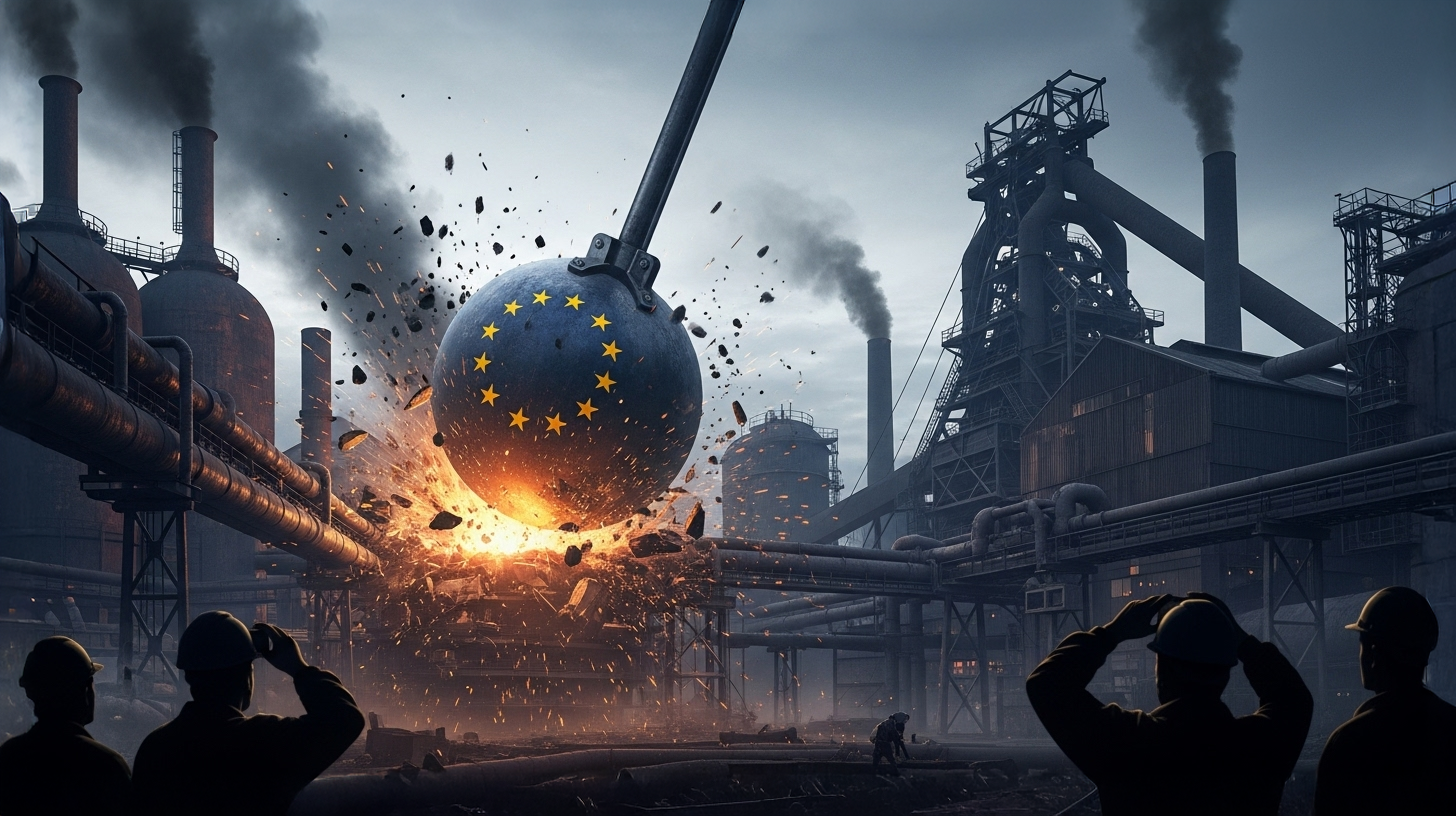
EU plunges British steel industry into the biggest crisis in its history – Image: Xpert.Digital
Shock from Brussels: Is British steel facing extinction?
What is the background to the current crisis in the British steel industry?
The British steel industry faces what is likely to be the greatest challenge in its history in the autumn of 2025. On October 7, 2025, the European Commission announced far-reaching safeguard measures for the European steel sector, which will have a massive impact on the UK's steel industry. The EU Commission proposes reducing duty-free steel import quotas by 47 percent from the planned volumes for 2024 to 18.3 million tonnes per year. At the same time, the tariff rate for steel volumes exceeding this quota is to be doubled from 25 percent to 50 percent. These measures aim to protect the European steel industry from the unfair effects of global overcapacity, particularly from cheap steel from China, which could be increasingly diverted to Europe following the imposition of high US tariffs.
The core of the problem: New EU rules and Britain's export dependency
For the British steel industry, these planned measures represent an existential threat. Approximately 78 to 80 percent of British steel exports go to the European Union, representing a value of around three billion British pounds. Of the roughly four million tons of steel produced annually by Great Britain, about 1.9 million tons are exported to the EU. The EU is thus by far the most important market for British steel. The British steel industry's dependence on this export market makes it particularly vulnerable to EU trade protection measures.
Industry representatives warn of an impending catastrophe
The reactions from the British steel industry are unanimously alarming. Gareth Stace, the director general of the industry association UK Steel, described the situation as potentially the biggest crisis the British steel industry has ever faced. He urged the British government to fully exploit trade relations with the European Union to secure country-specific quotas for the United Kingdom, otherwise a catastrophe looms. Stace also warned of a second serious risk: EU measures could lead to millions of tons of steel, which can no longer be exported to Europe due to European tariffs, being diverted to the British market instead. This could be the final nail in the coffin for many of the remaining British steel companies.
The Community trade union, which represents many British steelworkers, has described the proposed EU measures as an existential threat to the steel industry. Alasdair McDiarmid, the union's deputy general secretary, stressed that Europe is by far the largest destination for British steel exports and that losing access to this market would have a catastrophic impact on British jobs. He appealed to the governments of both the UK and the EU to begin urgent negotiations to mitigate the severe impact of these proposals on the steel industry. McDiarmid warned that a trade war with the EU, at a time when the global steel industry is already under enormous pressure, would be devastating for all involved, with workers in both the UK and Europe bearing the brunt of the consequences.
A sector in free fall: Production figures at a historic low
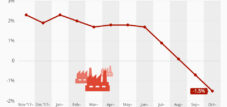
The British steel industry has been undergoing a difficult transformation for years. In 2024, crude steel production in the United Kingdom fell by a dramatic 29 percent to just four million tons. This was the third consecutive decline and marked a historic low. By comparison, British crude steel production has decreased by three-quarters since 2000. The United Kingdom slipped from 26th place among global steel producers in 2023 to 36th in 2024, now ranking between Sweden and Slovakia. The country's importance to global steel production has thus diminished further.
The drastic drop in production in 2024 is primarily due to the closure of the blast furnaces at Port Talbot. The Port Talbot steelworks, the largest in the UK, shut down its first blast furnace in July 2024, followed by the second and final one in September 2024. These closures ended over 100 years of primary steel production in the town. The blast furnaces are being replaced by an electric arc furnace, which is expected to be operational by the end of 2027. This conversion is part of the steel industry's green transformation and aims to reduce CO2 emissions at the site by 90 percent. The Indian owner, Tata Steel, is investing £750 million in the construction of the new electric arc furnace, while the UK government is contributing £500 million.
The high price of modernization: Thousands of jobs are lost
The shift to more climate-friendly production methods has serious social consequences. Tata Steel announced in January 2024 the elimination of 2,800 jobs, with 2,500 of these positions to be cut within 18 months. Most of these job losses are at Port Talbot, with a further 300 potential losses at Llanwern, Newport, within three years. Before the blast furnaces closed, over 4,000 people worked at the Port Talbot steel plant. After its closure in October 2024, approximately 2,000 employees remained, primarily engaged in processing imported steel plates to produce rolled steel products.
The Community trade union described Tata Steel's plans as devastating for Port Talbot and the entire steel industry. The job losses will not only directly impact workers at the steelworks, but also the entire supply chain and the local economy. Academic studies by the University of Leeds on previous mass redundancies in the Welsh steel industry in the early 2000s showed that affected steelworkers faced significant structural barriers to transitioning to new employment and that the redundancies also had negative repercussions in areas such as health and housing. Dr. Calvin Jones estimates that the job losses in Port Talbot could result in the town losing approximately £200 million in annual income, which is almost 15 percent of the town's total gross income.
London's diplomatic maneuvering in the steel crisis
The British government under Prime Minister Keir Starmer has signaled its strong support for the steel industry, but faces the difficult task of balancing competing interests. During a flight to India for a trade mission in October 2025, Starmer stated that his government was in talks with the EU about the proposed steel tariffs. However, he avoided providing details or confirming whether Britain was seeking an exemption from the new regulations. Starmer merely emphasized that the government was discussing steel tariffs with both the EU and the US and would provide more information in due course.
Trade Secretary Chris McDonald called on the European Commission to urgently clarify the impact of this measure on the United Kingdom. He stressed the importance of protecting the flow of goods between Britain and the EU and that the government would work with its closest allies to address global challenges rather than exacerbating industry concerns. The British government also announced that it would continue to consider stronger trade measures to protect British steel producers from unfair practices.
The logic behind the EU's protective measures
The European Union justifies its protective measures with the need to safeguard the European steel industry from the unfair effects of global overcapacity. EU Commission President Ursula von der Leyen emphasized that a strong, decarbonized steel sector is crucial for the competitiveness, economic security, and strategic autonomy of the European Union. Global overcapacity is harming the industry, and action must be taken now. She called on the Council and Parliament to move forward swiftly.
The Commission speaks of a global overcapacity of well over 600 million tons, which is more than five times the EU's annual steel consumption. This overcapacity, the increase in steel imports, and the closure of third-country markets weaken the sector's competitiveness, hinder investment in decarbonization, and jeopardize long-term profitability. The EU accuses China in particular of giving its steel industry an unfair advantage through state aid and ensuring that there is too much steel on the global market.
China's steel glut is flooding the world market
China is by far the world's largest steel producer. According to figures from the World Steel Association, China produced over one billion tons of steel in 2024, accounting for more than half of global steel production. By comparison, German steel production reached approximately 37 million tons in the same year. This enormous Chinese overcapacity is the result of a combination of weak domestic demand, particularly due to the ongoing housing crisis, and state-subsidized production. This overcapacity has led China to massively increase its steel exports.
Chinese steel exports surged in 2024, reaching 50 percent above the five-year average and 19 percent higher than the previous year. With 95 million tons of steel exported, China achieved its highest level since 2015-2016. Thanks to economies of scale, lower input costs, and overcapacity, Chinese steel prices are significantly lower than those of its international competitors. In many countries, the influx of cheap Chinese steel imports threatens domestic steel producers, who struggle to compete with the considerably cheaper imports.
Worldwide defense measures against cheap imports
The momentum of Chinese steel exports has prompted many countries to implement protective measures in the form of tariff increases or anti-dumping duties. In early 2025, Latin American countries such as Mexico, Chile, and Brazil began raising tariffs on Chinese steel. The United States and the European Union soon followed suit. More recently, key Asian trading partners of China, including India and Thailand, have also joined this wave of protectionism. This could strain economic relations, as China is a major buyer and investor in many Latin American and Asian countries.
The US under President Donald Trump took particularly aggressive measures. On March 12, 2025, the additional tariffs on steel and aluminum products, originally introduced in 2018, were reinstated after being partially suspended under the Biden administration. The tariff rate was initially set at 25 percent. On June 4, 2025, Trump increased the tariffs on steel and aluminum imports to 50 percent for all countries except the UK. These measures are intended to strengthen the American steel industry and protect national security interests. Approximately one-quarter of the steel used in the US is imported, the majority of it from neighboring Mexico and Canada or close allies in Asia and Europe.
Caught between US tariffs and EU barriers
The British steel industry is facing an unprecedented double burden. On the one hand, British steel exports to the US have been subject to a 25 percent tariff since March 2025, following Trump's reintroduction of steel tariffs. While the UK received some preferential treatment under an economic prosperity agreement with the US on May 8, 2025, and continues to pay a 25 percent tariff, while other countries have had to pay 50 percent since June 2025, these tariffs still represent a significant burden. The US is the second most important export market for British steel, with approximately 200,000 tons exported annually, representing nine percent by value and seven percent by volume.
On the other hand, the EU is now threatening to drastically increase the cost of, or even completely cut off, the most important export market for British steel with its planned 50 percent tariffs. British steel exporters described the situation to the media as a double blow. One exporter explained that the new EU rules would directly impact British exports and lead to negative trade diversion. Lisa Coulson, commercial director of British Steel, expressed particular concern about reports of the EU's planned reduction of steel import quotas. This could result in British manufacturers being excluded from their largest export market, while they continue to face a 25 percent tariff in the US.
High energy costs as a self-inflicted competitive disadvantage
In addition to trade policy challenges, the British steel industry is struggling with significant structural competitive disadvantages. A particularly serious problem is the extremely high cost of energy. New data from UK Steel, published in September 2025, shows that British steel producers are expected to pay up to 25 percent more for electricity than their competitors in France and Germany in 2025 and 2026. This translates to additional costs of £26 million per year. UK Steel estimated the additional costs for British steelmakers due to higher electricity prices compared to their EU competitors at £117 million annually.
High energy costs are particularly problematic as the steel industry increasingly switches to electric arc furnaces, which have a significantly higher electricity demand than traditional blast furnaces. Electricity is a fundamental input for steel production, and competitive electricity prices are becoming ever more critical for the competitiveness, long-term success, and survival of the industry as it transitions to electrification. Gareth Stace of UK Steel stressed that the British steel industry has its hands tied, facing electricity prices that are up to 25 percent higher than those of its European competitors. These uncompetitive electricity prices pose a threat to jobs, future investment, and net-zero ambitions.
Dependence on imports due to limited product variety
The British steel market is heavily reliant on steel imports. In 2023, production amounted to 5.6 million tonnes, while consumption reached 7.6 million tonnes. However, British steel producers only partially met this demand, selling 3.04 million tonnes on the domestic market. The remaining 4.46 million tonnes were sourced from foreign suppliers. Import penetration in 2023 was 60 percent, compared to 55 percent the previous year.
Importers were able to secure such a large share of the market not only because a significant portion of local steel products were exported, but primarily due to the limited product range of British steel mills. For example, cold-rolled Category 2 flat steel, used in the manufacture of automotive parts and household appliances, is produced in the UK at only one of Tata Steel's mills, and even there in very limited quantities. The company's management therefore decided to discontinue commercial sales and repurpose all of the product for further galvanizing production.
Our EU and German expertise in business development, sales and marketing

Our EU and German expertise in business development, sales and marketing - Image: Xpert.Digital
Industry focus areas: B2B, digitalization (from AI to XR), mechanical engineering, logistics, renewable energies and industry
More information here:
A thematic hub offering insights and expertise:
- Knowledge platform covering global and regional economies, innovation and industry-specific trends
- A collection of analyses, insights, and background information from our key areas of focus
- A place for expertise and information on current developments in business and technology
- A hub for companies seeking information on markets, digitalization, and industry innovations
80,000 jobs at stake: How Britain can defend its steel base
Weakening demand from the automotive and construction industries
The demand for steel in the UK is primarily driven by the automotive and construction sectors, both of which have faced challenges in recent years. UK car production fell by 13.9 percent to 779,584 units in 2024, with a further decline of eight percent in the domestic market to 176,019 units. Total vehicle production fell by 11.8 percent to 905,233 units over the same period. Electric vehicle production declined even more sharply, by 20.4 percent to 275,896 units. The automotive sector is undergoing a difficult transition to electric vehicles, which is impacting steel demand.
The construction sector also faced challenging times, driven by increased costs and a decline in investment and demand amid difficult economic conditions. Construction output fell sharply at the end of 2023, but the Office for National Statistics reported a slow recovery in most sectors during the second half of 2024, with the exception of public housing and commercial works. However, the industry experienced a high number of bankruptcies, totaling 4,102 in the twelve months to November 2024, although this was 6.3 percent lower than in the previous twelve months.
Historical review: The foundation of British industry
The steel industry has a long and significant history in Great Britain. The country was the birthplace of the Industrial Revolution between 1760 and 1840, which brought about innovative mechanization and profound social change. During this process, steam-powered machines were invented and used in the factories of the ever-expanding urban centers. The British steel industry played a pivotal role in the country's industrialization and contributed significantly to its economic power and global influence.
During the interwar period of the 20th century, the sympathies of the British steel industry undoubtedly lay with the Conservative-led government. They pressed the government for a policy of protectionist tariffs against foreign competition and supported the Ottawa Treaty, the creation of a closed economic area within the British Empire. The British steel industry's accession to the International Crude Steel Export Community in 1935 underscored the remarkable influence that the British iron and steel industry wielded over the government.
Post-war development: From nationalization to global takeovers
During World War II, the state controlled steel production, and this continued afterward. In 1967, the government consolidated ninety percent of production—14 companies with 268,500 employees—under the umbrella of British Steel. British Steel closed outdated, small steel mills and concentrated production at five sites. This restructuring met with fierce resistance. Workers protested in 1980 with a 13-week strike, ultimately unsuccessful. Prime Minister Margaret Thatcher, in office since 1979, pursued privatization.
By the late 1980s, the company was profitable again, with its workforce reduced to less than half its former size. In 1988, the Thatcher government privatized British Steel. In 1999, British Steel and the Dutch company Hoogovens merged to form Corus. Three years and three CEOs later, the company was on the brink of collapse. Under the leadership of Philippe Varin, Corus recovered through further job cuts. In February 2007, it was announced that the Indian Tata Group would acquire Corus. At that time, Corus employed 24,000 people at four sites in Great Britain.
Brexit as an additional crisis catalyst
Brexit has further complicated the situation for the British steel industry. Even after Brexit, the UK remains an open economy heavily dependent on foreign trade. In 2024, exports of goods and services accounted for roughly one-third of the gross domestic product. The EU, with a 48 percent share of all British exports, is a significantly larger market than the USA, which accounts for 16 percent. British hopes for a substantial Brexit dividend from leaving the European Union have not materialized. The country has neither gained significant financial flexibility nor has it been able to even remotely compensate for the disadvantages in trade policy resulting from Brexit through new trade agreements with third countries.
In 2021, the first year in which the Single Market rules were replaced by the provisions of the Trade and Cooperation Agreement, the adverse effects on trade between the two economies became evident. British imports from the EU suffered particularly. The Northern Ireland Protocol only partially fulfilled the expectations placed upon it. Border controls in the Irish Sea led to political tensions. Furthermore, trade diversion effects between Great Britain and Northern Ireland are observable.
The concrete consequences: How the EU plans will affect market access
The proposed 47 percent reduction in duty-free steel import quotas means that significantly less steel can be imported into the EU without incurring tariffs. For British steel producers, this could severely restrict or even completely cut off access to their most important export market. If British steel shipments exceed the new, significantly lower quotas, tariffs of 50 percent would be levied, effectively rendering British steel products uncompetitive in the European market. Emily Sawicz, Director and Senior Analyst for Industrials at RSM UK, described the EU announcement as a significant threat to the British steel industry. The EU accounts for approximately 80 percent of British steel exports, so these tariffs risk cutting off access to the UK's largest and most strategically important market, at a time when the sector is already under enormous pressure from global competition and rising energy costs.
The proposed measure would replace the steel protection measure, which expires in June 2026. It addresses the demands of workers, industry, several Member States, Members of the European Parliament, and EU stakeholders to provide strong and lasting protection for the EU steel industry in order to preserve jobs within the EU and support the sector in its decarbonization efforts. However, for the British steel industry, this poses an existential threat to its export opportunities.
Hope for exceptions and special regulations
The European Commission has announced that, due to their close integration into the EU single market under the European Economic Area Agreement, no tariff quotas or duties will apply to exports from Norway, Iceland, and Liechtenstein. These countries are part of the EEA and are therefore subject to different regulations than third countries. The Commission has also indicated its willingness to exempt Ukraine from tariffs, arguing that the interests of an accession candidate country facing an urgent and immediate security situation should be taken into account when allocating quotas, without compromising the effectiveness of the measure.
For the UK, which is neither part of the EEA nor a candidate for EU membership in a security crisis, there is currently no clear exemption. However, the EU ambassador to the UK, Pedro Serrano, stated that negotiations will take place with countries like the UK that have a trade agreement with the EU to consider a country-specific allocation of the duty-free quota. He confirmed that contacts have already taken place at the official level between Whitehall and Brussels and are ongoing. The British government hopes that these negotiations will lead to a more favorable solution for the domestic steel industry.
The government's strategy: negotiations and its own defensive walls
The British government is attempting to negotiate on several fronts to mitigate the impact of both US and European steel tariffs. Prime Minister Keir Starmer has repeatedly emphasized that Britain is in talks with both the EU and the US regarding the steel tariffs. However, the government is avoiding disclosing details of its specific demands or negotiating positions. This could indicate that the negotiations are still in their early stages or that the government wishes to avoid weakening its negotiating position by revealing too much information too soon.
Trade Secretary Jonathan Reynolds has announced in a letter to the Trade Remedies Authority that he intends to reject the authority's recommendations and make a different decision by introducing lower import limits on steel from certain countries. These measures are intended to ensure the overall effectiveness of the UK's safeguards for domestic steel producers while also guaranteeing security of supply for the UK market. In June 2025, the UK introduced stricter-than-expected trade restrictions on steel, limiting imports from Vietnam, South Korea, and Algeria to better protect domestic supplies from the effects of a global trade war.
Resistance from the EU: Europe's automotive industry sounds the alarm
The planned EU steel tariffs have sparked controversy not only in Britain but also within the EU itself. The European Automobile Manufacturers' Association has warned that these measures could jeopardize the domestic automotive industry. The association emphasized that European car manufacturers source around 90 percent of their steel directly from the EU and are particularly concerned about the inflationary impact these restrictions will have on prices in the European market. The significant reduction in quotas and the doubling of the out-of-quota tariff to 50 percent would severely limit the ability to alleviate market shortages through imports.
ACEA Director General Sigrid de Vries acknowledged the need for some degree of protection for the steel sector, but stated that the parameters proposed by the Commission were too broad and would isolate the European market too much. She called for a better balance between the needs of European steel producers and European steel consumers in this sector. The new rules of origin, based on the melt-and-cast principle, would restrict imports and impose a significant administrative burden on European consumers of imported steel products.
The challenge of decarbonization and carbon border adjustment
The steel industry worldwide is under enormous pressure to reduce its CO2 emissions and become climate-neutral by 2050. The European Union has set ambitious targets with its Green Deal and the Fit for 55 package. As part of these efforts, the Carbon Border Adjustment Mechanism (CBAM) was introduced. A transitional phase with reporting obligations has been in effect since October 2023. From January 1, 2026, CBAM will apply to importers of certain emissions-intensive goods into the EU. These include, in particular, products from the iron and steel, aluminum, cement, electricity, fertilizers, ammonia, hydrogen, and iron ore sectors.
The CBAM aims to create a level playing field for domestic and foreign producers, make the carbon price more effective, and promote climate-friendly production worldwide. For the steel industry, this means additional costs and administrative burdens, particularly for imports from countries with lower environmental standards. The British steel industry, already struggling with high energy and transformation costs, faces a further burden from CBAM as it simultaneously tries to decarbonize its own production.
The economic implications: Tens of thousands of jobs are in jeopardy
Despite its decline, the British steel industry remains a significant employer. The steel sector directly employs 33,700 people, with a further 42,000 jobs dependent on the wider supply chain. Wages in the steel industry average 26 percent above the national median and 35 percent above the regional median in Wales, Yorkshire, and Humberside, where the majority of steel jobs are located. In 2023, the British steel industry contributed £1.8 billion directly to the UK economy, a further £2.4 billion through supply chains, and £3.4 billion to the UK's trade balance.
The Community trade union estimates that around 80,000 jobs depend directly or indirectly on the steel industry when considering the entire value chain. With roughly 80 percent of UK steel exports going to Europe, the proposed EU measures pose a fundamental threat to the sector and the thousands of jobs and communities it supports across the country. The loss of these jobs would particularly affect regions already struggling with the effects of severe deindustrialization.
The search for solutions and demands on politics
The British steel industry faces the difficult task of finding alternative markets and increasing its competitiveness. UK Steel is calling on the government to implement comprehensive measures to improve the sector's competitiveness. These include, in particular, the lowest industrial electricity prices in Europe, the competitiveness and recyclability of steel scrap, a partnership between government and industry, and investment in innovation. UK Steel proposes the introduction of a bidirectional Contracts for Difference (CFD) mechanism for wholesale electricity, which would align UK industrial electricity prices with those in France and Germany.
The organization is also calling for the increase in grid charge compensation to 90 percent to be applied retroactively from April 2025 to avoid another year of excessive costs for British producers. These measures would finally allow the government to eliminate the inequality in industrial electricity prices. Gareth Stace stressed that the price is enormous. By ensuring competitive electricity prices, Britain can build a modern, low-carbon steel industry that will support clean energy, infrastructure, and manufacturing for decades to come.
Unequal rescue operations: The Scunthorpe and Port Talbot cases
While the blast furnaces in Port Talbot have already been shut down, the steelworks in Scunthorpe, owned by the Chinese conglomerate Jingye and operating under the name British Steel, finds itself in a similarly precarious situation. In April 2025, the British government took extraordinary measures to save the plant. Parliament was convened for a rare Saturday session to pass emergency legislation allowing the government to take control of the steelworks in England. This was the first such parliamentary session since 1982. Prime Minister Starmer declared that the future of British Steel hung by a thread and that economic and national security were at stake.
The different treatment of Port Talbot and Scunthorpe sparked controversy. Welsh politicians accused the British government of double standards. Liz Saville-Roberts, leader of Plaid Cymru in Westminster, remarked that Scunthorpe was receiving assurances, while Port Talbot had only been given a token gesture. She criticized the government's decision not to intervene in Wales and described the day as one of deep disappointment for Port Talbot. The government, however, argued that the circumstances of the two steelworks were different and that Port Talbot was in a more favorable position due to the Labour government.
Uncertain future prospects for a former industrial giant
The long-term prospects for the British steel industry remain extremely uncertain. Without successful negotiations with the EU on country-specific quotas or exemptions from the planned 50 percent tariffs, the sector could face an existential collapse. Following the complete conversion to electric arc furnaces and the cessation of primary steel production, the United Kingdom would be the only G20 nation unable to produce primary steel from iron ore and coal. This would significantly weaken the country's strategic autonomy and industrial base.
Britain's once-mighty steel industry has shrunk dramatically since its heyday in the 1970s and now accounts for just 0.1 percent of the economy. For the birthplace of the industrial revolution, which once claimed global prominence, this is yet another severe blow. The industry faces the Herculean task of competing in an increasingly protectionist global environment, while simultaneously managing the most expensive energy supply among the G7 countries and investing in costly decarbonization. Whether the British steel industry can overcome these multifaceted challenges will depend significantly on the government's ability to create the necessary framework and conduct successful international negotiations.
Your global marketing and business development partner
☑️ Our business language is English or German
☑️ NEW: Correspondence in your native language!

Konrad Wolfenstein
I and my team are happy to be available to you as your personal advisor.
You can contact me by filling out the contact form here wolfenstein@xpert.digital:or simply call me at +49 7348 4088 965. My email address is
I'm looking forward to our joint project.
☑️ SME support in strategy, consulting, planning and implementation
☑️ Creation or realignment of the digital strategy and digitization
☑️ Expansion and optimization of international sales processes
☑️ Global & Digital B2B trading platforms
☑️ Pioneer Business Development / Marketing / PR / Trade Fairs
🎯🎯🎯 Benefit from Xpert.Digital's extensive, five-fold expertise in one comprehensive service package | BD, R&D, XR, PR & Digital Visibility Optimization

Benefit from Xpert.Digital's extensive, five-fold expertise in a comprehensive service package | R&D, XR, PR & Digital Visibility Optimization - Image: Xpert.Digital
Xpert.Digital possesses in-depth knowledge across various industries. This allows us to develop tailored strategies precisely aligned with the requirements and challenges of your specific market segment. By continuously analyzing market trends and monitoring industry developments, we can act proactively and offer innovative solutions. The combination of experience and expertise generates added value and provides our clients with a decisive competitive advantage.
More information here: