Blue Ocean Strategy – Blue and Red Ocean Strategy – Image: Whale Design|Shutterstock.com
In the context of the Blue Ocean Strategy, the term "ocean" describes a market or industry. "Blue oceans" are understood as untouched markets or industries with little to no competition. Anyone venturing into a blue ocean would thus discover undiscovered markets or industries. "Red oceans," on the other hand, refer to saturated markets characterized by fierce competition, crowded with competitors all offering the same services or products.
The term "Red Ocean" is based on the image of bloody battles between predatory fish (the competitors), while the "Blue Ocean" is free of bloody battles.
The Blue Ocean Strategy concept is based on the idea that successful companies don't simply follow the competition, but rather seek their own innovative paths to create their own Blue Ocean. Innovations open up new markets and increase their attractiveness by eliminating certain unattractive market characteristics that are less valued in existing competition. Successful innovations are rarely based on technological advancements, but rather on a completely new design of the overall offering. This often involves redefining the market or the consumer.
Blue Ocean Methodology

Red Ocean strategy with competition, struggle and competitors – Image: Leremy|Shutterstock.com
The Blue Ocean Strategy is a strategic management method for developing sustainably profitable business models. Its core principle is that lasting success can only be achieved by developing innovative new markets that offer truly differentiating and relevant benefits—"Blue Oceans"—to the broad mass of customers and non-customers alike. This is to be achieved, among other things, through the elimination of insignificant competition, the acquisition of new customers, and optimized cost structures.
Value curves
First, a value curve is created for a market or industry to clarify which core elements characterize it from the perspective of customers and non-customers. Important characteristics can be, for example, significant and highly contested core attributes or investment drivers of competitors. A company's value curve is then visualized alongside the value curves of its current and potential competitors.
Value curves within a strategic group (e.g., premium vs. budget providers) are usually interchangeable and reflect an industry standard.
Value curves can be permanently altered by changing the core elements that were previously defined. There are four ways to redefine core elements:
Elimination:
Which factors need to be omitted? Customers' considerations regarding benefits can change drastically, so some components of a product may need to be eliminated.
Reduction:
What can be radically cut? Excessive differentiation drives up costs and can overwhelm customers.
Improvement:
Which elements of the product need to be improved beyond the industry standard?
Creation:
Which components of a product need to be reinvented? By modifying the core elements of a value curve, new business models should be able to be developed.
Implementation
Two aspects must be considered during implementation:
- Overcoming organizational hurdles (tipping point management)
- Integrate implementation into the strategy
Blue Ocean vs. Red Ocean

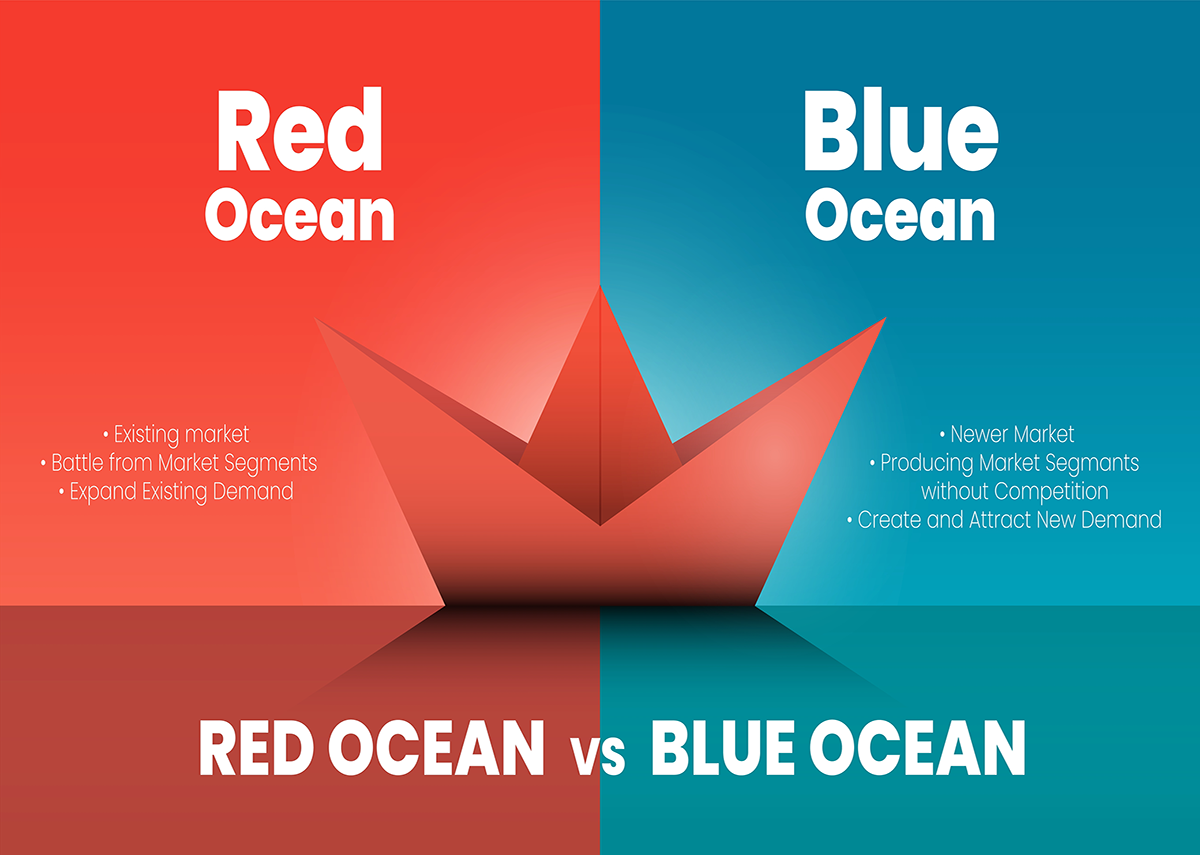
Red Ocean vs Blue Ocean – Image: Whale Design|Shutterstock.com
Red Ocean Strategy
- Competition in the existing market
- Beat the competition
- Utilize existing demand
- Direct relationship between benefits and costs
- Alignment of the overall system of business activities with the strategic decision for differentiation or low costs
Blue Ocean Strategy
- Creating new markets
- Avoid the competition
- Develop new demand
- Breaking the direct link between benefits and costs
- Aligning the overall system of business activities towards differentiation and low costs
Examples
Yellow Tail Wine
If not the oldest, then certainly the most frequently cited example is a wine producer from Australia. The company had the "stuck-in-the-middle" problem and was therefore unable to properly establish itself in the market. By adapting the wine into an easy-to-drink alcoholic beverage, reducing quality while raising prices, the company was saved. The new target group was no longer wine drinkers demanding quality and body, but beer drinkers who simply wanted to consume alcohol.
This has opened up a new market, or rather, the company has engaged in displacement within the beer market.
Stuck in the Middle: The company is too small to compete with the market leaders and too large to exploit the niche of specialists.
Southwest Airlines
Perhaps the oldest example is the story of the low-cost carrier Southwest Airlines, which considered alternative industries and created new value for potential customers. Southwest Airlines positioned itself as a competitor to the automobile, not to other airlines, and adapted its strategy to the resulting needs
- Reduced prices due to the elimination of additional services
- Improved check-in times and departure frequency
- It allows the customer to travel at a high speed (airplane) at a low price (comparable to a car)
This represents a redefinition of the service offered. The customer is now the ordinary traveler, not just the business or leisure traveler.
The Body Shop
Another prominent example is The Body Shop concept, which introduced new functional and emotional value to the cosmetics industry. The often glamorous image of cosmetic corporations was disregarded in The Body Shop concept. Instead, The Body Shop stood out through its functional approach, reduced prices, and unpretentious packaging. Increased emphasis was placed on natural ingredients, a healthy lifestyle, and ethical considerations. As a result, The Body Shop reached a new customer base and achieved significant cost savings (approximately 85% of costs were saved through packaging and advertising).
Nintendo
A more recent example of a Blue Ocean Strategy is the success of the Nintendo Wii game console, which was developed for a new target group for video games. With a control concept based on motion sensors, Nintendo avoids the competition for graphics and processing power from other consoles like Microsoft's Xbox or Sony's PlayStation.
Nespresso
Another example is the introduction of the Nespresso coffee system by the food company Nestlé.
Cirque du Soleil
Cirque du Soleil has carved out a new niche for itself in the circus market. Its most striking feature is that, unlike conventional circuses, no animals are used. Instead, the focus is on the artist and the combination of entertainment elements such as opera, ballet, and rock music. The music is performed exclusively live. The target audience is no longer primarily families with children, but rather adults willing to pay a correspondingly higher ticket price for high-quality entertainment.
The book 'Blue Ocean Strategy'

Blue Ocean Strategy – Image: Whale Design|Shutterstock.com
Blue Ocean Strategy is a book published in 2004 by W. Chan Kim and Renée Mauborgne, both professors at INSEAD, a private business school founded in 1957 and headquartered in France. It is also the name of the marketing theory described in the book, initially referred to as Value Innovation. Based on empirical studies spanning 15 years, and through the analysis of more than 100 leading companies, examples were found of businesses that tapped into new, previously untapped market segments, thereby rendering their existing competitors irrelevant.
They argue that these strategic moves create added value for the company, its customers, and its employees, while unlocking new demand and rendering the competition irrelevant. The book presents analytical frameworks and tools that foster a company's ability to systematically create and conquer "blue oceans"—uncharted new market areas. An expanded edition of the book was published in 2015, while a sequel, titled *Blue Ocean Shift*, appeared in 2017.
The first part introduces the key concepts of the Blue Ocean Strategy, including Value Innovation—the simultaneous pursuit of differentiation and low costs—as well as important analytical tools and frameworks such as the Strategic Planning Overview and the Four Actions Framework. The Four Actions Framework helps to resolve the conflict between differentiation and low costs within a company. The Four Actions Framework consists of the following elements:
Raising: This refers to the question of which factors within an industry need to be raised in terms of product, price, or service standards.
Eliminate: This refers to the question of which areas of a company or industry could be completely eliminated in order to reduce costs and create a completely new market.
Reduce: This refers to identifying aspects of a company's product or service that are not strictly necessary but play a crucial role in your industry. For example, the cost of manufacturing a specific material for a product could be reduced. It can therefore be reduced without eliminating it entirely.
Creation: This motivates companies to be innovative with their products. By creating a completely new product or service, a company can create its own market by differentiating itself from the competition.
The second part describes the four principles of Blue Ocean strategy formulation. These four principles address how a company can create blue oceans by looking beyond the six conventional boundaries of competition (Six Paths Framework), reducing its planning risk by following the four steps of strategy visualization, creating new demand by tapping into the three levels of non-customers, and bringing a commercially viable blue ocean idea to market by aligning the unprecedented value of an offering with strategic pricing and target costing, and overcoming barriers to adoption. Using numerous examples from various industries, the book demonstrates how to break free from traditional competitive (structuralist) strategic thinking and increase demand and profit for the company and the industry using blue ocean strategic thinking (reconstructivist). The four principles are:
- Creation of an uncontested market area through reorganization of market boundaries
- Focus on the big picture
- To penetrate beyond existing demand and supply into new market areas
- Finding the right strategic sequence
The third and final section describes the two key implementation principles of the Blue Ocean Strategy: Tipping Point Leadership and Fair Processes. These principles are essential for leaders to overcome the four major organizational barriers that can hinder even the best strategies from being implemented. These four barriers are cognitive, resource-related, motivational, and political. They prevent those involved in strategy implementation from recognizing the need to break with the status quo, finding the resources to implement the new strategy, gaining the support of employees, and overcoming the powerful vested interests that could block change.
In this book, the authors draw their readers' attention to the correlation of success stories across various industries and the formulation of strategies that provide a solid foundation for unconventional success—a strategy dubbed the "Blue Ocean Strategy." In contrast to the "Red Ocean Strategy," the conventional business approach derived from military organization for overcoming competition, the "Blue Ocean Strategy" seeks to balance innovation with value, price, and cost positioning. The book scoffs at the conventional choice between product/service differentiation and lower costs, suggesting instead that both differentiation and lower costs can be achieved simultaneously.
The authors ask readers: “What is the best unit of analysis for profitable growth? Company? Industry?”—a fundamental question without which any strategy for profitable growth is meaningless. The authors argue, with original and practical ideas, that neither the company nor the industry is the best unit of analysis for profitable growth; rather, it is the strategic move that creates the “blue ocean” and sustained high performance. The book examines the experiences of companies from sectors as diverse as watches, wine, cement, computers, automobiles, textiles, coffee machines, airlines, retailers, and even the circus to answer this fundamental question, building on the argument that “value innovation” is the cornerstone of a blue ocean strategy. Value innovation is necessarily the alignment of innovation with benefits, price, and cost. This creates an uncontested market space and renders competition irrelevant. The new chapters in the expanded edition of the book address how the three strategic propositions of value, profit, and people can be developed and aligned; how the Blue Ocean strategy can be maintained and renewed at both the business and corporate levels; and how to avoid the Red Ocean traps that keep companies entrenched in the existing market even when they attempt to create new market spaces.[7] The following section explains in detail the underlying concept of the book.
criticism
Many of the book's key concepts were already covered in *Competing For The Future* by Gary Hamel and C.K. Prahalad, published in 1996. The authors encouraged managers to stake out new marketing spaces, which they termed "white space," in order to "create and dominate new opportunities.".
Write to me


Xpert.Digital – Konrad Wolfenstein
Xpert.Digital is a hub for industry focusing on digitalization, mechanical engineering, logistics/intralogistics and photovoltaics.
With our 360° Business Development solution, we support renowned companies from new business to after-sales.
Market intelligence, smarketing, marketing automation, content development, PR, mail campaigns, personalized social media and lead nurturing are part of our digital tools.
You can find more information at: www.xpert.digital – www.xpert.solar – www.xpert.plus
Keep in touch