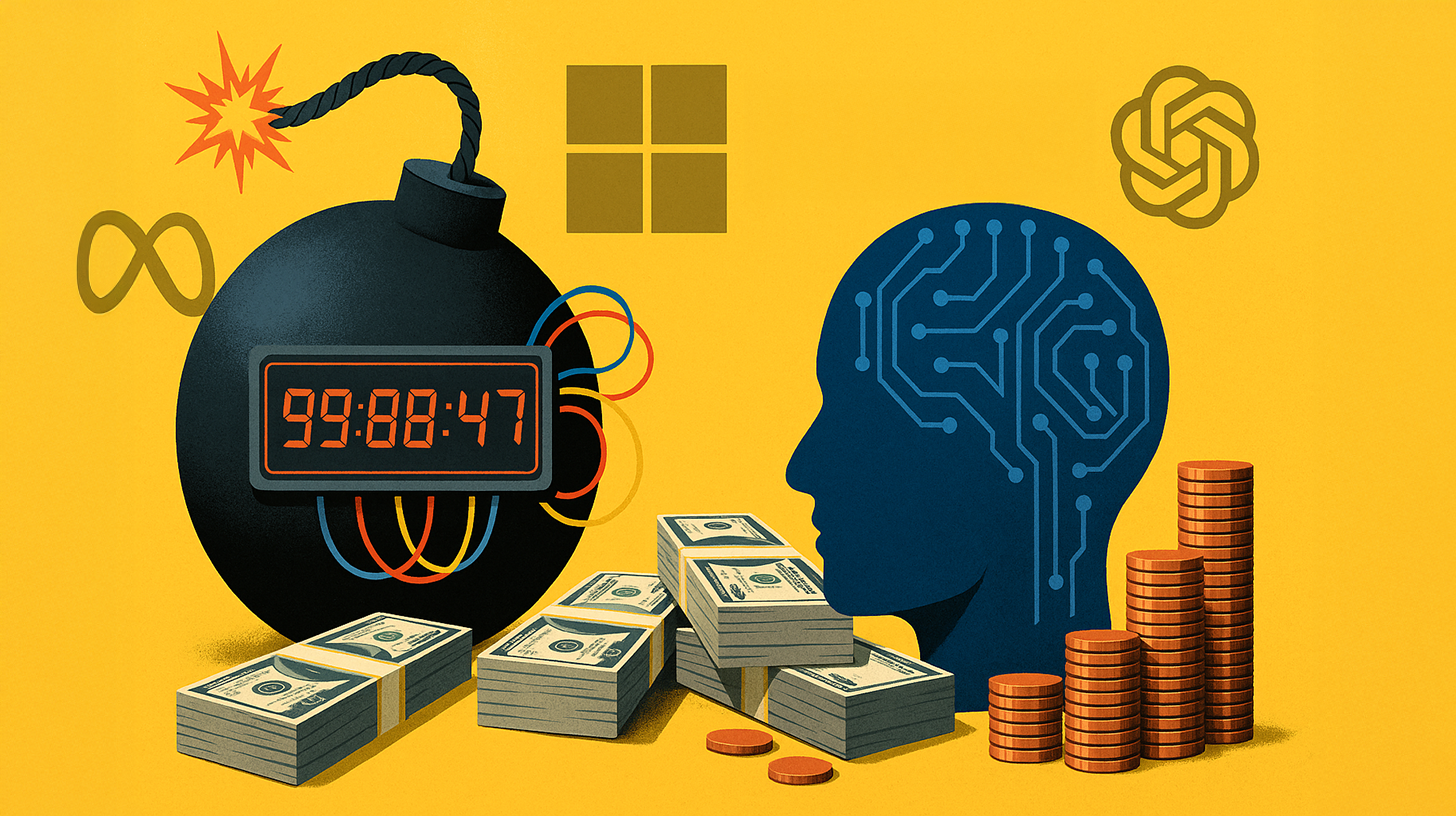
The billion-dollar time bomb of artificial intelligence: How Meta, Microsoft and OpenAI are creating a new tech bubble – Image: Xpert.Digital
The $200 billion bet: Why the AI boom could end in disaster
“Uncanny parallels”: Why the AI bubble is now even surpassing the dot-com era
The tech world is in a frenzy. Fueled by the promises of artificial intelligence, there seem to be no limits. But behind the glittering facade of ChatGPT, groundbreaking innovations, and exploding stock prices, a storm is brewing that has the potential to shake the global economy. Giants like Meta, Microsoft, and OpenAI are pumping hundreds of billions of dollars into a technology whose economic benefits are still uncertain – creating a speculative bubble of historic proportions.
The parallels to the dot-com bubble of the late 1990s are unmistakable and alarming. Reputable investment banks are sounding the alarm, legendary investors like Warren Buffett are holding back, and the warning signs are mounting: astronomical valuations without profitable business models, questionable circular financing, and an energy hunger that is pushing the physical limits of our planet. While an unprecedented arms race for the most expensive infrastructure rages in the West, disruptive players from China are demonstrating that comparable results are possible at a fraction of the cost – thus calling into question the entire foundation of the boom. This article delves deep into the epicenter of the AI bubble, exposes the fragile financial structures, and shows why the coming crash could be louder than anything we have seen before.
Related to this:


The dangerous game with artificial intelligence
The tech world is on the brink of an unprecedented financial catastrophe. What began as an artificial intelligence revolution is increasingly turning into a dangerous speculative gamble, bearing frightening parallels to the dot-com bubble of the late 1990s. Meta, Microsoft, OpenAI, and other tech giants are investing hundreds of billions of dollars in a technology whose commercial viability remains unclear.
Warning signs are mounting: Goldman Sachs, Morgan Stanley, and other renowned investment banks are warning of a massive misallocation of capital. While the share prices of major technology companies reach new highs, doubts are growing about the sustainability of this trend. Jim Chanos, one of the most prominent short sellers in the financial world, is already drawing direct parallels to the speculative excesses of the turn of the millennium.
The astronomical investments of the tech giants
The figures are staggering: Meta, Microsoft, Amazon, and Alphabet alone plan to invest over $215 billion in AI projects by 2025. That's roughly equivalent to the gross domestic product of countries like Finland or Chile. Microsoft spends $1 billion a week building new data centers, employing 100,000 construction workers—three times the number needed to build a pyramid.
Meta CEO Mark Zuckerberg announced plans to invest at least $66 billion in AI infrastructure by 2025, an increase of $2 billion over the original plan. Google's parent company, Alphabet, increased its investment spending for 2025 by $10 billion to $85 billion. This spending has more than tripled since 2021 and is reaching economically significant proportions.
The investments are primarily flowing into the construction of gigantic data centers equipped with specialized AI chips from Nvidia. A single AI server with eight Nvidia Blackwell chips costs at least one million dollars. Prices have reached a level that can no longer be justified by the real-world benefits of this technology.
Related to this:

OpenAI: The burning mountain of money at the center of the bubble
At the epicenter of this development is OpenAI, the company behind ChatGPT. The company's financial situation reveals the full extent of the problem: OpenAI anticipates losses of five billion dollars in 2024 on revenues of only 3.7 billion dollars. This loss ratio is exceptionally high, even for a rapidly growing technology company.
OpenAI's cost structure illustrates why profitable AI is so difficult to achieve: $700,000 daily for server infrastructure alone, $7 billion annually for training AI models, and $1.7 billion for personnel costs. Internal projections indicate that OpenAI might not become profitable until 2029 – and will accumulate losses totaling $44 billion until then.
This dire financial situation is forcing OpenAI to take drastic measures: The monthly cost of ChatGPT Plus is set to increase gradually from the current $20 to $44 over the next five years. At the same time, the company is constantly seeking new investors – the current funding round is expected to give OpenAI a valuation of $150 billion, even though the company is deeply in the red.
The dangerous game of circular finance
Particularly alarming is the way these investments are financed. Nvidia, the biggest beneficiary of the AI boom, is now investing $100 billion in OpenAI itself – a deal criticized by experts as circular financing. OpenAI buys Nvidia chips, Nvidia invests in OpenAI, and both companies profit from rising valuations based on ever-larger investments.
Jay Goldberg of D2D Advisory compared this situation to parents co-signing their children's first mortgage – a system that only works as long as all parties involved continue to invest. Peter Boockvar of One Point BFG draws direct parallels to Lucent and Nortel, two companies that artificially simulated growth during the dot-com bubble through similar manufacturer financing before they collapsed.
The Chinese challenge: DeepSeek shakes the system
While Western companies invest hundreds of billions in increasingly expensive AI infrastructure, the Chinese startup DeepSeek demonstrated that comparable results are possible with a fraction of the resources. The AI model R1 cost only $294,000 to develop and was trained on outdated Nvidia H800 chips.
For comparison, OpenAI spent over $100 million training GPT-4, while DeepSeek developed a competitive model for less than $300,000. This discrepancy calls into question the entire investment logic of the Western AI industry and could result in massive write-downs.
DeepSeek's success led to a temporary drop in Nvidia's stock price by almost $600 billion in market capitalization and unsettled the entire industry. Microsoft CEO Satya Nadella admitted that the developments in China had to be taken very seriously.
The energy crisis as a limiting factor
Another critical aspect of the AI bubble is its exploding energy consumption. Data centers in the US already consumed 176 terawatt-hours in 2023, and this figure could rise to between 325 and 580 terawatt-hours by 2028. That would correspond to up to twelve percent of total US electricity consumption.
A modern AI data center consumes as much electricity as 100,000 households; particularly large facilities consume up to twenty times that amount. Global electricity consumption by data centers could double by 2030, reaching the equivalent of the entire energy consumption of Japan.
This development is already reaching its physical limits: Popular locations like Northern Virginia are overcrowded, and tech companies are relocating to second- and third-rate regions. New buildings scheduled for completion in 2028 are already fully booked, even though it remains unclear whether the massive AI demand will actually materialize.
A new dimension of digital transformation with 'Managed AI' (Artificial Intelligence) - Platform & B2B solution | Xpert Consulting

A new dimension of digital transformation with 'Managed AI' (Artificial Intelligence) – Platform & B2B solution | Xpert Consulting - Image: Xpert.Digital
Here you will learn how your company can implement customized AI solutions quickly, securely and without high entry barriers.
A managed AI platform is your all-inclusive, worry-free solution for artificial intelligence. Instead of dealing with complex technology, expensive infrastructure, and lengthy development processes, you receive a ready-made solution tailored to your needs from a specialized partner – often within just a few days.
The key advantages at a glance:
⚡ Rapid implementation: From idea to ready-to-use application in days, not months. We deliver practical solutions that create immediate added value.
🔒 Maximum data security: Your sensitive data stays with you. We guarantee secure and compliant processing without sharing data with third parties.
💸 No financial risk: You only pay for results. High upfront investments in hardware, software, or personnel are completely eliminated.
🎯 Focus on your core business: Concentrate on what you do best. We take care of the entire technical implementation, operation, and maintenance of your AI solution.
📈 Future-proof & scalable: Your AI grows with you. We ensure continuous optimization and scalability, and flexibly adapt the models to new requirements.
More information here:
AI vs. Dotcom: Is the biggest tech bubble of all time looming? Who will survive the AI bursting?
Warren Buffett's cautious positioning
While many investors are succumbing to the AI hype, Warren Buffett remains characteristically cautious. The portfolio of his investment company, Berkshire Hathaway, demonstrates a strategic reluctance towards direct AI investments. Instead, he focuses on established technology companies like Apple and Amazon, which could benefit from AI without being entirely dependent on it.
Buffett's approach reflects the wisdom of a seasoned investor who has already weathered several speculative bubbles. His focus on companies with diversified business models and sustainable competitive advantages stands in stark contrast to the speculative excesses of pure AI stocks.
The parallels to the dot-com bubble are undeniable
The similarities to the dot-com bubble of the late 1990s are striking. Just as the internet was back then, AI is now being touted as a revolutionary technology that will render all traditional business models obsolete. According to experts, valuations have already surpassed the highs of the dot-com era.
Henry Blodget, a former star analyst from the dot-com era, warns of eerie parallels. Both technologies – the internet and AI – have an impact far beyond the tech industry. Investments in AI infrastructure alone will amount to at least $400 billion in 2024 and are massively driving the global economy and stock markets.
Torsten Sløk, chief economist at Apollo Global Management, goes even further: The current overvaluations in the AI sector even surpass those of the dot-com bubble at the end of the 1990s. The concentration on a few large technology companies is eerily reminiscent of the late 1990s, when internet companies gained significant value in a very short time before many collapsed in the subsequent crisis.
Related to this:

The structural differences exacerbate the risk
Paradoxically, the structural differences compared to the dot-com bubble could make today's situation even more dangerous. Unlike back then, the massive investments are financed not by debt, but by the profits of the tech giants. This means that the companies can survive for longer periods, leading to even greater misallocations of resources.
Today's tech companies are profitable and have strong balance sheets, allowing them to continue their investments for years, even if they don't pay off. This apparent strength could prove to be a weakness, as it prevents markets from correcting early.
Another critical difference: While private investors were the primary speculators during the dot-com era, institutional investors and pension funds are now heavily invested in AI stocks. A bursting of the bubble would therefore have far-reaching systemic consequences.
Financing structures are becoming increasingly fragile
The development of financing structures is particularly worrying. Tech companies that have been debt-free for years are increasingly taking out loans. In the first half of 2025, the volume of investment-grade loans to tech companies was 70 percent higher than in the previous year.
Microsoft has reduced its cash reserves but nearly tripled its finance lease liabilities—a form of debt for data centers—to $46 billion. Another $93 billion of these liabilities don't even appear on its balance sheet. Meta is negotiating $30 billion in loans with private lenders.
Smaller AI companies like CoreWeave and Fluidstack are taking on massive debt to buy Nvidia chips and using these chips as collateral for further loans. This Ponzi scheme only works as long as chip prices continue to rise and demand for AI continues to grow.
The warning signs are increasing
Experts have identified several classic warning signs of a speculative bubble. Prices for AI infrastructure are rising sharply without a corresponding improvement in the underlying fundamentals. Private investors without specialized knowledge are investing heavily in AI stocks; Nvidia stock has become one of the most popular stocks for retail investors.
Typical statements like "this time it's different" or "prices will keep rising" are widespread. The euphoria has reached a level where rational criteria for evaluation are suspended.
In a recent study, Goldman Sachs warns of a "nervous atmosphere" in which large technology companies "live in fear of disruption and deploy capital to act both offensively and defensively." The scale of these investments is now comparable to the spending of medium-sized economies.
The inevitable correction and its consequences
When the AI bubble bursts—and the question is not if, but when—the consequences will be devastating. Not all the hyped-up companies will survive. Just like after the dot-com bubble burst, in the end there will only be a handful of winners.
Microsoft, Meta, and Google could survive a crash because their business models are based on multiple pillars. Nvidia will likely survive, as its chips are also needed outside of AI. The outlook is considerably bleaker for smaller AI labs like Anthropic, Mistral AI, and the numerous data center providers.
Morgan Stanley analysts warn that a market downturn could begin "at any moment and without warning." With traditionally defensive assets overpriced due to years of money printing, investors may find no safe haven.
The way out of the crisis
Paradoxically, the bursting of the AI bubble could have positive long-term effects. If the focus on ever-larger metrics and the marketing pressure subside, the use of AI could be limited to areas that offer genuine added value.
The exaggerated expectations would be replaced by more realistic assessments. Companies would have to demonstrate that their AI investments actually lead to productivity gains and cost savings, instead of just delivering impressive demonstrations.
History teaches us that even after speculative bubbles burst, the underlying technology often survives and thrives. Amazon and Google emerged from the ruins of the dot-com bubble and became some of the world's most valuable companies. Similarly, a more sustainable and profitable ecosystem could develop after an AI correction.
Related to this:

The calm before the storm
The current situation is eerily reminiscent of the months before the dot-com bubble burst. All the warning signs are there: astronomical valuations, circular financing, inflated expectations, and a widespread attitude that "this time it's different.".
Meta, Microsoft, OpenAI, and the other protagonists of this story have created a time bomb whose explosive power could surpass that of the dot-com bubble. The billions pumped daily into this speculative bubble will not disappear without a trace—they will leave a trail of devastation through the technology industry and the global economy.
Smart investors should prepare for this inevitable correction now and diversify their portfolios accordingly. Because when this bubble bursts, the crash will be heard far and wide.
Consulting - Planning - Implementation

Konrad Wolfenstein
I would be happy to serve as your personal advisor.
You can contact me at wolfenstein∂xpert.digital or
Just call me on +49 7348 4088 965 .
Our global industry and economic expertise in business development, sales and marketing

Our global industry and economic expertise in business development, sales and marketing - Image: Xpert.Digital
Industry focus areas: B2B, digitalization (from AI to XR), mechanical engineering, logistics, renewable energies and industry
More information here:
A thematic hub offering insights and expertise:
- Knowledge platform covering global and regional economies, innovation and industry-specific trends
- A collection of analyses, insights, and background information from our key areas of focus
- A place for expertise and information on current developments in business and technology
- A hub for companies seeking information on markets, digitalization, and industry innovations