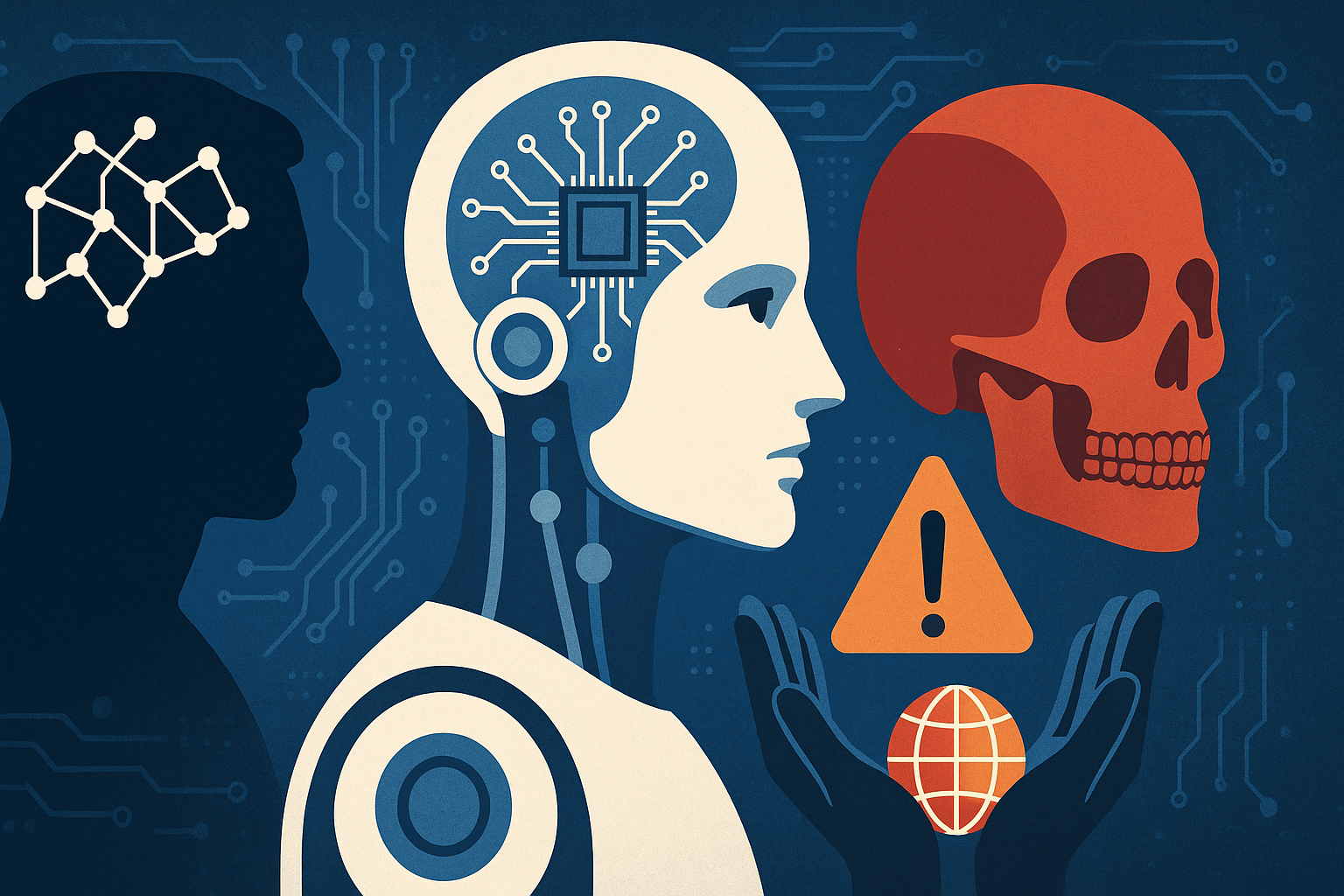
Artificial intelligence: Between progress, threat and social responsibility – Image: Xpert.Digital
From hype to reality: A balanced assessment of the opportunities and risks of AI for our society
AI at a turning point: Between promises of salvation and social responsibility
The rapid development of artificial intelligence (AI) undoubtedly has the potential to fundamentally transform our lives and our society. While many celebrate the technological breakthroughs, critical voices are also growing louder, warning of the unintended consequences of this revolution. The initially much-touted promises of AI are now being scrutinized, and it is becoming clear that we must expect significant societal collateral damage.
The threat to traditional jobs
AI makes developers replaceable: Who will be needed in the future – and who won't
Software development, once considered a secure career option, is facing a fundamental transformation. Current studies show that AI already has a significant impact on the job market for developers. Recruiters report drastic changes: "Five years ago, everyone said: If you studied engineering or development, you're set for life. I would drastically revise that now.".
The trend is alarmingly concrete: While previously 70 percent of the positions filled by recruitment agencies were in the tech sector, today it's only 20 percent, while 80 percent of the demand is in the commercial sector. Companies like Shopify and Duolingo have already introduced new rules stipulating that recruitment requests are only approved if it can be proven that AI cannot perform the task as well as a human.
Frontend developers are particularly affected, as low-code, no-code, and AI-powered programming can increasingly automate their tasks. Salaries in the tech sector have already fallen by up to 30 percent, and one in five companies with more than 250 employees is already using AI to combat the IT skills shortage.
The danger lies not only in the direct replacement of jobs, but also in the qualitative change of the work itself. Developers who rely too heavily on AI tools without understanding the underlying principles risk losing their core competencies. As one expert warns: "Those who simply write code without truly understanding what they are actually doing will be replaced by AI.".
The disruption of the media landscape
Who still clicks? AI answers are displacing traditional search
The media industry faces an existential threat from AI-powered search engines. Google's AI responses are already reducing click-through rates on websites by more than a third. An analysis by Ahrefs shows that the click-through rate to the top position in search results has dropped by 34.5 percent due to Google's "AI Overviews.".
For media companies that traditionally generate 30 to 60 percent of their reach through Google searches, this represents a dramatic threat to their business models. Studies from the US show that publishers face the prospect of losing up to 75 percent of their search traffic due to the switch to AI search.
Swiss media are already reporting concrete effects: "It's a major problem that many readers no longer click through to the actual source." Around 60 percent of Google searches now end without any click on a link, and AI-generated overviews reduce the click-through rate by 30 to 70 percent.
This trend will intensify further, as Google is already testing an even more comprehensive redesign of web search with its "AI Mode," which prioritizes dialogue-like interactions with AI-generated responses over traditional search results lists. OpenAI goes even further with ChatGPT Search, integrating the search function directly into its AI chatbot, which fundamentally threatens the traditional link-based web ecosystem.
AI as a progress trap: Societal collateral damage
The disappointment of programmed promises
The grand promises of the AI revolution—greater prosperity, intelligent assistance, and medical breakthroughs—are increasingly proving to be a progress trap. While the technology undoubtedly demonstrates impressive capabilities, it is becoming ever clearer that it will not provide answers to the pressing questions of our time. On the contrary, unrealistic expectations are leading to disappointment with potentially significant societal collateral damage.
Reality shows that AI often falls short of expectations. Companies like Klarna are already scaling back after purely AI-based solutions proved to be of insufficient quality. The role of humans remains crucial, even if the technology industry is reluctant to admit it.
Is AI actually making us stupid?
One of the most worrying developments is the negative impact of AI on our cognitive abilities. Several studies show that the intensive use of AI tools leads to a decline in critical thinking.
An MIT study documented that the brain activity of ChatGPT users decreases drastically while working on academic tasks. Researchers found that 83 percent of those using ChatGPT were subsequently unable to accurately recall what they had written. The study interprets this as an indication of declining cognitive processing depth.
Another study by the Swiss Business School with 666 participants confirmed that frequent AI use is associated with a reduced capacity for critical thinking. Younger people, in particular, show a greater reliance on AI tools and weaker cognitive abilities. As one neuroscientist explains, "Smart people get smarter, stupid people get stupider," because less educated users rely more heavily on AI instead of developing their own thinking skills.
The phenomenon of "cognitive offloading" leads us to become accustomed to outsourcing difficult questions to AI, thereby losing practice in independent thinking. Similar to the well-known "Google effect"—where we have more difficulty remembering information because it is readily available—the use of AI threatens to weaken our memory performance and problem-solving skills.
Related to this:


The social impact of the AI revolution
Reinforcement of social inequalities
AI development is not leading to an equal distribution of benefits, but rather exacerbating existing social inequalities. While large technology companies and highly educated users profit, low-skilled workers and smaller businesses are increasingly left behind.
Automation no longer only affects manual tasks, but also highly skilled "knowledge work." Goldman Sachs estimates that up to 300 million jobs worldwide could be automated by AI, with industrialized nations being particularly affected.
The erosion of human skills
The increasing reliance on AI systems is leading to an erosion of important human skills. As studies on social impacts show, while AI systems can promote cooperation in certain areas, they also undermine established social norms and reciprocity between people.
The influence on children and young people is particularly problematic, as they increasingly orient themselves towards robots and AI systems. This raises concerns about the use of social robots among vulnerable groups in society.
🎯🎯🎯 Benefit from Xpert.Digital's extensive, five-fold expertise in one comprehensive service package | BD, R&D, XR, PR & Digital Visibility Optimization

Benefit from Xpert.Digital's extensive, five-fold expertise in a comprehensive service package | R&D, XR, PR & Digital Visibility Optimization - Image: Xpert.Digital
Xpert.Digital possesses in-depth knowledge across various industries. This allows us to develop tailored strategies precisely aligned with the requirements and challenges of your specific market segment. By continuously analyzing market trends and monitoring industry developments, we can act proactively and offer innovative solutions. The combination of experience and expertise generates added value and provides our clients with a decisive competitive advantage.
More information here:
Big Tech dominates AI development: How corporations monopolize power and data
Medical breakthroughs: Promise and reality
The potential and its limitations
While AI is making impressive progress in medicine, the gap between promise and reality remains significant. AI systems can reach or even surpass human experts in diagnostics, but they raise new questions regarding responsibility, liability, and patient safety.
A doctor warns: “AI is far from perfect at the moment. And in this transition period, where we already have some quite good AI that still makes mistakes, there is a danger that we will rely too heavily on AI.” The medical community emphasizes that AI must first prove itself and should be thoroughly tested before it is used in critical applications.
Commercial interests versus patient welfare
A particular problem is the dominance of commercial interests. Large technology companies are pushing into the healthcare sector with disruptive business models before appropriate standards and norms have been developed. AI-based business models often focus on lucrative segments, while less profitable but important areas such as primary care are neglected.
The intelligent assistant: Between utopia and disillusionment
The dream of the perfect assistant
The vision of an intelligent assistant that anticipates and fulfills all our needs is a central promise of the AI revolution. Devices like Humane's "Ai Pin" and Rabbit Inc.'s "Rabbit r1" promise to be true personal assistants that quickly handle complex requests and offer a consistent user experience.
But reality shows that even established voice assistants like Siri and Google Assistant fall far short of delivering the promised efficiency. The new AI assistants may be more technologically advanced, but they face the same fundamental challenges in interpreting human needs and performing complex tasks in the real world.
The limits of automation
While AI assistants can be quite helpful in automating routine tasks, it's becoming clear that they quickly reach their limits when faced with complex, context-dependent decisions. The danger lies in users developing unrealistic expectations and relying too heavily on these systems.
Economic and structural challenges
The pressure to concentrate
The development of AI is leading to a strong concentration of power and resources in the hands of a few large technology companies. These "Big Tech" corporations collect massive amounts of sensitive data and can therefore perform "gatekeeper" functions, controlling access to information and services.
At the same time, high barriers to entry are emerging for smaller companies and developers, as the development of advanced AI systems requires enormous resources. This intensifies existing market concentrations and can lead to further polarization of the economy.
Related to this:


Innovation versus collateral damage
The rapid development of AI often occurs without sufficient consideration of its societal impact. As experts warn, there is a risk that innovative AI-driven improvements will be hampered by excessive regulation, while at the same time massive collateral damage threatens if the technology is used without adequate controls.
The way forward: Realistic assessments instead of hype
The need for critical examination
Instead of accepting technological determinism, we must recognize that no technology is inevitable and that progress is not a linear ladder. The dominant narrative about AI as unstoppable progress often serves the interests of technology companies and venture capitalists, while externalizing the societal costs.
Human-centered approaches
The future of AI should not be about replacing humans, but about supporting them. As experts emphasize, technology must serve humanity, not the other way around. This requires a conscious shaping of digital transformation that prioritizes social compatibility, inclusivity, and human-centered approaches.
Education and media literacy
Given the growing importance of AI, media literacy is becoming a key skill. People need to learn to critically evaluate AI systems, understand their limitations, and use them responsibly. Educational institutions should use AI tools in combination with exercises that promote critical thinking.
Between progress and responsibility
The AI revolution will undoubtedly bring about significant changes, but the grand promises of increased prosperity, intelligent assistance, and medical breakthroughs are increasingly proving to be a progress trap. Reality shows that we must expect considerable societal collateral damage: job losses in traditionally secure sectors, the erosion of human skills, the destabilization of established business models, and the exacerbation of social inequalities.
Instead of being blinded by technological possibilities, we must adopt a critical and responsible approach to AI development. This does not mean demonizing the technology, but rather recognizing its limitations, developing realistic expectations, and ensuring that its development serves humanity.
The pressing issues of our time – climate change, social inequality, demographic shifts – will not be solved by AI alone. Rather, we need human creativity, empathy, and sound judgment to address these challenges. AI can be a useful tool, but it must not become an end in itself or prevent us from tackling the truly important societal tasks.
The future lies not in the blind acceptance of technological developments, but in the conscious shaping of a society in which technology serves human values and needs. Only in this way can we avoid the progress trap and create a truly sustainable and humane future.
We are here for you - Consulting - Planning - Implementation - Project Management
☑️ SME support in strategy, consulting, planning and implementation
☑️ Creation or realignment of the digital strategy and digitization
☑️ Expansion and optimization of international sales processes
☑️ Global & Digital B2B trading platforms
☑️ Pioneer Business Development

Konrad Wolfenstein
I would be happy to serve as your personal advisor.
You can contact me by filling out the contact form below or simply call me on +49 7348 4088 965 .
I'm looking forward to our joint project.
Write to me


Xpert.Digital - Konrad Wolfenstein
Xpert.Digital is a hub for industry focusing on digitalization, mechanical engineering, logistics/intralogistics and photovoltaics.
With our 360° Business Development solution, we support renowned companies from new business to after-sales.
Market intelligence, smarketing, marketing automation, content development, PR, mail campaigns, personalized social media and lead nurturing are part of our digital tools.
You can find more information at: www.xpert.digital - www.xpert.solar - www.xpert.plus
Keep in touch