
Published on: December 7, 2024 / Updated on: December 7, 2024 – Author: Konrad Wolfenstein

Solarmax, a manufacturer of inverters and battery storage systems based in Burgau, Bavaria, is insolvent – stock image: Xpert.Digital
Price slump and competition from China: Solarmax goes bankrupt
On November 29, 2024, the Neu-Ulm District Court ordered the preliminary insolvency proceedings for SOLARMAX GmbH, based in Burgau. Michael Pluta of PLUTA Rechtsanwalts GmbH was appointed as the preliminary insolvency administrator.
The Solarmax brand, known for its inverters, was originally developed by the Swiss company Sputnik Engineering, which filed for bankruptcy in 2014. At that time, approximately 10% of solar installations in Germany were equipped with inverters from the SolarMax or Sputnik brands. In 2008, Sputnik was among the top five manufacturers in this sector.
SOLARMAX GmbH develops and manufactures battery storage systems for photovoltaic installations in Germany and also sells inverters. Due to a massive price collapse in the market, triggered by dumping prices from Chinese suppliers, the company was forced to sell its products below cost. Business operations are currently continuing, and intensive negotiations are underway with several partners regarding the company's future.
SOLARMAX customers currently have the opportunity to benefit from the sale of excess inventory. Despite the challenging situation, the team continues its work and remains committed to customer service. The company currently employs 34 people, whose salaries are secured by insolvency benefits.
Michael Pluta explained: “The proceedings present a challenge, as the market environment is difficult for the company. Our top priority at the moment is to maintain business operations. We will handle the proceedings in the best possible way in the interest of the creditors.” Pluta is being supported in these proceedings by business economist (VWA) Reinhard Wünsch.
SolarMax in preliminary insolvency proceedings
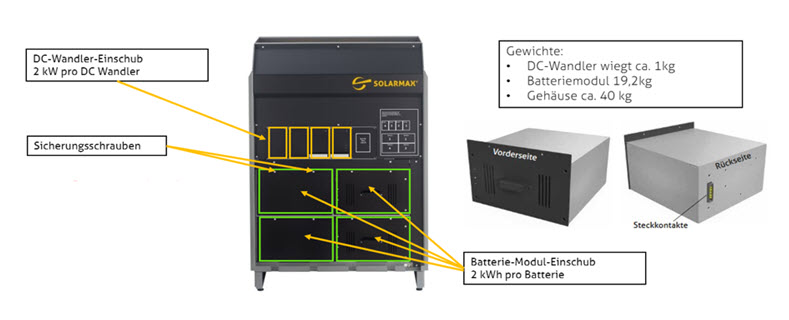
Battery storage system – made in Germany – Image: ©SOLARMAX
A period of uncertainty for SolarMax
SolarMax, a German company specializing in the development and manufacture of inverters and PV storage systems for private households, is currently facing a major challenge. The Neu-Ulm District Court has initiated preliminary insolvency proceedings, and the company has since entered a period of uncertainty. Nevertheless, it is crucial for all involved to carefully consider the reasons behind this step, the current situation, and potential future prospects.
The years of success and the challenges posed by price competition
For years, SolarMax has played a key role in the solar energy sector. The company, once considered a promising supplier of high-quality inverters, benefited from a growing solar market, fueled in Germany for a long time by favorable conditions such as attractive feed-in tariffs, government subsidy programs, and increasing environmental awareness. Over time, however, the entire industry worldwide became embroiled in intense price competition. The market entry of Chinese manufacturers, who produce on a large scale and can offer their products at significantly lower costs, put considerable pressure on the margins of European companies. This price competition was not a sudden phenomenon but developed gradually, coinciding with periods of stagnation in demand and increasing consumer scrutiny. SolarMax was thus forced to offer its products below their actual manufacturing costs in order to remain competitive. This inevitably led to financial strain that pushed the company to its limits.
The preliminary insolvency proceedings
The consequence was unavoidable: preliminary insolvency proceedings were initiated. Michael Pluta of Pluta Rechtsanwalts GmbH, an experienced specialist in this field, was appointed as the preliminary insolvency administrator. His task is to carefully analyze the situation, maintain continuous contact with creditors and potential investors, and ensure that the interests of all parties involved are protected. Such insolvency is always a complex process that affects not only the financial aspects but also the emotional dimension. Many employees, some of whom have worked for the company for years, suddenly face an uncertain future.
Stability through guaranteed wages and salaries
Despite these adverse circumstances, SolarMax is striving to maintain production and business operations. The wages and salaries of all 34 employees are secured for the next three months – a crucial step to ensure at least a degree of stability in the short term. A company spokesperson emphasized in this context: "We are aware of our responsibility to our employees and are doing everything we can to provide them with as much security as possible in this difficult situation." This statement underscores the company's commitment to its workforce. While the looming loss of jobs and expertise is a significant blow to the company, the preliminary insolvency proceedings also provide time to explore structural solutions.
Measures to stabilize and increase efficiency
A key focus now is on reducing excess inventory and utilizing existing resources efficiently. The company is intensively examining which stock items still have a suitable market and where price adjustments might be necessary to generate revenue. This requires a delicate touch: On the one hand, a sell-off should not give the impression that SolarMax is definitively abandoning its market position; on the other hand, releasing tied-up capital is one of the few immediately available measures to create short-term financial breathing room.
Discussions with partners and investors regarding a possible future
In parallel, discussions are underway with potential partners and investors. The goal is to find new capital providers or strategic alliances that will offer the SolarMax brand a future perspective. In this context, the provisional insolvency administrator, Michael Pluta, stated: "We are currently holding constructive talks with various interested parties to determine whether we can find a way to continue SolarMax and utilize the existing structures." These words indicate that not only the liquidation of the company is being considered, but also the option of restructuring it or transferring it to an investor who values the brand name and technical expertise.
Challenges posed by global competition
A complicating factor is the challenging market environment in the solar industry. Global competition has intensified dramatically in recent years. Many traditional European suppliers are suffering from the favorable production conditions of their Asian competitors. While the European solar industry still enjoys a reputation for quality and innovation, it is a challenge to compete against the cost factor. This price pressure is leading to a redistribution of market share and forcing companies to completely rethink their strategies. SolarMax is no exception – rather, this case exemplifies an entire industry that must constantly reinvent itself.
Clarification regarding the independence of SolarMax Technology, Inc.
It is also essential to clarify that the insolvency of SolarMax in Germany should not be confused with the independent US company SolarMax Technology, Inc. Both companies operate independently. While SolarMax in Germany is attempting to navigate the preliminary insolvency proceedings, SolarMax Technology, Inc. in the US is grappling with its own problems. "We would like to emphasize that this difficult situation pertains to the German business unit, which operates independently of other companies," stated the management. This distinction is important to avoid misunderstandings regarding the brand and to focus attention on the actual challenges facing the company.
Potential for a new beginning
The process itself presents both opportunities and risks. On the one hand, it could lead to a realignment, allowing SolarMax to streamline, strategically reposition, and potentially re-enter the market with fresh capital. This new beginning could also involve adjusting the product portfolio: perhaps it will be possible to leverage technologically innovative approaches, such as intelligent storage systems or the development of more efficient inverters, to differentiate itself from the competition. Closer collaboration with installation companies or energy suppliers is also conceivable, enabling products to be tailored more precisely to the needs of end customers. Customers who rely on green energy increasingly expect intelligent, comprehensive solutions that not only generate solar power but also optimally store, manage, and utilize it in their homes. A company that positions itself as a competent system supplier in this area could certainly regain market relevance.
Risks of a possible breakup
On the other hand, serious hurdles lurk: If SolarMax fails to convince new investors or withstand price pressure, the company could be broken up. In such a case, creditors would try to extract as much as possible from the remaining assets, but the continued existence of the brand would then be hardly realistic. It is therefore crucial that the right course is set now to enable an economic and strategic realignment.
Developments and challenges in the industry
From a bird's-eye view, the SolarMax case exemplifies how the solar market in Europe has evolved. The industry, once booming thanks to government subsidies and climate policy, now faces fiercer global competition. Such processes are painful, but in the long run, they also foster efficiency, innovation, and competitiveness within companies. Those who want to succeed must possess not only high-quality products but also a deep understanding of customer needs. Unlike just a few years ago, buyers today are better informed, meticulously compare prices and services, and increasingly prioritize warranties, service, and the long-term stability of their supplier.
Decisions for the future
The coming weeks and months will show what happens next. The outcome of the preliminary insolvency proceedings is uncertain, and concentrated efforts are needed to find a viable solution. If the company can be successfully restructured and repositioned in the market under new conditions, SolarMax could once again become a significant player in the German solar industry. If this is not possible, at least an attempt will have been made to save the long-established expertise, jobs, and brand.
The importance of a clear vision
SolarMax is thus at a crossroads: either it manages to turn its current problems into opportunities and emerge stronger, or it must choose the path of dissolution. The statement by a company representative, "Now it's a matter of carefully weighing all the options and shaping the future wisely," sums it up perfectly. In a time when the energy transition is becoming an increasingly important societal goal, it is also crucial for a manufacturer facing insolvency to develop a clear vision. The future of the solar industry will be determined by innovation, cost efficiency, and customer focus – and this is precisely where SolarMax must focus its efforts to grow beyond the current crisis.
Related to this: