
Xpert.Digital: Why 1.15 million visitors are worth more than 10 million — and why mass is a mistake in B2B industrial publishing – Image: Xpert.Digital
Breaking the sound barrier: How German SMEs benefit from a new B2B publishing model
AI search and GEO: Why sound industry knowledge will be the most valuable asset on the internet in 2026
Foregoing advertising as a guarantee of success: The radical concept behind the record traffic at Xpert.Digital
In digital publishing, a simple but deceptive equation often prevails: more volume equals more revenue. However, in the highly specialized B2B sector – particularly in complex fields such as mechanical engineering, artificial intelligence, or renewable energies – this logic falls short. This is precisely where Xpert.Digital comes in, impressively proving the opposite: with an uncompromising focus on in-depth expertise, niche topics, and ad-free content, the platform surpassed the magic mark of 1.15 million monthly visitors in May 2026.
This remarkable milestone is no accident, but rather the result of a far-sighted strategy in a rapidly changing search engine era. While large parts of the media landscape rely on AI-generated mass content, Xpert.Digital focuses on the "economics of the precise signal." Driven by Google's EEAT (Experience, Expertise, Authoritativeness, Trustworthiness) concept and the rise of Generative Engine Optimization (GEO), it's clear that true, in-depth expertise is more valuable than ever. The following article analyzes why the quality of reach far surpasses mere quantity in the industrial sector, how strategic multilingualism opens up global markets, and why controlled growth through ambidexterity represents the publishing model of the future.
When numbers alone tell the wrong story
In May 2026, Xpert.Digital broke a barrier considered a premium benchmark for B2B industrial publishers: 1.15 million visitors in a single month. This figure sounds like a simple traffic record, but it is actually the result of a strategic decision made over many years, one that differs fundamentally from what mainstream publishers and mass platforms do. To understand the economic significance of this achievement, one must first grasp why reach in the B2B context is a completely different currency than in the consumer segment.
In B2C digital publishing, it's all about sheer volume: the more clicks, the higher the ad revenue, the more valuable the inventory. In the B2B industrial sector—especially in segments like mechanical engineering, intralogistics, renewable energies, artificial intelligence, extended reality, and digitalization—a fundamentally different logic applies. Here, target group precision is what matters, not the sheer number of visitors. A decision-maker in a medium-sized mechanical engineering company specifically searching for information on autonomous intralogistics systems has a monetary value that far exceeds that of an ordinary consumer click. Xpert.Digital has internalized this logic from the very beginning and implemented it without compromise.
Reaching the mainstream without the logic of the mainstream
That a platform specializing in industrial B2B niches has reached the mainstream in terms of user numbers is remarkable from an economic perspective—and by no means a given. The German industry association bvik, which regularly publishes marketing benchmarks for the B2B sector, confirms that specialized trade publications in the industrial environment traditionally have significantly lower absolute reach than generalist platforms. The breakthrough to over one million visitors while simultaneously maintaining a clearly defined industry focus is therefore an exceptional phenomenon.
The explanation lies in the intelligent use of a market phenomenon that has accelerated dramatically since 2024: Google and other search engines have fundamentally changed their quality assessment. The concept of so-called EEAT—Experience, Expertise, Authoritativeness, Trustworthiness—prioritizes proven competence, genuine experience, and thematic depth. Generic, mass-produced content is measurably losing visibility, while platforms with genuine expert authority are benefiting significantly. In this environment, Xpert.Digital entered a massive growth trajectory in November 2024—a direct result of a strategy that has been consistently pursued for years.
This development aligns with the findings of the bvik Trend Barometer Industrial Communication 2026: With 86 percent approval among surveyed industrial marketers, Generative Engine Optimization (GEO) is considered a must-have, as users increasingly conduct their research using AI assistants. Those sources deemed trustworthy and technically substantial by these systems will receive disproportionate visibility in the future. Xpert.Digital, through its years of building genuine industrial expertise, is strategically better positioned in this new era of information retrieval than mass-market competitors.
Niche as a fortress: The economic model of the specialized industrial hub
The full economic value of a niche publisher only becomes clear when one understands the cost structure and impact channels of B2B purchasing decisions. In the industrial sector, typical purchasing decisions involve capital goods, system solutions, and service contracts with long decision-making cycles, multiple stakeholders, and high information requirements. The target audience is not looking for entertainment, but rather reliable, in-depth guidance—often in an early research phase where no concrete supplier preferences yet exist.
A publishing model tailored to these needs—one that deliberately avoids advertising and instead focuses on demonstrating expertise—generates a level of trust that paid channels cannot replicate. 76 percent of B2B buyers prefer content in their native language, even if they understand other languages. Xpert.Digital, with 27 available languages, addresses this trust advantage on a global scale, thereby opening up international buyer markets that become accessible to German SMEs as potential customers or cooperation partners.
The absence of advertising is not a romantic idealistic decision, but a rational economic positioning. Platforms with aggressive advertising send an ambivalent signal to high-level decision-makers in the industrial sector: advertising revenue implicitly suggests that content may be influenced by advertising interests. The ad-free model positions Xpert.Digital as an independent, purely information-driven source—a status symbol that carries considerable value in the B2B context and structurally secures its credibility.
The thematic portfolios: What is covered — and what can still be explored
Xpert.Digital's existing portfolio of topics—mechanical engineering, logistics and intralogistics, renewable energies, artificial intelligence, extended reality, and digitalization—covers the key industrial transformation axes of the coming decade. Nevertheless, it is worthwhile to analyze whether other segments with strategic relevance and potential for media coverage are not yet being served, or not sufficiently so.
Mechanical engineering remains the heart of Germany's industrial economy. In the field of AI, the global market for AI in engineering is projected to grow from US$21.53 billion in 2025 to US$84.38 billion by 2029—an annual growth rate of 40.7 percent. AI is already in use at 40 percent of German industrial companies, and almost as many plan to implement it. In the German mechanical engineering sector, 52 percent of executives view AI as a potential game-changer, while only eight percent are actively using AI systems—a classic early diffusion phase where the need for guidance is particularly high.
Extended Reality (XR) is developing in the German market with a pronounced industrial focus, fundamentally different from consumer-oriented markets. The global XR market was estimated at US$253.5 billion in 2025 and is projected to grow to US$2,127.81 billion by 2034—an annual growth rate of 25.5 percent. Applications in maintenance, training, digital twins, and remote assistance represent precisely the intersections between XR and mechanical engineering or intralogistics that Xpert.Digital already touches upon thematically, but could expand upon even further.
Renewable energies remain a core strategic segment. In 2024, the global energy sector exceeded an investment volume of three trillion US dollars for the first time, two trillion of which went into clean energy. However, two areas offer potential for further development: industrial cybersecurity (OT security) and the hydrogen economy. The global market for OT security (operational technology) was worth approximately 20.7 billion US dollars in 2024 and is projected to grow to 82.1 billion US dollars by 2033. This topic is highly relevant for energy and manufacturing companies that need to secure their digital infrastructures. Hydrogen, on the other hand, despite subdued short-term market development—the H2 market index for 2025 stands at 41 out of 100 points—is structurally undisputed as a long-term decarbonization technology for industry.
Other topics that fit the existing portfolio and do not yet appear to have been systematically explored include:
- Circular economy as an interface between logistics, production, and regulation: At the Circular Valley Convention 2026, it became clear that the circular economy is becoming a strategic industrial and locational issue, employing over one million people in Germany. The connection to mechanical engineering, intralogistics, and digitalization is thematically obvious.
- Industrial cybersecurity as an independent cluster: While digitalization exists as an overarching term, OT security — the protection of production facilities and critical infrastructure against cyberattacks — offers a rapidly growing segment with a high demand for B2B information, with a projected CAGR of over twelve percent.
- Supply chain resilience and sustainable supply chains: Regulatory requirements such as CSDDD, CSRD, and CBAM create a huge need for guidance among medium-sized industrial companies. This topic combines logistics, digitalization, and sustainability—a natural extension of their existing portfolio.
- Humanoid robotics and physical AI: More than six out of ten German industrial companies see humanoid robots as a productivity factor. As an interface between AI, mechanical engineering, and intralogistics, this would be a pioneering field.
🎯🎯🎯 Data-driven B2B industry hub as a quasi-in-house solution

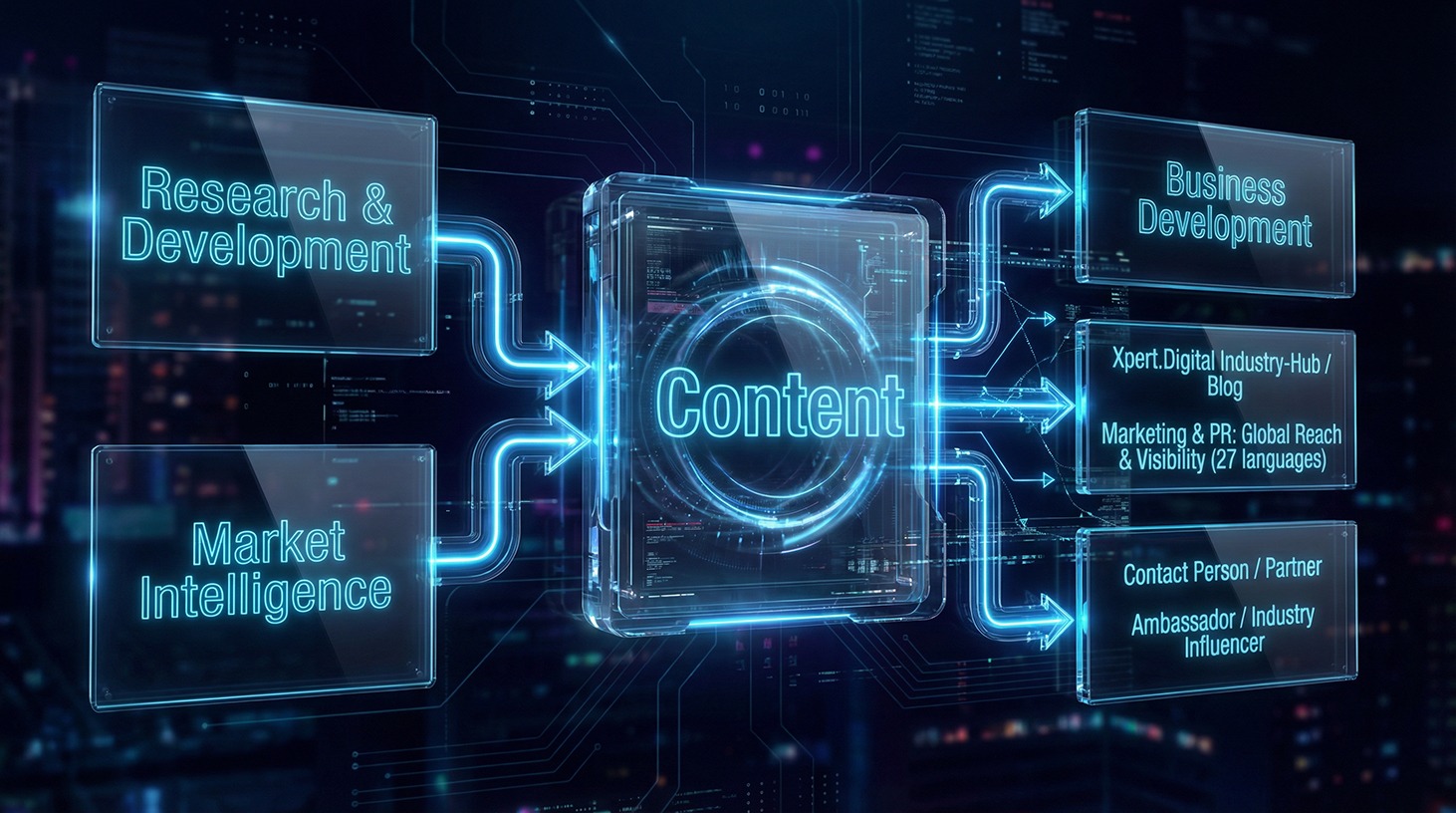
The quasi-in-house solution: How Xpert.Digital closes operational gaps in B2B marketing and sales – Smart Content-Driven Business - Image: Xpert.Digital
Xpert.Digital is a data-driven B2B industry hub led by Konrad Wolfenstein . The company acts as an external, quasi-in-house solution for industrial partners, closing operational gaps in marketing, content, and sales – without requiring additional resources on the client side.
More information here:
Multilingual B2B publishing as a lever for international reach: Why in-depth knowledge is the new competitive moat for industrial media
Progressive exploration as a strategic principle: The ambidexterity approach
What Xpert.Digital calls "progressive exploration from ambidexterity" is a well-established concept in organizational research with considerable strategic relevance. Organizational ambidexterity—literally: ambidexterity—refers to the ability to simultaneously engage in exploration (uncovering new possibilities) and exploitation (optimizing the efficiency of existing systems). Harvard professor Michael L. Tushman describes it as the fundamental challenge to sustainable corporate performance: those who only optimize survive in the short term; those who only explore lose their footing.
For Xpert.Digital, this means specifically: Expanding established topic clusters (exploitation) occurs simultaneously with developing new topics and market areas (exploration). The statement that appealing to the masses was never the goal is not modesty, but a precise strategic statement. In a market where AI-generated mass content increasingly clogs search engine rankings with generic content, the differentiating factor is no longer quantity, but what Google calls "information gain": new perspectives, proprietary data, unique practical experience that cannot be found elsewhere.
This approach requires institutional knowledge of the target industry, which cannot be acquired in weeks. Xpert.Digital's starting point is 2013—over a decade of continuous knowledge accumulation in the industrial environment. The result of this long accumulation of expertise is a depth of content that is difficult for new content producers to replicate. This creates a genuine competitive advantage (moat)—a protective barrier not based on an exclusive license or patent protection, but on a trust-based reputation for expertise built up over years.
Small and medium-sized enterprises as addressee and sounding board
Focusing on the economic performance of small and medium-sized enterprises (SMEs) is more than a marketing promise — it is a precise target group decision with considerable economic logic.
German SMEs, comprising roughly 99 to 99.5 percent of all companies in Germany, constitute almost the entire business landscape. In a narrow definition based on the EU SME definition, they employ approximately 53 percent of all workers, while in a broader definition, they account for roughly 60 to 68 percent. They generate approximately 28 to 35 percent of total economic turnover and around 45 percent of economic output, and are responsible for approximately 70 to 89 percent of all apprenticeships.
This particular segment of the SME sector is in a phase of accelerated digital transformation: 75 percent of medium-sized companies state that AI influences their business strategy, and 52 percent plan to work more efficiently with the help of AI.
At the same time, these medium-sized businesses find it more difficult than large corporations to navigate a fragmented, saturated information market. 36 percent of medium-sized companies cite a shortage of skilled workers as the main obstacle to digitalization, while 29 percent point to technological complexity. Companies like Xpert.Digital, which make this complexity manageable through in-depth, trustworthy, and multilingual expert content, make an economically measurable contribution to the decision-making ability of businesses that cannot afford to commission their own research departments to monitor the market.
Multilingualism, encompassing 27 languages, multiplies this value. While multilingual customer communication allows international B2B market players to consume content in their native language, it simultaneously creates SEO presence in markets traditionally not addressed by German or English-language trade publications. This international reach is key to Xpert.Digital achieving a monthly visitor volume of 1.15 million despite its clear niche focus. The target audience is not a homogenous German demographic, but rather a global network of industry professionals seeking guidance in the subject areas covered by Xpert.Digital.
The paradox of controlled growth
The strategic decision to enter into only a limited number of partnerships despite increasing demand seems at first glance to contradict the entrepreneurial imperative of optimization. Growth is good, more is better—this is the basic assumption of conventional scaling logic. In fact, behind this deliberate capacity limitation lies a deeper economic insight, which is well documented in agency and publishing research.
The value of a small, specialized team lies not despite, but because of its size, in certain parameters: speed of decision-making, content coherence, short communication channels, and the ability to react editorially to geopolitical and economic developments in real time. Large media organizations with extensive business units structurally have longer response times, higher fixed costs, and coordination efforts that hinder agility. In a media landscape where the relevance curves of topics such as AI regulation, supply chain crises, or energy price shocks can shift within days, this agility is an invaluable advantage.
The principle of selective partnership—working with those with whom you can collaborate effectively as a team—conceptually corresponds to what innovation literature describes as "complementary assets": The strategic added value of a collaboration is not determined by the number of partners, but by their cultural and content-related fit. A partnership that requires thematic depth the partner cannot provide, or that forces compromises on editorial independence, would damage the core of the business model. Therefore, refusing such partnerships is not a hindrance to growth, but rather a means of quality assurance.
Geopolitics and economic situation as fuel for expert publishing
The strategic importance of choosing not just to parrot existing information, but to explore new opportunities based on the current economic and geopolitical situation, can hardly be overstated. The intersection of geopolitical shifts—trade disputes, resource dependencies, reshoring trends—and industrial transformation creates a constantly growing need for orientational knowledge that goes beyond purely technical information.
The circular economy is no longer just an environmental issue, but a geopolitical security project: "Raw materials have become power factors," stated Federal Environment Minister Carsten Schneider at the Circular Valley Convention 2026. Sustainable supply chains will be under constant stress in 2026 due to geopolitical tensions, volatile markets, climate risks, and increasing regulatory requirements. Those who present these interrelationships between geopolitics, commodity markets, regulations, and industrial practice in accessible articles create a point of reference that neither purely PR-driven corporate communications nor general business media can offer at this level of industrial depth.
This geopolitical context also applies to hydrogen and renewable energies. The H2 market index 2025, with 41 out of 100 points, indicates subdued market development, but simultaneously reflects the industry's enormous need for guidance. Political objectives, investment security, and funding programs are identified as the three biggest drivers of the hydrogen ramp-up—precisely the areas where independent, in-depth expertise offers the greatest added value.
The scalability of trust
What Xpert.Digital has built can be described economically as trust capital—a form of intangible asset that accumulates over decades and can be quickly destroyed by short-sighted compromises. The Google algorithm now directly rewards this trust: sources cited in AI-generated answers and AI overviews are preferentially those that provide verifiable expertise, real-world experience, and clear information gain. This means that the platform's value structurally increases, not decreases, with the spread of AI-powered search systems—a remarkable contrast to those content producers who relied on generic AI output and are now systematically losing visibility.
B2B content in niche markets isn't about reach, but about precision. Providing the right content to the right decision-makers at the right moments in their buying journey creates leverage that far exceeds what mere visitor statistics might suggest. This leverage is precisely what 1.15 million monthly visitors to Xpert.Digital represent: not a mass of fleeting clicks, but a network of industrial decision-makers, engineers, buyers, and entrepreneurs actively seeking reliable information in areas where incorrect decisions can have significant economic consequences.
The next step
The question is not whether Xpert.Digital will continue to grow—the structural drivers, the specialist expertise, the multilingualism, and the EEAT architecture all point in that direction. The question is in which direction that growth will be directed. The identified gaps in the thematic portfolio—industrial cybersecurity, the hydrogen economy as a geopolitical issue, the circular economy as an industrial and locational question, humanoid robotics and physical AI, as well as supply chain resilience under regulatory pressure—offer natural expansion opportunities that will not disrupt the existing competence profile but rather extend it organically.
The proven principles remain indispensable: no advertising funding as a guarantee of editorial independence, selective partnerships as a quality filter, thematic depth instead of superficial breadth, and the ability to interpret economic and geopolitical developments from an industrial perspective that provides decision-makers with genuine guidance. This is precisely the economics of the precise signal—and it is more valuable than ever in a world of informational noise.
Your global marketing and business development partner
☑️ Our business language is English or German
☑️ NEW: Correspondence in your native language!

Konrad Wolfenstein
I and my team are happy to be available to you as your personal advisor.
You can contact me by filling out the contact form here wolfenstein@xpert.digital:or simply call me at +49 7348 4088 965. My email address is
I'm looking forward to our joint project.
☑️ SME support in strategy, consulting, planning and implementation
☑️ Creation or realignment of the digital strategy and digitization
☑️ Expansion and optimization of international sales processes
☑️ Global & Digital B2B trading platforms
☑️ Pioneer Business Development / Marketing / PR / Trade Fairs
B2B support and SaaS for SEO and GEO (AI search) combined: The all-in-one solution for B2B companies

B2B support and SaaS for SEO and GEO (AI search) combined: The all-in-one solution for B2B companies - Image: Xpert.Digital
AI search changes everything: How this SaaS solution will revolutionize your B2B ranking forever.
The digital landscape for B2B companies is undergoing rapid change. Driven by artificial intelligence, the rules of online visibility are being rewritten. For companies, it has always been a challenge not only to be visible in the digital mass, but also to be relevant to the right decision-makers. Traditional SEO strategies and managing local presence (geo-marketing) are complex, time-consuming, and often a battle against constantly changing algorithms and intense competition.
But what if there were a solution that not only simplified this process but also made it smarter, more predictive, and far more effective? This is where the combination of specialized B2B support with a powerful SaaS (Software as a Service) platform comes into play, specifically designed for the demands of SEO and GEO in the age of AI search.
This new generation of tools no longer relies solely on manual keyword analysis and backlink strategies. Instead, it leverages artificial intelligence to more accurately understand search intent, automatically optimize local ranking factors, and conduct real-time competitive analysis. The result is a proactive, data-driven strategy that gives B2B companies a decisive advantage: they are not only found, but perceived as the leading authority in their niche and location.
Here's the symbiosis of B2B support and AI-powered SaaS technology that transforms SEO and GEO marketing, and how your company can benefit from it to grow sustainably in the digital space.
More information here: