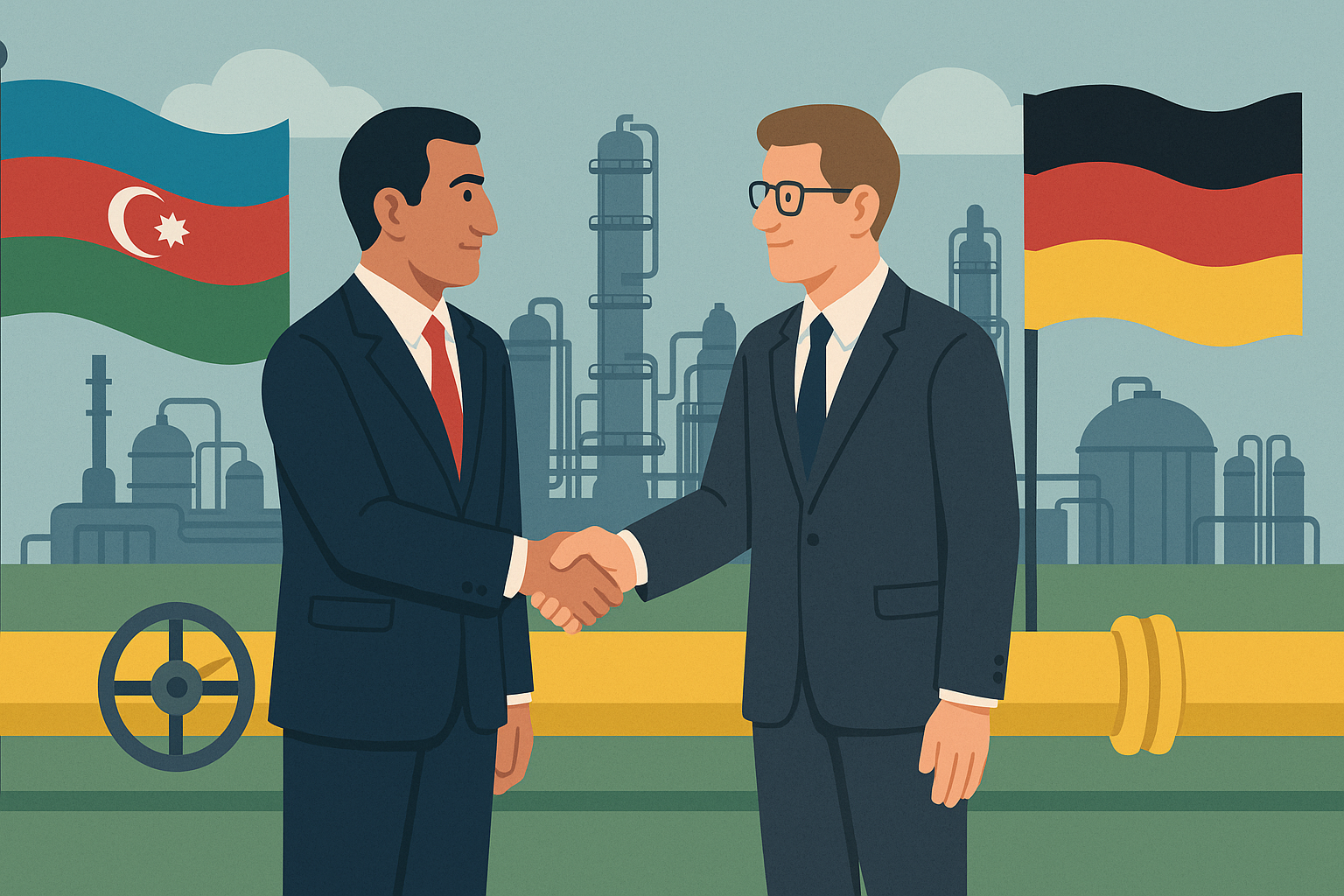
Strategic energy partnership: Azerbaijan and Germany double gas cooperation through SOCAR-SEFE agreement – Image: Xpert.Digital
Energy transition accelerated: Azerbaijan becomes Germany's new gas partner with 15 TWh annually
Strategic partnership sealed: How Germany is reducing its energy dependence through gas from Azerbaijan
The long-term gas supply agreement signed on June 10, 2025, between the Azerbaijani state oil company SOCAR and the German energy company SEFE marks a historic turning point in German-Azerbaijani energy relations and significantly strengthens Europe's efforts toward energy diversification. The ten-year contract provides for a gradual increase in annual gas deliveries to up to 15 terawatt-hours (TWh), or approximately 1.5 billion cubic meters, which, together with existing deliveries to Uniper, will double total Azerbaijani gas exports to Germany to around 3 billion cubic meters annually. This strategic partnership not only underscores Azerbaijan's growing role as a reliable energy partner for Europe but also demonstrates Germany's consistent strategy to reduce its dependence on Russian energy imports by developing alternative supply sources from the Caspian region.
Contract details and economic dimensions
Scope and timeframe of the delivery agreement
The contract between SOCAR and SEFE covers a ten-year period and foresees the start of gas deliveries as early as 2025. Annual delivery volumes will be gradually increased to the target volume of 15 TWh, which corresponds to approximately 1.5 billion cubic meters and thus represents a substantial addition to Germany's energy portfolio. This amount corresponds to roughly one-twentieth of Germany's annual gas consumption and underscores the strategic importance of the agreement for Germany's energy supply. Deliveries will be handled via the proven infrastructure of the Southern Gas Corridor, thereby ensuring a secure and continuous supply.
SEFE as a strategic partner
SEFE (Securing Energy for Europe), formerly known as Gazprom Germania, brings a unique historical dimension to this partnership. Following the Russian invasion of Ukraine, the company was initially placed under the trusteeship of the Federal Network Agency and later fully nationalized. With an annual sales volume of 200 TWh of gas and electricity, SEFE is one of the most important energy suppliers for industrial customers in Europe and has gas storage capacities of 5.6 billion cubic meters, which corresponds to approximately a quarter of Germany's total storage capacity. This transformation from a Russian subsidiary to a German state-owned company symbolizes the fundamental shift in the European energy landscape since 2022.
Geopolitical context of energy diversification
Azerbaijan's role in European energy security
Azerbaijan's position as an energy supplier to Europe has changed dramatically and gained strategic importance since the Russian attack on Ukraine. The country increased its gas exports to Europe from approximately 8 billion to roughly 13 billion cubic meters annually within two years, responding decisively to Europe's call for help during the 2022 energy crisis. This remarkable increase of over 60 percent demonstrates both Azerbaijan's technical capabilities and its political will to act as a reliable energy partner for Europe. With a share of approximately seven percent of total EU gas imports, Azerbaijan now ranks fourth among the most important gas suppliers to the European Union, after Norway, Algeria, and Russia.
Germany's energy transition after 2022
Since the beginning of the war in Ukraine, German energy policy has undergone a fundamental realignment, making the rapid diversification of gas supply sources a top priority. Germany, previously heavily dependent on Russian gas imports, had to develop alternative supply sources in a very short time, taking into account both short-term security of supply and long-term strategic goals. The new SOCAR-SEFE contract fits seamlessly into this strategy and complements the existing deliveries to Uniper, which have amounted to up to 1.5 billion cubic meters annually since 2013 and run until 2045. This dual supply chain via two different German energy companies creates additional redundancy and security in the gas supply.
Infrastructure of the Southern Gas Corridor
Technical architecture of gas supplies
The Southern Gas Corridor forms the technical backbone of Azerbaijani gas deliveries to Europe and represents one of the most significant energy infrastructure investments of recent decades. This complex system comprises three main components: the South Caucasus Extended Pipeline (SCPx) through Azerbaijan and Georgia, the Trans-Anatolian Pipeline (TANAP) through Turkey, and the Trans-Adriatic Pipeline (TAP) through Greece, Albania, and Italy. With a total length of nearly 3,500 kilometers and an estimated investment of US$45 billion, this infrastructure network represents one of the largest cross-border energy investments in European history.
Capacities and transport routes
The Trans Adriatic Pipeline (TANAP), operational since December 31, 2020, has a transport capacity of ten to twenty billion cubic meters of natural gas per year, thus enabling a significant expansion of Azerbaijani gas exports to Europe. The pipeline connects to the TANAP in Kipoi on the Turkish-Greek border and transports the gas 878 kilometers through Greece, Albania, and the Adriatic Sea to southern Italy, from where it can be distributed to European markets, including Germany. This infrastructure ensures that the gas volumes agreed upon in the new SEFE-SOCAR contract can be reliably and continuously transported to Germany without relying on Russian or other politically sensitive transit routes.
Bilateral relations and diplomatic developments
High-level political contacts
The intensive diplomatic relations between Germany and Azerbaijan have developed remarkable momentum in recent years and form the political foundation for the deepened energy partnership. Since February 2023, Azerbaijani President Ilham Aliyev has visited Germany four times, underscoring the high priority both countries attach to their bilateral cooperation. These frequent high-level contacts foster the necessary trust and political stability essential for long-term energy partnerships. Federal President Frank-Walter Steinmeier paid a historic visit to Armenia and Azerbaijan in April 2025, marking the first trip by a German Federal President to the region and highlighting the growing importance of the South Caucasus for German foreign policy.
Strategic partnership in the energy sector
Energy cooperation between Germany and Azerbaijan extends far beyond mere gas deliveries, encompassing areas such as energy efficiency, technology transfer, and sustainable development. As early as 2018, Uniper and SOCAR signed an agreement to jointly increase energy efficiency in Azerbaijani oil and gas production, aiming to improve energy consumption in production processes and reduce greenhouse gas emissions. This technological collaboration demonstrates that the German-Azerbaijani energy partnership is not solely focused on short-term supply relationships but also pursues long-term sustainable development goals.
Significance for European energy security
Diversification effects and security of supply
The new SOCAR-SEFE contract significantly contributes to the diversification of European gas supplies and reduces strategic vulnerability caused by dependence on single suppliers. Doubling Azerbaijani gas exports to Germany to approximately 3 billion cubic meters annually establishes an additional supply route that operates independently of Russian or other geopolitically sensitive transit routes. This diversification is particularly valuable because it is based on proven infrastructure and avoids the uncertainties of new technological approaches or untested transport routes. The Southern Gas Corridor has demonstrated its reliability since its commissioning, transporting almost 80 billion cubic meters of natural gas via the Baku-Tbilisi-Erzurum pipeline alone.
Long-term energy industry perspectives
The ten-year term of the SOCAR-SEFE contract offers Germany and Europe crucial planning security during the energy transition and enables an orderly transformation of energy systems. This long-term security of supply is particularly important as it creates space for the parallel development of renewable energies and new technologies such as green hydrogen without jeopardizing basic industrial supply. Azerbaijan has already announced its intention to export renewable energies and green hydrogen to Europe in the future, which could make the partnership a sustainable bridge to a low-carbon future. The continuous investments in production and infrastructure capacities that SOCAR has committed to underscore its long-term dedication to a stable energy partnership.
Southern Gas Corridor becomes a key route for European energy security
The strategic energy partnership between Azerbaijan and Germany, significantly strengthened by the new SOCAR-SEFE agreement, represents a milestone in European energy diversification and marks an important step towards reducing dependence on Russian gas imports. Doubling Azerbaijani gas exports to Germany to approximately 3 billion cubic meters annually not only creates additional security of supply but also demonstrates the effectiveness of the Southern Gas Corridor as an alternative transport route for Caspian gas to Europe. The close integration of energy-related interests with high-level diplomatic contacts and technological cooperation creates a solid foundation for a lasting and trusting partnership, enabling both countries to jointly address the challenges of the energy transition while ensuring short-term security of supply.
Innovative photovoltaic solution for cost reduction (up to 30%) and time savings (up to 40%)

Innovative photovoltaic solution for cost reduction and time savings - Image: Xpert.Digital
More information here:
Your partner for business development in the fields of photovoltaics and construction
From industrial rooftop PV to solar parks and larger solar parking lots
☑️ Our business language is English or German
☑️ NEW: Correspondence in your native language!

Konrad Wolfenstein
I and my team are happy to be available to you as your personal advisor.
You can contact me by filling out the contact form here wolfenstein@xpert.digital:or simply call me at +49 7348 4088 965. My email address is
I'm looking forward to our joint project.