Smart logistics solutions are needed
A constantly expanding variety of product variants, limited space on the assembly line, and the constant pressure to integrate new technologies into the production process: there's no question that intralogistics experts face major challenges if they want to successfully master the complexities of automotive production logistics. Some are even warning of a collapse of assembly supply if new approaches to counteracting this overload aren't implemented.
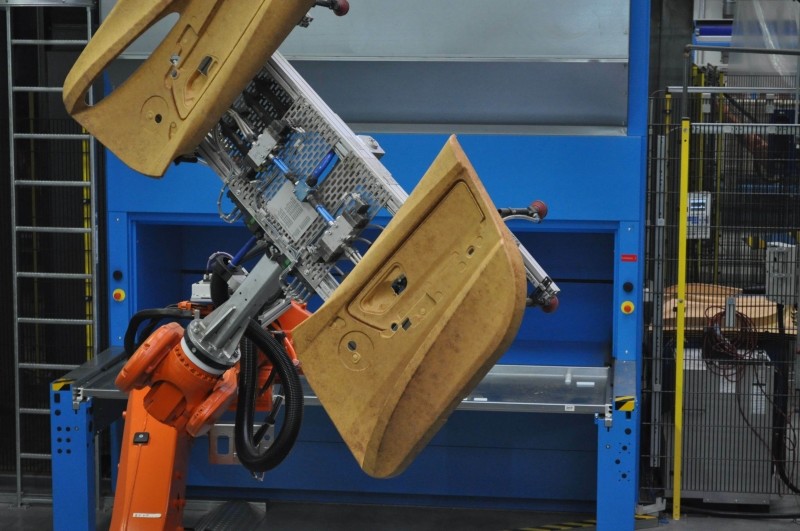
One thing is certain: the automotive industry is characterized by a trend toward continuous innovation. This leads to new technologies in manufacturing and assembly, thereby increasing the challenges for material flow and, consequently, for logistics. The development toward ever-deepening automation and the use of increasingly faster, fully automated assembly robots alone mean that logistics must constantly deliver new peak performances to ensure a steady and smooth flow of materials.
Where just a few years ago components and spare parts were taken from conventional shelving units and transported to the production line, today autonomous, driverless transport systems navigate the area, ensuring the smooth provision and loading of materials to the machines. Pre-assembled kits are now transported to the line just in time, guaranteeing uninterrupted production.
However, this requires increasingly sophisticated software for planning, control and scheduling decisions, without which functioning automobile production would be impossible.
It is up to logistics providers to keep pace with increasingly efficient processes and software systems and to supply production lines with parts and tools. The demands on supply capacity resulting from higher production output are just one of the challenges.
Increasing individualization leads to ever more complex processes
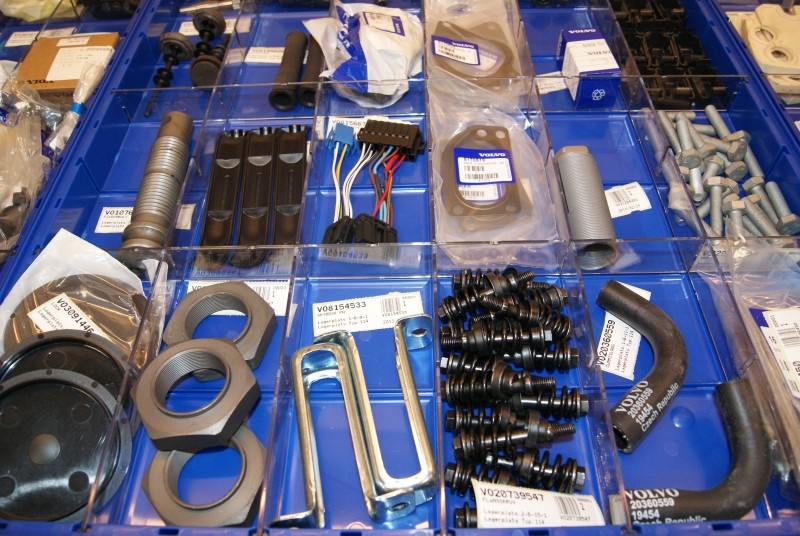
The ever-increasing individualization of vehicles, equipment, and engines is leading to a constantly growing arsenal of parts and semi-finished products that must be kept in stock for assembly. For example, at the Audi plant in Ingolstadt, only 1.5 vehicles are delivered each year that are exactly identical. And that's just the current situation, which doesn't even take future developments in e-mobility into account. It's easy to imagine how much the range of items that need to be kept in stock will expand once the production of battery-powered vehicles really gets going. The success of the market for vehicles with alternative drive systems is still far from certain. For warehouse logistics, this means there's a risk of under- or over-stocking of components, with considerable repercussions for the internal supply chain.
The material flow in automotive manufacturing – on the verge of collapse?
The increasing number of parts required means that space at the tightly scheduled assembly lines is becoming ever more limited. Since the assembly lines cannot simply be lengthened, and the areas behind them cannot be expanded indefinitely, a bottleneck of parts pushing towards the lines is practically inevitable. It is estimated that in automotive manufacturing, only 40% of the production area is used for assembly, while the remaining 60% is already reserved for logistics. Until now, automotive manufacturers and their suppliers have often resorted to pre-assembling sub-assemblies elsewhere and only delivering these sets to the line for final assembly. The space shortage was thus addressed by creating space elsewhere. This method, born more out of necessity, does not necessarily make the processes more efficient. But even these makeshift areas are slowly becoming scarce, and increasingly, transport systems carrying pre-assembled sets are clogging the ever-lengthening routes to assembly.
Intralogistics manufacturer Kardex Remstar offers a solution with its newly launched Vertical Buffer Module storage lift system. The Kardex Remstar LR 35, the first model in the series, is designed for pre-assembling assembly kits and providing space-saving buffering at the production line. Designed for storing and retrieving small parts and lightweight tools, the unit can handle up to 500 order items per picking station per hour. This makes it ideal for manufacturing companies with a high degree of product variety in series production, where the smooth delivery of assembly kits to the assembly lines is of paramount importance. Used as a picking station and buffer, it ensures that picked assembly kits are available at the assembly line just-in-time. Order containers with assembly kits are pre-picked at a Kardex Remstar LR 35 and then transported to production, where they are buffered in another storage unit of the same series. When an assembly kit is requested, it is immediately provided and transported to the assembly line via conveyor technology. This allows incoming assembly orders to be processed without a long lead time, and the pre-picking of parts ensures that the required kits are always complete, error-free, and available at the right time. Furthermore, the rapid delivery of parts directly to the workstation reduces operator walking distances and waiting times, leading to a reduction in personnel requirements. The high-density storage in a compact space also guarantees minimal floor space consumption.
Therefore, the system presents itself as a viable and efficient solution for providing small to medium-sized assembly kits for automotive production. Ultimately, however, only time will tell to what extent solutions like the Vertical Buffer Module or other technologies will ensure a reliable assembly supply for the automotive industry in the long term.
Keep in touch