Smart Artificial Intelligence – @shutterstock | metamorworks
+++ Smart assistants are getting smarter +++ How smartphone users benefit from AI +++ Are artificial songwriters coming? +++ Smart health hasn't taken off yet +++
Smart Artificial Intelligence – Artificial Intelligence and Smart Technology
Smart assistants are getting smarter
How good is the general knowledge of digital voice assistants like Alexa? The US digital agency Stone Temple has investigated this question for the second time. To answer it, various voice assistants were asked the same 5,000 questions on general factual knowledge. The Google Assistant on smartphones performed best with a response rate of 77.2 percent – of which just over 95 percent were correct. Siri came in last in the study (40 percent – of which 80 percent were correct). Compared to the previous year, however, the learning curve for all assistants is showing an upward trend.


How smartphone users benefit from AI
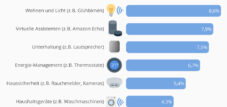
Artificial intelligence, or machine learning, was one of the major topics at this year's Consumer Electronics Show (CES) in Las Vegas. The new technology has long since arrived on smartphones and in users' minds, as Deloitte's Global Mobile Consumer Survey shows. For the study, around 24,600 smartphone owners from 16 industrialized countries, including Germany, were surveyed. Of these, 65 percent have already used a machine learning-based smartphone application – the Staista graphic shows which ones have the greatest awareness and reach.

Are the artificial songwriters coming?
The year is 2025, and Helene Fischer has just received the Echo award for her latest number-one album. But something is different: the album was written entirely by Silveriron 1.0, an artificial intelligence (AI). Nonsense? Perhaps, but 23 percent of the approximately 1,100 respondents in a recent survey by the auditing firm PwC can certainly imagine such a scenario. The study participants are similarly optimistic about AI solving climate change or curing cancer. Whether it actually happens, we'll soon find out.

Smart health isn't taking off yet
Germans are wary of the digitalization of the healthcare sector. Even the analysis of vital data using smartphones or wearables is met with considerable skepticism. 57 percent would only use these technologies if complete data security were guaranteed. The rejection of care robots and artificial intelligence is even more vehement, as the infographic created in collaboration with our client BearingPoint shows.

Keep in touch