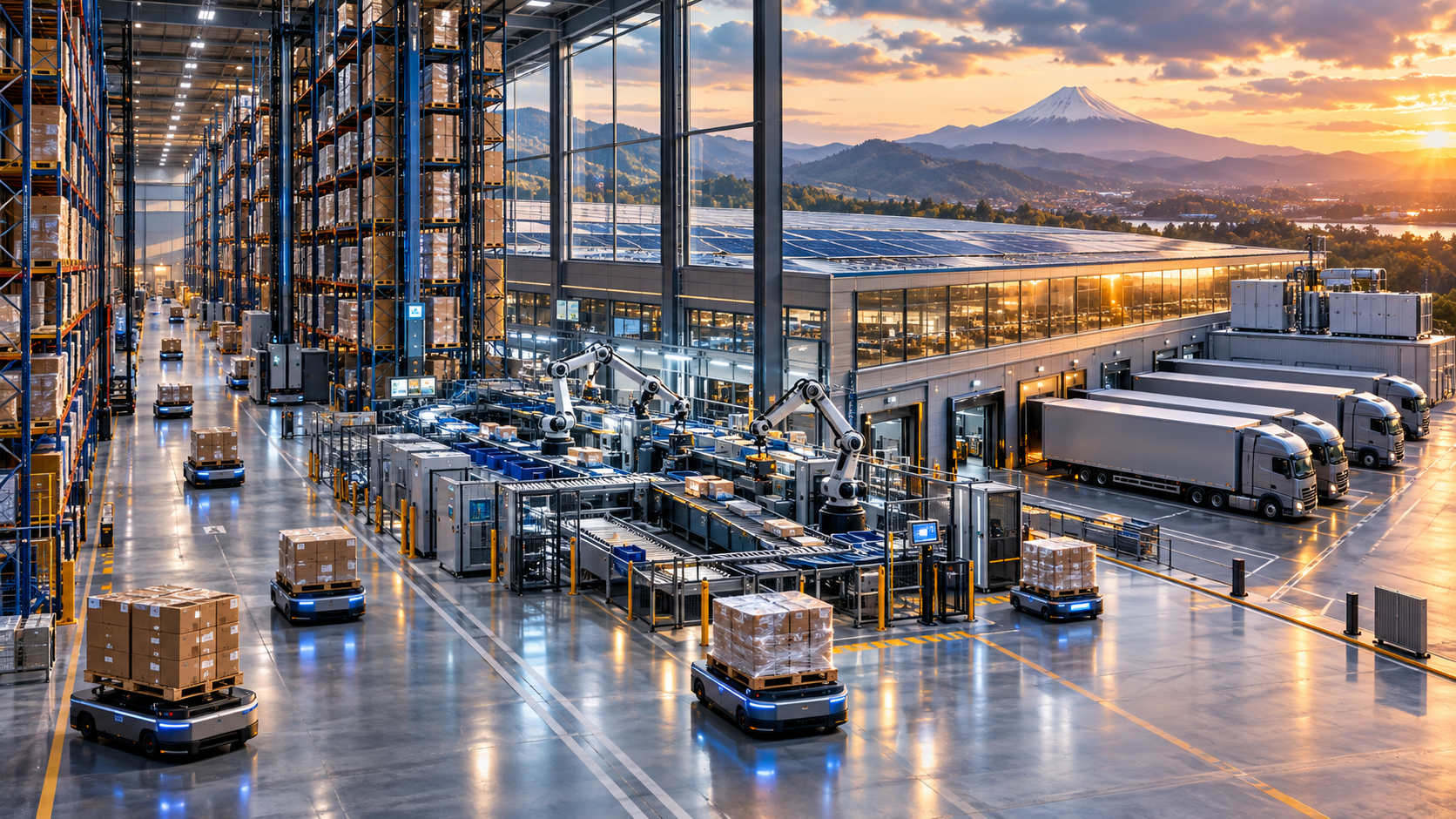
Artificial intelligence alone does not decide global competition – creative image on the topic, featuring AI: Xpert.Digital
But the question is whether goods, energy and data will still flow in the next crisis
Neither semiconductors nor software: Why gigantic high-tech warehouses are the biggest business of the future
Why artificial intelligence remains completely worthless without modern logistics
In the heated public debate surrounding artificial intelligence, semiconductors, and digital business models, a crucial truth is often overlooked: the smartest software is of little use if the physical world grinds to a halt. While algorithms calculate demand in milliseconds and forecast global flows, the harsh reality in highly automated warehouses, at multimodal hubs, and along transport routes determines actual economic success. Logistics is no longer merely an auxiliary function concerned only with storing pallets. Rather, it is evolving into the critical "operating system" of the global economy. The following text illuminates the quiet but immense transformation of our supply chains—from the rapid rise of robots and the massive impact of e-commerce to the absolute necessity of resilience in the face of geopolitical crises. It is the story of an industrial revolution taking place not in cyberspace, but at the interface of bits and concrete.
The silent power of supply chains: Logistics is becoming a key economic infrastructure
The public debate about the next industrial transformation focuses heavily on artificial intelligence, semiconductors, and data centers. It's easy to overlook the fact that digitally generated forecasts, automated decisions, and intelligent production systems only create economic value if physical goods can be reliably moved, stored, sorted, and delivered. An algorithm can accurately predict the need for spare parts, but it cannot open a blocked waterway, replace missing storage capacity, or bridge a power outage. The real industrial revolution of the coming years, therefore, takes place at the intersection of software and physical infrastructure: in automated distribution centers, multimodal hubs, digitally controlled transport networks, and resilient energy and data structures.
The economic importance of this sector is enormous, yet market sizes are often misrepresented. Depending on whether only outsourced logistics services are included, or also internal transport and warehousing activities, or even other parts of the trade and infrastructure system, estimates for 2026 range from approximately US$4.3 trillion to around US$12.7 trillion. This wide range is not a statistical error, but rather the result of differing definitions. Therefore, the trend is more meaningful than a single global figure: Several market studies anticipate significant growth through the early 2030s, driven by e-commerce, urbanization, digital supply chains, infrastructure investments, and increased demands for speed and reliability.
In this context, logistics properties are no longer passive warehouses. Modern centers combine building technology, robotics, warehouse management software, energy supply, data analysis, and transport control into a productive overall system. Their economic performance extends beyond simply storing goods. They reduce search and waiting times, increase throughput, minimize inventory errors, consolidate shipments, and enable companies to respond more quickly to changes in demand. This impacts working capital, delivery capability, customer satisfaction, and market access simultaneously. A well-positioned and intelligently operated logistics platform can therefore be just as strategic as a production plant or a data center.
At the macroeconomic level, the quality of logistics influences how easily companies can reach international markets, how reliably intermediate goods arrive, and how high the friction costs included in the price of goods are. The World Bank therefore assesses logistics performance not only based on roads, ports, and airports, but also on customs clearance, service quality, shipment tracking, international connectivity, and on-time delivery. This broader perspective is crucial: A new highway only marginally improves competitiveness if border processes are slow, data is incompatible, or storage and transshipment capacities are inadequate.
The construction boom is changing locations and capital flows
The expansion of modern logistics facilities initially generates classic investment impulses. Land is developed, warehouses are built, energy and data networks are expanded, and transport connections are improved. Additional expenditures include racking systems, conveyor technology, refrigeration, fire protection, photovoltaics, charging infrastructure, and digital control systems. A large distribution center therefore attracts added value from numerous industries. During the construction phase, construction companies, planners, and plant engineers benefit; in later operation, contracts arise for maintenance, security services, energy supply, transport, packaging, software, and technical integration.
However, the regional economic impact depends heavily on the project's integration. An isolated warehouse at a highway interchange generates less sustainable development than a site connected to industry, rail, ports, educational institutions, and local suppliers. Crucially, it's not just the square footage that matters, but its function within the network. An import warehouse with minimal local processing can cause significant traffic congestion without creating many skilled jobs. Conversely, an automated spare parts center that integrates repair services, data analytics, and regional suppliers can attract additional expertise and long-term business functions.
For real estate investors, modern logistics is attractive because users cannot easily relocate critical processes, and high-quality properties often have long lease terms. At the same time, the market is becoming increasingly differentiated. Standard warehouses without sufficient power supply, low floor load-bearing capacity, outdated fire protection concepts, or weak data connections are losing relative appeal. Spaces that support automation, allow for expansion, and meet stricter energy requirements are in demand. The European market is therefore showing increasing quality selection: Even with only a slow overall recovery in demand, high-performance properties with good energy supply, suitable locations, and modern facilities remain sought after, while weaker properties come under greater pressure.
This trend is also visible in emerging logistics hubs. In Sofia, the vacancy rate for industrial and logistics space fell to 1.4 percent in the first quarter of 2026; at the same time, according to the market report, monthly rents were around six euros per square meter for Class A spaces and 4.50 euros for Class B. Such figures indicate a tight market, but say nothing about the quality of individual projects. For Bulgaria, the strategic opportunity lies not merely in providing affordable warehouse capacity, but in expanding the combination of EU single market access, industrial production, IT expertise, and corridor location into a higher-value logistics offering.
Automation becomes a productivity lever
The market for warehouse automation is growing significantly faster than many established segments of traditional logistics. A global volume of approximately US$34.2 billion is projected for 2026; by 2031, it could rise to around US$65.7 billion. This corresponds to an average annual growth rate of nearly 14 percent. This market encompasses not only robots, but also automated storage and retrieval systems, conveyor technology, control systems, and integrated software that coordinates the flow of goods within a warehouse.
Autonomous mobile robots (AMRs) and automated guided vehicles (AGVs) are particularly important. Both reduce unproductive walking and driving distances, but differ in their flexibility. Classic AGVs often follow predefined routes, while AMRs can better perceive their surroundings and dynamically adapt their paths. These are complemented by automated small parts warehouses, shuttle systems, pallet cranes, sorting systems, image recognition, and robotic arms for palletizing and depalletizing. The greatest impact comes not from the individual machine, but from the coordinated integration of all components with inventory, order, and transport data.
The increasing prevalence of robotics is also evident in the robotics market. Of the professional service robots sold worldwide in 2024, approximately 102,900 units were used in transport and logistics; this means that more than half of all professional service robots were intended for this application. At the same time, the total number of professional service robots sold rose to nearly 200,000 units. This finding underscores that mobile robotics is transitioning from the pilot phase to broader operational use.
The economic appeal stems from several effects. First, automated systems can operate with consistent performance over extended periods. Second, error costs decrease when items, serial numbers, or loading units are automatically recognized and checked. Third, existing space can be used more efficiently, for example, through high shelves and narrow aisles. Fourth, occupational safety improves when machines take over heavy, monotonous, or ergonomically demanding movements. Fifth, performance becomes more predictable, which is particularly valuable during peak times and tight delivery windows.
NTT Logisco provides a concrete example. The company combines image recognition with automated sorting when refurbishing returned communication devices. An earlier version of the image recognition system increased productivity per employee by approximately 15 percent for certain inspection tasks and, according to the company, achieved very high recognition accuracy. A later solution for the automatic registration and sorting of returns reported a 30 percent increase in productivity and the elimination of sorting errors. This case is particularly relevant because the circular economy requires not only return transport but also identification, condition assessment, refurbishment, and reuse.
Humans do not disappear from the camp
The idea of a completely unmanned warehouse is technically fascinating, but economically convincing only in certain environments. Automation works particularly well with high and stable volumes, standardized loading units, predictable order profiles, and a limited number of physical anomalies. The more heterogeneous the products, packaging, and orders are, the more complex the technical solution becomes. Fragile goods, irregular shapes, damaged packaging, or short-term assortment changes still require human judgment or highly sophisticated robotics.
The investment calculation should therefore not be reduced to just saved working hours. Capital costs, planning, structural modifications, system integration, testing, maintenance, spare parts, software licenses, cybersecurity, and the risk of technological dependency must all be considered. The economic value of flexibility must also be taken into account. A highly specialized system can be very efficient with an unchanged product range, but lose value if packaging sizes, distribution channels, or volume structures change. In a volatile market, a slightly less efficient but modular solution may achieve a better return on investment.
Successful projects therefore don't begin with the purchase of a robot, but with a thorough analysis of processes. Companies need to know which items are moved how frequently, where waiting times occur, which activities pose a risk of injury, and what fluctuations are to be expected. Only then can a decision be made as to whether an automated high-bay warehouse, a goods-to-person system, mobile robotics, or simply improved software is the right solution. Industry analyses explicitly recommend testing automation gradually, involving IT and employees early on, and selecting the solution based on the product structure, order profile, integration capabilities, and maintenance expertise.
The most likely development path is therefore the hybrid warehouse. Humans handle exceptional cases, quality decisions, troubleshooting, and flexible tasks; machines take care of recurring transport, storage, sorting, and parts of order picking. This changes the skill structure. The need for purely manual tasks tends to decrease, while operation, maintenance, data management, and process control become more important. Automation thus does not eliminate the need for labor, but rather shifts it and increases the costs associated with underqualified personnel.
For aging economies, this transformation can alleviate some of the demographic pressure. However, it does not automatically solve the social problems of the transition. Employees whose jobs are eliminated cannot simply become mechatronics engineers, software administrators, or data analysts. Businesses and policymakers must therefore treat continuing education as an integral part of the investment. Those who invest millions in technology but allocate only a small amount to training, change management, and internal career advancement risk resistance, user errors, and untapped productivity.
Resilience replaces the pure logic of efficiency
For decades, a lean supply chain was considered ideal. Low inventory levels, few suppliers, high capacity utilization, and centralized warehouses reduced costs under normal operating conditions. However, the pandemic, blockades of major shipping lanes, natural disasters, and geopolitical conflicts have demonstrated that maximum efficiency under stable conditions does not equate to maximum economic efficiency across the entire business and crisis cycle. A system without reserves may appear advantageous until a single disruption impacts production, trade, or supply for weeks.
Resilience does not mean stockpiling every commodity everywhere. Such a strategy would be expensive and negate many efficiency gains. A segmented approach is more sensible. Critical spare parts, medicines, semiconductors, or essential goods require different safety stocks and contingency plans than easily replaceable consumer goods. Similarly, frequent disruptions such as seasonal weather must be handled differently than rare extreme events. The OECD recommends considering the performance of the entire system and basing resilience on visibility, scenario planning, reliable data, regulatory cooperation, and public-private preparedness.
A robust supply chain combines several instruments. These include alternative suppliers, regionally distributed inventories, standardized intermediate products, flexible production, redundant transport routes, and contractually secured emergency capacities. Crucially, it must be able to switch quickly in the event of a disruption. Two suppliers offer little security if both depend on the same port, the same energy supplier, or the same source of intermediate products. Diversification must therefore address real dependencies along multiple stages and cannot end with the immediate supplier list.
This changes the investment logic. Reserve capacity, emergency power, additional inventory, and secondary transport routes appear as a burden in traditional cost accounting. However, in a risk-adjusted analysis, they represent insurance against production downtime, contractual penalties, lost revenue, and reputational damage. Companies need scenarios that link the probability of occurrence with the potential extent of damage. Not every redundancy is cost-effective, but foregoing all redundancy can be a threat to a company's survival.
Your intralogistics experts

Consulting, planning and implementation of complete solutions for high-bay warehouses and automated storage systems - Image: Xpert.Digital
More information here:
The end of cheap logistics: The e-commerce boom is forcing cities to develop completely new logistics concepts
Japan demonstrates the value of decentralized security
Aeon's new Iwate Front Distribution Center in Prologis Park Kitakami-Kanegasaki exemplifies this paradigm shift. Aeon is leasing approximately 38,823 square meters and using the site as an existing hub for the northern part of the Tohoku region and as a distribution center for Iwate Prefecture. The 4,666-square-meter low-temperature area is scheduled to begin operations on October 7, 2026; the 28,824-square-meter ambient temperature storage areas are slated to follow on February 23, 2027. As of mid-September 2026, the center is therefore not yet open but is in the final stages of its initial operational phase.
Clarification is important because effects already realized are often prematurely inferred from announced projects. Nevertheless, Aeon's target figures are remarkable: The reorganization of logistics sites is intended to reduce the distance from the center to the stores in Iwate by 58 percent. Digitization and automation are expected to increase the delivery productivity of warehoused goods by 40 percent. Such figures represent corporate goals or metrics and should be verified after ramp-up using actual operational data. However, they demonstrate how significantly location choice and automation can collectively impact costs and performance.
Until now, the Aeon Tohoku Regional Distribution Center in Miyagi served as the central hub for the entire region. Distributing the inventory function between Miyagi and Iwate creates a backup structure designed to stabilize the supply of goods in the event of disasters or technical failures. The new center also features an emergency power system to ensure continued logistics operations during power outages. While the existence of an emergency power supply is verifiable, the published information does not imply a specific guarantee of multi-day self-sufficiency, nor should it be claimed.
The building itself also contributes to resilience. Completed in 2025, the two-story Prologis Park has a total area of approximately 55,000 square meters on a plot of land measuring around 78,500 square meters. Covered driveways and loading docks, as well as a snow removal service, enable operations even in adverse weather conditions. Its proximity to the Kitakami-Kanegasaki highway interchange and connections to several major highways facilitate supplying northern Tohoku. Automated storage systems, AGVs, and depalletizing robots simultaneously reduce personnel and time requirements for standardized goods flows.
This example demonstrates that resilience need not be at odds with efficiency. While relocating part of the inventory increases the need for coordination and can tie up additional capital, it simultaneously shortens the final distribution route, improves regional responsiveness, and creates a second operational pillar. The economic benefits arise precisely from this combination: lower routine costs in daily transport and reduced losses in the event of a crisis.
Bottlenecks make logistics risks visible
Global supply chains remain dependent on a few maritime corridors despite regional warehousing centers. The Panama Canal illustrates how climate, water availability, and global trade are interconnected. After a temporary improvement, the canal authority announced renewed restrictions in August 2026 due to an expected strong El Niño event. From September 15, 2026, a maximum of 32 ships per day will be allowed to transit, nine through the Neopanamax locks and 23 through the Panamax locks. In the first nine months of fiscal year 2026, the canal had reported an average of 35 daily transits.
Such restrictions have multiple effects. Reduced transit times lengthen waiting periods and increase the value of reserved slots. Shipping companies can levy surcharges or reroute vessels onto longer routes. Shippers respond with higher safety stocks, earlier orders, or alternative modes of transport. Ultimately, some of the costs are passed on to producers and consumers. At the same time, not all shipping companies benefit equally, as longer turnaround times tie up ships and increase fuel, personnel, and financing costs.
The lesson is not to avoid all dependence on global trade. Complete regionalization would weaken the advantages of specialization, increase prices, and require unrealistically high investments in many sectors. A more sensible approach is the conscious evaluation of systemic hubs. Companies should know what proportion of their value creation depends on a particular canal, port, border crossing, data center, or energy connection. Only this transparency enables economically sound alternative strategies.
UNCTAD describes the maritime economy as characterized by more fragile growth, rising costs, geopolitical uncertainty, and changing shipping routes. This necessitates investment in resilient ports, digital transparency, cybersecurity, and lower-emission fleets. For inland logistics hubs, this means they cannot be planned in isolation. Their performance depends on the capacity of ports, rail terminals, road corridors, and digital interfaces.
E-commerce is changing the geography of warehouses
E-commerce not only increases shipment volume but also changes the structure of demand. Instead of fewer large deliveries to stores, there are many small orders to households or collection points. Customers expect short delivery times, precise time windows, and hassle-free returns. This increases the demands on order picking, packing, sorting, and inventory accuracy. A traditional large warehouse on the outskirts of a city can only partially meet these demands if the last mile is overloaded or too long.
As a result, multi-tiered networks are emerging. Large national centers maintain broad product ranges and supply regional hubs. These, in turn, supply urban micro-centers, parcel stations, branches, or directly to end customers. This increases proximity to the market but can fragment inventory. The crucial capability, therefore, lies in accurately forecasting which items will be needed at which location. This is where artificial intelligence gains its concrete logistical value: not as a buzzword, but as a tool for demand forecasting, inventory positioning, route planning, and dynamic capacity management.
Returns are an often underestimated part of this economy. They generate return transport, visual inspection, sorting, refurbishment, resale, or disposal. Especially in product categories with high return rates, reverse logistics can consume a significant portion of the margin. Automatic identification and sorting, such as that used by NTT Logisco for returned communication devices, is therefore not just about process optimization. It is a prerequisite for the economically scalable implementation of repair, reuse, and circular economy models.
The increasing proximity to customers simultaneously exacerbates conflicts over available space. Urban locations are expensive and compete with residential, commercial, and public uses. Micro-centers therefore only function if their higher real estate costs are offset by shorter delivery routes, better vehicle utilization, and higher service quality. Municipalities must also consider traffic, noise, and emissions. Good urban logistics does not consist of as many small warehouses as possible, but rather of a coordinated combination of locations, low-emission vehicles, collection systems, and consolidated deliveries.
Geopolitics is reorganizing supply chains
Nearshoring and friendshoring relocate parts of production closer to sales markets or to countries with closer political ties. This development is often described as a departure from globalization, but it is actually more of a reorganization. Companies are trying to reduce delivery times and political risks without completely abandoning international specialization. This is creating new industrial and logistics corridors in Central and Eastern Europe, Mexico, Southeast Asia, and parts of North America.
For a location to be successful, it's not enough to simply offer affordable land and wages. Relocating production requires suppliers, energy, skilled workers, digital networks, customs expertise, and reliable transport routes. Logistics thus becomes a test of a location's true quality. A region can be geographically close to the target market yet economically distant if border crossings, rail capacity, or permits are slow. Conversely, a somewhat more distant location can become more competitive through reliable corridors and good service providers.
Bulgaria has opportunities in this environment as an EU member, production location, and link between Southeast Europe, Turkey, and the rest of the single market. However, the expansion of the logistics sector should not be limited to Sofia. Plovdiv, Ruse, Burgas, Varna, and hubs along key north-south and east-west routes can assume specialized functions. Transpress's investment in a logistics center in the Sofia-Boshurishte Industrial Park, dating back to 2022, was a visible example of modernization; it amounted to 16 million leva and covered an area of approximately 40 decagrams. Therefore, it is not a new project from 2026 and should be placed in its proper historical context.
Strategically more important than individual flagship projects is the development of a robust network. This includes modern border crossings, efficient rail connections, intermodal terminals, secure parking facilities, charging infrastructure, and digital freight information. Bulgaria cannot differentiate itself sustainably solely through lower costs. Higher added value is generated when logistics is combined with assembly, quality control, repair, packaging, spare parts management, and regional dispatching.
Sustainability becomes a question of cost and location
Automation doesn't automatically reduce the ecological footprint. Robots, conveyor systems, cooling, servers, and charging infrastructure increase the electricity demand of a logistics center. Whether emissions decrease therefore depends on energy efficiency, the energy mix, building design, and the impact of transportation. An automated warehouse can consume more energy than a simple hall, but at the same time, it can consolidate shipments, reduce wasted trips, use space more efficiently, and minimize food waste. The overall assessment must consider the entire flow of goods.
Large roof areas offer significant potential for photovoltaics. Combined with storage, intelligent load management, and charging points, logistics properties can cover a portion of their own energy needs and reduce peak loads. Economic efficiency improves when self-generated solar power supplies not only lighting and conveyor technology, but also cooling systems or electric delivery fleets. Limitations include structural considerations, grid connection, daily energy profiles, and seasonal fluctuations. Emergency power capability also requires separate consideration: photovoltaics alone does not guarantee stable off-grid operation during a power outage.
European building policy is increasing the pressure to act. The revised directive on the overall energy performance of buildings also covers non-residential properties and aims to make new buildings of this type emission-free by 2030. For logistics facilities, energy performance certificates, minimum standards, solar suitability, and charging points are therefore becoming increasingly important. Investors must already factor potential retrofitting costs into purchase, financing, and lease agreements.
The decarbonization of transport is also changing location choices. Electric distribution vehicles require sufficient grid capacity and predictable charging windows. Hydrogen can play a role in certain heavy-duty applications, but remains dependent on availability, efficiency, and cost. For many companies, the greatest short-term savings lie in better capacity utilization, fewer empty runs, adjusted speeds, and intelligent route planning. Technological openness is sensible, but it must not be used as a pretext for postponing economically available efficiency measures.
Emissions data is also becoming a commercial factor. Large customers are increasingly demanding verifiable information on transport-related emissions, energy consumption, and supply chain risks. As a result, data quality is becoming an integral part of a logistics provider's offering. Those who accurately document shipments, distances, vehicle types, capacity utilization, and energy sources can more easily meet regulatory requirements and support their customers in their reporting. Sustainability is thus transforming from a communication challenge into an operational data and cost issue.
Concentration creates new vulnerabilities
The larger and more automated a center is, the higher its potential productivity. At the same time, the potential damage from a failure increases. A fire, cyberattack, software error, or power outage can affect not just a single building, but an entire regional supply network. High-density warehouses also increase the demands on early fire detection, extinguishing technology, and spatial separation. Batteries in robots, charging infrastructure, and new packaging materials are changing the risk profile.
Cybersecurity is becoming an integral part of operational security. Warehouse management, robot control, access control systems, sensors, and transport platforms are interconnected. An attacker doesn't need to control every machine; even manipulated order data or blocked interfaces can bring operations to a standstill. Therefore, companies require segmented networks, secure remote maintenance, up-to-date software, tested recovery plans, and manual emergency procedures. Complete digitalization without an analog fallback option can increase efficiency but simultaneously weaken recovery capabilities.
Vendor dependency also deserves more attention. Proprietary systems can be powerful, but they tie users to spare parts, licenses, and specialized knowledge in the long term. If a vendor fails or discontinues a product line, significant migration costs arise. Open interfaces, documented data models, and contractually secured access to critical software are therefore economically relevant. The lowest purchase price is not necessarily the lowest overall cost over the system's lifespan.
Overcapacity remains a risk. If companies simultaneously react to high e-commerce forecasts, too many similar spaces can be created. Rising interest rates exacerbate the situation because financing costs and required returns increase. Speculative projects in secondary locations without a guaranteed tenant or sufficient energy supply are particularly vulnerable. Modular construction, alternative uses, and a realistic analysis of regional demand offer better protection than blanket optimism.
Capital discipline determines success
An automated logistics center is a long-term investment in volume, product range, technology, and location. Therefore, the profitability analysis must consider various scenarios. In addition to a baseline scenario, companies should model lower growth, higher energy prices, rising wages, more expensive financing, system failures, and changing customer requirements. A project is not robust if it only pays off with ideal capacity utilization and uninterrupted operation.
More important than a high-profile payback period is the total net present value over the entire service life. Benefits include saved labor hours, fewer errors, increased capacity, reduced space requirements, improved delivery quality, and avoided downtime. On the cost side, it's not just purchase and construction that matter, but also integration, training, maintenance, replacement investments, software, energy, and financing. Residual value is also a crucial factor: a building that can be flexibly adapted is more likely to retain its value than a system tailored to a single process.
Phased investments can reduce uncertainty. Mobile robots and modular conveyor technology can often be expanded gradually, while a fully automated high-bay warehouse ties up large sums of capital early on. Pilot projects are useful if they test real peak loads, different products, and disruption scenarios. However, a pilot project shouldn't be so small that it masks the later complexity. The transferability to the entire network must be considered from the outset.
For medium-sized businesses, rental, leasing, and robotics-as-a-service models are gaining importance. They reduce initial capital requirements and can include technical support. However, this also creates ongoing obligations and greater dependence on the provider. The right financing option depends on utilization, balance sheet structure, technological maturity, and the strategic importance of the process. Critical core functions should not be outsourced simply because a subscription appears cheaper in the short term.
Infrastructure policy needs a systems approach
Government economic policy often treats transport, energy, digitalization, spatial planning, and education in separate departments. However, for modern logistics, these areas are directly intertwined. A new distribution center cannot operate efficiently if the grid connection takes years, the access road is congested, or qualified maintenance personnel are lacking. Similarly, a digital waybill is useless if authorities and companies use incompatible systems.
Priority should therefore be given to eliminating specific bottlenecks. This includes faster permitting, efficient power grids, interoperable data standards, modern border control, and reliable rail and road corridors. The World Bank emphasizes the interplay between infrastructure, customs, service quality, shipment tracking, and on-time delivery when it comes to logistics performance. Investment sums alone are consequently an insufficient measure of success; shorter transit times and greater reliability are crucial.
Funding policies should be technology-neutral but results-oriented. Subsidies for individual vehicles or robotic systems can create perverse incentives if networks, processes, and skills are lacking. Programs that support measurable improvements in energy consumption, throughput, safety, or resilience are more effective. At the same time, competition must be maintained. If a few platforms or real estate providers control critical nodes, the overall system's dependency can increase.
Education policy is not a mere supplementary measure, but rather an integral part of the infrastructure. What's needed are mechatronics engineers, electricians, data experts, dispatchers, and managers who understand both physical processes and software. Vocational schools, universities, and companies should develop practical programs in robotics maintenance, warehouse IT, cybersecurity, and sustainable transport planning. Without these skills, an economy may import technology, but it will fail to develop its own value creation capabilities.
By 2030, efficiency will separate from mere technological advancement
By 2030, autonomous systems, image recognition, predictive analytics, and networked transport platforms will be commonplace in many logistics networks. The crucial change, however, is not simply about equipping every warehouse with as many robots as possible. Competitive advantages arise where companies manage data, buildings, energy, personnel, and transport as a single system. Automation will only accelerate the deterioration of a poorly organized process; a well-understood process, on the other hand, can scale significantly through targeted technology.
The most successful networks will be both efficient and fault-tolerant. They will have transparency down to upstream supply chains, defined alternative routes, segmented safety stocks, and robust restart plans. They will use artificial intelligence for forecasting and decision preparation, but will not rely blindly on models. Physical reserves, experienced personnel, and clear lines of responsibility will remain essential.
For national economies, this shifts the definition of industrial competitiveness. Low wages and cheap land are no longer enough. Attractive locations now offer a combination of fast permitting, stable energy, efficient networks, a skilled workforce, and access to multiple modes of transport. Logistics is becoming a kind of operating system for the real economy: mostly invisible as long as it functions, but immediately noticeable when it fails.
The reasoned perspective is therefore neither enthusiastic about technology nor skeptical. The expansion of modern logistics centers is economically necessary because labor shortages, e-commerce, geopolitical risks, and decarbonization are creating new demands. Automation can significantly increase productivity, safety, and delivery capacity. However, it only realizes its full potential with disciplined site selection, modular technology, qualified employees, and a resilience strategy that takes real dependencies into account.
The invisible revolution in supply chains is therefore not a side effect of the AI age. It is its material prerequisite. Computing power can plan, optimize, and forecast; prosperity only arises when this intelligence is translated into reliable flows of goods, lower costs, and stable supply. In the coming years, therefore, those companies and countries that talk most loudly about artificial intelligence will not necessarily be the ones that win. Success will come to those who combine digital intelligence with resilient physical infrastructure and remain capable of acting even under stress.
Your global marketing and business development partner
☑️ Our business language is English or German
☑️ NEW: Correspondence in your native language!

Konrad Wolfenstein
I and my team are happy to be available to you as your personal advisor.
You can contact me by filling out the contact form here wolfenstein@xpert.digital:or simply call me at +49 7348 4088 965. My email address is
I'm looking forward to our joint project.