
GPT 6 Luna is cheaper than DeepSeek V4.1 Flash and nobody noticed? – Creative image on the topic, with AI: Xpert.Digital
AI prices take a surprising turn: GPT-6 Luna beats DeepSeek in API
GPT-6 Luna is cheaper than DeepSeek – but there's a catch to the price comparison
DeepSeek was considered a price leader – now OpenAI is cheaper for many queries
DeepSeek was long considered the epitome of affordable AI. But with GPT-6 Luna, OpenAI has surprisingly shaken up the pricing landscape: Under regular API plans, Luna costs less per input token and per-response than DeepSeek V4.1 Flash – even during the Chinese provider's most favorable time window. For many typical tasks, OpenAI can therefore offer the lower price. However, this doesn't mean that Luna is always the more economical choice. DeepSeek scores points with particularly low-cost cache hits, high speed, and open model weights that can also be self-managed. Which model ultimately costs less therefore depends not only on the price per token, but also on the length of the contexts, the proportion of reused inputs, the time of day, the desired performance, and the operating model. A detailed comparison reveals where GPT-6 Luna is actually cheaper – and in which cases DeepSeek may still be the better choice.
The AI prize leader suddenly comes from the USA
China's price advantage is gone – at least on the invoice
GPT-6 Luna costs less than DeepSeek V4.1 Flash in its standard programming interface. This finding initially sounds like a calculation error because it contradicts the prevailing image of the AI market, which has been entrenched for months: top Western models are considered powerful but expensive, while Chinese providers score points with aggressive pricing, open model weights, and high efficiency. This image has shifted for two of the most interesting efficiency models currently available. OpenAI charges $0.10 for one million uncached input tokens with GPT-6 Luna and $0.50 for one million output tokens. DeepSeek charges $0.15 for input and $0.60 for output with V4.1 Flash outside of peak hours. During defined peak hours, DeepSeek's rates even rise to $0.30 and $1.20, respectively.
This means that GPT-6 Luna's regular price for new input tokens is one-third lower than DeepSeek's cheapest direct plan. For output tokens, the difference is around 16.7 percent. Compared to DeepSeek's top-tier plan, Luna is roughly 66.7 percent cheaper for input and around 58.3 percent cheaper for output. This isn't a minimal rounding difference, but a clear price reversal. It affects precisely the two items that account for the largest share of the bill for many productive applications: newly processed context and generated content.
The provocative statement that Luna is cheaper and hardly anyone has noticed therefore contains a kernel of truth. However, it requires an important clarification. The lower list price does not automatically make Luna the more economical model in every application. DeepSeek has a significant advantage when reading cached input, can be self-hosted, and sometimes exhibits higher performance and significantly lower latency in demanding tasks. The economically accurate statement is therefore: GPT-6 Luna undercuts DeepSeek V4.1 Flash at the most important regular API rates, but the actual cost leadership depends on context length, cache size, time of day, output length, quality target, and operating model.
A sober look at the price list
The standard rates initially create unusually clear conditions. GPT-6 Luna costs $0.10 per million tokens for normal input, $0.01 for already cached input, and $0.50 for output. Writing to the cache is charged at $0.125 per million tokens. DeepSeek V4.1 Flash, on the other hand, differentiates between peak and off-peak times. Outside of peak times, it charges $0.15 for new input, $0.003 for cache hits, and $0.60 for output. During peak times, these values double to $0.30, $0.006, and $1.20, respectively.
DeepSeek's peak usage times are Monday to Friday between 1:00 and 4:00 a.m. and between 6:00 and 10:00 a.m. Coordinated Universal Time (UTC). For Germany, this generally translates to time slots in the early morning and late morning/midday in October, depending on whether it's summer or winter time. Weekends and Chinese holidays are considered off-peak hours. This pricing structure rewards flexible batch processing and disadvantages applications with consistent real-time traffic. A European customer service department that primarily operates during German office hours can therefore generate a significant portion of its usage during the more expensive time slots. Conversely, a nighttime document run can be consistently scheduled at half the standard rate.
OpenAI eliminates this time-of-day-dependent uncertainty in its standard pricing. In addition, there are Flex and Batch modes, each costing approximately half the standard price. For asynchronous tasks, Luna can theoretically drop to $0.05 per million input tokens and $0.25 per million output tokens. Conversely, the accelerated mode costs roughly twice the standard price. Regional processing can also incur a surcharge. Therefore, the seemingly simple model comparison is actually a comparison of pricing, deployment method, region, time window, and workload.
Why the price drop remained almost invisible
That the price reversal received little public attention is less surprising than it initially seems. Markets react not only to numbers, but also to ingrained narratives. DeepSeek became synonymous with radically affordable AI, while OpenAI is perceived as a premium provider. Such mental anchors change more slowly than price lists. A single new tariff is therefore often integrated into the existing worldview, rather than challenging the worldview itself.
Added to this is the speed of the model market. GPT-6 Luna appeared in an environment where new models, variants, levels of thought, context boundaries, and deployment options change almost daily. DeepSeek updated V4.1 Flash to version 1017 shortly thereafter without changing the price. Public discussion focused on benchmarks, programming capabilities, and speed. The more strategically important fact that a closed OpenAI model was suddenly undercut by a Chinese open-weight model at core tariffs got lost amidst version numbers and test results.
The way prices are presented also complicates comparison. DeepSeek communicates peak and off-peak times as well as extremely cheap cache hits. OpenAI differentiates between Standard, Flex, Batch, Fast, regional processing, and long contexts. Brokerage platforms, in turn, display their own prices, which depend on special offers, hardware utilization, and routing. Depending on whether a comparison considers the direct provider, a router, the cheapest third-party provider, or actual average prices paid, a different picture emerges. For example, DeepSeek might appear cheaper at times when using an external provider, even though the official direct API is more expensive. A reliable comparison must therefore first define exactly what is being compared.
Ultimately, the price per token is abstract for many users. A difference of five hundredths of a US dollar per million input tokens seems insignificant. However, with billions or trillions of tokens, this becomes a significant cost factor. At the same time, even small differences in the issuance length can more than compensate for the price difference. This combination of seemingly tiny unit prices and highly scalable volumes prevents easy headlines.
The calculation behind the surprise effect
The basic formula is simple: The cost of a query is calculated by multiplying the number of new input tokens by the input price, adding the cached tokens at the cache price and the generated tokens at the output price. With one million new input tokens and 200,000 output tokens, GPT-6 Luna costs $0.20 at the standard rate. DeepSeek V4.1 Flash costs $0.27 off-peak and $0.54 during peak hours. In this example, Luna is approximately 25.9 percent cheaper than DeepSeek's off-peak rate and approximately 63 percent cheaper than its peak rate.
A typical document-oriented operation with one million new input tokens, one million cache tokens, and 100,000 output tokens costs $0.16 on Luna. DeepSeek charges $0.213 outside of peak hours. Luna is therefore about 24.9 percent cheaper. During peak hours, the DeepSeek charge rises to $0.426. Although DeepSeek reads the cache much more cheaply, one million cached tokens are not enough in this example to offset the higher prices for new inputs and outputs.
The situation is different for extremely cache-intensive applications. If only 100,000 new input tokens and 100,000 output tokens are processed, but ten million tokens are simultaneously read from the cache, Luna costs around $0.16. DeepSeek costs about $0.105 outside of peak hours. DeepSeek is then about 34 percent cheaper. During peak hours, however, the same DeepSeek operation costs about $0.21, so Luna is ahead again. This example shows how strongly DeepSeek's time-based price and cache advantage interact.
Mathematically, the threshold outside of peak hours lies where the amount of cache tokens reaches approximately 7.14 times the new input tokens plus 14.29 times the output tokens. Below this threshold, Luna is cheaper; above it, DeepSeek can gain the advantage. During DeepSeek's peak hours, the boundary shifts drastically: then, the cache tokens would have to exceed approximately 50 times the new input plus 175 times the output before DeepSeek would become cheaper. For most common chat, analytics, extraction, and programming tasks, Luna thus remains the more advantageous option at its current API price.
The cache is DeepSeek's sharpest weapon
The most important counterpoint to the Luna narrative is caching. DeepSeek charges only $0.003 for one million cache tokens outside of peak hours. Luna costs $0.01. DeepSeek is thus 70 percent cheaper; conversely, Luna's cache read price is more than three times higher. Even during DeepSeek's peak hours, a cache costs only $0.006, remaining 40 percent cheaper than Luna's.
This difference is significant for applications with long, largely static system instructions, extensive product catalogs, recurring legal documents, or constant program code. When the same context is reused hundreds or thousands of times, the cost of caching can become more important than the cost of new input. Therefore, a company that combines a stable knowledge base with many short user queries has a different cost profile than a search agent that processes new web pages, files, and tool results on every run.
Caching, however, is not an automatically available discount on all input. The context must be technically cacheable, recur in a sufficiently identical form, and be reused within the respective storage logic. Dynamically constructed prompts, frequently changing documents, or personalized contexts reduce the hit rate. Furthermore, a high cache rate alone does not guarantee business success. It must be combined with correct responses, low latency, and a robust application. A cheap cache that provides outdated or incorrectly structured information saves tokens but simultaneously generates additional costs.
For economic evaluation, the published cache price is therefore not decisive, but rather the actual measured cache hit rate per application. Companies should separately track new input, cache reads, cache writes, and output. Only then will it become clear whether DeepSeek's theoretical advantage translates into practical benefits. Without this measurement, the claim that a model is cheaper because of its low cache remains just as incomplete as a blanket reference to Luna's lower standard rates.
Long contexts reverse the result again
OpenAI sets a significant limit for GPT-6 Luna at more than 272,000 input tokens per request. Exceeding this limit doubles the input and cache prices for the entire request; the output price increases by 50%. In standard mode, this results in $0.20 per million new input tokens, $0.02 for cache hits, and $0.75 for output tokens. Regional surcharges or accelerated processing can further affect these costs.
This means that Luna loses its direct price advantage over DeepSeek for very long individual queries outside of peak hours. A query with one million new input tokens and 100,000 output tokens costs approximately $0.275 with Luna according to the long-context rate. DeepSeek charges around $0.21 during off-peak hours. DeepSeek is about 24 percent cheaper in this scenario. During peak hours, however, DeepSeek, at around $0.42, is significantly more expensive than Luna.
This limit is relevant for extensive codebases, large contract archives, scientific collections, and long-running agent sessions. It also illustrates why a simple price comparison per million tokens without knowledge of the individual request size can be misleading. One million tokens distributed across a thousand short requests are priced differently on Luna than the same amount in a single, very long request. Therefore, for financial planning, it is essential to know not only the monthly token volume but also the distribution of context lengths.
Technically, a smart architecture can partially avoid this surcharge. Instead of loading the entire dataset with every query, content can be pre-searched, reordered, and limited to relevant sections. However, this incurs additional costs for embedding, vector search, ranking, data transfer, and orchestration. Therefore, the most economically viable solution is not necessarily the model with the largest context window, but rather the architecture that requires as little expensive context as possible to deliver a reliable response.
Cheaper per token does not mean cheaper per result
The price per million tokens is only the first aspect of economics. Crucially, it depends on how many tokens a model requires to successfully complete a task. A model can be cheaper per token but still incur higher costs per solved problem if it provides more detailed answers, generates more thought processes, calls tools more frequently, or has to repeat tasks more often. Conversely, a more expensive model can be more economical if it arrives at the correct result directly with a short answer.
The current comparison reveals an interesting tension. Independent measurements place DeepSeek V4.1 Flash slightly ahead of GPT-6 Luna at maximum cognitive intensity. In the combined intelligence index, DeepSeek achieves approximately 39 points, Luna about 38. The difference is small enough that it shouldn't be interpreted as general superiority in every task. In specific categories, particularly agent-based and programming-related tasks, DeepSeek can be significantly stronger. In other tests or with lower cognitive demands, the picture changes.
With a standardized mix of cache, new input, and output, Luna's effective price was determined to be approximately $0.08 per million weighted tokens, while DeepSeek's high-level thinking yielded about $0.18. This illustrates Luna's advantage under these assumptions. However, thinking levels are not identical products. A comparison between Luna's low-level thinking and DeepSeek's maximum-level thinking does not answer a meaningful procurement question. Models must be compared at a quality level sufficient for the specific process.
The correct metric is therefore cost per accepted result. For a programming agent, this could be the price per successfully resolved error; for document analysis, the price per correctly extracted data record; and for customer service, the price per case resolved without human escalation. Only when error rate, repetitions, token consumption, and verification effort are taken into account can a reliable statement about actual cost-effectiveness be made.
🎯🎯🎯 Data-driven B2B industry hub as a quasi-in-house solution


The quasi-in-house solution: How Xpert.Digital closes operational gaps in B2B marketing and sales – Smart Content-Driven Business - Image: Xpert.Digital
Xpert.Digital is a data-driven B2B industry hub led by Konrad Wolfenstein . The company acts as an external, quasi-in-house solution for industrial partners, closing operational gaps in marketing, content, and sales – without requiring additional resources on the client side.
More information here:
DeepSeek vs. GPT-6 Luna: Which wins in a price comparison?
Speed is a production factor in its own right
DeepSeek has a significant speed advantage. In independent measurements, V4.1 Flash generated approximately 217 to 231 tokens per second at high thinking intensity, while GPT-6 Luna reached about 128 tokens per second at maximum thinking intensity. Even more striking is the time to first token. In certain measurements, DeepSeek was around one second, while Luna was significantly longer at maximum thinking intensity. Such values vary depending on the vendor, load, prompt, region, and test setup, but the magnitude indicates a real difference.
For interactive applications, speed isn't just a matter of convenience. Longer wait times reduce completion rates, increase abandonment, and limit the number of tasks a human can handle with AI support. In a programming process, rapid feedback can enable more iterations per hour. In a voice assistant, the time to the first audible result determines whether the system feels natural or sluggish. A lower-token-cost model can therefore be more costly from a business perspective if it ties up manpower or degrades customer experiences.
For asynchronous processes, the priorities are reversed. Nightly document classification, a batch of product descriptions, or non-time-critical data cleansing doesn't require a response in a second. In these cases, Luna's more affordable Flex or Batch plan can offer greater benefits than DeepSeek's speed advantage. The value of latency, therefore, depends on the process. Those who don't translate it into monetary terms are merely comparing technical specifications.
A complete cost analysis should therefore include not only the API fee but also latency, throughput, concurrency limits, and failure risks. DeepSeek specifies a high direct concurrency limit for Flash. OpenAI offers different processing modes, each with its own costs and performance characteristics. For large users, guaranteed capacity can be more important than a difference of a few tenths of a dollar per million tokens.
Two architectures, two business models
DeepSeek V4.1 Flash is a large mixture-of-experts model with approximately 552 billion parameters. However, only a portion of the network is activated for each processing step. The architecture separates input and output processing and operates with a significantly smaller number of active parameters than the overall size would suggest. This approach explains how a very large model can combine high performance with comparatively low inference costs and high speed.
In contrast, GPT-6 Luna is a closed model. OpenAI does not publish complete weights or all architectural details. Therefore, the economic benefit for customers arises solely from the service offered, not from their own deployment. OpenAI controls the model, inference software, capacity planning, product integration, and a significant portion of the demand. This vertical control enables aggressive pricing but also binds the customer more closely to the platform.
The difference changes the meaning of the word "price." With Luna, "price" primarily refers to the API bill. With DeepSeek, "price" can refer to the direct API, a third-party provider, or the total cost of running the service. Because the weights of V4.1 Flash are available under a permissive MIT license, companies and data centers can self-host, modify, and integrate the model into sovereign infrastructures. Therefore, the designated DeepSeek API is not the only economically viable form of the model.
Self-operation, however, is not free. Hardware, electricity, cooling, storage, network, standby capacity, monitoring, updates, and specialized personnel must be factored in. A very large model only achieves attractive unit costs with high and consistent utilization. For irregular demand, a usage-based API is often more cost-effective because the provider shares the infrastructure's resources across many customers. DeepSeek's open weights offer a strategic option; they do not, however, guarantee a lower overall price.
OpenAI's attack on the low-cost segment
The Luna pricing is not merely a technical footnote, but a strategic move. OpenAI lowered the input price compared to GPT-5.6 Luna from $0.20 to $0.10 and the output price from $1.20 to $0.50. This positions Luna not just as a smaller variant within a premium portfolio, but as a mass-market model for high volumes. The company is targeting precisely the market where open-weight vendors and Chinese developers have traditionally held their strongest economic leverage.
Such a pricing strategy can have several causes. Advances in model architecture, quantization, caching, memory management, and utilization lower real marginal costs. A large internal demand base improves server utilization. Long-term computing capacity can enable lower average costs. At the same time, a provider may deliberately forgo margin to secure early adoption of its interface by developers, agent platforms, and enterprise processes.
For OpenAI, Luna also serves as a tool for internal price differentiation. A low-cost model handles standardized, high-volume tasks, while more powerful variants capture higher willingness to pay. Customers remain within the same ecosystem and can switch between model tiers on a per-request basis. This not only increases Luna's overall volume but also the potential for increased use of more expensive models, tools, and enterprise features. The low token price acts as an entry point into a broader platform business.
This development puts DeepSeek under pressure, even though its prices remain exceptionally low. Competition is shifting from the question of which provider is the cheapest to the question of which provider delivers the lowest cost per result for a given level of quality. Price leadership is thus becoming more short-term, context-dependent, and harder to achieve through effective communication.
DeepSeek's answer lies beyond the price list
DeepSeek is by no means devalued by Luna's lower standard price. V4.1 Flash offers a combination of high intelligence, very high output speed, a large context window, multimodal capabilities, and open weights. For organizations that prioritize technical control, customizability, or data sovereignty, this combination can be more important than the lowest direct API price.
The MIT license permits commercial use, modification, and distribution with relatively few restrictions. Data center operators can develop their own offerings based on it. Companies can operate, or have operated, a controlled instance in a desired jurisdiction. Governments and regulated industries gain the option of separating the model and infrastructure organizationally. While Luna offers regional and European processing options, it remains an external, closed service.
DeepSeek can also compete through third-party pricing. Various inference platforms offer the model temporarily below the direct official price. Such offers can result from more efficient hardware, optimized utilization, special conditions, or temporary discounts. For buyers, this increases competitive pressure but also complexity. The cheapest intermediary is not automatically the most reliable partner in terms of availability, data privacy, model version, and support.
In addition, there are separately priced search and retrieval functions. DeepSeek charges $0.75 for every thousand successful searches or retrievals. These costs must not be confused with the model price. With OpenAI, tool calls can also trigger their own fees. Agentic systems therefore not only consume tokens but also generate a chain of model executions, searches, file accesses, and repetitions. DeepSeek's competitiveness increasingly depends on this overall chain, not on a single pricing line.
What the price reversal reveals about the AI market
The most important economic message is that inference is increasingly becoming a mass-market commodity. Technological advances, specialized chips, better utilization, and intense competition are driving down the cost per unit. Historically, the cost for a given level of performance has fallen by orders of magnitude within a short period. GPT-6 Luna and DeepSeek V4.1 Flash continue this trend and push the boundaries of what can be automated.
However, falling unit prices do not necessarily mean falling total costs. When the price per token drops, companies build longer contexts, more agent steps, and larger user bases into their applications. A process that previously generated a model response can now plan, search, call multiple tools, review intermediate results, and revise the response. As a result, the number of tokens per transaction may increase faster than their price falls. This pattern is a classic rebound effect: efficiency makes usage cheaper and thus triggers additional demand.
For providers, a race for economies of scale is emerging. Low prices attract volume, volume improves utilization, high utilization reduces unit costs and enables further price reductions. Large platforms have advantages because they can aggregate demand and distribute infrastructure across many products. Open-weight models act as a counterweight because they shift competition to the level of inference providers. Not only the model itself, but also the hardware operator can compete for customers.
In the long run, the pure token price is likely to lose strategic importance. Models will become more interchangeable, while data access, integrations, security, resilience, observability, and domain-specific quality will gain in importance. The price will remain visible and easily comparable, but the margin will shift to tools, platform features, and industry-specific solutions. Luna and DeepSeek are therefore not just two models, but two paths into the same industrialized AI market.
The new procurement logic for companies
Companies should not automatically declare either OpenAI or DeepSeek the standard. A robust test suite with real-world tasks is more sensible. This involves capturing typical queries, context lengths, cache sizes, output lengths, latency requirements, and quality criteria. Both models are then run against the same dataset using comparable reasoning and identical tools. Evaluation focuses not only on correct answers but also on costs, duration, repetitions, and the effort required for human review.
Separating workloads is particularly important. Short batch requests, long documents, programming agents, and interactive assistants have different cost functions. Luna can be economically superior for short and medium-length contexts as well as asynchronous batch processing. DeepSeek can be advantageous for very long idle requests, extremely cache-intensive processes, low latency, or self-provisioning. A single global model therefore often wastes money or quality.
A modern architecture utilizes routing. Simple tasks are assigned to the cheapest sufficiently good option. Difficult cases are passed on to a more powerful model. In case of timeouts or capacity issues, a backup provider takes over. A self-hosted DeepSeek instance can be used for sensitive data, while general, high-volume operations run through Luna. This multi-model strategy reduces dependencies and makes price fluctuations manageable.
At the same time, procurement must pay attention to version stability. A model's name can be redirected to a new snapshot without changing the API name. This improves functionality but can alter reproducible processes. Contracts should therefore cover performance characteristics, data processing, availability, change notifications, and exit options. The cheapest token is worthless if an unnoticed model change destabilizes a regulated process.
From token price to complete unit cost accounting
Professional AI cost accounting begins at the process level. For each function, new input tokens, cache tokens, output tokens, tool calls, and repetitions are measured. Infrastructure, data transfer, storage, observability, and human quality assurance are also factored in. The result is not the price per million tokens, but the price per invoice, customer case, code change, or evaluated document.
This is followed by an assessment of the costs of errors. An incorrect product description causes different damage than a faulty credit decision. The higher the consequential costs, the less sensible it is to optimize solely for the cheapest tariff. A model that processes a transaction for a fraction of a cent less can negate the entire advantage due to a slightly higher error rate. Quality must therefore be translated into a key economic indicator.
Latency also has a monetary value. For internal tools, waiting time can be linked to personnel costs and transaction volume. For external applications, abandonment rate, revenue, and customer satisfaction can serve as approximations. This makes it clear when DeepSeek's speed justifies a higher token price or when Luna's low price clearly prevails for asynchronous tasks.
Finally, the risk of vendor lock-in must be factored in. A closed model can generate low operating costs but high switching costs. An open model can incur higher operating expenses but offers strategic alternatives. The decision between Luna and DeepSeek is therefore also a decision about flexibility. The economic value of this flexibility usually only becomes apparent when prices change, regulatory requirements arise, or capacity bottlenecks occur.
Why simple winner lists are misleading
A ranking based on a single price no longer adequately reflects the market. GPT-6 Luna is cheaper for regular, not-too-long real-time traffic. DeepSeek V4.1 Flash is cheaper for cache reading. Luna offers particularly inexpensive asynchronous modes. DeepSeek varies depending on the time of day and can be self-hosted. DeepSeek is faster in independent measurements and slightly more efficient at maximum processing intensity. Luna can still achieve significantly lower costs per task. Each of these statements is simultaneously true.
The choice also depends on the source. Direct supplier pricing creates transparency and clear accountability. Routers can be cheaper and mitigate outages, but add another layer of contracts and data. Self-operation provides control, but requires capital, personnel, and capacity. Therefore, a company with a few million tokens per month has a different optimal solution than a global platform operator with billions of daily requests.
Benchmarks should not be viewed in isolation. Small point differences may fall within the margin of error or the nature of the task mix. Higher levels of reasoning consume more time and tokens. A model that performs well on average may underperform in a specific domain. Therefore, procurement based on public rankings does not replace internal testing.
The claim that Luna is cheaper than DeepSeek and nobody noticed is useful as a wake-up call, but too simplistic as a universal judgment. It forces the market to re-examine old assumptions. That's precisely where its value lies. Yesterday's cheapest provider might be more expensive tomorrow, and the supposed premium model could become a cost killer.
The real winner is the interchangeable AI stack
From an economic perspective, neither model should be declared the permanent winner. The organization that can easily exchange, measure, and combine models will prevail. Prices and performance change too rapidly to permanently bind an architecture to today's ranking. A neutral model layer, clean logging, and automated quality tests make the competition between providers beneficial to the buyer.
For today's standard traffic, GPT-6 Luna offers a compelling price advantage. Its core rates are lower than DeepSeek V4.1 Flash, even when DeepSeek's cheapest direct time slot is used. However, for long single-context traffic, extreme cache usage, minimal latency, open weights, and reliable operation, DeepSeek remains highly attractive. Those who only consider the price range overlook these countervailing factors.
The strategic perspective, however, is clear: OpenAI has shattered the narrative of the inevitably expensive Western model. DeepSeek can no longer win solely on its reputation for radical price leadership. Competition is shifting to performance per dollar, speed, operational freedom, and comprehensive integration. This increases the pressure on all providers and lowers the market entry costs for new AI applications.
Ultimately, the surprising news isn't that Luna is a few hundredths of a dollar cheaper. The crucial point is how quickly a seemingly stable price structure can collapse. Companies that only review their model choices annually are likely overpaying in this market. Companies that continuously measure quality, latency, and costs are turning the price war between OpenAI and DeepSeek into their own competitive advantage.
📈🚀 From visibility to trust 👀🤝 Your scalable path with Xpert.Digital

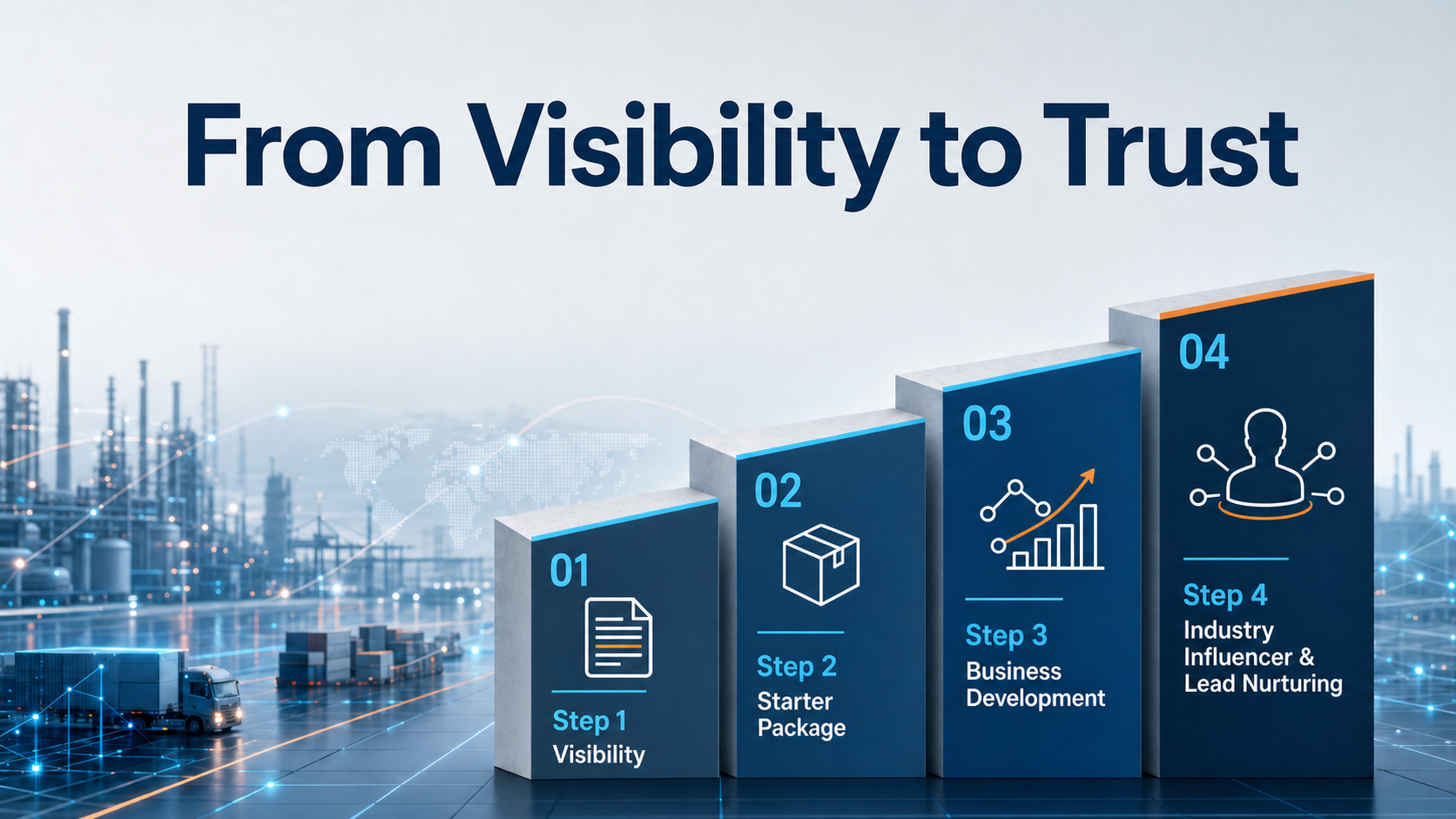
From visibility to trust: Your scalable path with Xpert.Digital - Image: Xpert.Digital
In industrial B2B, sustainable business relationships rarely emerge overnight. They develop step by step – through visibility, professional relevance, recurring touchpoints, and growing trust. Xpert.Digital's 4-stage model addresses precisely this: It offers a structured path that begins with a manageable entry point and can evolve into deeper collaboration in business development if needed.
Instead of relying on loud marketing promises, this model puts the relationship at the forefront. Companies start with clearly defined, easily calculable measures and then decide, based on their own experience, how far they want to expand the collaboration. A key factor for this undisturbed trust-building process: The platform completely avoids annoying advertising ads, so the editorial focus remains solely on the companies' expertise.
More information here:
Your global marketing and business development partner
☑️ Our business language is English or German
☑️ NEW: Correspondence in your native language!

Konrad Wolfenstein
I and my team are happy to be available to you as your personal advisor.
You can contact me by filling out the contact form here wolfenstein@xpert.digital:or simply call me at +49 7348 4088 965. My email address is
I'm looking forward to our joint project.