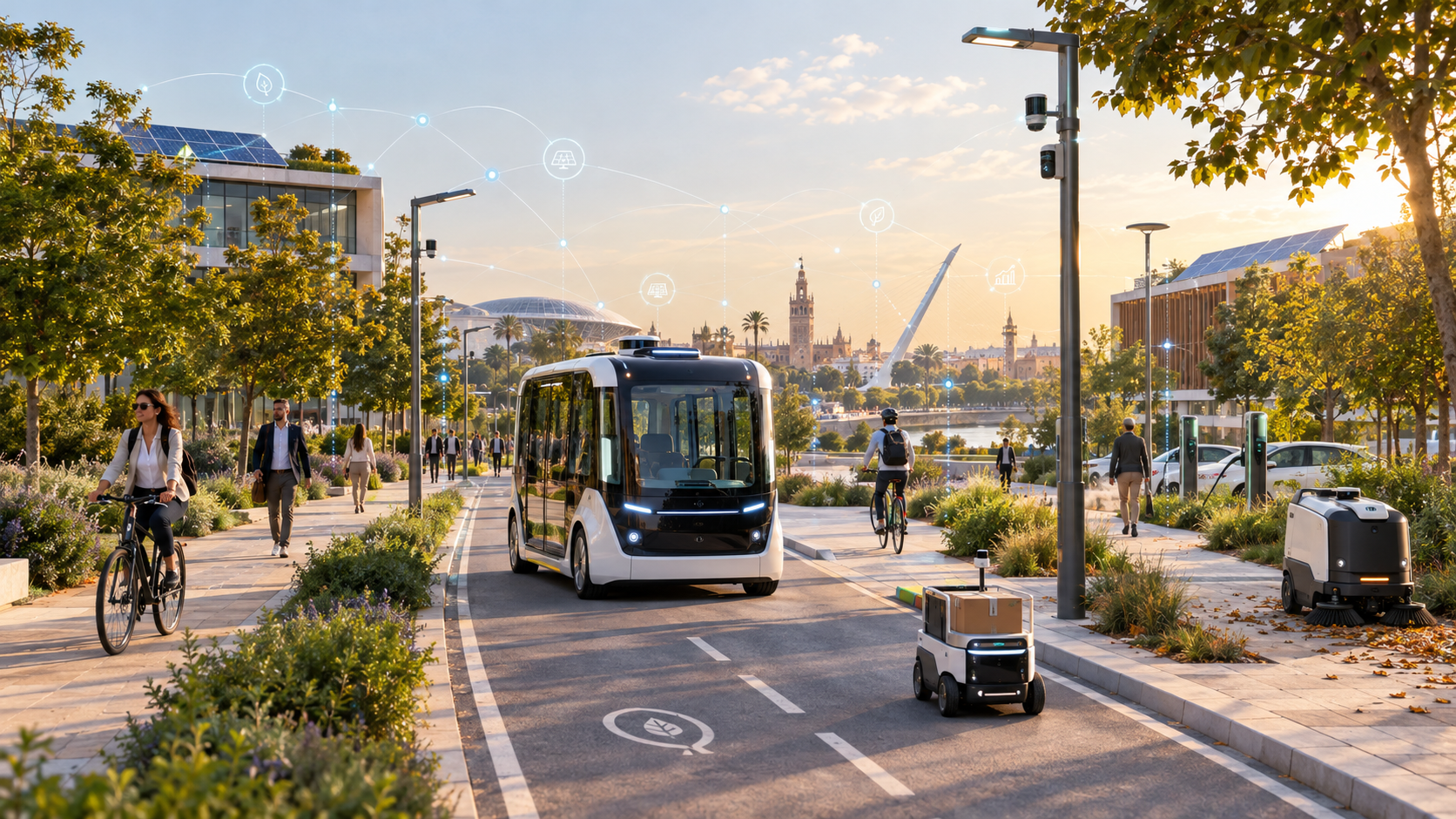
Autonomous mobility and intelligent logistics: Seville TechPark in focus – creative image on the topic, with AI: Xpert.Digital
The role of Sevilla TechPark as a pioneer for urban technologies
Seville TechPark: An urban testing ground for modern technologies
Smart Cities: Why Failure Is the Key to Success
The Sevilla TechPark is evolving into a pioneering urban real-world laboratory, serving as the operating system for the city of tomorrow. With an investment of €19.8 million from the FEDER Andalucía 2021–2027 program, an integrated platform is being tested here, linking mobility, logistics, energy, building technology, and municipal services. The goal is not only to test individual technical solutions but to establish a holistic operating model that can serve as a reference for other cities. The project's approach is clear: a city does not become intelligent simply through the deployment of technologies such as sensors or autonomous vehicles, but through the ability to transform collected data into more efficient decisions and measurable environmental benefits. The Sevilla TechPark offers optimal conditions for this by simulating real-world urban challenges in a controlled environment. This innovative approach could not only boost the local economy but also set new standards for applied urban technologies, thus establishing a pioneering role in Europe. As the project unfolds, the question remains whether the insights and technologies gained are actually transferable to other cities and how long-term economic sustainability can be ensured.
Sevilla TechPark will become the operating system of the city of tomorrow
Those who want autonomous cities must first let them fail in everyday life
Sevilla TechPark is evolving from a traditional science and technology park into an urban real-world laboratory where mobility, logistics, energy, building technology, security, and municipal services are tested as an integrated system. A total of €19.8 million from the FEDER Andalucía 2021–2027 program is available for this purpose. However, the size of the budget alone is not the crucial factor. The economically significant aspect is the simultaneous digitization, automation, and interconnection of several previously separate infrastructures. This creates the opportunity not only to test individual technical solutions but also to develop a new operating model for densely populated business locations and, in the long term, for entire urban districts.
The provocative core of the project is this: A city doesn't become intelligent simply by acquiring sensors, robots, or autonomous vehicles. It only becomes intelligent when it can translate data into better decisions, lower operating costs, more reliable services, and measurable environmental benefits. Sevilla TechPark offers exceptionally favorable conditions for this. The site is complex enough to replicate real-world urban problems, yet spatially and organizationally more controllable than an open metropolis. This very intermediate position makes the location a suitable testing ground between the laboratory and the mass market.
The clear outlook, therefore, is that the project can be far more economically valuable for Andalusia than its immediate investment volume would suggest. However, this depends on interoperability, robust business models, security, and transferability rather than spectacular individual applications to determine its success. If the park only receives six technologically interesting, isolated solutions, its impact will remain limited. On the other hand, if it develops into an integrated urban platform with exportable standards and verifiable performance data, Seville can establish a European benchmark for applied urban technologies.
An economic location of urban scale
Sevilla TechPark is not a small demonstration campus, but a highly concentrated economic hub. By the end of 2025, the site comprised 602 companies and organizations, 35,806 direct jobs, and an aggregate economic activity of €6.125 billion. Compared to the previous year, this activity increased by 11.1 percent, while direct employment rose by approximately 13 percent. More than 40,000 people move through the area on a typical day. This is in addition to students, visitors, delivery traffic, and employees of external service providers. Functionally, the park thus achieves the scale of a medium-sized city, without possessing its full municipal structure.
This density increases the economic benefits of any infrastructure improvement. If a new mobility system shortens the daily commutes of thousands of employees by just a few minutes, significant productivity gains result over the course of a year. Consolidating the flow of goods not only reduces emissions but also minimizes disruptions caused by delivery vehicles, traffic congestion, and uncoordinated deliveries. An intelligently managed energy infrastructure can reduce peak loads, make better use of locally generated electricity, and postpone investments in additional grid capacity. The value, therefore, lies less in a single spectacular application than in the sum of many small efficiency gains.
The park also boasts a strong technological base. In 2025, the organizations located there invested approximately €515.3 million in research, development, and innovation. Around 7,235 professionals worked exclusively in this sector. The advanced technologies segment comprised 304 facilities, employed 20,523 people, and generated approximately €3.647 billion in economic activity. This scale is significant because a real-world laboratory can only have a lasting impact if it is surrounded by companies, research institutions, skilled professionals, and potential users who can absorb the findings and translate them into marketable products.
The economic context also alters the assessment of the overall budget. €19.8 million represents only about 0.32 percent of the park's annual economic activity. The program is therefore too small to immediately transform the entire local economy, but large enough to stimulate technological standards, investment decisions, and new markets. From an economic perspective, it is a targeted catalyst investment. Its success should therefore not be measured by the ratio of subsidies to short-term operating cost savings, but rather by the long-term private capital mobilized, the emergence of new providers, and scaling beyond the immediate site.
Six building blocks, one common system
The planned investment areas cover key functions of a modern business district. €3.66 million is earmarked for autonomous and semi-autonomous electric passenger transport. A further €2.66 million is allocated to automated last-mile logistics. Intelligent lighting and integrated access control will receive €2.33 million. The digital infrastructure, including a data platform, event, emergency, and security management, as well as a digital twin, is budgeted at €3.88 million. The largest single item, at €4.78 million, is a smart energy community with decentralized resources and building-to-grid capabilities. An additional €1.45 million is allocated for mobile cleaning robots, which will, among other things, autonomously collect and remove green waste from more than 3,700 trees.
The publicly disclosed individual budget items total €18.76 million, which is €1.04 million less than the communicated total budget of €19.8 million. This difference does not necessarily indicate a substantive contradiction, as total and sub-budgets may contain different allocations, reserves, taxes, or ancillary services. However, for a reliable economic evaluation, the figures should be presented on a uniform basis. Financial transparency is particularly important for pilot programs so that it remains clear later on which costs are attributable to research, physical infrastructure, software, integration, operation, and evaluation.
The six areas should not be viewed as separate technical projects. The autonomous shuttle requires access data, traffic and demand information, charging infrastructure, high-availability communication, and interfaces to the security center. The logistics platform needs digital identities, delivery time windows, micro-hubs, autonomous vehicles or drones, and potentially priority rules for traffic areas. The energy community must coordinate generation, storage, buildings, charging stations, and flexible consumers. The cleaning robots, in turn, require maps, obstacle data, safe navigation zones, and maintenance information. The common denominator is therefore a digital control architecture.
Economically, the greatest leverage arises where a single set of data can be used multiple times. A precise digital map of the park can serve the shuttle, logistics robots, cleaning machines, emergency management, and maintenance. Occupancy sensors can support mobility planning, lighting control, and security management. Energy and charging data can improve load management, fleet operations, and building control. Such synergies reduce the marginal costs of additional applications. Without common standards, however, the opposite is likely: redundant sensors, incompatible platforms, multiple maintenance contracts, and increasing dependence on individual vendors.
The autonomous shuttle as a productivity test
The electric shared transport system will connect the Banqueta de la Expo area with several destinations within the Sevilla TechPark. Instead of a rigid, timetable-based service, it will be an intelligent mobility solution combining vehicles, demand management, artificial intelligence, communication, monitoring, and teleoperation. Depending on the time of day, the system can serve concentrated commuter flows or operate on an as-needed basis during off-peak hours. This addresses a real problem in many business parks: efficient main transport routes often end at the property line, while the final leg to the workplace remains unattractive, slow, or entirely dependent on private cars.
The economic benefit of such a system depends primarily on actual demand. Crucial factors include passenger numbers per operating hour, average waiting time, capacity utilization, reliability, and the number of car journeys it replaces. A shuttle that operates autonomously but is poorly utilized generates little social benefit. Conversely, a well-utilized system can reduce parking pressure, inner-city traffic congestion, and wasted time. It also improves accessibility for people who cannot or do not want to use their own vehicle, thereby indirectly increasing the attractiveness of the location for employees and businesses.
Autonomy is not an end in itself. In an early phase, safety drivers, control center personnel, and teleoperators can significantly reduce the expected personnel cost savings. Additional costs include high-resolution sensors, map updates, connectivity, cybersecurity, maintenance, and certification. In the long term, autonomous mobility can become economically viable, particularly on short, repeatable, and clearly defined routes. The Sevilla TechPark offers more favorable conditions for this than a completely open urban space: routes can be defined, speeds limited, stopping points controlled, and problematic traffic situations systematically recorded.
The pilot project's most important outcome, therefore, lies initially in knowledge. It must demonstrate under which weather conditions, traffic densities, and mixed traffic situations the system functions reliably, when remote access is required, and how passengers react to delays or unusual maneuvers. Only this data allows for a reliable assessment of the subsequent unit costs. The crucial metric is not how many kilometers a vehicle travels autonomously, but rather the cost per reliably transported passenger kilometer compared to a conventional shuttle, a scheduled bus, a demand-responsive bus service, or the promotion of active mobility.
Last mile without delivery chaos
The automated goods logistics system, equipped with a €2.66 million investment, could become just as important for the park as passenger transport. In an area with more than 600 organizations, numerous deliveries, courier runs, restaurant traffic, spare parts transports, and internal goods movements occur daily. If these are handled individually by conventional vehicles, traffic increases disproportionately to the number of shipments. Delivery vehicles stop briefly in unsuitable areas, blocking pathways and causing unnecessary searching and maneuvering. At the same time, many vehicles are only partially loaded.
An integrated model could consolidate shipments at a few transfer points and handle the final distribution with autonomous ground vehicles, specialized robots, or, where appropriate, drones. The economic appeal lies not only in automating driving but also in consolidating the entire supply chain. Larger vehicles transport consolidated shipments to a micro-depot; a digital platform manages shipments, routes, time slots, and recipients; smaller, low-emission systems handle the final leg of the journey. This can reduce delivery costs, traffic congestion, and energy consumption, provided the volume is high enough and the transfer processes are standardized.
The challenge lies in the diversity of goods. Documents, packages, food, sensitive laboratory equipment, and heavy spare parts all have different requirements regarding security, temperature, liability, and timeframes. An economically viable system must therefore be modular. It requires standardized containers, verifiable handovers, and a clear digital chain from sender to recipient. Furthermore, it must be determined which deliveries can be automated and which still require human intervention.
An additional market opens up for the location if the platform not only relieves the parking operator but also functions as a neutral logistics service for companies. Usage-based fees, subscriptions for regular deliveries, prioritized express services, and data services for planning goods flows are all conceivable. The economic test, therefore, is whether technical automation can generate an independent service model. If successful, the concept can be transferred to airport grounds, hospitals, industrial parks, trade fair grounds, university campuses, and larger residential areas.
Energy becomes a controllable resource
At €4.78 million, the smart energy community is the largest single technological component. Its goal extends beyond additional solar panels. The park is designed to coordinate decentralized energy producers, battery storage, potentially hydrogen components, buildings, charging points, and flexible consumers in real time. The Building-to-Grid (B2G) principle no longer views buildings merely as passive consumers, but as active units that can generate, store, and shift energy, and, under certain conditions, make it available to the overall system.
The economic value arises from several sources. Locally generated solar power can cover a larger share of consumption if storage and flexible loads absorb peak generation. Electric vehicles can be charged preferentially when renewable energy is plentiful or electricity prices are low. Air conditioning, hot water, storage, and certain industrial processes can be shifted in time within technical limits. This reduces the maximum power that needs to be drawn from the grid. Particularly in a growing technology park, avoiding peak loads can reduce the need for expensive grid reinforcements.
However, an energy community is not an automatic guarantee of lower costs. Additional metering systems, control software, storage, maintenance, and billing incur capital and operating costs. Battery storage loses capacity with use, hydrogen production lines suffer conversion losses, and economic viability depends heavily on electricity prices, grid fees, regulatory rules, and the load profile. Therefore, each technology must be evaluated according to its specific contribution. Hydrogen, for example, can be useful for seasonal storage or special applications, while batteries are usually more efficient for short-term load shifting.
The interplay with mobility is particularly relevant. Autonomous shuttles, logistics vehicles, cleaning robots, and private electric cars increase electricity demand but also create flexible loads. A central platform can integrate charging times, battery levels, planned trips, and local solar production. The park would then not simply consume more electricity but actively manage demand. In the long term, vehicles capable of bidirectional charging could also feed energy back into the grid. This model becomes economically attractive when the savings from self-consumption, flexibility, and avoided peak loads exceed the additional system costs.
The data platform as the actual infrastructure
The digital infrastructure, comprising a data platform, event management, security, and digital twin, is funded with €3.88 million. At first glance, this area seems less tangible than vehicles, solar panels, or robots. In reality, it determines whether individual devices can be integrated into a cohesive system. Without shared data models and open interfaces, autonomous vehicles, lighting, buildings, charging points, and security components remain in separate technical silos. This leads to increased integration efforts and long-term operating costs with each new application.
In this context, a digital twin is not merely a three-dimensional visualization. It should depict the current state of important facilities, transport routes, and energy flows as consistently as possible. This allows for the simulation of changes, the identification of maintenance needs, and the preparation of emergency scenarios. Before a shuttle route is changed, it would be possible to examine how stops, pedestrian flows, and charging requirements develop. In the event of a disruption, affected areas, available access routes, and critical facilities could be displayed in a common environment. Within the energy system, peak loads and storage utilization could be predicted.
The economic benefits of such a platform arise from improved decision-making and reduced coordination costs. Employees no longer need to gather information from multiple systems, maintenance can be based more on condition rather than rigid intervals, and new applications gain standardized access. However, the risk of strategic dependency also increases. If data formats, interfaces, and operational knowledge remain proprietary, switching providers later can be expensive or practically impossible. Therefore, data portability, documented programming interfaces, and clear rights to operational data are not mere technical details, but rather essential components of economic sustainability.
Data quality must also be treated as an asset. Incorrect location data can mislead autonomous systems, incomplete energy data prevents optimal control, and poorly maintained master data distorts analyses. The park therefore needs binding rules for responsibilities, updating, access, storage, and deletion. A data platform only generates productivity if its information is reliable enough to support operational decisions.
Your intralogistics experts

Consulting, planning and implementation of complete solutions for high-bay warehouses and automated storage systems - Image: Xpert.Digital
More information here:
Innovative approaches to urban mobility in the Seville TechPark
Intelligent lighting with multiple benefits
€2.33 million has been allocated for intelligent lighting and integrated access control. Modern luminaires can adjust their energy consumption depending on the time of day, occupancy, traffic volume, and security situation. The immediate benefits are lower energy consumption and a longer lifespan for the components. However, the greater strategic value lies in using light sources as carriers for sensors, communication, and local data processing.
Such an infrastructure could anonymously record movements, measure environmental data, monitor traffic flow, or provide communication modules for autonomous systems. This transforms the light fixture from a passive consumer device into a component of the digital nervous system. This multiple benefit only justifies higher investment costs if the platform actually serves several applications. If sensors are installed without a clear purpose, however, additional maintenance and security costs arise without a corresponding economic return.
The connection to access controls touches on sensitive issues. A technology park must be able to efficiently distinguish between vehicles, employees, visitors, and service providers without generating unnecessary surveillance. The best solution is not the maximum possible data collection, but rather the minimum necessary processing for a clearly defined purpose. Digital identities, time-limited authorizations, and traceable logs can improve security. In contrast, a blanket collection of personal movement data would create legal risks, acceptance problems, and stringent protection requirements.
Economically, the infrastructure should therefore be evaluated based on life cycle costs and measurable performance. This includes kilowatt-hours saved, maintenance costs, downtime, response speed in case of failures, and the number of additional services actually used. The purchase price of individual luminaires is less meaningful than the total costs over ten or fifteen years. An open, modularly expandable infrastructure may initially be more expensive, but in the long run be cheaper than a closed system with low entry costs and high barriers to switching.
Robots under 3,700 trees
The mobile cleaning robot will receive €1.45 million and is intended, among other things, to collect green waste from more than 3,700 trees. This sub-project seems more modest compared to autonomous passenger transport or smart energy systems, but it has significant practical value. Street cleaning takes place in unstructured environments. Leaves, branches, curbs, pedestrians, bicycles, parked vehicles, changing light conditions, and weather place high demands on perception and navigation.
The economic benefits do not depend on completely replacing human labor. A division of labor is more sensible, in which machines take over monotonous, physically demanding, or time-critical tasks, while employees handle monitoring, maintenance, special cases, and more complex activities. Especially during peak seasons with heavy leaf fall, robots can provide additional capacity without permanently adjusting staffing levels to meet peak demands. This requires high operational readiness and limited time for retrieval, cleaning, charging, and repair.
A reliable evaluation requires more than just considering the square meters cleaned or the kilograms collected. Relevant factors include the cost per effectively cleaned area, the number of necessary human interventions, energy consumption, downtime, and the quality of the result. Equally important is safety in mixed environments. A slower robot that reliably detects obstacles and reacts predictably can be more economically valuable than a faster system with frequent interruptions.
Beyond the park, this application has export potential. Green spaces, universities, airports, hospitals, large corporate campuses, and municipalities face similar challenges. Seville can provide reference data for Mediterranean conditions, including heat, dust, intense sunlight, and seasonal vegetation residues. This creates a test profile that differs from northern European testing environments and can be strategically interesting for manufacturers.
Public demand as a market accelerator
Technologies like autonomous shuttles, smart energy communities, and urban robotics often suffer from a classic market entry problem. Suppliers need real-world operational data and credible reference customers, while potential customers, due to safety and cost concerns, prefer to wait for already proven solutions. A publicly funded real-world laboratory can break this cycle by defining real-world demand, securing development funding, and enabling testing under controlled conditions.
For young companies, a solid reference is often more valuable than immediate revenue. A system that has been operated for two years in a complex technology park and evaluated using verifiable key performance indicators is easier to sell to other locations than a mere prototype. Established companies also benefit because they can test new product lines with less market risk. The park can thus become a showcase where international customers can observe real-world operations, not just presentations.
This mechanism only works, however, if intellectual property, data rights, and subsequent marketing opportunities are balanced. If a single operator gains too much control, competition and reuse can be restricted. If the rights remain entirely with public bodies, companies may lose the incentive to invest. A sensible balance allows providers to develop commercially, while simultaneously ensuring the park has long-term data access and protecting it from excessive dependence.
Market response indicates a fundamental interest. During the preparatory phase, 74 solution ideas were initially submitted by 80 organizations. In the subsequent selection phase, 41 concrete proposals were received from 33 institutions; 45 percent of these institutions were located within the park itself. This suggests an active local ecosystem but also demonstrates the continued need for external expertise. It would be particularly valuable for the regional economy if local small and medium-sized enterprises (SMEs) not only acted as suppliers but also developed their own scalable products, software modules, and services.
Scaling determines the economic value
A pilot project initially generates local benefits. It only becomes economically significant when the results can be transferred to other locations. Therefore, Sevilla TechPark should not only produce functioning systems, but also standardized technical architectures, performance indicators, security concepts, and business models. These intangible results can be more valuable to other cities than the physical hardware within the park.
Scalability demands modularity. A smaller municipality might not need a complete platform but could opt for smart lighting and energy management. An industrial park is more interested in autonomous logistics and access control. A hospital campus could combine shuttles, delivery robots, and emergency management. The more clearly the building blocks are separated, documented, and connected via open interfaces, the larger the potential market becomes.
Andalusia has the opportunity to build a regional supply chain for smart city technologies. This includes sensor manufacturers, software developers, system integrators, energy companies, vehicle suppliers, telecommunications firms, engineering offices, maintenance services, and research institutions. The greatest economic impact will arise when one-off installations generate recurring revenue: software maintenance, fleet operation, data analysis, security monitoring, servicing, training, and energy optimization.
However, exportability is challenging. Every city has different traffic regulations, network infrastructures, data protection practices, and organizational responsibilities. A solution that only works under the specific conditions of a controlled park is not yet a standard urban product. The program must therefore distinguish early on between site-specific adaptations and generally applicable components. Only the latter form the basis for a larger market.
Regulation becomes part of the product
Autonomous mobility, AI-supported safety, and networked energy systems operate within an increasingly demanding European legal framework. For safety-critical AI, key requirements include risk management, data quality, technical documentation, logging, human oversight, robustness, and cybersecurity. For vehicles, type approval, functional safety, software updates, and industry-specific cybersecurity regulations are additional considerations. Cameras, access data, and movement information are also subject to data protection regulations.
These requirements are sometimes seen as an obstacle to innovation. For Seville, however, they can become a competitive advantage. If systems are developed transparently, securely, and in compliance with data protection regulations from the outset, suppliers gain an edge over solutions that only need to be adapted later. Regulatory compliance then becomes not merely a cost factor, but an integral part of product quality and a selling point in the European market.
Human oversight is particularly important. Autonomous systems must clearly indicate when they are leaving their safe operating range. A control center needs clearly defined responsibilities and sufficient time for intervention. If too many vehicles are monitored simultaneously by one person, teleoperation itself can become a risk. Therefore, technical performance promises must be linked to realistic staffing levels and emergency plans.
Liability issues should not be postponed. In the event of an incident, vehicle manufacturers, software providers, operators, infrastructure managers, and maintenance companies may all be involved. Clear protocols and immutable operational data help to reconstruct the causes. Economically, they reduce uncertainty for insurers and operators. A real-world laboratory should therefore not only demonstrate that the technology works, but also that responsibilities are manageable in regular operation.
Cybersecurity as a basic economic condition
The more interconnected mobility, energy, and access systems become, the greater the potential damage from a cyberattack. A manipulated light might only cause localized darkness; a compromised control platform, on the other hand, could stop vehicles, block building access, disrupt charging infrastructure, or provide emergency responders with false information. Integration creates efficiency but also increases interdependence.
Cybersecurity must therefore be embedded in the architecture itself. This includes separate network segments, strong identities for devices and users, encrypted communication, secure updates, continuous monitoring, and a well-established incident response procedure. Low-maintenance devices located outdoors are particularly critical because they operate for many years and are physically accessible. An inexpensive sensor can become costly over its lifecycle if security updates are lacking or the manufacturer discontinues support.
The digital twin can also play a role here. It can visualize dependencies and simulate which services would be affected if certain components failed. However, it is crucial that the twin itself does not become an unprotected central access point. High-quality security, tiered permissions, and consistent logging are essential.
From an economic perspective, safety should not be viewed solely as the avoidance of hypothetical damage. A demonstrably resilient operation increases the trust of companies, employees, insurers, and future customers. For suppliers within the park, in particular, a successfully tested safety concept can become a valuable component of their export offerings. Conversely, a serious incident could damage the acceptance of the entire program and delay further investments.
Jobs change instead of simply disappearing
Automation raises legitimate concerns about employment. Autonomous vehicles, logistics robots, and cleaning machines are taking over tasks currently performed by drivers, delivery personnel, and cleaning staff. A serious analysis cannot downplay this displacement effect. At the same time, new jobs are emerging in fleet management, maintenance, data analysis, cybersecurity, system integration, and customer service.
For Sevilla TechPark, the crucial question is not just how many jobs will be lost or created, but what qualifications will be needed and who will have access to them. Employees in operational areas possess valuable process knowledge. With targeted training, they can become control center operators, robotics technicians, or quality specialists. Without such transitions, a divide threatens: highly qualified employees will benefit from new technologies, while less qualified employees will bear the adaptation costs.
With its universities, research institutions, and companies, the region offers excellent conditions for practical training opportunities. These programs should not only target developers. There is also a need for technicians specializing in sensors, batteries, and communications; specialists in secure data processing; operators for teleoperation; and experts in integrating energy and building systems. These mid-level qualification profiles, in particular, can generate significant regional employment.
A successful transformation is therefore not solely reflected in fewer staff hours per service. It is also reflected in increased workplace safety, reduced physical strain, improved qualifications, and new career development paths. Automation is more socially sustainable when productivity gains do not remain exclusively with the operator, but are partially reinvested in further training, improved services, and new economic activities.
The greatest risks lie between the technologies
The most significant risk is not the complete failure of a single machine. More likely are interface problems, delays, and performance that functions technically but is not economically viable. A shuttle can operate safely without attracting enough passengers. A data platform can collect vast amounts of information without enabling better decisions. A battery can reduce peak loads but, due to high investment costs, fail to achieve a positive overall return on investment.
Added to this is the risk of technological lock-in. If core functions are tied to proprietary systems, switching costs increase later. Vendors can raise prices, restrict interfaces, or discontinue updates. The park should therefore rely on open standards, exportable data, and modular components. At the same time, openness must not be confused with a lack of accountability. Someone has to be responsible for integration, security, and overall performance.
Another risk is the pilot project trap. Many urban innovation projects generate attention during the trial phase but lose their operational basis after the funding period ends. To avoid this, ongoing costs, staffing requirements, replacement investments, and revenue models must be calculated early on. Every application needs a plausible path from demonstrator to regular operation. Otherwise, the result will be a technically impressive but economically unsustainable system.
Finally, there is a time risk. The development and testing phases each last up to 24 months and are scheduled to be completed by December 31, 2028, at the latest. During this period, hardware prices, regulations, and technological possibilities can change. The architecture must therefore remain adaptable. Rigid specifications that freeze the state of the system in 2026 might already seem outdated by the time the project ends.
Success requires verifiable key performance indicators
The quality of the program can only be assessed through a joint impact measurement. For mobility, this includes passenger numbers, waiting times, capacity utilization, cost per passenger kilometer, replaced car journeys, and safety-related interventions. In logistics, relevant factors are shipment costs, delivery time, consolidation rate, vehicle mileage, and misdeliveries. The energy community must be measured by its self-consumption rate, peak load reduction, storage utilization, system losses, security of supply, and total costs.
For lighting and access systems, energy consumption, downtime, maintenance costs, response time, and data breaches are all factored into the evaluation. For cleaning robotics, the key areas cleaned, the amount of debris collected, human intervention, downtime, and cost per unit of performance are crucial. The data platform, in turn, must demonstrate how many systems are integrated, the level of data quality and availability, and which decisions have demonstrably improved.
Key performance indicators should be defined before regular operations begin to prevent any retrospective manipulation of results. Equally important is a realistic benchmark. An autonomous shuttle must be compared not only with the current situation but also with more cost-effective alternatives such as a conventional electric bus, improved cycling infrastructure, or optimized pedestrian routes. Only in this way can it be determined whether the technological solution truly delivers the greatest societal benefit.
Even negative results have economic value if they are properly documented. If it turns out that an application is not economically viable under certain conditions, other cities can avoid misinvestments and suppliers can improve their products. A real-world laboratory should therefore not be focused on the public staging of consistently successful technologies. Its true value lies in systematically reducing uncertainty.
Seville can become more than a showcase
Sevilla TechPark combines economic density, technological expertise, and a clearly defined urban space. This combination makes the location suitable for testing autonomous mobility, digital infrastructure, energy, and robotics not in isolation, but in everyday operation. The total budget of €19.8 million is manageable considering the size of the park, but can act as a lever for private investment, new reference markets, and regional value creation.
The strongest aspect of the concept is its system logic. Passenger transport, freight logistics, lighting, access, data, energy, and cleaning share infrastructure and influence each other. This is precisely how Sevilla can gain insights that remain hidden in ordinary, stand-alone projects. The weakest point would be an implementation where each component has its own platform, its own data, and its own operational logic.
The justified economic outlook is therefore cautiously positive. The location has real problems, a large user base, high research intensity, and a vibrant business environment. This increases the likelihood that technical solutions will not remain in demonstration mode. At the same time, economic viability, regulatory maturity, acceptance, and cybersecurity remain challenging. Autonomy and artificial intelligence do not automatically reduce costs; often, they initially shift these costs to software, sensors, integration, and monitoring.
Sevilla TechPark won't become a European role model simply because of the number of robots or sensors it has. The crucial factor is whether the park can demonstrate that its systems are safer, cheaper, cleaner, and more easily transferable than conventional alternatives. If it succeeds in this, it will create far more than just a modernized business location. The Cartuja will then become an economic demonstrator of how cities can transform technology into productive infrastructure. If the integration fails, costly silos will remain. This is precisely why the project is relevant: it tests not only technology, but also a region's ability to turn innovation into a sustainable business and operating model.
Your global marketing and business development partner
☑️ Our business language is English or German
☑️ NEW: Correspondence in your native language!

Konrad Wolfenstein
I and my team are happy to be available to you as your personal advisor.
You can contact me by filling out the contact form here wolfenstein@xpert.digital:or simply call me at +49 7348 4088 965. My email address is
I'm looking forward to our joint project.