
A race against power shortages: America's AI boom is running up against a wall of electricity
Xpert Pre-Release

Available in 27 languages 📢
Prefer Xpert.Digital on GoogleⓘPublished on: October 15, 2026 / Updated on: October 15, 2026 – Author: Konrad Wolfenstein
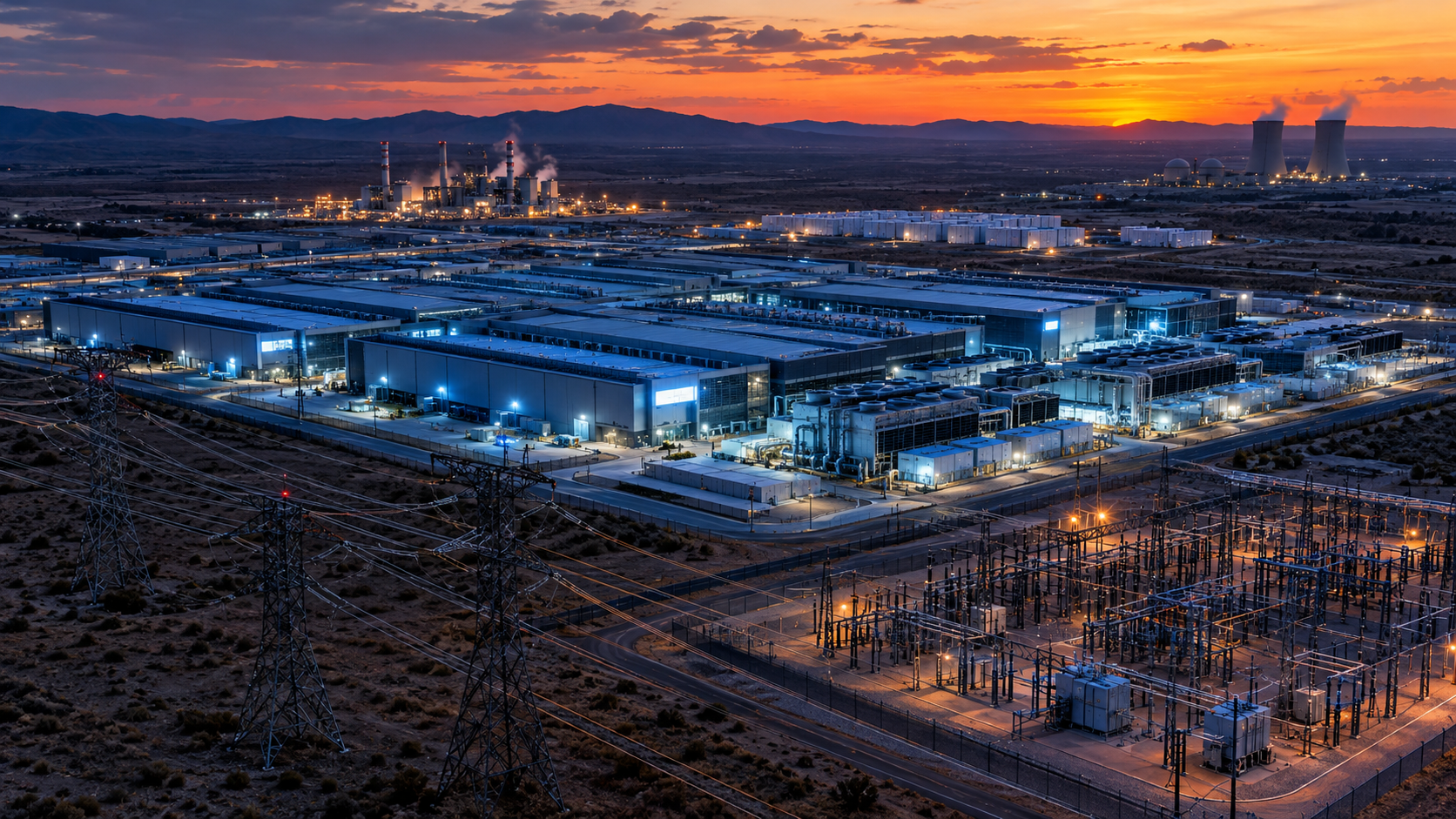
A race against the power shortage: America's AI boom is running up against the power grid – creative image on the topic, with AI: Xpert.Digital
Not chips, but megawatts now determine the future of artificial intelligence
Energy as a key resource: The hidden bottleneck of the AI revolution in the USA
Energy shortage and AI: How the power supply is slowing progress
The race for artificial intelligence (AI) in the United States is increasingly driven by one crucial factor: the availability of electrical power. For a long time, the competition was primarily viewed in terms of more powerful processors, larger datasets, and greater capital. But the reality is more complex. The focus is now shifting to the physical infrastructure needed to power data centers. The challenge lies not only in generating enough energy but also in delivering it reliably and on time to where it is needed.
By 2028, a net gap of approximately 32 gigawatts is expected in the US between the energy demands of planned data centers and the actual available power supply. This situation highlights not only the uncertainty surrounding future energy supply but also the economic implications of the AI boom. If the infrastructure for renewable energy, transmission lines, and transformers cannot keep pace with the rapid growth of the AI industry, the development of artificial intelligence could be significantly hampered. The following article examines the various aspects of this issue: from the challenges of power supply and the consequences for data center location decisions to the political and societal implications.
Megawatt shortage: How the US must master the AI race with electricity issues
The American race for artificial intelligence is usually described as a competition for more powerful processors, better models, larger datasets, and more capital. This view is now too simplistic. The crucial bottleneck is shifting from the digital to the physical realm: power generation, grids, transformers, permits, skilled personnel, cooling, and robust sites increasingly determine how much computing power can actually be put into operation. This also changes the economic logic of the AI boom. An ordered graphics processor does not create productive capacity as long as there is no dedicated workspace, a secure network connection, and consistently available power.
For the United States, a net gap of approximately 32 gigawatts between the energy demand of planned data centers and the realistically available supply is expected by 2028. This figure represents about 34 percent of the projected demand and already accounts for various backup solutions, including on-site gas-fired power plants, fuel cells, and other generation downstream of the grid connection point. Therefore, this number is not merely a warning of a theoretical deficit. It indicates that a significant portion of the announced digital infrastructure is likely to be built later, on a smaller scale, in different locations, or not at all.
The central economic thesis is this: The US is not facing a general energy shortage in the simple sense, but rather a spatial, temporal, and institutional scarcity of reliably available electrical power. National generation capacity is of little help if it is not available in time at the locations where new data centers are to be built. The problem therefore lies as much in transmission lines, substations, reserve capacities, connection procedures, and local acceptance limits as in the number of power plants. The AI race thus becomes an infrastructure race, the speed of which does not keep pace with the innovation rate of the software industry.
A power shortage of industrial proportions
A 32-gigawatt gap is exceptionally large from an economic perspective. It corresponds to the continuous output of dozens of large power plant units and cannot be filled by a few solar installations, emergency generators, or short-term power purchase agreements. Even more important is the distinction between power and energy. Data centers not only require many terawatt-hours throughout the year, but also consistently high and reliable power at virtually any given time. For AI applications, rapid load changes are an additional factor, as training and using large models does not place a constant load on the servers.
The American data center sector consumed approximately 176 terawatt-hours of electricity in 2023, representing about 4.4 percent of total US consumption. Estimates for 2028 range from roughly 325 to 580 terawatt-hours, depending on the expansion trajectory, utilization, and technological advancements. This could increase its share of national electricity consumption to between 6.7 and 12 percent. An updated median estimate places consumption at around 464 terawatt-hours in 2028. Such ranges do not indicate an analytical weakness but rather reflect the enormous uncertainty surrounding the pace of expansion, chip availability, efficiency improvements, and actual utilization.
Since 2017, the electricity demand of American data centers has more than doubled. Annual growth rates of between 13 and 27 percent are being discussed for the period from 2023 to 2028. This dynamic is impacting an electricity system whose demand had largely stagnated for many years. Power plant planning, grid development, and regulatory procedures were therefore not designed for a situation in which individual new customers would register for capacities in the hundreds of megawatts or even above one gigawatt within just a few years.
The difference between a 50-megawatt data center and a 1-gigawatt AI campus is not merely quantitative. A gigawatt project itself becomes a regional energy system. It alters load forecasts, power plant demand, reserve planning, grid stability, water consumption, and wholesale prices. Several such projects in the same region can shift a grid operator's entire investment plan. This is precisely why it is misleading to view the AI boom simply as a continuation of traditional cloud expansion.
The real scarcity lies in the network
On paper, the United States has numerous planned power plants and a large inventory of energy sources. In practice, however, supply often fails due to the connection between generation and consumption. New transmission lines require planning, environmental impact assessments, land acquisition, financing, permits, and coordination across multiple levels of government. While a server room can be built in about two years, a high-capacity grid connection in heavily congested markets often takes four to seven years. In parts of the PJM service area, connection processes can take even longer.
This temporal discrepancy is the core of the problem. The semiconductor industry and major cloud providers plan in product cycles of just a few years. Transmission networks, on the other hand, are designed for decades and expanded through lengthy processes. A data center can expedite its chip orders, but it cannot make a high-voltage power line available overnight. This creates a structural imbalance between the pace of private-sector investment and public or regulated infrastructure planning.
Bottlenecks are not limited to power lines. Large transformers, switchgear, turbines, and other electrical components have lead times of several years. For large power transformers, waiting times of well over two years are observed, and in some categories, even over three years. Such equipment is not a standardized, off-the-shelf product. It is customized to the voltage level, grid configuration, and location, and cannot be arbitrarily substituted. Even with secured financing, a single missing component can prevent an otherwise complete system from being connected to the grid.
The long waiting lists exacerbate the uncertainty. Developers often register more projects than will actually be built because an early place in the queue has strategic value. In Texas, the queue for large loads temporarily reached a size of around 474 gigawatts, several times higher than the state's previous peak load. Such a figure is not a realistic consumption forecast but rather an indication of speculative reservations, multiple registrations, and project options. For grid operators, the problem remains of having to distinguish between serious projects and strategic placeholders.
Computing power becomes a location problem
Previously, data center locations were chosen based on a combination of affordable land, tax breaks, fiber optic connections, proximity to customers, low environmental hazards, and inexpensive energy. Going forward, demonstrably available capacity will play a more significant role. The cheapest location will no longer automatically be the most attractive; rather, it will be the one that can offer a reliable timeline for network connectivity and power supply. This will change the competitive landscape between states, utilities, and municipalities.
Traditional centers like Northern Virginia benefit from dense digital infrastructure, skilled service providers, and a large ecosystem. However, this very concentration generates rising marginal costs. Additional projects there compete for the same lines, substations, land, and skilled personnel. Regions with less developed data center economies can therefore catch up if they credibly provide new generation and network infrastructure. The competitive advantage is shifting from mere connectivity to a combination of connectivity, energy, and political viability.
This creates a portfolio logic for operators. Not every computational task needs to be performed in the same location. Training large models can be shifted to a certain extent in terms of time and location, provided data connections, software architecture, and security requirements allow it. Applications with very low latency or strict data requirements, on the other hand, remain more location-bound. Companies can therefore geographically separate training, model adaptation, inference, and data storage to a greater degree. However, such a division increases complexity and can incur additional network and data transmission costs.
Internationally based providers possess a strategic advantage because they can shift investments to countries or regions with readily available energy. For the United States, this does not automatically mean a loss of AI leadership. However, it does mean that some computing power could be generated where electricity is more readily available. Energy policy thus becomes industrial policy, and grid planning becomes a factor in technological sovereignty.
Owning gas-fired power plants only solves part of the problem
Many operators are responding to slow grid connections by generating electricity on their own premises or in the immediate vicinity. Gas-fired power plants are the most obvious option because they provide predictable output, can be built relatively quickly, and operate independently of weather conditions. Mobile or modular gas turbines promise even greater speed. This is how private energy systems are being created behind the grid connection point for large AI campuses.
However, this strategy has its limitations. A consistently reliable self-sufficiency system must be designed to handle outages, maintenance, and rapid load changes. In AI data centers, server loads can fluctuate dramatically within a very short time. A local gas-fired power plant cannot react quickly enough in every situation, which is why battery storage, backup generators, or a grid connection remain necessary. To achieve the same security of supply as a large interconnected grid, local generation must be significantly oversized. Depending on the technical design, the required capacity surcharge can range from 30 to 70 percent.
In addition, there are gas pipelines, emissions permits, noise abatement measures, and fuel risks. A campus with its own generation shifts the infrastructure requirements but does not eliminate them. Instead of a grid connection, gas transport, turbine deliveries, and local environmental permits become the bottleneck. At the same time, the AI sector's dependence on natural gas increases. This can provide short-term security of supply but increases long-term price, climate, and regulatory risks.
The supply chain for gas turbines is also strained. Orders have increased significantly, and major manufacturers have full order books. The assumption that an operator can simply purchase their own generation capacity and install it within a few months is therefore unrealistic. The market for rapid power solutions is itself becoming a seller's market, with rising prices and longer waiting times.
On-site power generation remains economically viable primarily where the value of an early start of operations is exceptionally high. If an AI campus becomes productive a year or two earlier thanks to a local power solution, the additional revenue can justify the higher energy costs. For less urgent projects, waiting for grid connection may be more cost-effective. The optimal solution therefore depends not only on the electricity price but also on the economic value of the avoided delay.
Nuclear energy is valuable, but not fast enough
Nuclear power plants are generally a good fit for data centers. They supply large quantities of predictable, low-CO₂ energy and have high capacity factors. Long-term power purchase agreements with financially strong technology companies can stabilize existing plants, finance capacity upgrades, or enable the recommissioning of decommissioned units. Modernizing existing plants can create additional capacity without having to build a completely new power plant.
Nevertheless, nuclear energy will only partially fill the short-term gap until 2028. New plants require lengthy approval and construction times. Small modular reactors promise standardized mass production but are still in an early commercial phase. Even restarts and power upgrades require technical inspections, approvals, investments, and grid adjustments. Nuclear energy is therefore a strategic answer for the 2030s, but not a universal emergency solution for the next two years.
The direct allocation of existing nuclear power plant capacity to individual data centers is also systemically complex. If existing generation is contractually assigned to a new large consumer, the existing electricity demand of other customers does not disappear. Without additional capacity, a bilateral contract may be economically attractive, but it merely redistributes regional scarcity. The crucial factor, therefore, is whether a contract actually finances new generation, an extension of operating licenses, or a measurable increase in capacity.
From a macroeconomic perspective, the most valuable nuclear energy projects are those that create additional, secure power while simultaneously relieving pressure on the grid. Simply redistributing existing capacity, on the other hand, can exacerbate conflicts over costs and security of supply. The debate must therefore distinguish between financial allocation and physical additionality.
Fuel cells, batteries and renewable energies
Fuel cells are becoming more attractive as a modular, relatively quick-to-install solution. They can generate electricity on the grounds of a data center, require less space than large solar parks, and can be expanded incrementally. However, their economic viability depends on fuel prices, maintenance, lifespan, and technical availability. If they are powered by natural gas, emissions and gas infrastructure remain significant concerns. Hydrogen could improve the climate footprint, but it is currently neither universally available nor price-competitive.
Battery storage is particularly important for AI data centers because it reacts very quickly to load fluctuations. It can smooth power output, bridge short-term grid disturbances, and stabilize local generation. However, its role should not be confused with that of a continuously supplying power plant. A storage system shifts energy over time; it does not generate it. It can cushion supply shortages for several hours, but for supply gaps lasting several days, a very large and expensive system would be required.
Solar and wind energy can provide significant amounts of electricity and are cost-effective in many regions. However, the installed capacity alone is insufficient for a 24/7 AI campus. Weather-dependent generation must be supplemented by storage, flexible load management, grid swapping, or backup power plants. This does not mean that renewable energies are unsuitable. It means that their economic evaluation must take into account the costs of the overall system.
A robust architecture will therefore usually be hybrid: renewable energy for low variable costs, batteries for rapid response, backup generation for extended periods of low supply, and a grid connection for balancing and reserve. This combination is more expensive and complex than a simple power purchase agreement, but offers greater control over scheduling and security of supply. The AI boom is thus accelerating the evolution of data centers into integrated energy systems.
🎯🎯🎯 Data-driven B2B industry hub as a quasi-in-house solution

The quasi-in-house solution: How Xpert.Digital closes operational gaps in B2B marketing and sales – Smart Content-Driven Business - Image: Xpert.Digital
Xpert.Digital is a data-driven B2B industry hub led by Konrad Wolfenstein . The company acts as an external, quasi-in-house solution for industrial partners, closing operational gaps in marketing, content, and sales – without requiring additional resources on the client side.
More information here:
Energy crisis: How the AI industry is fighting for resources
The price of scarcity is reaching households and industry
The energy question isn't just a problem for the operators. When a data center requires new power plants, power lines, and reserve capacity, the question of distribution arises: Who bears the costs? If investments are financed through general grid fees and electricity tariffs, households and existing businesses pay for a portion of the infrastructure for a new major consumer. If all costs are allocated to the project, its profitability may decrease, or the location may become unattractive.
In the PJM grid area, which covers large parts of the Midwest and the East Coast, prices for secured capacity have increased by more than 1,000 percent since 2024. A price of $28.92 per megawatt per day for the 2024/25 delivery year has risen to values of $325 to $329. Even price caps have not been able to eliminate the structural problem. Recent auctions have been several gigawatts short of the targeted reliability level.
Capacity prices are not the same as the actual energy price. They compensate power plant operators for making capacity available on days with particularly high demand. These costs are nevertheless passed on to households, businesses, and industry. This can make particularly energy-intensive manufacturers less competitive. When a brick factory, a chemical plant, or a metal processor faces significantly higher electricity costs, it results in an indirect redistribution of resources from the traditional industrial sector to digital infrastructure.
This is politically sensitive because data centers create relatively few jobs during operation. They can generate high tax revenues and large construction investments, but their employment intensity is lower than that of many factories. If, at the same time, energy costs for local businesses and households rise, public acceptance can quickly turn negative. The economic benefits of a data center must therefore be assessed regionally and should not be limited to the size of the announced investment.
A viable model requires tariffs based on consumption. Large consumers should bear minimum purchase requirements, long-term contractual obligations, guarantees, connection costs, and, where applicable, exit fees. This prevents utilities from investing billions while a speculative project is later abandoned. Such rules make non-binding reservations more expensive and reward projects with secured financing and realistic load growth.
Political resistance becomes an investment risk
Public opinion towards data centers has deteriorated significantly. Only a minority of the population supports the current pace of expansion, and support for an AI data center in one's own community is particularly low. Objections concern electricity prices, water consumption, noise, land requirements, the impact on the landscape, and whether the local benefits justify the burdens.
This resistance is economically significant. More than $170 billion in projects are reported to have been blocked, withdrawn, or delayed since the beginning of 2024. In the first half of 2026 alone, reports indicate that more than 120 projects worth nearly $200 billion were affected. While such figures likely include projects with varying degrees of probability of realization, they nevertheless demonstrate that permits and public acceptance have become substantial risk factors.
In the short term, political headwinds need not completely halt capacity growth. Projects that are already well-developed have land, contracts, permits, and significant sunk costs. Completion of these facilities is likely. In the medium term, however, resistance alters the project pipeline. Early-stage projects are subject to stricter scrutiny, locations change, and financing costs increase. This is precisely why strong growth until 2027 followed by slower expansion thereafter can be plausible.
The political debate is also not a simple conflict between progress and technophobia. Municipalities react rationally when they fear high infrastructure costs, low long-term employment, and unclear environmental consequences. Operators also react rationally when they prefer locations with fast permitting processes and favorable rates. A workable solution must therefore make local costs transparent, provide binding commitments to benefits, and contractually assign risks.
Water, noise, and land area exacerbate the debate
Energy is the biggest, but not the only, bottleneck. Data centers require cooling, and their water consumption depends heavily on location, climate, workload, and technology. Evaporative cooling can be efficient at saving electricity, but it consumes water continuously. Closed-loop systems reduce direct water consumption, but often require more electrical energy or higher investment. Therefore, there is no universally optimal cooling approach.
For the US, a rise in direct water demand from around 17 billion gallons in 2023 to as much as 73 billion gallons in 2028 is being discussed. Individual large facilities can require several million gallons daily. Nationally, the share of total water consumption remains limited, but locally it can be significant. Locations where data centers compete with agriculture, households, and industry during dry periods are particularly problematic.
The indirect water consumption of electricity generation must also be factored into the assessment. A data center with low on-site water requirements can still have a high water footprint due to its energy mix. Conversely, a water-efficient power plant can improve the overall balance. A sound assessment must therefore consider both the plant and the energy system together.
Noise is generated by cooling towers, fans, transformers, and emergency generators. Continuous low-frequency noise can be more noticeable to neighbors than short-term construction noise. Added to this are light emissions, traffic congestion during the construction phase, and large, windowless buildings. These impacts are technically manageable if distances, enclosures, limits, and measurement requirements are planned early on. If they are only addressed after complaints, costs and the risk of conflict increase.
Billions in investment meet a shortage of skilled workers
Besides energy and permits, the labor market limits expansion. Data centers need electricians, welders, pipefitters, engineers, network technicians, refrigeration specialists, and project managers. These same professional groups are also needed for power plants, electricity grids, factories, and infrastructure programs. The shortage worsens when several large-scale projects begin simultaneously in a region.
Higher wages can attract additional workers, but they don't immediately solve the skills problem. Training, certification, and practical experience take time. Furthermore, overwork increases the risks to quality, workplace safety, and deadlines. A shortage of skilled workers therefore has a twofold effect: it increases construction costs and prolongs project completion, thereby increasing financing costs and lost revenue.
For regions, the construction boom can still create significant advantages. Tens of thousands of skilled tradespeople have already worked on large data center projects. Local companies receive contracts, employees earn income, and municipalities benefit from economic activity. The crucial difference lies between temporary construction effects and permanent jobs. A billion-dollar project can employ thousands of people during construction but later require only a comparatively small operating team.
From an economic policy perspective, agreements on training, regional procurement, and infrastructure are therefore sensible. If an operator co-finances training centers, qualifies local companies, and covers a portion of the network or water costs, a larger share of the benefits remains local. Pure tax breaks without verifiable returns, on the other hand, can lead to municipalities bearing high indirect costs while receiving only limited revenue.
The AI hardware market will be affected unevenly
A delayed server room disrupts the entire supply chain. Operators often order chips, memory, network equipment, optical components, power supplies, cooling systems, and racks well in advance of commissioning. If the network connection is delayed, pre-built systems cannot be installed. This ties up capital, increases storage costs, and accelerates the obsolescence of unused hardware.
Estimates that AI hardware worth more than $200 billion could be temporarily uninstalled should be treated with caution. The exact scale is difficult to verify, and some of the equipment is likely undergoing routine transport, integration, or acceptance testing. Nevertheless, the underlying logic is plausible: if chip production and orders grow faster than the available, fully equipped data center space, an inventory of unused technology inevitably arises.
The impact is not evenly distributed. Leading providers of AI accelerators and custom computing chips are relatively protected by global demand, high productivity per watt, and strong negotiating power. If a US site is delayed, an international customer or another campus can absorb some of the capacity. Furthermore, the most powerful chips remain scarce and strategically sought after.
Manufacturers of storage, optical modules, analog components, power distribution systems, cooling systems, and other site-specific equipment are more vulnerable. These products are needed closer to the actual deployment date and cannot always be easily redirected to another project. Operators may postpone orders, extend delivery schedules, or change specifications. This creates a higher risk for suppliers of inventory build-up, price pressure, and fluctuating order volumes.
The order of investments is particularly critical. Those who secure expensive chips early but lack a reliable power supply incur opportunity costs. Conversely, those who wait for a guaranteed connection risk not receiving the necessary hardware later. Operators must therefore coordinate energy, construction, and IT procurement more closely. The ability to plan in an integrated manner will become a competitive advantage.
Efficiency gains economic value
In a world of scarce megawatts, the value of every watt saved increases. Until now, computing efficiency has primarily been assessed based on operating costs and sustainability goals. In the future, it will also determine how many models can run on a limited power connection. A chip that performs more calculations with the same power consumption increases the economically viable capacity of a site without requiring an additional grid connection.
This strengthens providers with high performance per watt and promotes specialized accelerators. Software optimization, quantization, smaller models, more efficient inference, and better utilization are also becoming more important. Not every application needs the largest available model. Companies can save costs and energy by distributing tasks across different systems according to complexity.
Building technology also remains relevant. The key performance indicator (KPI) Power Usage Effectiveness (PUE) describes the ratio of total electricity consumption to IT power consumption. Modern systems approach values around 1.1 under favorable conditions, while older systems are significantly higher. The more efficiently cooling, power conversion, and distribution operate, the greater the proportion of the connected load that is actually available for processing.
However, efficiency has a feedback effect. Cheaper calculations can generate additional demand and thus offset some of the savings. If more efficient models make more applications economically viable, overall usage increases. Efficiency therefore does not solve the energy bottleneck on its own, but it slows the growth of electricity demand and improves the return on investment for scarce infrastructure.
Flexible data centers could become part of the solution
Data centers are often viewed as providing a continuous baseline load. In reality, their tasks differ. Real-time applications and critical cloud services require high availability. Training large models, data preparation, and some background processes, on the other hand, can be deferred or throttled temporarily. This offers significant potential for flexibility.
Network operators could offer faster, but not fully guaranteed, connections. In return, the operator commits to reducing its load during a few critical hours. Battery storage, local generation, and intelligent workload management can limit the impact on computing operations. Even a small number of flexible hours can significantly reduce the need for rarely used peak capacity.
This solution requires new contracts and transparent metering. Operators need to know how often and for how long throttling is possible. Network operators require reliable response times and must not count flexible load twice as guaranteed capacity. Reserves must be available for time-critical services. However, if implemented correctly, flexibility can accelerate connectivity, reduce network costs, and transform data centers from mere consumers into system service providers.
Geographic load shifting is also conceivable. An international operator could relocate training tasks to where electricity is currently available at a much lower price. This requires fast networks, suitable software, and clear rules for data transmission and security. The price of electricity would thus become a stronger control signal for digital work. Computing power would gain a spatial flexibility that traditional industrial processes possess only to a limited extent.
Between overinvestment and genuine scarcity
The current project pipeline contains both real demand and speculative excess. Developers secure land, grid connections, and permits before it's definitively clear which model, customer, or financing is behind it. Multiple applications may represent the same future project. Therefore, the total number of announced gigawatts should not be equated with future consumption.
At the same time, it would be wrong to dismiss the bottleneck simply as a consequence of exaggerated forecasts. Even if a large part of the pipeline fails, real demand is growing rapidly. For 2026 and 2027, US data center capacity is expected to increase by approximately 38 percent, or 12 and 17 gigawatts respectively. A capacity of around 64 gigawatts by the end of 2026 and 90 gigawatts by the end of 2027 would be exceptionally high, even after cutbacks.
The most likely path therefore lies between two extremes. Neither will all announced projects be built on time, nor will the expansion of AI completely collapse. Roughly half to 60 percent of the capacity planned for the coming years could be connected to the grid on schedule. Other projects will be postponed, scaled back, relocated, or abandoned. The electricity shortage acts as a selection mechanism: operators with strong capital and secure energy contracts will prevail, while speculative or poorly prepared projects will fall through the cracks.
This has a disciplining effect. In the early stages of the AI boom, the mere announcement of large capacities was often enough to impress investors and markets. Now, the quality of implementation is gaining importance. What matters is not reserved megawatts, but actually operational, fully utilized, and profitable computing power. The market is thus moving from a phase of capacity promises to a phase of infrastructure testing.
The overall economic calculation remains open
AI data centers can increase productivity, enable new services, and strengthen technological competitiveness. However, the economic return depends on whether the generated computing power is translated into applications with measurable benefits. High investments do not automatically equate to high added value. If models primarily complement existing digital services without generating corresponding willingness to pay, the return on investment for the infrastructure can come under pressure.
At the same time, data centers have positive regional effects. In Loudoun County, they contribute a large share to the general budget, even though they occupy only a small portion of the commercial space. Other municipalities use tax revenue to fund schools, infrastructure, and public services. Such examples demonstrate that significant local benefits are possible. However, they are not guaranteed and depend on tax rates, incentives, ownership structures, and agreements.
The overall economic assessment must also consider displacement effects. If scarce grid capacity is allocated to a data center, it may no longer be available for a factory, housing construction, or electrification. Rising electricity prices reduce the competitiveness of other industries. Conversely, if the large customer finances new power plants and transmission lines, the region can benefit in the long term. Therefore, depending on the tariff and investment model, the same data center campus can either socialize costs or modernize infrastructure.
The real political question is not whether data centers are good or bad. It is under what conditions their private benefits are compatible with the public interest. This includes additional power generation, network costs based on usage, binding schedules, water and noise protection, transparent load data, and local compensation. Blanket bans squander opportunities, while unconditional subsidies shift risks onto the general public.
The power shortage is reshaping the AI market
The anticipated energy gap is not a peripheral issue of the AI boom, but rather its next major selection mechanism. It doesn't fundamentally limit the development of artificial intelligence, but it will determine its pace, locations, winners, and losers. Companies with their own energy expertise, an international portfolio of locations, long-term supply contracts, and efficient hardware possess a structural advantage.
For semiconductor manufacturers, this means greater differentiation. High-end processors remain in demand, but the market is increasingly valuing usable computing power per watt. Suppliers of memory, optics, cooling, and power technology must expect more volatile demand. Energy companies, grid technology manufacturers, and providers of flexible generation, on the other hand, are moving to the center of AI value creation. The boom is expanding from the chip industry to the entire electrical infrastructure.
The challenge for policymakers and regulators is to reconcile speed and cost fairness. Faster approvals are necessary, but must not mean that households and existing industries pay without scrutiny. Large loads require clear connection criteria, financial guarantees, and a realistic ramp-up. Flexible contracts can enable earlier operation without jeopardizing grid stability.
The US possesses capital, technology, energy resources, and entrepreneurial dynamism. Its problem is less an absolute lack of resources than the lack of synchronization between digital expansion and physical infrastructure. Power plants, transmission lines, transformers, and skilled workers cannot be scaled to the rhythm of a software update. Those who ignore this gap produce announcements instead of computing power.
The AI boom doesn't end at the power outlet; it will be decided there. The next few years will show whether the United States can translate its digital ambition into a resilient energy system. If it succeeds, the expansion could lead to new power plants, more modern grids, and productive AI applications. If it fails, expensive chips will remain in storage, projects will be stuck in queues, and electricity costs will fall on those who benefit least from the boom.
📈🚀 From visibility to trust 👀🤝 Your scalable path with Xpert.Digital

From visibility to trust: Your scalable path with Xpert.Digital - Image: Xpert.Digital
In industrial B2B, sustainable business relationships rarely emerge overnight. They develop step by step – through visibility, professional relevance, recurring touchpoints, and growing trust. Xpert.Digital's 4-stage model addresses precisely this: It offers a structured path that begins with a manageable entry point and can evolve into deeper collaboration in business development if needed.
Instead of relying on loud marketing promises, this model puts the relationship at the forefront. Companies start with clearly defined, easily calculable measures and then decide, based on their own experience, how far they want to expand the collaboration. A key factor for this undisturbed trust-building process: The platform completely avoids annoying advertising ads, so the editorial focus remains solely on the companies' expertise.
More information here:
Your global marketing and business development partner
☑️ Our business language is English or German
☑️ NEW: Correspondence in your native language!

Konrad Wolfenstein
I and my team are happy to be available to you as your personal advisor.
You can contact me by filling out the contact form here [email protected]:or simply call me at +49 7348 4088 965. My email address is
I'm looking forward to our joint project.