Shutterstock / LovePHY
Everyone is familiar with them: the space heaters installed at the entrances of shops or department stores, which use a dense cloud of warm air to insulate the interior from the cold or heat outside. But such devices are also increasingly common in other sectors such as manufacturing, transport, and logistics.
In contrast to the often large-volume devices that blow meter-thick clouds of heat from wide air ducts, these systems generate fine walls of air from significantly narrower nozzles. The air is expelled at a higher pressure, creating an invisible air wall. While conventional air curtains are designed to circulate large volumes of air (between 4,000 and 5,000 m³/h), air wall technology operates at only 800 to 1,000 m³/h. However, the airflow velocity is between 15 and 30 m/s (compared to 8 to 12 m/s). And this thin jet of air is sufficient to ensure the separation of the air masses.
A major advantage of this solution is the reduction in energy costs resulting from the smaller size. Consumption is up to 40 percent lower than that of a conventional system.
Air curtain technology in intralogistics
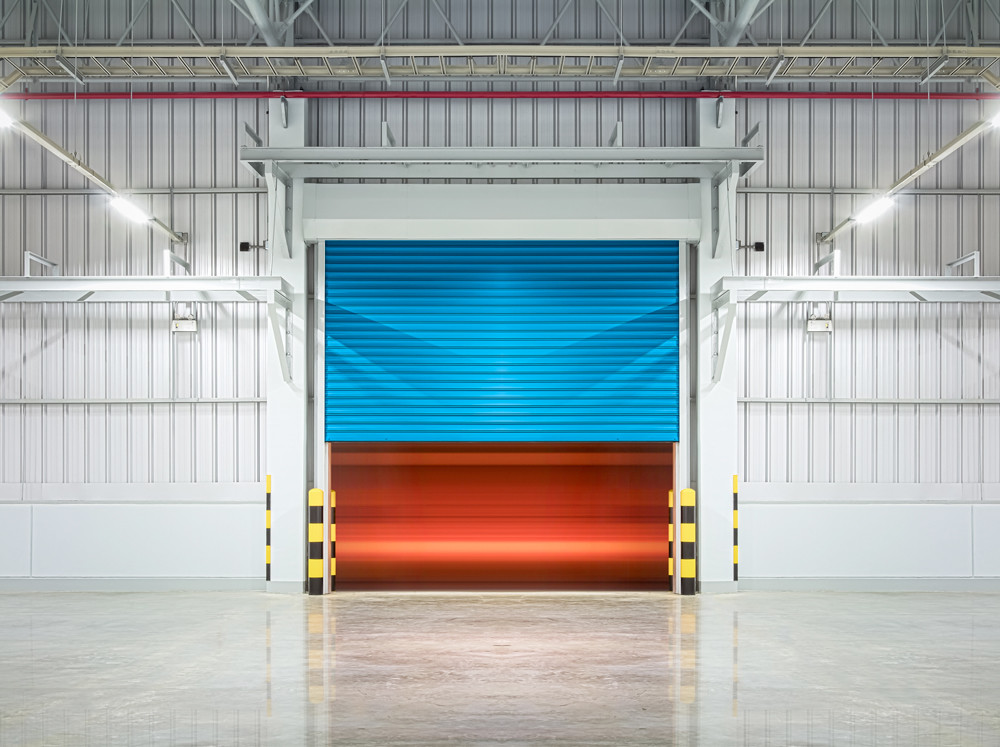
The operation of warehouse facilities is characterized by constant goods handling and intensive use of the warehouse doors. Long door opening times lead to the warehouse cooling down or heating up, with negative consequences for the stored goods, their quality, and working conditions. Doors equipped with air curtain technology (air doors) help to prevent this effect. Barrier-free enclosures thus offer a number of advantages in logistics as well:
Heating capability
The warehouse doors, which remain open due to the constant flow of goods, allow the interior to cool down despite the heating system running. Besides the immense energy consumption for the power-hungry heating, this reduces the quality of working conditions. Furthermore, the temperature fluctuations limit storage options for sensitive products. With the use of air curtain technology, the doors remain permanently accessible, but the air exchange is significantly reduced. Maintaining constant temperatures in the warehouse is now more energy-efficient and cost-effective.
Cooling costs
The same applies to cooling in the warehouse. When the doors to the cold storage rooms are opened, warm air flows in, which means the rooms have to be cooled again to the required temperature. This air exchange is effectively prevented by air doors, thus reducing cooling costs.
Climate zones
Since many products require different temperatures, humidity levels, oxygen content, etc., for optimal storage, warehouses often integrate multiple climate zones. However, the necessary spatial separation by walls and doors restricts access. Air doors can often provide barrier-free access to these zones. Furthermore, opening these connecting doors prevents the risk of the climate zones mixing, which could negatively impact product quality. Combining these doors with separate air purification systems can further enhance their effectiveness.
Reduce waiting times
Inefficient heating could be prevented by keeping the gates closed, but this creates further problems. Opening closed gates causes queues of waiting goods transports, increasing waiting times and therefore costs – not to mention the lack of space in front of the gates caused by the congestion. Air gates, on the other hand, can be passed through unimpeded at any time.
Promote health
Optimal working conditions are a key prerequisite for healthy and productive employees. Conversely, sick leave leads to lost productivity. Illnesses are frequently caused by temperature fluctuations in the warehouse and the resulting cold drafts from open doors. Installing air doors can prevent this, thus reducing sickness-related costs.
Accident prevention
Since closed gates are usually only opened shortly before passage, these passages pose a potential hazard for employees. If the gate opens too late or closes too early, accidents can easily occur. Such hazards do not arise with barrier-free air-wall gates. The same applies to vehicles, which are thus protected from damage caused by collisions with gate elements.
Fire and smoke containment
In the event of a building fire, it is crucial to keep escape and rescue routes smoke-free for as long as possible. Therefore, in case of fire, escape routes such as stairwells and corridors are pressurized with increased air pressure. However, as soon as the escape route doors are used, the generated overpressure escapes, increasing the risk of toxic smoke ingress. Air barrier doors, specially developed for this purpose, seal off escape doors and maintain the overpressure even when the doors are open. This keeps the escape and rescue routes smoke-free for as long as possible and allows them to be used without hindrance.
Prevent emissions
Dust or odor emissions caused by products, which must protect other areas of the company, surrounding businesses, or residents, can be prevented by air curtain technology. With conventional systems, these emissions would escape unhindered into the environment when the doors are opened.
Damage caused by insects
In industries like the food sector, flying insects jeopardize product quality and can cause significant damage, especially during storage. Insects can easily enter storage areas through open doors, whereas air doors prevent them from entering due to their sealing effect.
A number of German companies, such as LWT and ML-Technologies, specialized in this technology. It remains to be seen whether and how this innovative solution will gain traction in intralogistics.
Keep in touch