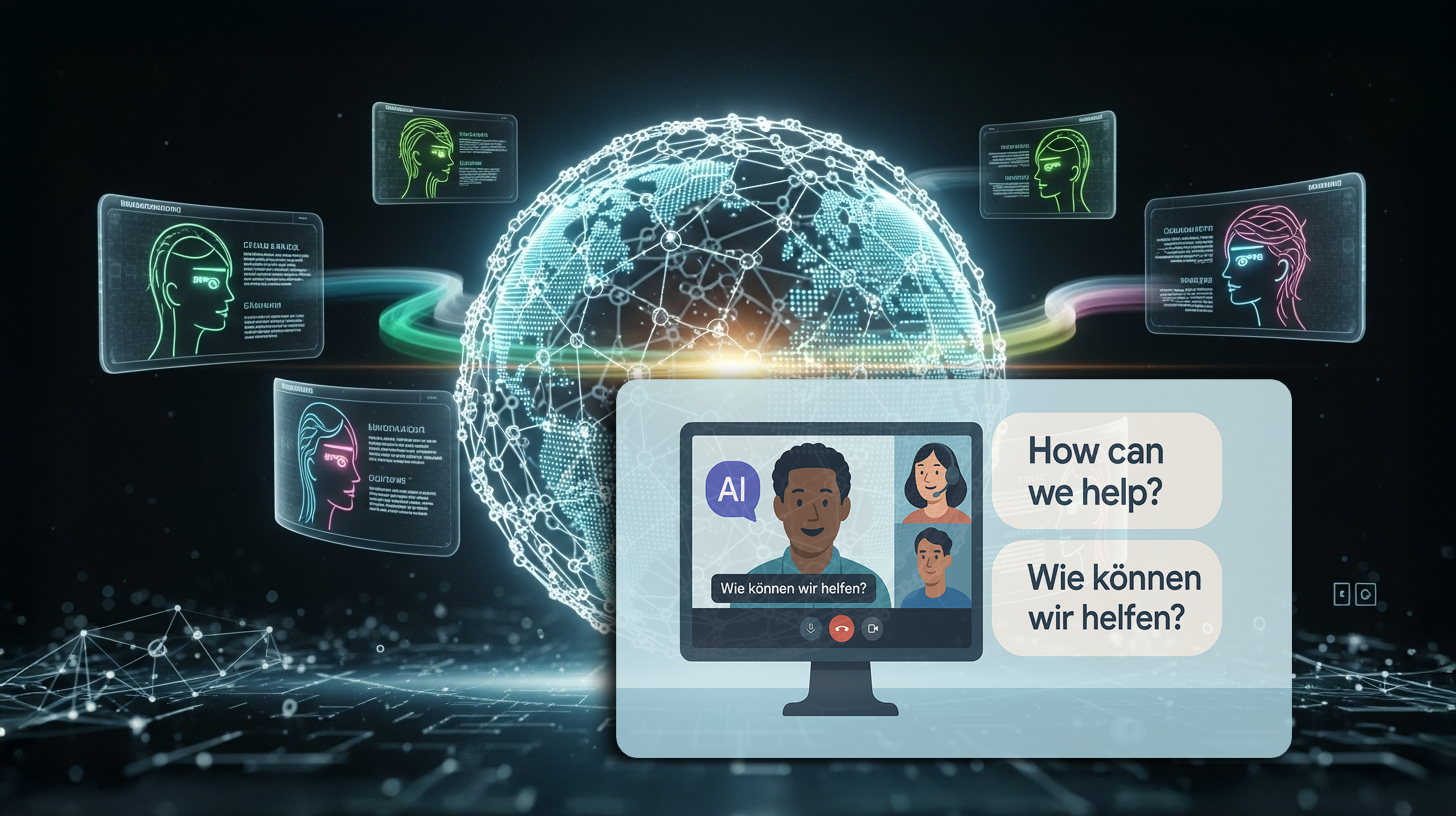
AI translation in Google Meet: Further development in real-time communication – access and availability of the beta function – Image: Xpert.Digital
Will human interpreters become obsolete? Google Meet attacks with new AI technology
How to activate Google's live interpreter in Meet – and how much the service costs
Imagine an international meeting where language barriers simply vanish. A conversation where you listen to your counterpart and hear their words almost instantly in your own language – all with the speaker's original voice and intonation. This vision is now a reality with the new AI-powered real-time translation in Google Meet. German users can now also experience this revolutionary technology, which translates conversations almost without delay while maintaining remarkable naturalness.
The key to the feature developed by Google DeepMind lies in a completely new approach: Instead of first converting speech to text and then synthesizing that back into speech, the AI works directly at the audio level. The result is a translation with a latency of only two to three seconds, which preserves not only the content but also the emotions and the speaker's distinctive voice. This creates a seamless and natural flow of conversation for participants, taking global communication for businesses, educational institutions, and private users to a whole new level.
Revolution for meetings: Google activates AI translator for German – How to activate Google's live interpreter in Meet
The development of AI-powered speech translation in Google Meet marks a crucial turning point for global digital communication. Since September 2025, German users have had access for the first time to a technology that overcomes language barriers almost in real time while preserving the natural quality of spoken language.
Related to this:


Technical innovation through direct audio translation
The speech translation in Google Meet is based on a fundamentally new approach. Unlike conventional translation systems, the technology avoids the multi-stage processing of audio to text and back to audio. Instead, Google DeepMind's speech models work directly at the sound level, achieving virtually instantaneous translation with a latency of only two to three seconds.
This technical architecture utilizes an end-to-end speech model that directly converts spectrograms of spoken language from one language to another. This allows the system not only to translate the content but also to preserve the voice, intonation, and emotional nuances of the original speaker. Listeners hear both the original voice in the background and the translated version, resulting in a more natural flow of conversation.
Access and availability of the beta function
Using AI translation requires a Google AI Pro or Ultra subscription, but only one participant with the appropriate access is needed to activate the feature for all meeting participants. Google AI Pro costs approximately €22 per month, while the premium Google AI Ultra plan is significantly more expensive at €275 per month, but offers expanded features and higher usage limits.
Activation is done via the settings in Google Meet, where users can select the "Language translation" option and specify their desired target language. The feature is currently only available in the desktop version of Chrome and requires a stable internet connection for cloud-based processing.
Language support and expansion plans
German is the fifth language available in combination with English. Spanish, Portuguese, Italian, and French were already implemented as translation pairs with English. Direct translation between other language pairs without an intermediate English step is still under development and will be expanded gradually.
The selection of languages follows a technical logic. Languages with similar structural properties, such as Spanish, Italian, Portuguese, and French, were easier to integrate than structurally different German with its more complex grammar and frequent compound words. Despite these challenges, initial tests with the German translation show impressive results in terms of comprehensibility and naturalness.
Advances in Translatotron Technology
The foundation for Google's breakthrough is DeepMind's Translatotron series. Originally introduced in 2019, the Translatotron already bypassed the traditional cascading of speech recognition, text translation, and speech synthesis. The third generation, Translatotron 3, is the first to utilize completely unsupervised learning and trains only with monolingual datasets, significantly improving its scalability to new language pairs.
This end-to-end architecture offers several advantages over conventional systems. Inference speed is significantly higher, errors between processing steps are avoided, and preserving the original voice is made easier. Additionally, names and proper names are handled better because they are not corrupted by multiple transformation processes.
Data protection and security aspects
Voice data is processed both locally and in the cloud, with Google applying strict data protection standards. As part of Google Cloud, the data is subject to the same security obligations as other enterprise services. Data transmission is encrypted, and content stored in Google Drive is also encrypted by default.
Audio and video data are only permanently stored if a participant explicitly starts a recording. No permanent audio recordings are created for the translation function itself. Google has confirmed that no attention tracking features are implemented and that customer data is not used for advertising purposes.
Our recommendation: 🌍 Limitless reach 🔗 Connected 🌐 Multilingual 💪 Sales power: 💡 Authentic with strategy 🚀 Innovation meets 🧠 Intuition


From local to global: SMEs conquer the world market with a clever strategy - Image: Xpert.Digital
In an era where a company's digital presence determines its success, the challenge lies in creating an authentic, personalized, and far-reaching presence. Xpert.Digital offers an innovative solution that positions itself as the intersection of an industry hub, a blog, and a brand ambassador. It combines the advantages of communication and sales channels in a single platform and enables publication in 18 different languages. Cooperation with partner portals and the ability to publish articles on Google News and a press distribution list with approximately 8,000 journalists and readers maximize the reach and visibility of the content. This represents a crucial factor in external sales and marketing (SMarketing).
More information here:
When real-time translation still fails: dialects, irony, and technical hurdles
Challenges in language processing
AI translation must cope with the peculiarities of natural spoken language. People interrupt themselves, change sentences mid-speech, and use a less structured syntax than in written language. Therefore, the AI model does not simply act as a word-for-word translator, but rather attempts to grasp and convey the meaning and context as a true interpreter.
Despite this advanced approach, minor translation errors occasionally occur, particularly with idiomatic expressions or culture-specific turns of phrase. The system currently translates most idioms literally, which can lead to amusing misunderstandings. However, Google is working on improvements through enhanced Large Language Models, which aim to capture better context and even tone and irony.
Related to this:

Application areas and target groups
Real-time translation opens up new possibilities for international business, educational institutions, and private communication. Companies can bring global teams together without language barriers, while educational institutions can facilitate access to lectures and seminars for students from different countries.
This technology is particularly valuable for small and medium-sized enterprises that previously could not afford professional interpreting services. The low latency enables, for the first time, natural multi-person conversations across language barriers, something that was impossible with traditional sequential translation.
Comparison with competing technologies
Google competes with other technology companies in this area. Meta has developed a similar solution with its Seamless system, but it supports more languages and combines traditional speech recognition with text translation. Apple also offers real-time translation with its AirPods Pro, but limits this to certain regions and currently excludes the EU.
The key advantage of Google's approach lies in its integration with the widely used Meet platform and its direct audio-to-audio translation without intermediate text steps. This leads to more natural results and lower latency than competing products.
Technical architecture and AI models
The language translation leverages Google's latest developments in AI architecture. The underlying models are based on Transformer decoders optimized for performance on Google's Tensor Processing Units. These systems support long context lengths and utilize efficient attention mechanisms to accurately capture even extended conversational contexts.
DeepMind has also developed the innovative PEER architecture, which utilizes over one million tiny expert networks. This mixture-of-experts approach makes it possible to increase the overall capacity of the model without dramatically increasing computational costs. The Product Key Memory technique allows for the efficient selection of the most relevant experts for each specific translation task.
Impact on the future of communication
AI translation in Google Meet represents a significant step towards truly globalized digital communication. The technology could complement traditional language learning methods and enable new forms of international collaboration. At the same time, it presents established translation service providers with new challenges, as automated solutions increasingly improve in quality and availability.
The low latency of two to three seconds is already approaching the speed of human interpreters, while scalability and cost-efficiency offer significant advantages. With the planned expansion to additional language pairs and improvements in context capture, this technology could fundamentally change the nature of international communication in the medium term.
Limits and development needs
Despite the impressive progress, limitations remain. The current beta version is restricted to desktop Chrome and requires a stable internet connection for cloud processing. Mobile devices are not yet supported, which limits flexibility.
Translation quality varies depending on the conversational context, accent, and speaking speed. Specialized terminology, regional dialects, and cultural references cannot yet be reliably captured. Google is continuously working on improvements through expanded training data and refined algorithms.
Economic importance and market potential
Integrating AI translation into Google Meet could have significant economic implications. Businesses can reduce costs for professional translation services while simultaneously expanding their international reach. The technology enables smaller companies to compete in global markets without having to build extensive language resources.
With over 300 million monthly Google Meet users worldwide, there is enormous potential for the widespread adoption of this technology. The gradual expansion to additional language pairs and the planned integration into enterprise workspace solutions indicate Google's strategic positioning in this growing market segment.
AI-powered real-time translation in Google Meet is therefore not just a technological innovation, but could act as a catalyst for a new era of cross-border digital communication. With the continuous development of the underlying DeepMind technologies and the gradual expansion of language support, this feature is expected to have a lasting impact on how people and businesses communicate with each other worldwide.
We are here for you - Consulting - Planning - Implementation - Project Management
☑️ SME support in strategy, consulting, planning and implementation
☑️ Creation or realignment of the digital strategy and digitization
☑️ Expansion and optimization of international sales processes
☑️ Global & Digital B2B trading platforms
☑️ Pioneer Business Development

Konrad Wolfenstein
I would be happy to serve as your personal advisor.
You can contact me by filling out the contact form below or simply call me on +49 7348 4088 965 .
I'm looking forward to our joint project.
Write to me


Xpert.Digital - Konrad Wolfenstein
Xpert.Digital is a hub for industry focusing on digitalization, mechanical engineering, logistics/intralogistics and photovoltaics.
With our 360° Business Development solution, we support renowned companies from new business to after-sales.
Market intelligence, smarketing, marketing automation, content development, PR, mail campaigns, personalized social media and lead nurturing are part of our digital tools.
You can find more information at: www.xpert.digital - www.xpert.solar - www.xpert.plus
Keep in touch