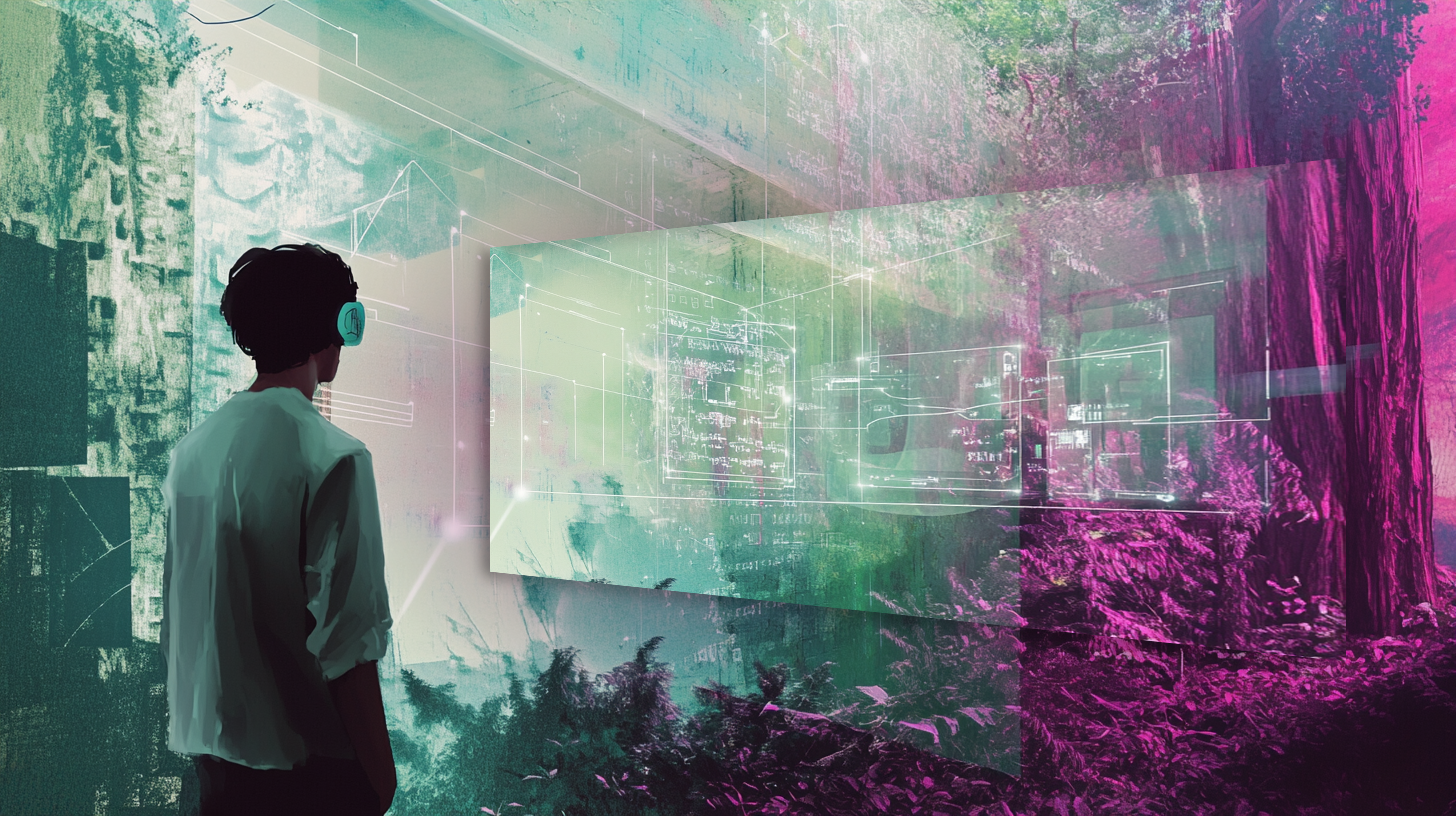
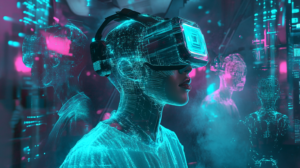
AI transformation in VR development: How Meta conjures immersive 3D worlds from individual images – Image: Xpert.Digital
Meta Labs develops groundbreaking tool for 3D VR worlds
The future of VR creation: Lifelike 3D worlds with new technology
A research team at Meta Reality Labs in Zurich has unveiled an impressive technology that makes it possible to generate lifelike 3D environments for virtual reality headsets from a single image. This innovation promises to fundamentally change the way VR content is developed and could represent a significant step towards democratizing VR content creation. By combining various AI methods, the researchers have succeeded in breaking down a complex and ambiguous task into manageable sub-problems, thus paving the way for simplified VR development.
Related to this:

The technological innovation behind Meta's 3D VR environment generator
The technology developed by Meta represents a novel approach to AI-powered VR content generation. The process consists of several sequential steps that together create a coherent 3D environment. First, coherent 360-degree panoramas are generated using a pre-trained diffusion model. These are then translated into the third dimension using a metric depth estimator.
In the next phases of the process, a point cloud is generated from the 3D data. A so-called inpainting model then fills in missing areas with information from these point clouds, thus ensuring visual consistency. The end result is a 3D environment rendered using Gaussian splatting, which can be explored in VR within a defined area.
The research team, consisting of Katja Schwarz, Denis Rozumny, Samuel Rota Bulo, Lorenzo Porzi and Peter Kontschieder, explains that the central insight of their work is to break down the inherently complex and ambiguous task of creating a 3D environment from a single image into a series of more manageable sub-problems, each of which can be solved using existing techniques.
Flexibility of input data
A remarkable feature of the method is its versatility with regard to input data. The technology works not only with artificially generated images but also with conventional photographs. Furthermore, even purely textual descriptions of a scene can serve as input to generate high-quality 3D environments suitable for use in VR headsets.
Potential for simplifying VR content creation
The ability to create a complete VR environment from a single image or text description has far-reaching implications for VR content creation. Traditional methods for developing VR environments require significant technical expertise, specialized software, and often a considerable investment of time.
Meta's new technology could significantly lower these hurdles and make VR content creation accessible to a wider audience. For example, users could create a 3D environment from a single image and then explore it with Meta Quest or use it as a starting environment.
Current restrictions and challenges
Despite the impressive progress, some limitations and challenges remain, as outlined in the research paper. A key limitation is navigation within the generated environment, which is currently restricted to a cube with sides approximately 2 meters long. The researchers explain that expanding the navigable area beyond this is difficult because it significantly increases the complexity of the task.
Furthermore, the pipeline does not yet support real-time scene synthesis. This means that creating the environment takes time. However, once the Gaussian Splats environment is created, it can be displayed in real time on a VR device.
Integration into Meta's strategic vision
The development of this 3D generation technology is part of Meta's broader strategy to merge AI and immersive technologies. Mark Zuckerberg has repeatedly emphasized the vision of a metaverse that is intended to serve as the successor to the mobile internet.
Meta has consistently invested in the development of VR and MR technologies in recent years, from the Horizon family for social interactions in VR to the integration of AI assistants into VR environments. The ability to create engaging 3D environments more easily is a key building block for realizing this vision.
Related to this:
AI as a catalyst for VR development
The technology demonstrated by Meta exemplifies a larger trend: Artificial intelligence is increasingly becoming a catalyst for advances in VR development. Similar approaches can be found in other areas, such as the creation of AI avatars for immersive environments or AI-powered virtual worlds like Victoria VR, which utilizes OpenAI integration.
The combination of AI and VR opens up new possibilities for creating realistic, interactive, and intuitive virtual experiences. In particular, simplifying the development process and reducing technical barriers to entry could contribute to wider adoption of VR technologies.
The future of VR: What Meta's 3D development holds in store for us
Meta's technology for generating 3D VR environments from individual images marks a significant advancement in simplifying VR content creation. By cleverly combining various AI methods, a complex problem is broken down into solvable subtasks, leading to impressive results.
It is currently unknown when this technology will be available in commercial products like the Meta Quest. However, according to the researchers, commercialization seems imminent. With continued development, current limitations such as the restricted navigation area could be overcome.
The increasing integration of AI into VR technologies promises to revolutionize both the creation and use of virtual environments. With innovations like this, Meta is positioning itself at the forefront of this development, paving the way for a future where immersive digital experiences will be both easier to create and more accessible to a wider audience.
Related to this:
Your global marketing and business development partner
☑️ Our business language is English or German
☑️ NEW: Correspondence in your native language!

Konrad Wolfenstein
I and my team are happy to be available to you as your personal advisor.
You can contact me by filling out the contact form here wolfenstein@xpert.digital:or simply call me at +49 7348 4088 965. My email address is
I'm looking forward to our joint project.