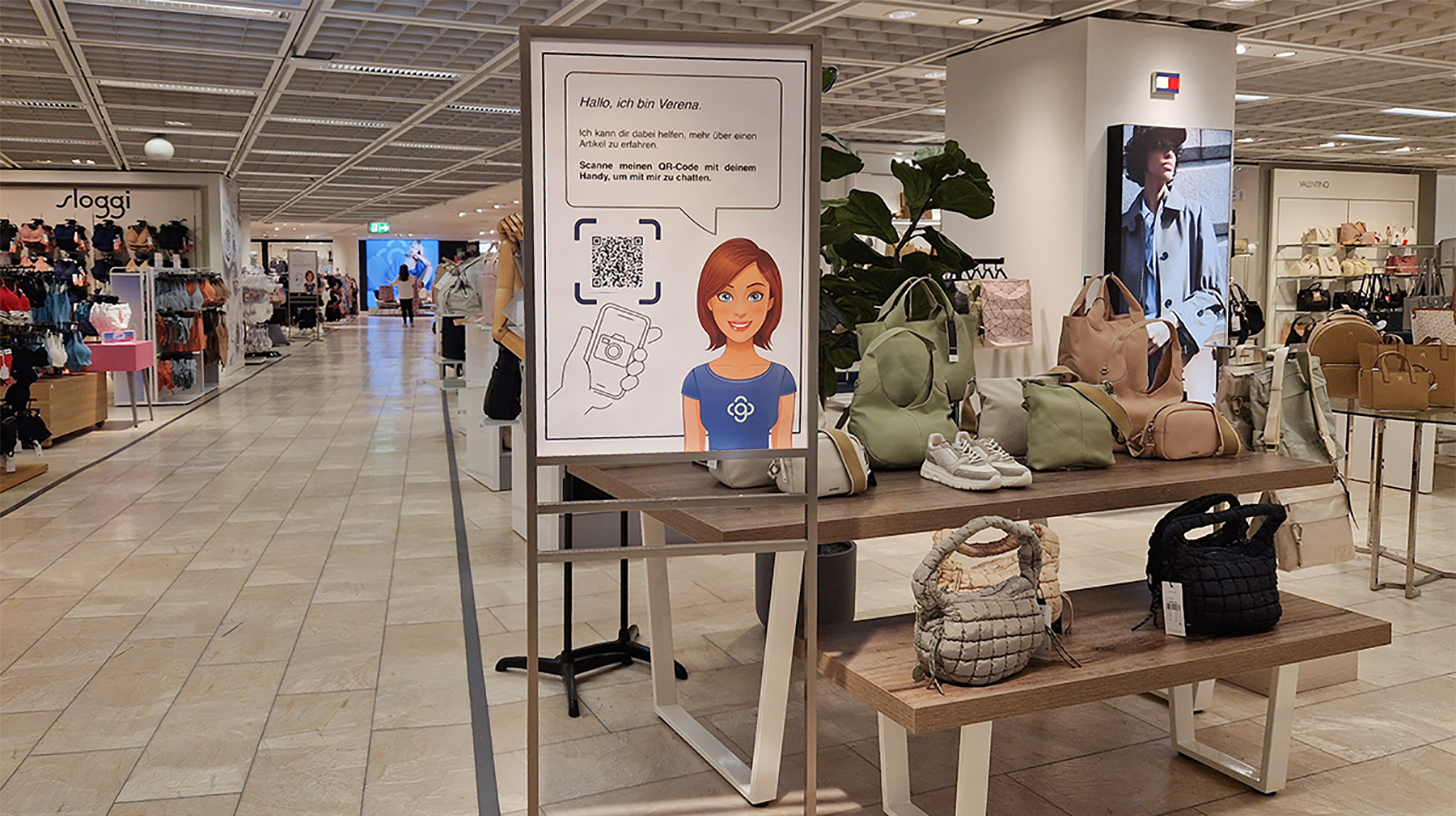
Department store chain Galeria and Bütema AG are testing the AI assistant "Verena" in the fitting rooms of their Bonn branch – Image: Bütema AG
Galeria's pilot project: AI assistance in the changing room
Smart Shopping: The digital fitting room at Galeria put to the test
A new shopping experience at Galeria: The long-established department store chain Galeria is breaking new ground to offer its customers a modern shopping experience. In a current pilot project, the company is testing the use of AI-based digital services in fitting rooms. Specifically, this means that in selected fitting rooms of the Galeria store in Bonn, an artificial intelligence named "Verena" assists customers when trying on clothes. What initially sounds futuristic is intended to improve service and make shopping more convenient today. But why is Galeria launching this experiment, how does the technology behind it work, and what opportunities and risks are associated with it? This article examines the background of the project in detail, the technical details of the smart fitting room, the advantages for customers, potential challenges, and examples of similar initiatives in the retail sector – and ventures a look into the future.
Related to this:


Background: Galeria on a course of innovation
Galeria (formerly Galeria Karstadt Kaufhof) is Germany's largest department store chain with around 80 stores nationwide. The company has a long tradition, but – like many traditional department stores – faces the challenge of reinventing itself in the age of online shopping and changing customer demands. In recent years, Galeria came under financial pressure and even had to close stores and undergo insolvency restructuring. After this difficult period, the company is now reporting improved figures and is working to modernize its concept and adapt it to current market needs.
A key component of this realignment is the investment in digital innovations at the point of sale. Galeria aims to increase the attractiveness of its stores and revitalize brick-and-mortar retail with new technologies. Customers should have reasons to consciously choose to visit the department store instead of shopping exclusively online. In particular, the in-store shopping experience is to be enhanced – through services that online retailers simply cannot offer. The pilot project using AI in the fitting rooms should be seen in this context. Galeria expects a dual impact: Firstly, customers should experience practical added value in the stores and be more likely to return. Secondly, the technology can relieve the burden on employees by automatically answering routine questions. In short, Galeria is relying on artificial intelligence in the sales area to improve service quality while simultaneously increasing in-store efficiency. This pilot project is part of a broader digitalization strategy with which Galeria aims to bridge the gap between tradition and modernity.
AI-powered services in the changing room: How does "Verena" work?
The centerpiece of the pilot project is the AI assistant "Verena," specifically designed for use in fitting rooms. Verena is a digital service accessible via chatbot on customers' smartphones. The technical implementation is surprisingly simple for users: QR codes have been installed in the fitting rooms of the Galeria store in Bonn. Customers scan these codes with their smartphone cameras, opening a chat interface that allows them to communicate directly with Verena. No additional app needs to be installed – everything runs conveniently in the phone's browser window.
Verena is based on advanced AI technology. In the background, the assistant uses a language model (according to Galeria, this uses ChatGPT technology) to understand user input in natural language and generate appropriate responses. The key feature: You can ask Verena normal questions or make requests, just as if you were chatting with a sales assistant. For example: "Do you have this blouse in a larger size?" or "Is this dress also available in blue?" Verena recognizes the intent behind the request and accesses the stored databases and services to help.
What specific functions does Verena offer? Among other things, the digital assistant can:
Retrieve article information
Verena provides details about the items just tried on. This could include the price, information about the material and care, or available sizes and colors. The customer doesn't have to search for a label or ask the sales staff – a quick chat with Verena is all it takes.
Check availability
If a customer wants to try an item in a different size or color, Verena can immediately check whether that version is in stock in the store. The AI accesses Galeria's inventory management system. Within seconds, the customer learns, for example: "These pants are also available in sizes 40 and 42. Size 42 is in stock."
Recommend matching items
Verena also acts as a style-savvy shopping companion. The AI is able to suggest accessories or combinations for items that are being tried on. For example, if someone tries on a dress, Verena might suggest: "This black cardigan, which we also have in stock, would go perfectly with it." or "Would you like to complete the look with a matching belt? I have a suggestion." These recommendations are partly based on predefined assortment logic (e.g., which items belong together) and potentially on AI analyses of what other customers have bought. The assistant is designed not only to help but also to inspire – much like a human salesperson putting together a complete outfit.
Sales representatives call
A particularly practical feature is the integration of the sales staff. If a customer needs something the AI alone cannot provide—for example, another garment in the fitting room—she can request assistance directly through Verena. The chat interface includes an option or prompt such as "Ask a sales assistant for help." Clicking this (or typing it in the chat) immediately sends a signal to the sales team that assistance is needed in that fitting room.
Communication between Verena (representing the customer) and the employees takes place via a separate application called "Karl." Karl is the employee app that Galeria is introducing as a supplement to this project. You can think of Karl as the counterpart to Verena – while Verena chats with the customer, Karl maintains contact with the sales staff in the store. When Karl receives a request (for example, "Customer in fitting room 3 would like to try on this dress in size M"), the responsible employees are notified immediately. The message appears on their work smartphones, including relevant information such as the item number, desired size, and color. The Karl app offers sales staff practical functions for a quick response: It displays the stock level and price of the requested item at a glance and can even indicate whether the item might be located on a different floor or in a different storage room. This saves the employee a trip to the stockroom to check – thanks to Karl, they already know in advance.
As soon as a team member takes on the request, they can also give the customer a brief update via the app, for example: "I'll bring size 42 to the fitting room." This message appears directly in Verena's chat, so the customer is informed that help is on the way. Interestingly, Karl ensures that each request is handled by only one team member – as soon as someone responds, the task is marked as "in progress" and is no longer visible to other team members. This prevents two employees from accidentally handling the same request or causing confusion.
Technically, Verena is a combination of a chatbot interface, data connectivity, and an AI language model. The AI has been "fed" the necessary product data and rules. For example, Verena knows the product catalogs, size ranges, color names, and current stock levels. When a customer asks a question, the AI model interprets the query and pulls the relevant information from the database to formulate a precise answer. The use of ChatGPT technology means that the answers are formulated in natural language, instead of sounding stiff and pre-programmed. So, instead of a bare piece of information like "Size M: yes, available," Verena could give a friendly response: "I have good news – the blouse is also in stock in M. Would you like to try it on? I can gladly ask someone to bring it to you." This tone is intended to create the impression that you are actually chatting with a helpful salesperson.
Another advantage of the ChatGPT integration is its multilingual capabilities. Verena isn't limited to German. Customers who speak little German can simply write in their preferred language – be it English, French, or even Russian or Turkish. The AI understands the request and responds in the same language. For Galeria's branch in Bonn, a city with an international clientele, this is a major plus: tourists or expats can shop comfortably in the local branch and enjoy full service despite language barriers. Even if the sales staff doesn't speak all the languages, Verena can bridge this gap. In the background, Karl would still display the request in German (or a standardized language) so that employees know what to do – the AI handles the translation.
To draw customers' attention to the new service, Galeria has added extra signage to its Bonn branch. For example, a digital information display (LED poster) in the entrance area of the women's lingerie department features a friendly cartoon character (a stylized "Verena") who explains the new service: "Hello, I'm Verena. I can help you in the fitting room – give it a try!" Signs and displays with brief instructions are also located directly in the fitting rooms: "Simply scan the QR code and ask questions!" This ensures that as many customers as possible learn about the digital assistant and can easily access it.
In summary, the technical process works as follows: The customer scans a code –> a chat with Verena opens –> the AI understands the request and answers it or alerts an employee –> the employee app, Karl, coordinates the human assistance. This system combines the strengths of the digital world (speed, information, 24/7 availability in the fitting room) with the strengths of brick-and-mortar retail (personal service from knowledgeable sales staff). It is an example of how humans and machines can work hand in hand in retail to create a better overall experience.
Benefits for customers and the shopping experience
Integrating AI services into fitting rooms offers a range of benefits for customers, making shopping more pleasant and efficient. Here are the key advantages promised by the pilot project:
comfort
Customers no longer have to peek half-naked out of the fitting room or interrupt their fitting to get a different size. Verena takes care of this – one scan and a few clicks, and help is on its way. The annoying back-and-forth or waiting in front of the fitting room is eliminated. Especially in large department stores, the walk to an available sales assistant or the stockroom can be long; this AI shortcut saves time and effort.
Immediate information
Frequently asked questions during trying-on – “How much did that cost again?”, “Does it come in red?”, “Does that go with X?” – can be answered immediately. Customers gain quick access to product information without having to decipher a label or wait for a salesperson. This increases transparency: Customers know about prices, materials, and care instructions right away and can make more informed decisions.
More choice in the cabin
Offering the option to request additional sizes or colors increases the likelihood of leaving the fitting room with the perfect item. Often, customers don't buy anything because the size they tried on didn't fit and no other option was available. Verena ensures that alternative options are immediately available. This increases customer satisfaction—they're more likely to find something that truly fits—and ultimately boosts sales for Galeria.
Individual advice and inspiration
Although Verena doesn't possess a human sense of fashion, she can still make personalized suggestions. The AI recommends suitable items that complement the outfit. This might lead the customer to discover products they hadn't considered – similar to a good salesperson saying, "By the way, I have a belt that would go perfectly with those trousers." These additional suggestions can enrich the shopping experience and make the customer feel like they've received comprehensive advice.
Discretion and comfort
Some people hesitate to actively ask for help in stores – whether due to shyness, language barriers, or because there isn't a sales assistant nearby. Verena lowers this barrier: customers can anonymously type in their questions without feeling observed. This can be particularly helpful in sensitive departments like the lingerie section, for example, if someone has a question about fit or availability that they'd rather not ask aloud in the store. Digital communication in the private fitting room gives customers control and privacy.
Multilingual service
As mentioned, the ability to communicate in different languages is a major advantage. Tourists, international students, and expats can take full advantage of the service without misunderstandings caused by language barriers. This makes these customers feel valued and can help Galeria establish a reputation as an internationally customer-friendly department store.
Continuity and memory function
Since Verena is a digital service, it could potentially be linked to customer accounts in the future (provided customers consent). It's conceivable that the AI could remember which sizes or brands the customer prefers, or what they last tried on. This would allow Verena to provide even more targeted assistance on future visits (for example, "Last time, size 38 fit well; should I ask for size 38 again this time?"). Customers could also save their chat history to later purchase items they saw in the store online. While not all of these features are live in the pilot program, they demonstrate the potential future direction.
From the salesperson's perspective, and for the company as a whole, there are advantages that indirectly benefit the customer. Sales staff can work more efficiently: they know exactly what each fitting room needs and can potentially fulfill multiple requests in one trip (e.g., picking up two requested sizes on the way to the warehouse). This reduces downtime and frustration for both sides. Furthermore, employees can dedicate their consultation time to those who truly need personalized assistance, while routine questions (price, size, color available?) are handled by AI. Ideally, this creates a better working environment: less rushing, fewer simple questions constantly being answered – instead, focused advice where it matters. Satisfied salespeople, in turn, are more friendly, which improves the shopping experience for all customers.
Last but not least, Galeria's offering demonstrates that brick-and-mortar retail can be modern and innovative. For a department store chain that might seem a bit old-fashioned, the image of a technological pioneer is valuable. Customers, especially younger ones, might be pleasantly surprised to find that Galeria, of all places, offers such a digital assistant. This could attract new customer groups or at least spark conversation ("Have you tried the AI fitting room at Galeria yet?"). Overall, the initiative contributes to making in-store shopping more appealing – through service, speed, and a certain entertainment factor for tech-savvy customers.
Related to this:


Challenges and potential risks of the technology
As promising as the concept sounds, there are also challenges and risks that Galeria must keep in mind with this pilot project. New technologies are rarely perfect – here are some aspects that could be critical:
Acceptance by all customers
A department store's clientele is very diverse. Not everyone feels comfortable pulling out their smartphone while changing clothes and chatting with an AI. Older customers or those less tech-savvy might be hesitant or not see the added value. They might prefer the classic "curtain call": "Excuse me, could you bring me a size larger?" Galeria therefore needs to monitor how well Verena is actually used. Training may be necessary – for example, sales assistants actively pointing out: "Did you know you can call us via QR code if you need something?" The usage rate will be a crucial factor in determining whether the investment is worthwhile. If many QR codes go unscanned, the concept would need to be reconsidered or promoted differently.
Technical reliability
Nothing is worse than technology failing at the crucial moment. An unstable Wi-Fi connection in the fitting room, a server outage, or a software bug could render the service unusable. Customers trying out Verena and then potentially waiting minutes for a response or encountering error messages would be more likely to be frustrated than impressed. Therefore, Galeria must ensure a robust infrastructure: sufficient mobile reception or in-store Wi-Fi in the fitting rooms, fast backend systems, and a fail-safe AI platform. Such teething problems can be identified during the pilot phase. Nevertheless, there is always a residual risk that technology might fail – in this case, a "Plan B" is needed (i.e., having enough staff available to step in).
Data quality and AI accuracy
Verena is only as smart as the data available to her. If, for example, the inventory in the system is incorrect (a classic problem: the system shows "1 item available," but it has already been sold and not yet booked out), the AI could incorrectly promise availability that doesn't actually exist. Such discrepancies would disappoint customers and diminish trust in the service. The AI also needs to provide the right answers – while ChatGPT is very powerful at generating speech, it can also make mistakes or "hallucinate." Galeria and Bütema (the technology partner) must carefully train and test the system to ensure that Verena doesn't, for example, provide incorrect product information or make nonsensical recommendations. The AI's answers should be precise and helpful; otherwise, users will be frustrated. Continuous quality control is essential, especially at the beginning. It may be necessary to automatically forward some inquiries that Verena cannot reliably answer to a human employee to prevent incorrect responses.
Data protection and privacy
As soon as digital services come into play, data protection becomes a pressing issue in Germany. Customers must be able to trust that their interactions with Verena will not be misused. While chat histories, if stored, generally don't contain highly sensitive data (since customers usually only ask about sizes, prices, etc.), shopping preferences or potentially personal comments could still be considered sensitive. Galeria must communicate transparently about what data is collected and how it is used. Ideally, chats should be stored anonymously or only temporarily, unless the customer consents to more extensive data sharing (e.g., linking to a customer account for future offers). The AI platform (ChatGPT) also raises questions: Are customer inputs sent to servers in the USA? Do the processes comply with the GDPR? IT departments will need to scrutinize these aspects closely. A data protection blunder could cast the entire project in a negative light.
Cybersecurity
Where new digital touchpoints emerge, new attack vectors can theoretically arise as well. A QR code, for example, could be manipulated by malicious actors (theoretically, but difficult in practice, as it's located inside a store). Or someone could try to "hack" the AI or throw it off balance with their input. Galeria should ensure that Verena can only access the intended data and doesn't disclose any unwanted information. It's conceivable that users might intentionally try to steer the AI away from the actual topic – ChatGPT is known for trying to generate an answer to every possible question. If a customer, for example, were to start asking Verena about the weather or political issues, it would be interesting to see how the system reacts. Ideally, Verena would remain polite but firm on the topic of shopping and filter out other topics to prevent misuse.
Employee acceptance and role change
It's also crucial to consider how employees react to the introduction of Verena. On the one hand, the assistant relieves them of routine tasks; on the other hand, some sales staff might fear that a successful AI could jeopardize their jobs. Galeria must clearly communicate that Verena is a support tool, not a replacement for human consultation. Ideally, employees will readily adopt Karl (the app) because they realize it structures their workday. Nevertheless, thorough training is essential: Staff must learn how to use the new system and understand when to intervene and when Verena can handle things independently. The team also needs to agree on who is responsible for incoming chat inquiries to ensure no one misses important signals. A risk would be if employees ignore Verena or view it as a bothersome additional task – in which case the service would be ineffective. This requires training, motivation, and perhaps even new guidelines for the service process.
Cost-benefit question
Ultimately, every technical pilot project faces the question of whether the effort is worthwhile. Developing and integrating an AI assistant isn't cheap. Licenses for AI services, app programming, employee equipment, maintenance – all of this costs money. Galeria will therefore carefully measure whether the pilot project in Bonn delivers measurable benefits: Does it increase sales in the lingerie department? Do customers buy more or visit more frequently? Is there positive feedback and fewer abandoned purchases? Only if these KPIs are convincing will the system likely be rolled out to other stores. Otherwise, it might remain just a nice experiment. There's a risk, therefore, that despite all efforts, the return on investment won't be high enough – for example, because only a minority of customers use the service or because the additional sales generated through referrals remain low. The project must therefore be economically viable, not just technically exciting.
All these challenges demonstrate that introducing technology in retail requires careful planning and execution. Galeria has chosen a sensible approach with its limited pilot project (one department in one store) to test and learn on a small scale before a full rollout. This allows them to iron out any initial problems and adjust processes without impacting the entire chain. The coming weeks and months will reveal how customers and employees react to Verena – and where adjustments might be necessary.
Comparison with similar initiatives in other retail companies
Galeria's idea of digitally upgrading the fitting room is innovative – but not entirely without precedents. In fact, various retailers have been experimenting with smart fitting room concepts and AI services for several years to improve the shopping experience. A look at some similar initiatives shows how the trend is emerging and where the differences lie:
Adler Fashion Stores (Germany, 2015)
The fashion chain Adler was among the first in Germany to test a "smart fitting room." In a branch in Erfurt, Adler equipped fitting rooms with RFID technology and touchscreens. Garments were tagged with RFID chips, allowing the fitting room to recognize which items the customer had taken inside. Product information for each garment was then displayed on a screen – price, available sizes, colors, and even suggestions for matching items. Customers could also request additional sizes via touchscreen, which were then brought to them by staff. This concept was similar to Galeria's, but without a chatbot: Interaction primarily involved selecting items on the screen, not free-flowing voice input. Despite positive feedback, the smart fitting room remained a pilot project at Adler; it did not (at that time) become widespread – presumably due to the high hardware costs per fitting room and the limited acceptance a few years ago.
Galeria Kaufhof (Germany, 2007)
Interestingly, Galeria's current project isn't the company's first foray into this area. Back in 2007 – then still Kaufhof, as part of the Metro Group's Future Store Initiative – a pilot project was conducted in the Essen branch, testing RFID fitting rooms in the men's department. Customers could access information about items via RFID and a screen, and use the service to have alternatives brought to them. This very early experiment, over a decade ago, demonstrated what is now regaining relevance. However, the technologies were far less advanced back then (RFID was in its infancy in the fashion industry, touchscreens were expensive, and AI as we know it today didn't exist). The project faded into obscurity, but the insights gained have likely influenced current developments.
Ralph Lauren & Oak Labs (USA, from 2015)
In the premium segment, the American fashion brand Ralph Lauren caused a stir a few years ago with its high-tech mirrors in fitting rooms. In its New York flagship store, Ralph Lauren installed so-called "Smart Mirrors," developed by the startup Oak Labs. These mirrors initially look like normal, large fitting room mirrors, but feature integrated touchscreen functions and RFID readers. Here's how it works: The clothing brought into the fitting room by the customer is automatically recognized by the mirror (via RFID tags). An intuitive menu then appears on the mirror's display: The customer can change the lighting in the fitting room (to simulate daylight or evening light, for example, and see how the outfit looks) and request different sizes or colors with a touch. The mirror also displays recommendations ("This shirt is also available in these colors, and look, these pants would go well with it."). The ingenious feature was that the customer could select the language – the interface could be switched to Spanish or Chinese, for example, to assist international customers. As soon as assistance was requested, sales staff were notified and brought the desired items to the fitting room. This concept was well received by customers, as it was seamlessly integrated into the usual process (trying on clothes in front of a mirror). However, the costs are high, and such smart mirrors initially remained limited to a few flagship stores.
Mango & Vodafone (Spain, from 2020)
Fashion retailer Mango partnered with Vodafone to introduce digital fitting rooms in several stores. This involved using a smart mirror called the "Digital Fitting Room." Its functionality is similar to the aforementioned systems: RFID chips identify the clothing, product information and mix-and-match tips are displayed on the mirror's screen, and customers can request different sizes or items from staff with a tap of their finger. Mango planned to roll out this technology more broadly in its stores as part of its strategy to advance the smart retail concept. A key selling point was that all data and images are only displayed to the customer's smartphone (if they connect), ensuring privacy – the retailer receives no live images from inside the fitting room. This project demonstrates that retailers across Europe are embracing this trend and experimenting with augmented reality and connected fitting rooms.
Amazon Style Store (USA, from 2022)
Online giant Amazon has also demonstrated innovative approaches in brick-and-mortar stores with its fashion offensive. In 2022, Amazon opened its first "Amazon Style" store in Los Angeles, a clothing store heavily supported by digital technology. Shopping there works like this: Customers only see one item of each garment on display. If they like something, they scan the item's QR code with the Amazon app. Within the app, they can then select the size and color they want to try on. An automated system in the background gathers all the selected items and prepares a personal fitting room. The app notifies the customer which fitting room has their selection ready as soon as it's available. When the customer enters the fitting room, all the chosen items are already there. Additionally, there's a touchscreen in the fitting room: Amazon's AI uses it to make personalized suggestions for other items the customer might like (based on their online shopping history and currently selected items). Customers can also order additional items via the screen, which are then quickly brought to the fitting room without having to search the store again. While there's no chatbot involved, Amazon's concept uses AI to recognize preferences and transform the fitting room into a showroom for personalized recommendations. This omnichannel approach (linking app and store) has garnered significant attention.
Macy's On-Call (USA, 2016)
A slightly different example was the initiative of the US department store chain Macy's. Macy's tested a mobile AI assistant based on IBM Watson in some of its stores, which they called "On Call." Customers could access a special page in the store using their smartphone browser (or request a link via SMS) and type in their questions, such as: "Where can I find men's shoes?" or "Do you have red cocktail dresses?" The Watson chatbot responded with directions within the store or basic product information. This service was primarily aimed at making it easier to find your way around the large department store and covering simple FAQs. The project was an interesting precursor, but it also revealed limitations: Many customers still preferred to ask an employee directly, and the AI at that time was not as conversational as today's chatbots. Macy's On Call therefore remained a limited test and was not rolled out across the board.
These examples illustrate two things: First, there's a broad trend in retail to bridge the gap between online convenience and the offline experience. Whether via smart mirrors, RFID, or chatbots, many approaches aim to provide customers in-store with a similar level of information and convenience as they're accustomed to from online shopping (for example, "Customers who bought this product were also interested in…" or real-time availability displays). Second, the diverse solutions demonstrate that there's no one-size-fits-all solution. Each chain is experimenting differently, depending on budget, target audience, and store concept. Galeria's approach with a smartphone-based chatbot solution is relatively new, as many have previously relied on built-in displays or fixed installations. Using the customer's smartphone as an interface (via QR code) has advantages and disadvantages: It's more cost-effective (no expensive mirror hardware is needed), and QR codes are familiar to many people after the pandemic; on the other hand, it requires the customer to actively use their own device. Galeria will now find out whether the latter is more successful than a provided touchscreen.
Future prospects and possible further developments
Galeria's AI-powered changing room project is still in its early stages – but a look into the future reveals the long-term potential of such solutions. Should the pilot project in Bonn prove successful, various further developments are conceivable:
Rollout to other branches
The most logical step would be to introduce Verena (and the Karl app) in more Galeria stores. The rollout would likely be phased in, starting with larger branches or those with a high tourist traffic (where multilingual support is particularly appealing). Gradually, all fashion departments in the stores could be equipped with the QR codes and the service. In a few years, it could be commonplace to find a sign indicating the presence of a digital assistant in every Galeria fitting room. Verena could potentially be extended to other product categories, such as sportswear, menswear, or children's departments – anywhere fitting rooms are used. The questions asked in other departments might differ slightly, but the basic functionality (size availability, product information, requesting assistance) remains the same.
Expansion of functions
Verena could become even more intelligent and versatile over time. For example, the AI could learn from conversations which questions are asked most frequently and further optimize its answers. Verena could also be linked to the Galeria customer account: If a regular customer is logged in (e.g., via their loyalty card number or app login), Verena could provide personalized recommendations based on previous purchases ("The blouse you're trying on would go well with the trousers you bought from us last year."). Exclusive discount coupons or loyalty points could also be offered via the chat to encourage usage.
From a technical standpoint, the AI assistant could one day function not only text-based but also voice-controlled. Many people are now accustomed to voice assistants thanks to Siri, Alexa, and similar systems. One could imagine a voice interface being set up in the fitting room (e.g., a microphone/speaker system or via the phone's microphone) so that the customer could say, "Verena, I need these jeans in size 32." The AI would convert the voice request into text and process it accordingly. This would be even more natural, but it also places higher demands on data privacy (microphones in fitting rooms are sensitive) and ambient noise.
Visual technologies and augmented reality
Another exciting avenue is the combination of AI with image processing. Apps already exist that can use a smartphone camera to identify the garment in front of you or virtually dress you in clothes (AR filters). In the future, Verena could potentially use the smartphone camera image to provide customer feedback: For example, you could film yourself in front of a mirror and ask Verena, "How does this jacket fit?" – the AI could then, based on the video analysis, reply, "The shoulders look a bit narrow; perhaps a size larger would be more comfortable." This would be a very advanced application that still requires considerable research, but it's not out of the question in a few years. Similarly, AR could allow Verena to virtually display alternative colors or items on your body without you having to change: You're wearing a red dress, ask, "What does it look like in blue?", and you see a simulated blue version on your phone or in a smart mirror. Such virtual fittings are already being developed for online shopping – in stores, they could complement the traditional fitting room experience (for example, to quickly select colors before trying everything on).
Beyond the fitting room: Verena could also be helpful outside the fitting room in the long term. Imagine the AI being accessible throughout the entire store – for example, via the Galeria app, which you have open while shopping. Customers could then ask questions on the sales floor, such as "Do we also have this model in the Alexanderplatz store?" or "Where can I find the housewares department?" – essentially a digital concierge for the entire store. In combination with location technology (smartphone tracking in the store), Verena could navigate you through the store: "Walk straight ahead for 20 meters, then turn right – the shoe department is there." In this way, the AI would become an all-around assistant for the shopping experience.
Furthermore, the insights gained from Verena's chats could provide valuable data for improving the product range and service. Galeria could, for example, learn which sizes are most frequently requested (and perhaps often out of stock – a signal for inventory management). Or which items are often asked about in combination – this could inform product range recommendations. Feedback such as "This item is itchy," should customers mention it, could also be collected. Naturally, such chat data would have to be analyzed anonymously, but it is a treasure trove for identifying customer trends.
Galeria's pilot project is likely to be closely watched by the industry as a whole. If it goes well, it could have a ripple effect: other retailers – especially fashion houses or large textile chains – could adopt similar solutions more quickly. AI technology is becoming increasingly accessible, and services like ChatGPT allow even smaller companies to develop smart assistants without their own data science team. Industry-wide standards or platforms for such in-store assistants may emerge in the near future, similar to the standard software for point-of-sale systems that exists today. Galeria therefore has the opportunity to be a pioneer in Germany. At the same time, the company must remain flexible, as developments are dynamic: what is a chatbot via QR code today could look completely different in five years. It is crucial that the focus remains on added value for the customer. Technology for its own sake will not be successful in the long run – but technology that offers genuine service can bring about lasting positive change in the retail sector.
Galeria's pilot project in Bonn combines classic shopping culture with cutting-edge AI technology. It's a bold move intended to demonstrate that even a traditional retailer can be innovative. Customers benefit from faster assistance and more information directly in the fitting room, while staff receive support with routine tasks. Of course, there are still some hurdles to overcome, from customer acceptance to fine-tuning the technology. But if Galeria wisely utilizes the experience gained from the test, "Verena" could be the starting point for a new standard in everyday shopping. The fitting room – often a "blind spot" in the store where service ended as soon as the curtain was drawn – is transformed into a space for digital dialogue. It remains to be seen whether customers will embrace this offering. The future of retail is certainly being shaped by projects like these – and Galeria is now actively involved. There are many indications that we will encounter such helpful AI assistants more frequently in the future, whether at Galeria or elsewhere, and that shopping will become a bit more pleasant and smarter as a result.
Related to this:
Your global marketing and business development partner
☑️ Our business language is English or German
☑️ NEW: Correspondence in your native language!

Konrad Wolfenstein
I and my team are happy to be available to you as your personal advisor.
You can contact me by filling out the contact form here wolfenstein@xpert.digital:or simply call me at +49 7348 4088 965. My email address is
I'm looking forward to our joint project.