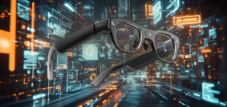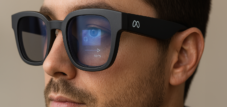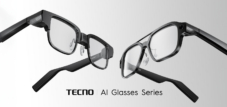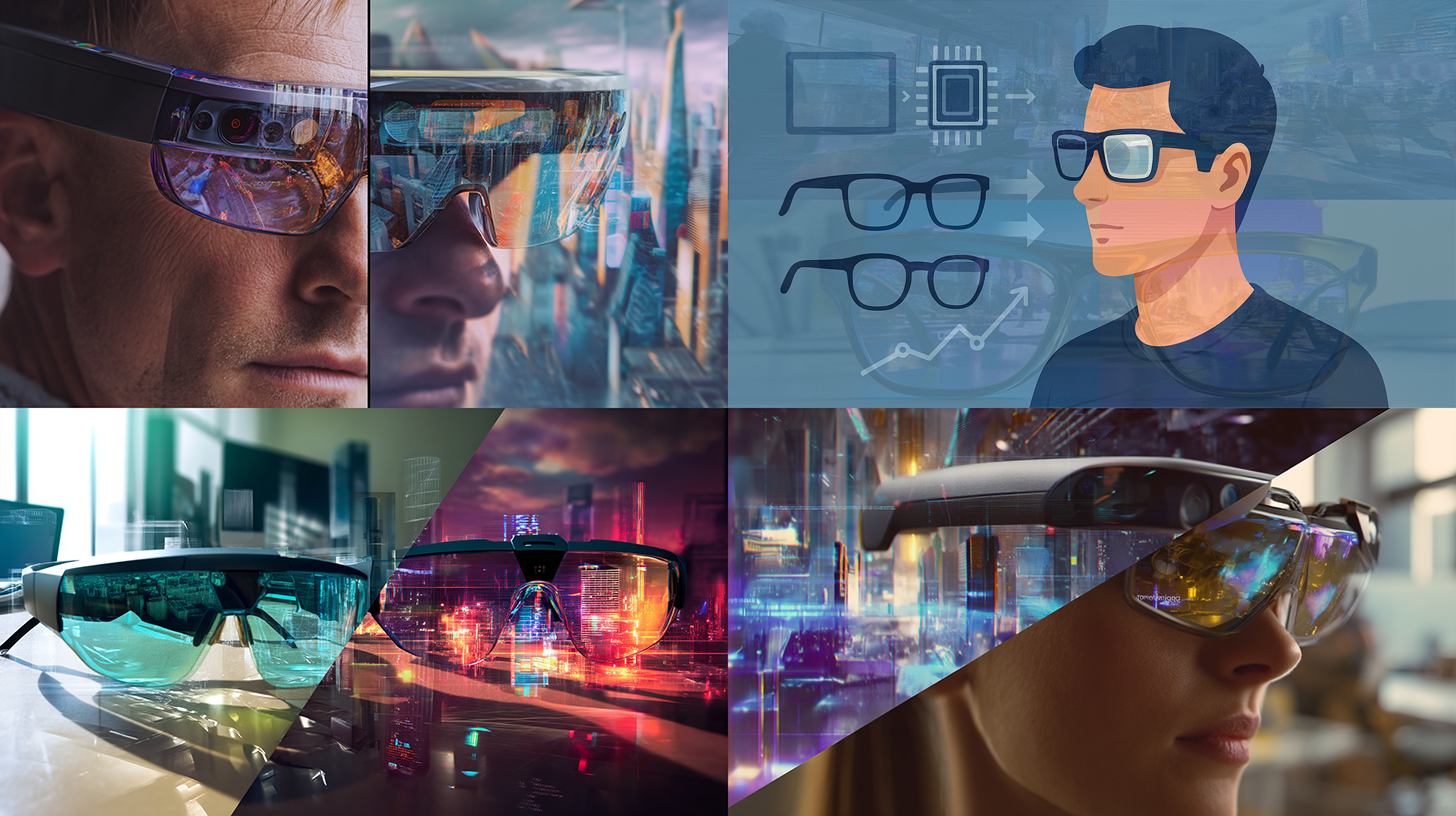
Trends and developments in smart glasses: Advances in display integration and miniaturization – Image: Xpert.Digital
Innovation leap in smart glasses: Practical, aesthetic, comfortable
Miniaturization and progress: Smart glasses as new companions
Smart glasses technology is currently undergoing impressive development, focusing on the integration of advanced displays and the miniaturization of components. The trend is clearly moving towards everyday glasses that are not only technologically sophisticated but also aesthetically pleasing and comfortable. These developments mark a crucial shift from mere gadgets to practical everyday companions.
Related to this:


Display technologies and integration in modern smart glasses
Innovative display solutions
The integration of displays into smart glasses has advanced considerably. Current models utilize various technologies to project information directly into the user's field of vision. Micro-LED displays are particularly noteworthy, distinguished by their energy efficiency and high image quality. For example, Meta, as part of its "Hypernova" project, is developing AR glasses that integrate a display at the bottom of the right lens, allowing the user to view the projected information with their right eye.
In contrast, the Xreal Air uses two 1080p OLED panels that serve as a second monitor for USB-C or HDMI devices and can project a virtual canvas of up to 201 inches into the user's field of vision. This technology enables various levels of AR: from simple image transmission and virtual desktops to advanced spatial computing, where 3D objects are superimposed onto the real environment.
Innovative positioning and integration
An interesting approach comes from Halliday, whose smart glasses use a 3.6-millimeter display module at the edge of the right lens to project a 3.5-inch text field into the wearer's field of vision. This solution avoids using the lenses themselves as a display surface and focuses on discreetly enhancing the peripheral vision. The display is invisible to others, thus protecting the user's privacy.
The company tooz has developed another innovative solution: a micro-LED display that is integrated directly into the eyeglass lens. This display is positioned slightly offset from the eye's focal point, requiring the user to actively look at it to read the data. A particular advantage of this approach is that the display can be used in lenses of varying prescriptions, for both nearsighted and farsighted individuals.
Miniaturization and comfort: The path to everyday usability
Weight reduction and ergonomic design
The miniaturization of components plays a crucial role in the everyday acceptance of smart glasses. Modern models strive to reduce weight and adapt their design to classic eyeglasses. The Xreal Air, for example, weighs only 79 grams, making it particularly comfortable to wear. The Halliday Smart Glasses go a step further, weighing just around 35 grams while visually resembling classic horn-rimmed glasses with a wide, black frame.
Material innovations for improved wearing comfort
The choice of materials is crucial for the comfort of smart glasses. CHARMANT has developed a frame for TDK's smart glasses that optimizes comfort through the use of titanium and Z-Titanium. The front of the frame is made of lightweight, high-strength titanium, while the temples are crafted from Z-Titanium – a flexible material with excellent elasticity that reduces lateral pressure on the head. This innovative material choice represents a significant improvement over commonly used plastic frames, which, while lightweight, can cause pressure points in the temple area.
Compact optical systems and battery life
The integration of compact optical systems is another important aspect of miniaturization. Projects such as that of Almer Technologies GmbH in collaboration with the Switzerland Innovation Park Biel/Bienne aim to develop compact AR glasses that combine an appealing design with energy-saving electronics and robust mechanics.
Battery life is also an important factor for everyday usability. The Halliday glasses, for example, offer a usage time of up to eight hours on a single charge, while comparable models like the Ray-Ban Meta glasses only manage about four hours. This improved battery life is partly achieved by omitting a camera in the frame, which also reduces privacy concerns.
Related to this:
The current market and future developments
The smart glasses market is developing rapidly and diversifying. Meta sold approximately one million smart glasses in 2024 and is now planning a high-end model with its Hypernova project, which is expected to launch at a price of over $1,000. These glasses aim to be more than just fashionable accessories; they also offer practical functions such as photography, navigation, and notification display.
Future developments will likely involve even greater integration of artificial intelligence. Halliday's glasses, for example, offer AI features such as translating speech from up to 40 languages, which is then displayed as text on the screen, as well as providing automatic summaries of spoken lectures. This AI integration could significantly expand the usefulness of smart glasses, transforming them into versatile everyday assistants.
A significant step towards everyday usability
Current hardware development and the design of smart glasses show significant progress toward devices suitable for everyday use. The integration of various display technologies directly into the user's field of vision marks a significant step away from simple glasses with only audio or camera functions. At the same time, miniaturization and improved materials enable lighter, more comfortable designs that visually resemble normal glasses more closely and appear less bulky.
The combination of advanced display technology, improved wearing comfort, and longer battery life could mark the breakthrough for smart glasses as a mainstream technology. With the integration of AI functionalities and further refinement of the design, smart glasses are increasingly becoming practical companions that seamlessly integrate our interaction with the digital world into everyday life.
Related to this:
Your global marketing and business development partner
☑️ Our business language is English or German
☑️ NEW: Correspondence in your native language!

Konrad Wolfenstein
I and my team are happy to be available to you as your personal advisor.
You can contact me by filling out the contact form here wolfenstein@xpert.digital:or simply call me at +49 7348 4088 965. My email address is
I'm looking forward to our joint project.