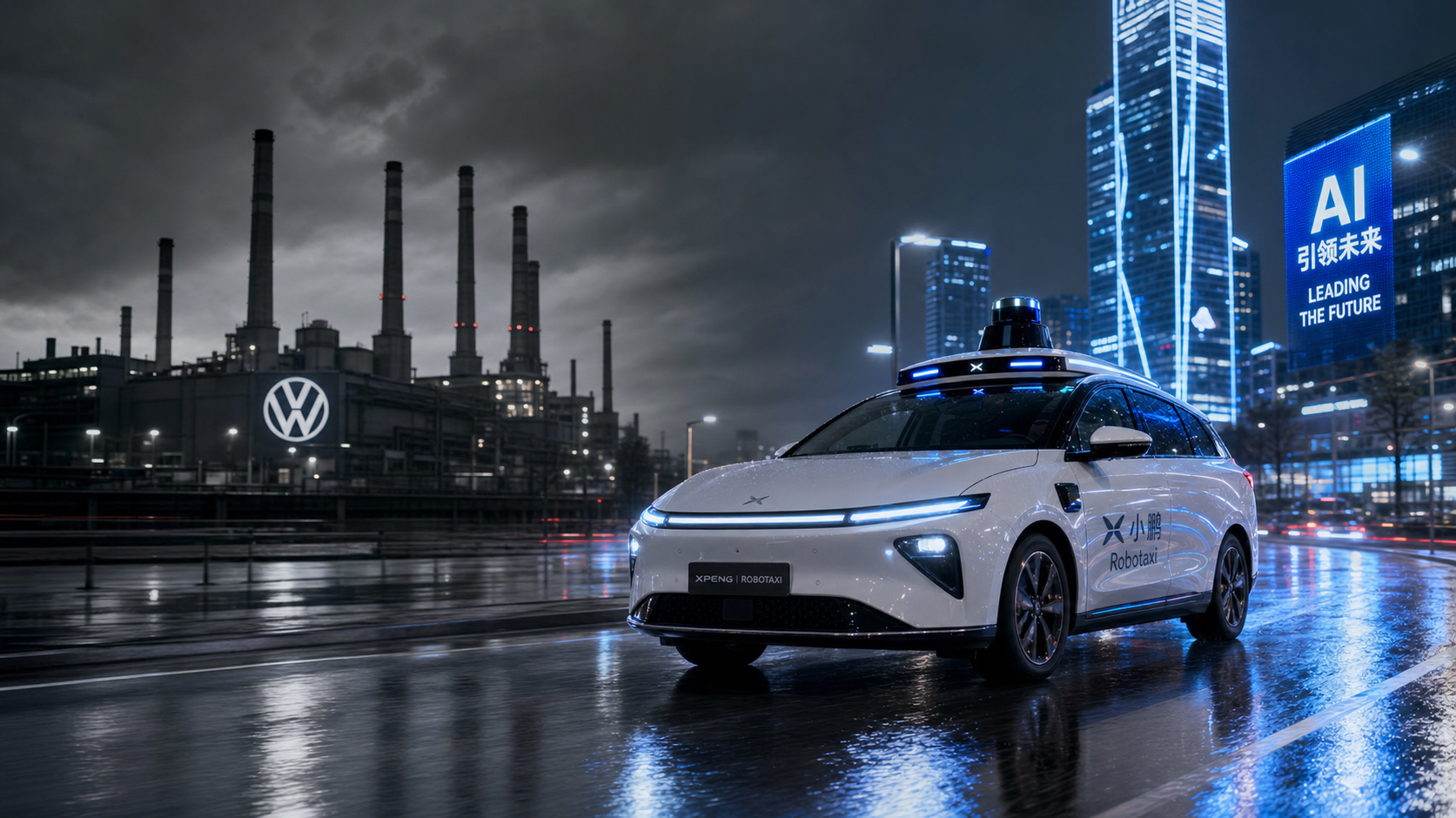
The multi-billion dollar robotaxi market: Why Chinese AI could soon be chauffeuring us on German roads – Image: Xpert.Digital
The pilot project trap: Why the German automotive industry missed the starting signal for robotaxis
The multi-billion dollar robotaxi market: Why Chinese AI could soon be chauffeuring us on German roads
Bureaucracy instead of innovation: How Germany is holding itself back in autonomous driving
While driverless robotaxis are becoming increasingly commonplace on the streets of the US and China and are entering mass production, Germany is bogged down in bureaucratic hurdles, endless pilot projects, and structural transformation problems. After the camera, computer, and solar industries, is Germany now facing the loss of its next major key technology? This is precisely the warning issued by former Hessian Minister-President and current economics professor Roland Koch in a sharp economic policy analysis.
His thesis: We are not failing in international competition due to a lack of inventiveness among our engineers, but rather because of a sluggish system that prioritizes flawless regulation over rapid innovation and underestimates the power of real-world driving data. The following text examines Koch's analysis in detail, compares it with current market data from players like Waymo, Baidu, and Xpeng, and reveals what is at stake economically – and what concrete measures Germany could still take to turn the tide.
More information here:
The tragedy of autonomous driving: Is Germany losing its next major key technology?
The article that prompted this analysis was written by Prof. Dr. h.c. mult. Roland Koch, the former Minister-President of Hesse (CDU, 1999–2010) and, since November 2020, Chairman of the Ludwig Erhard Foundation. Koch is neither a technologist nor an automotive executive, but rather an experienced economic policy expert with decades of practical experience at the intersection of government, regulation, and business. He teaches at the Frankfurt School of Finance and Management as Professor of Management Practice in Regulated Environments and is Co-Director of the Frankfurt Competence Center for German and Global Regulation. This background shapes his perspective: he argues not as an engineer, but as someone who knows the institutional and political obstacles from personal experience. His commentary for the Ludwig Erhard Foundation should therefore not be read as a technical analysis, but as an economic policy diagnosis with a focus on regulatory policy. This contextualization is essential for a fair critique.
From cameras to robotaxis: The pattern repeats itself
Koch begins with a historical review that, at first glance, seems provocative, but on closer inspection reveals a real observation: Germany lost camera technology to Japan, its computer industry to the USA, solar energy to China – and now the next loss looms in the field of autonomous driving. Indeed, the parallels are striking. In all the aforementioned cases, the original technological expertise was present in Germany: Leica stood for world-class optical precision, Nixdorf Computer developed one of the strongest European IT architectures in the early 1980s, and SMA Solar was among the pioneers of inverter technology for photovoltaic systems. None of these positions could be maintained in the long term because other countries scaled up faster, invested more aggressively, and provided more targeted government support.
Whether this parallelization holds true in its entirety warrants critical clarification. Each of these industries had its own specific causes for lagging behind. The loss of consumer camera production to Japan was closely linked to Japan's industrial export offensive of the 1970s and 1980s. The decline of Nixdorf Computer was largely attributable to flawed corporate strategy and the rapid platform shift brought about by IBM-compatible PCs. Solar module production migrated to China because unprecedented government subsidies reduced production costs there to a level that no European manufacturer could survive without substantial import tariffs. Autonomous driving follows a different logic: Here, it's less about production costs and more about the ability to build software-intensive platform economies and consistently exploit regulatory frameworks. Nevertheless, the pattern Koch describes reveals a structural problem that persists across different generations of technology—and this pattern should be taken seriously.
The series launch: What actually began in Guangzhou
The specific trigger for Koch's analysis is real and well-documented. In May 2026, the Chinese manufacturer Xpeng officially began series production of its first robotaxis in Guangzhou. The vehicle, model GX, is designed for Level 4 autonomous driving and is based on a completely in-house developed full-stack technology platform – from the chips and software to the vehicle itself. The technological approach is remarkable: Xpeng forgoes expensive lidar sensors and HD maps, instead relying on a purely camera-based system that utilizes four proprietary Turing AI chips with a combined computing power of up to 3,000 TOPS. The end-to-end VLA 2.0 model enables reaction times of less than 80 milliseconds. Pilot operations with passengers are planned for the second half of 2026, with fully driverless operation without a safety driver scheduled to begin in early 2027.
However, for a dispassionate assessment, it is important to distinguish between series production and the mass market. Xpeng is still in an early stage of commercial operation. The company plans to achieve fully autonomous operation by 2027 and aims for up to 100,000 units in the medium to long term. Actual industrial scaling is therefore still pending. Nevertheless, the symbolic value of this step is enormous: China has demonstrated that it has completed the transition from the research and development phase to series production – and this for a vehicle with the highest level of autonomy, which would not yet be eligible for regulatory approval in Germany.
Waymo and Baidu: The extent of their lead in numbers
Even more clearly than Xpeng's series launch, a look at established robotaxi providers reveals just how far ahead the US and China actually are. Waymo, the Alphabet subsidiary and global technology leader in the robotaxi sector, already provides around 250,000 paid rides per week without safety drivers. The service is commercially active in San Francisco, Los Angeles, Phoenix, Atlanta, and Austin, added Miami in early 2026, and plans to operate in up to ten US cities by the end of 2026. In November 2025, Waymo received approval to operate its vehicles on American highways without human accompaniment. Internationally, the company has its sights set on London and Tokyo.
In China, the robotaxi ecosystem is operating on a different track, but with comparable dimensions. Baidu's Apollo Go platform completed 3.1 million fully driverless rides in the third quarter of 2025 and is now active in around 20 Chinese cities. Growth accelerated from 148 percent year-on-year in the second quarter to 212 percent in the third quarter of 2025. Since February 2025, Apollo Go has been operating throughout China without safety drivers. Besides Baidu, Pony.ai, with over 300 robotaxis, and WeRide are other significant players. According to Counterpoint Research, the global robotaxi market will reach a volume of US$168 billion by 2035 and comprise a fleet size of 3.6 million vehicles. Other forecasts go even further: McKinsey estimates a market volume of up to €400 billion for the EU and US combined by 2035.
On the other hand, European and German manufacturers lack comparable commercial services without safety drivers – they are still working on test projects. Baidu, together with the US mobility service Lyft, plans to launch robotaxi services in Germany and Great Britain starting in 2026. Conversely, this means that it could become realistic in the future to hail an autonomous taxi in Berlin that runs on Chinese software, is brokered via an American platform, and operates on German roads – without any German company being involved in the value chain.
Germany in figures: Where the gap is measurable
This finding is corroborated by independent study data. The Center of Automotive Management's (CCI 2025) Connected Car Innovation study arrives at a nuanced, yet generally clear, conclusion. In driver assistance systems up to Level 2 and 2+, Chinese manufacturers have already overtaken their German counterparts. In 2024, Chinese manufacturers accounted for more than 70 percent of global innovation in this area, while German companies reached 14 percent. German manufacturers still hold a leading position in Levels 3 and 4, but CAM predicts that Chinese suppliers will have surpassed their German counterparts in terms of innovation by around 2028. According to a study by Alvarez & Marsal, the competitiveness index of the German automotive industry fell to 7 points in 2025, compared to 18 points the previous year, making it the weakest score of all industries examined. Almost a quarter of the decision-makers surveyed rated their own competitive situation as difficult or very difficult.
The software dimension of this backlog is particularly revealing. Volkswagen's software subsidiary CARIAD, founded in 2020 and intended to form the backbone of the group's digital transformation with around 6,000 employees, became a symbol of the failure of the German transformation approach. Massive software problems delayed important model launches by years; the electric Porsche Macan was delayed by three years, as were Audi models. In October 2025, VW CEO Oliver Blume implemented a radical change of strategy: CARIAD was transformed into a coordination center for external partners, instead of continuing to rely entirely on in-house development. In March 2025, CARIAD laid off around 30 percent of its workforce. Furthermore, in December 2024, it was revealed that sensitive location data from around 800,000 VW Group electric cars had been stored unprotected in an Amazon cloud storage system for months – a report by the Chaos Computer Club. The data leak was another painful chapter in CARIAD's history of problems and severely damaged the already fragile trust in the company's IT expertise.
The regulatory framework: protective barrier or innovation brake?
Koch identifies the state as a regulator as one of the biggest obstacles, and the fact check largely supports this assessment. In May 2021, Germany became the first country in the world to pass a law permitting Level 4 autonomous vehicles to operate regularly on public roads. The corresponding Autonomous Vehicle Approval and Operation Ordinance (AFGBV) came into force on July 1, 2022. This sounds like pioneering work – and was indeed an important step in the legal framework. However, the devil is in the details: The law restricts its use to pre-approved, defined operating areas, mandates an external technical supervisor as a human safety net, and requires that criminal liability for traffic violations be determined on a case-by-case basis. The result is a framework that makes innovation legally possible, but only allows it economically with considerable bureaucratic effort.
A further complication is the dual regulatory framework. Driver assistance systems and autonomous vehicles fall under two parallel regimes in the EU: the UNECE regulations (R155, R156, R157) and the EU AI Act. This dual burden of national law, EU regulations, and international UN standards creates a regulatory complexity that neither American nor Chinese competitors face in their domestic markets. While China's Ministry of Industry and Information Technology (MIIT) has also developed standards that will become mandatory from 2027, the fundamental difference lies in the government's approach to supporting these systems: whereas European regulations place the burden of proof on manufacturers, Chinese authorities and companies often work in a strategic partnership, actively providing approvals and testing facilities.
Nevertheless, one-sided criticism of the regulatory framework is unfair. Safety requirements for driverless vehicles transporting people are legitimate and necessary. The central question is not whether to regulate, but how – namely, whether regulation is conceived as an iterative process that matures alongside the technology, or as a precondition that must be met before any practical experience can be gained. On this point, Koch is right: Germany opted for the second approach, and this has resulted in learning curves that are crucial in international competition.
The data problem: Why the gap is self-reinforcing
A structural argument that Koch addresses in his article, and whose significance can hardly be overstated, is the question of data. Autonomous driving is not a classic engineering product, developed according to a complete set of specifications and then sold. It is a learning system that continuously improves its capabilities through massive amounts of real-world driving data. Every kilometer driven is training. Waymo has consistently applied this principle for years: By deploying extensive test fleets in American cities early on, the company was able to accumulate data on a scale that established a qualitative advantage over competitors who launched later. Baidu Apollo's fleet had covered over 130 million autonomous kilometers by February 2025.
In Germany, by contrast, data collection operates within a complex web of data protection, liability law, and federal jurisdiction, which Koch aptly describes as a hindrance. Germany's federal structure means that operating permits are a matter for the individual states – a patchwork system that structurally hinders the development of supra-regional operating areas and thus the continuous data flows necessary for machine learning. The Conference of Transport Ministers signaled its intention to accelerate the transition from pilot to regular operation in March 2026, but concrete implementation steps are still pending. Even the model regions for autonomous driving announced in the coalition agreement of the 21st legislative period are still in the planning stage. This is telling: A system that relies on real-world data cannot catch up in the competition as long as practical experience itself remains limited to a few approved operating areas.
Our EU and German expertise in business development, sales and marketing


Our EU and German expertise in business development, sales and marketing - Image: Xpert.Digital
Industry focus areas: B2B, digitalization (from AI to XR), mechanical engineering, logistics, renewable energies and industry
More information here:
A thematic hub offering insights and expertise:
- Knowledge platform covering global and regional economies, innovation and industry-specific trends
- A collection of analyses, insights, and background information from our key areas of focus
- A place for expertise and information on current developments in business and technology
- A hub for companies seeking information on markets, digitalization, and industry innovations
Autonomous driving: Systemic failure or political opportunity for Germany?
Industrial culture and the logic of the saturated industry
Koch's diagnosis that the German automotive industry was simply "satiated" is the most pointed and, at the same time, most vulnerable thesis of his article. While its basic premise is correct, it falls short if reduced solely to the complacency of established manufacturers. The core problem is structural: Autonomous driving is essentially a software and AI product that requires a platform logic. However, German automakers are traditionally product and hardware companies with decades-long value chains, supplier relationships, and brand values based on physical quality. The shift from a product logic to a service and platform logic is not a strategic decision that can be made overnight – it requires profound changes in corporate culture, talent, technology architecture, and business model.
The contrast with Waymo and its Chinese competitors makes the difference clear. Waymo was given the luxury by Alphabet of solving a problem without the pressure of profitability for over a decade. Google invested billions in a technology that for a long time offered no commercial return. The Chinese providers were propped up to growth through government strategy and massive subsidies. In this competitive environment, the German approach fails not because of a lack of will on the part of the engineers, but because of a systemic failure on several levels simultaneously: the risk aversion of the capital markets to a profitable business model that does not yet exist; the regulatory burden that restricts room for experimentation; and the cultural conviction that quality and safety must take precedence over speed of market launch. This is a virtue in many areas – but in the competition for learning AI systems, it proves to be a systematic disadvantage.
Criticism of Koch's analysis: What the text underestimates
A fair analysis of Koch's contribution must also identify the points where his argument is oversimplified or omits important nuances. First, Koch underestimates the actual progress Germany has made in the field of autonomous driving for private vehicles. Mercedes-Benz and BMW already offer Level 3 systems on German highways – as the first manufacturers worldwide to receive government type approval for this level of automation. The Center for Automotive Management confirms that German manufacturers still hold a leading position in innovation for Level 3 and 4 passenger cars. The weakness lies specifically in the commercial robotaxi business, not in the entire field of autonomous driving systems.
Secondly, Koch implicitly assumes that the scaling success in the US and China can necessarily be transferred to the German market. This is not a given. San Francisco, Phoenix, and Guangzhou have geographical, climatic, infrastructural, and regulatory peculiarities that make a direct comparison difficult. Operating a robotaxi in Berlin, with its historically developed street layout, winters with snow and ice, and dense mixed traffic of bicycles, trams, pedestrians, and cars, presents different technical challenges than operating in a flat, sunny US city. This does not justify passivity, but it does explain part of the more cautious approach.
Thirdly, Koch's text tends to frame regulation primarily as a problem. This is too simplistic. European data protection standards also have advantages: they build trust among users, set international standards, and prevent the uncritical adoption of surveillance infrastructures that are linked to autonomous driving systems in other countries. A productive development of the regulatory framework would be more effective than a fundamental demand for deregulation.
What's true: The pilot project trap is real
Koch's most incisive and best-substantiated thesis is his critique of the German model project culture. His observation that pilot projects in Germany often become ends in themselves—generating reports, visibility, and political legitimacy, but never leading to scaling—is confirmed by the available data. In February 2026, the Conference of Transport Ministers decided to establish a project working group open to all federal states on autonomous driving in model regions. It wasn't until May 2026 that the minimum requirements for such model regions were defined—including fleets of more than 100 vehicles with added value for traffic. While Baidu Apollo Go had already completed 3.1 million fully driverless journeys in the third quarter of 2025 and was present in 20 cities, Germany was still defining the criteria for model regions that were supposed to comprise 100 vehicles.
This is no accident, nor is it a minor organizational weakness. It's the result of a systemic approach that initially confines innovation to protected spaces, postponing questions about impact and scalability to a later point in time, which then rarely arrives. In Los Angeles, San Francisco, Shanghai, and increasingly London, entire cities serve as testing grounds. This isn't reckless; rather, it's the prerequisite for learning systems to truly learn. A system that only gathers experience within a defined operational area will always be optimal only for that specific area.
The economic risk scenario: What's at stake
The economic consequences of this perceived lag are not abstract. The global robotaxi market is projected to grow to as much as US$168 billion by 2035; other forecasts predict up to US$275 billion, or even €400 billion according to McKinsey, in the EU and US markets alone. Companies in this market without their own platform, software, and fleet technology will be forced to purchase services from third-party providers – thereby relinquishing added value, jobs, and tax revenue to other countries.
The CAM analyst team explicitly identifies the risk scenario: it is realistic that autonomous taxis, powered by software from the US or China, will be brokered via foreign mobility platforms and operate on German roads in the future. This is not mere theory, but the strategic intention of Baidu, which, together with Lyft, plans to launch robotaxi services in Germany and the UK starting in 2026. Waymo has identified London as its next international market. This means that if Germany fails to act, others will take over the market – not by stealing technology, but by offering better and faster-scaling services in a market where network effects and data flywheel effects quickly create insurmountable advantages.
The automotive industry remains a backbone of the German economy. It is directly and indirectly responsible for millions of jobs and a significant portion of export earnings. A structural loss in the key category of autonomous driving would therefore have consequences far beyond the companies themselves. According to KPMG, 69 percent of German automotive companies expect to have to fundamentally realign their business models, products, and processes within the next three years. The question is no longer whether, but how quickly and with what results.
What really needs to change: Constructive perspectives
Koch concludes his text by calling for consistency rather than testing – and this is essentially correct, even if it doesn't fully address the complexity of implementation. A fair assessment of the necessary measures results from comparing the German situation with successful international models.
First, the approval framework needs to be accelerated and standardized. The federal government has recognized that the transition from pilot operation to regular operation must be accelerated. The Conference of Transport Ministers signaled its intention in March 2026 to reduce the patchwork of regulations across Germany regarding operating permits. These are steps in the right direction, but they now need to be supported by concrete timelines and measurable targets. Standardized approval procedures, rather than case-by-case assessments as demanded by Koch, are a necessary condition for scaling up.
Secondly, the issue of liability is solvable and must be resolved. The insurance industry itself has recognized that autonomous driving will drastically reduce the claims rate. Liability law lags behind because it is historically geared towards human drivers. A clear legal framework that defines the vehicle manufacturer or platform operator as the liable party as soon as the vehicle takes over the driving task would create planning certainty and thus attract private investment.
Thirdly, data must be made systemically usable. This does not mean weakening data protection, but rather creating a regulated data space in which fleet operators are permitted to use their driving data for training autonomous systems under defined conditions. Technology-neutral solutions – such as pseudonymized, aggregated data pools under government supervision – could partially compensate for the data disadvantage without jeopardizing the fundamental rights of the population.
Fourth, Germany needs an honest discussion about which parts of the value chain must be strategically kept within the country and which can be made more efficient through international cooperation. Not every software platform needs to be developed in Germany – but critical infrastructure decisions regarding data sovereignty, security standards, and public mobility infrastructure must remain in German and European hands.
Conclusion: A fair overall assessment
Roland Koch's contribution to the Ludwig Erhard Foundation is largely correct in its core diagnosis and well-supported by the available data. Germany has fallen behind in the commercial robotaxi market. While its lead in private vehicles at Levels 3 and 4 still holds, independent forecasts predict it will be exhausted by 2028. The reasons lie in a complex interplay of regulatory caution, federal fragmentation, the structural weakness of traditional industrial companies in building software-intensive platforms, and the failure to establish the data foundation upon which machine learning AI systems depend.
Koch's analysis risks oversimplification in its equation of regulation with hindrance and in its underestimation of the genuine technological advances German manufacturers have made in vehicle automation. No other country has yet brought Level 3 systems in passenger cars to market with international type approval – that is a real achievement. But it is not an achievement in the commercially relevant segment of autonomous mobility services, and that is the market that will globally reshape the technological value creation architecture of transportation over the next ten years.
The tragedy Koch describes is real. It cannot be addressed by abandoning safety standards, but rather by the willingness to shape regulation as a dynamic process that evolves alongside technology – and by the political courage to move from the experimental stage to the everyday stage. This is not a technical problem. It is a political one.
🎯🎯🎯 Data-driven B2B industry hub as a quasi-in-house solution


The quasi-in-house solution: How Xpert.Digital closes operational gaps in B2B marketing and sales – Smart Content-Driven Business - Image: Xpert.Digital
Xpert.Digital is a data-driven B2B industry hub led by Konrad Wolfenstein . The company acts as an external, quasi-in-house solution for industrial partners, closing operational gaps in marketing, content, and sales – without requiring additional resources on the client side.
More information here:
Your global marketing and business development partner
☑️ Our business language is English or German
☑️ NEW: Correspondence in your native language!

Konrad Wolfenstein
I and my team are happy to be available to you as your personal advisor.
You can contact me by filling out the contact form here wolfenstein@xpert.digital:or simply call me at +49 7348 4088 965. My email address is
I'm looking forward to our joint project.