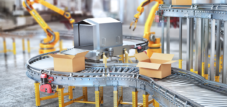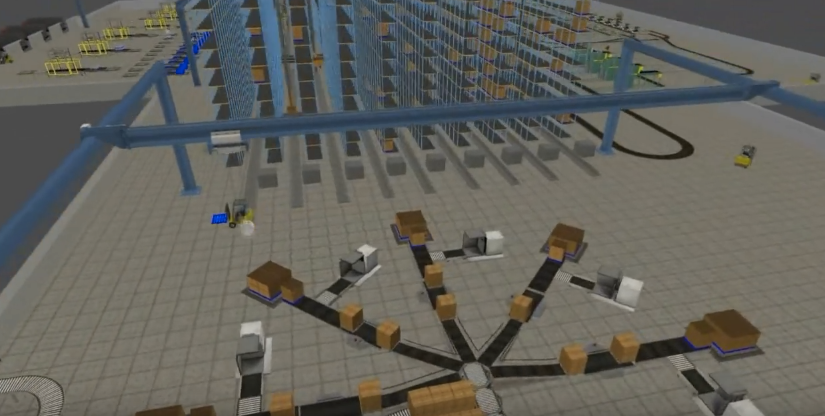
3D process simulation (Source: FlexSim)
With increasing digitalization, the days of hand-drawn or computer-generated sketches in the planning of new logistics facilities are finally numbered. A number of software tools with integrated 3D visualization technology now offer a cost-effective, flexible, and, above all, quickly implementable alternative to traditional methods. These tools allow clients to clearly and independently map and plan a wide variety of scenarios for their intended processes in three dimensions.
And the technology is not limited to the construction of buildings or their equipment for intralogistics: Complex processes such as the internal flow of materials or the intralogistics processes of storing and retrieving goods can also be realistically replicated.
Several providers, such as Tarakos and Pro-Sim, active in this field. They offer customers access to their software, which allows for the clear visualization of planned projects. The 3D simulation software they offer for process modeling makes it easier for decision-makers to quickly assess the impact of proposed changes aimed at optimizing logistics or material flow.
This offers small and medium-sized enterprises (SMEs) in particular the opportunity to visualize the processes between their systems and machines, or in storage and conveyor technology, using 3D objects without having to invest large sums of money. Users can usually access a comprehensive selection of 3D objects provided by the vendor and supplement them with their own designs if necessary. This modular approach speeds up the creation process and limits costs.
The software tool allows a wide variety of logistics and production environments to be integrated into the visualization as needed:
- Storage systems (from conventional rack storage to automated vertical lifts)
- Conveyor technology and systems, automatically or manually operated
- Vehicles such as forklifts, industrial trucks or driverless vehicles
- Transport systems
- Storage and retrieval machines, shuttles, etc.
- Personnel and/or robots
An intuitive menu and user interface further simplifies the creation process. Users are guided through the individual steps of the software in an easily understandable way, making it possible to create the visualization even without extensive prior knowledge.
Sufficient flexibility is ensured, as the integrated 3D objects can be continuously adjusted via configurable parameters. Whether it's device dimensions, room heights, special designs of conveyor lines or warehouse layouts: these can be easily changed, and the 3D visualization adapted to the new circumstances.
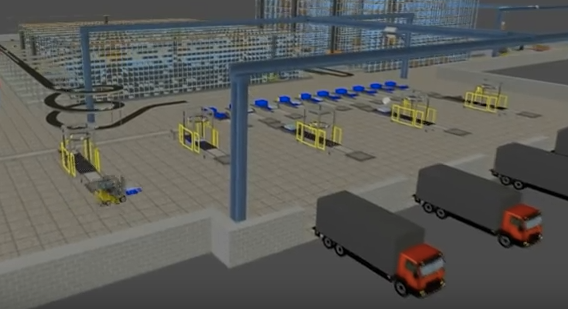
Warehouse in 3D (Source: FlexSim)
Changes in material flow can also be effectively animated. To do this, the various storage locations, conveyor speeds, and cycle times are entered into the software, and the desired distribution or branching strategies are selected. The paths and speeds of employees and industrial trucks are defined in the same way. Based on this information, the program calculates the expected throughput at individually selected locations. The entire process is displayed in real time but can also be played back in slow motion or time-lapse. This provides an excellent basis for testing and clearly demonstrating the performance of the desired processes.
The advantages of such a standardized software solution are obvious:
- Simple 3D visualization of processes in logistics, material flow, and factory planning
- Cost-effective, quick solution
- Great flexibility
- Low investment and qualification threshold
- Location-independent availability
Besides the comparatively low acquisition or rental costs of the software, it is especially the uncomplicated implementation that makes such a system an interesting solution for potential customers.
Once the software has created such a digital layout, the graphical installation of new machines becomes significantly easier for the customer. They can move the equipment from location to location and adapt it to local conditions almost via drag and drop. In this way, errors, undersizing, or oversizing are identified much more quickly and can be corrected immediately.
Even planned optimizations of existing systems, such as processes in transport routes and material flow, can be more easily identified with 3D assistance. Employee walking routes in the warehouse, cycle times in assembly, and material flows between the warehouse and production can also be better assessed.
The provider Tarakos even offers viewers of its visualizations a flight experience: A virtual tour of the 3D-animated scenarios is possible, allowing processes and spatial conditions to be presented from entirely new, realistic perspectives. Using Oculus Rift 3D glasses, users are immersed directly in the scene. This provides viewers with completely new insights into the processes and facilities. The result is a level of detail that was unimaginable in the days of good old two-dimensional sketches.
Keep in touch